

War lord of darkness, p.2
War Lord of Darkness,
p.2
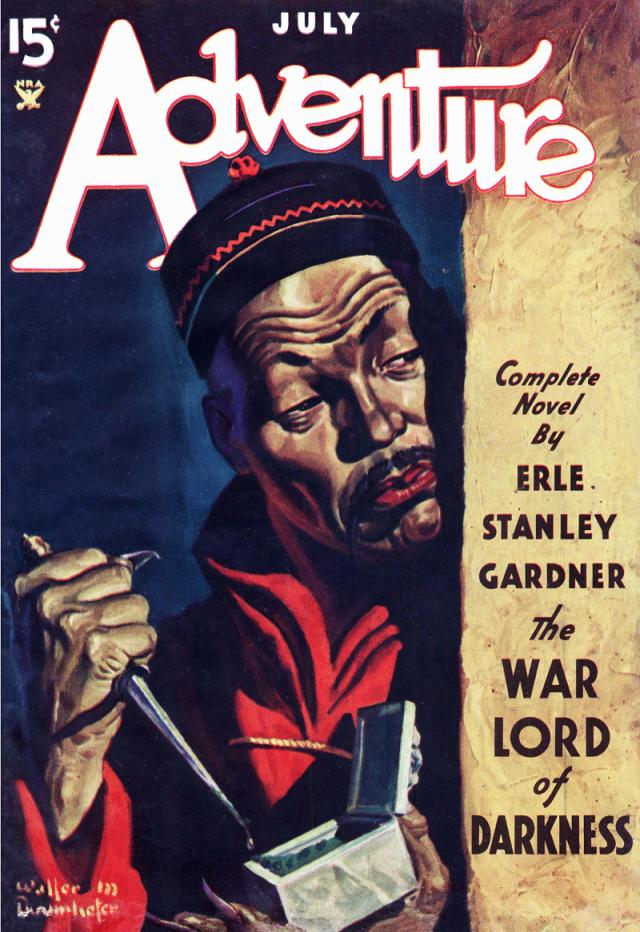


“No,” he said hastily, “Macao.” “Canton,” she said, “is where we’re going.”
“We?”
“My brother and myself. My brother’s down getting the baggage straightened around.”
Ballinger shook his head lugubriously. “He’s got to cut that out,” he said, “or he won’t last long in the tropics. Don’t worry about responsibilities in this country. Never hurry, never worry, never drink before noon, never go out in the sun when you can avoid it, never eat foods that aren’t steaming hot, and you’ll live to a ripe old age in the Orient.”
She stared thoughtfully at the swirling waters, watched the skyline of Shanghai slipping astern.
“They say,” she said, abruptly changing the subject, “there’s a typhoon somewhere to the south.”
Ballinger grinned.
“Never worry,” he said. “That’s one of the rules.”
“But there is a typhoon, isn’t there?” “At this time of year," he said, “there’s always a typhoon somewhere to the south.”
“And yet you don’t worry?”
He shook his head.
Half an hour later, in company with her brother Sidney, Edith Minter again saw Ballinger, this time seated across the chess board from Jimmy Harder.
The two men played chess with a fierce antagonism that was vitally personal.
Sidney Minter, who was, himself, something of a chess expert, watched the progress of the game with a fascinated interest. Sidney Minter was tall, thin and nervous. There was a haunted expression about his eyes. His skin was shiny with the oily perspiration constant in that latitude from Spring ’till Fall.
Ballinger’s game was directly opposed to the genial personality which he presented to the public. He played a tricky, treacherous game, laying traps by a succession of moves which were apparently careless, yet which were part of a carefully laid campaign.
Harder, on the other hand, played brilliantly aggressive game, his defense, at times, weakened by the swiftness of his attack. But Ballinger made no effort to assume the aggressive. He played a waiting game, organizing a perfect defense, giving several apparent openings to his opponent, openings which were, in fact, only invitations to his opponent to plunge headlong to destruction.
In the end, Jimmy Harder, ignoring the traps, masked his offensive with a few swift moves. Once past Ballinger’s defense, Harder simply outplayed the other man, bringing pieces to bear upon the vulnerable point more rapidly than Ballinger could stiffen his defenses. Three major pieces fell in quick succession, and then Harder made two apparently aimless moves, while Ballinger tried to unite his crippled forces. There followed a swift move by Harder, and the game was over; Ballinger was checkmated by a master stroke of daring originality.
Neither man said a word as they reassembled the pieces for another game.
Sidney Minter spoke with feeling. “I say, you fellows play an extraordinary game. There are two distinct, individual types of play. Both of them acutely well developed.”
Jimmy Harder merely flashed Minter a swift glance. Ballinger leaned back from the board, stretched, grinned, and lit a cigarette.
“Sometimes I think the same rules apply to chess that apply to life. You can carve out your own career if you will only take the time to plan out a careful campaign.”
“There’s no question,” Minter admitted, “but what a man shows his character and individuality in the type of game he plays.”
Jimmy Harder’s eyes showed quick interest.
“If you play enough chess with a man,” he said, “you can tell just about the type of tactics he’s going to use in any kind of a contest.”
Ballinger looked suddenly thoughtful.
Minter nodded.
Neither Ballinger nor Harder spoke to the other.
The chess game continued. The Patoma wheezed down the river, left the mouth of the Whangpoo and turned into the yellow waters of the main river.
At dinner time the men discontinued their play. Five games had been played. Harder had penetrated Ballinger’s defense by masterly aggressives in three of the games. Twice the supposedly weak point which Harder has assailed in Ballinger’s defense had proven to be a cunningly laid trap.
The captain, weary-eyed, cynical and worried, sat at the table with the four first-class passengers. Edith Minter, recognizing the verbal restraint between Harder and Ballinger, tried her best to draw them into conversation.
She failed.
It was after the dinner hour, after cigars and cigarettes had been finished, while the intense heat which presaged the coming of a typhoon lay the lifeless waters, that Jimmy Harder sought the forward part of the deck. He seated himself against the steel bars, struck a match. The flickering flame illuminated his features.
A moment later, and there was a faint suggestion of sound.
Blackness covered the ship, a blackness so intent it was impossible to see a hand a foot from the eyes. The range lights of the steamer glowed as pale moons, illuminating portions of the masts. The engines throbbed regularly. The bow hissed through the turgid waters, where the river widened.
Harder spoke in a low voice, confident of receiving a reply, knowing that, despite the fact he had received no signal, Mow Jie would be perched precariously on the other side of the steel grating.
“What know you,” he asked, “of that which is taking place in Canton?”
He spoke in the Cantonese dialect, his voice rippling smoothly through the nine tones which give to the language such a peculiar singsong effect.
Mow Jie answered him in the same language.
“Master,” he said, “I have been listening and I have been talking. I listened much and talked little.”
“What,” Harder inquired, “have your ears learned?”
“There are many men on the ship,” Mow Jie said. “They go south for some reason. I cannot learn the reason, Master, but this much I know: there are storm clouds to the south. I have heard talk of a mysterious one who is known by the title of Yeah Jing Suhn.” Harder translated the title—“The War Lord of Darkness.” He said, musingly, “That is his title. And why do they call him that, Mow Jie?”
“As to that I know not,” Mow Jie said. “I only know what my ears hear.” “There is talk of this tone?”
“Much talk, my Master.”
“And of what does the talk consist?” “Only that the man is all powerful and invisible. Soon the weight of his hand will be felt upon the provinces of the south. He is to be invincible. He is to sweep all before him, and the night is his friend.”
Harder rocked on his heels.
“It would be well,” he said puffing his cigarette until the end flamed into hot brilliance as an angry red star against the darkness, “to do more listening and with wider ears.”
In the darkness could be heard the soft chuckle of Mow Jie, and after that was no further sound.
Harder tossed his cigarette over the rail and strode back to his cabin.
On the way he passed Ballinger, sprawled in a deck chair.
Ballinger coughed as Harder passed. It almost seemed that there was something significant about that cough.
Harder uttered a grim small grunt and went on.
The five men who sat in the front room of the big residence on The Peak at Hongkong were men who had seen much of China. They were not the type to become stampeded over trifles, nor were they the kind to underestimate danger.
More than two thousand feet below, in a direct line, were the lights of Hongkong. Across the bay showed the twinkling clusters of light which marked Gow Loong—called Kowloon by the whites, who failed to catch the delicate sounds of the Chinese language or to learn that the name meant Nine Dragons, which, to the Chinese mind, could plainly be seen half lying in the water, where the hills sent long, twisting yellow ridges out into the blue waters of the bay.
‘“I took the Patoma,” Jimmy Harder said, “in order to save time.”
“And ran right into the typhoon in the straits of Formosa,” one of the men remarked.
Harder grinned.
“We got through, and that was about all. On the boat with me was George Ballinger.”
The men exchanged significant glances.
“Do you,” asked the spokesman, “know where he was going?”
“He said that he was going to Macao, but my man advises me that he sails tomorrow night for Canton.”
The men once more exchanged significant glances. The spokesman, who was the head of one of the large corporations that held extensive investments in the Orient, leaned forward and lowered his voice.
“This much we know. Trouble is brewing above Canton. We cannot tell where. There has been an excessive amount of banditry. Huge ransoms have been demanded, and, in many instances, have been paid.
“Charles Belter went up to protect some of our interests, the interests of one of our members. He took a large sum of cash with him. He disappeared. We waited for the usual demands for ransom. None came. The day before we sent you the cablegram, a body was found floating down the river. The throat was cut from ear to ear in the neat, workmanlike fashion of bandits who know their throat cutting. About the wrist, tied by a thong, was the metal tag which had been issued to Belter when he took out insurance.”
“How long had the man been dead?” “That is something we can’t tell accurately. Remember, the body was merely one of those that drift on by. There was no opportunity for a post mortem. Apparently he had been in the water for a week.”
Jimmy Harder squinted thoughtfully. “You don’t think it was just ordinary banditry?”
“We can’t possibly conceive of any reason why Belter would have left Canton without notifying us. We can’t understand why he would have gone up river without a military escort, or without reporting to the consul in Canton.” “But he did go up the river?”
“He must have.”
“It was his insurance tag?”
“Beyond a doubt. It’s been verified from the records of the company.” “How much money was he carrying?” The spokesman hesitated. Once more the men exchanged significant glances.
“A very large sum,” said the spokesman.
“You told me that before.”
“More than one hundred thousand dollars,” the spokesman said.
“How much more?”
“Quite a bit more.”
“In cash?”
“Yes.”
“Why was he carrying that in cash?” “That,” the spokesman said in a tone of finality, “is something which we can’t explain.”
“You want me to work on a case in the dark?”
“Yes.”
“That,” Harder said, “is putting me under rather a great handicap.”
There was no comment.
Harder laughed and shrugged his shoulders.
“All right, have it your own way. Tomorrow when the bank opens I want you gentlemen to pool a fund. You will get that fund from the banks. You will make every effort to keep the amount of that fund or its nature from becoming known—secrecy, let’s say, to the point of ostentation. That fund will amount to two hundred thousand dollars. You will get the money in the form of large bills and they will be placed in a suitcase. You will have a duplicate suitcase prepared. Have both at the office when I call.”
“Why all the money?” asked the spokesman.
Harder grinned.
“After I have left the office, carrying the duplicate suitcase, you can deposit the original amount in the bank.”
“In other words, you’re carrying a duplicate suitcase as a decoy.” “Exactly,” Harder said.
The men looked at each other, taking that silent vote which comes from a perfect understanding.
The spokesman interpreted those almost imperceptible nods of the head. “That,” he said, “can be arranged.”
The night river boat to Canton carried the same four passengers who had been tossed about on the Patoma by the tropical typhoon.
As before, Ballinger and Harder did not bother to speak. It was Edith Minter who stared at Ballinger in surprise and said, “But I thought you were going to Macao.”
“Changed my mind,” he told her, grinning with extreme good nature, “and decided to take a run up to Canton.”
“Business?”
He dismissed the question with a waving gesture of his hands.
“My child,” he said, “there is no business. Business, in case you haven’t heard, is dead.”
Jimmy Harder, carrying a light airplane trunk which contained his clothes, a bag which contained his toilet kit and sundries, and another mysterious black bag which never left his possession, was a glum and taciturn passenger. When Edith Minter questioned him, he made no attempt to disguise his mission.
“Business,” he said.
“Mr. Ballinger tells me that it is your business to keep peace in the Orient. It seems to me that is rather a large order.”
“Did Ballinger say it’s a large order?”
“No, I just said that it would be.”
“It is.”
“You are headed for Canton?”
“Yes.”
“Tell me, is there any danger of pirates?”
“You mean on the trip?”
“Yes.”
“Why,” he said, “do you ask that question?”
“Because of all the precautions they take. We’re locked in behind steel bars as though we were precious gems. There are two boats run by competing companies, and yet they both leave at the same time, so one can give aid to the other in case of a pirate attack. There is a third boat that comes up from Macao and joins in the procession.” “Who told you all this?”
“Mr. Ballinger. He seems to know a great deal about China.”
“Then,” Harder said with a slow smile, “It’s the precautions that are taken against an attack by pirates that make you think there is danger, is that it?”
“What else could I think?” she said. “Look at the navigating offices, they’re shut off by steel doors that are bullet proof. There are slits in them and a Sikh guard stands constantly on duty with a loaded gun in his hands.”
“If,” he told her, “the precautions were not taken, there would be danger.”
“As it is, there isn’t?”
“There is always danger in China!” And, raising his hat, he walked away and entered his cabin. Nor did he emerge until the river boat was splashing through the waters of the river just below Canton.
Once through the Canton Customs, both Ballinger and Jimmy Harder loaded their luggage into respective rickshaws and gave directions in low tones. Edith Minter and her brother went at once to the Victoria Hotel and made no secret of their destination. Neither Harder nor Ballinger showed up at the hotel, nor did they seem to be on the Island of Shameen at all.
Down by the front of the river, where the Street of Shifting Sand joined the Street of Increasing Sand, was a little insignificant structure, given over apparently to the manufacture of wicker baskets. In the back of this structure, clad in Chinese garments, a tight fitting skull cap with a red button on his head, Jimmy Harder squatted on his heels, native fashion, and waited.
Mow Jie brought him a report shortly before noon.
“The Fat One,” he said, “has chartered a junk to take him four days journey up river.”
“It is well,” said Harder. “We, too, journey four days upstream. We leave this afternoon. Remember, you are the servant of a poor but worthy man who desires to express thanks to the gods at the upriver monastery for the granting of a favor which has been bestowed upon him through the benificence of the gods.”
Mow Jie gave his peculiar quiet chuckle.
“A man who is very worthy,” he said, “and very, very poor.. It would be well if you were a poor silk merchant.”
Jimmy Harder nodded slow acquiescence. Already he had commenced to steep his soul in the character of the Chinese he was to impersonate.
It took him approximately two hours to complete his disguise. When he emerged from the store, he was to all intents and purposes a Chinese of the middle class. The skull cap concealed bits of adhesive tape by which the corners of his eyes were drawn up. The expression in his black eyes was typically Chinese, the expression of one who has “retired within himself,” or, as the Chinese sometimes call it, “the art of holding face.”
That afternoon, the big junk pulled away from its anchorage, with much clashing of cymbals; with an appropriate barrage of firecrackers that the devils might be frightened away; with tin cans containing burning incense sticks in the living quarters in the stem of the big junk.
With a stern wind, it was possible to get some assistance from the huge sails, in addition to which there were an extra number of polers to tread the long runways along the side of the boat. For Harder, despite his protestations of poverty, had seen to it that the junk was equipped with extra men so that progress could be materially speeded if necessary.
- The trip up the river started without incident. Apparently, all was to proceed smoothly.
Just at dusk, however, Mow Jie sought out Harder.
“Observe,” he said in a low voice, “the junk which is coming down the river.”
Harder’s eyes shifted to it, and then glanced to Mow Jie.
“One of the boatmen,” said Mow Jie, tells me that this junk started up the river ahead of us, bearing a fat man whose laugh shook the timbers of the vessel.”
Jimmy Harder kept in character as a Chinese silk merchant. His face remained perfectly bland and expressionless.
“Perhaps our junk men will veer over close so that they can make keng gie with the boatmen of the other junk.”
Mow Jie puffed placidly at the longstemmed bamboo pipe with its stained ivory mouthpiece.
“Orders that this shall be done have already been given, First Born.”
The junk veered its course, swung over toward the other junk. Voices raised in a shrill chatter.
A man who lay on a rude stretcher, raised himself awkwardly to a sitting position. It was George Ballinger, his left arm splinted and arranged in a sling which hung from his neck.
The Chinese, satisfied that the white passenger could not understand their, language, engaged in animated comment.















