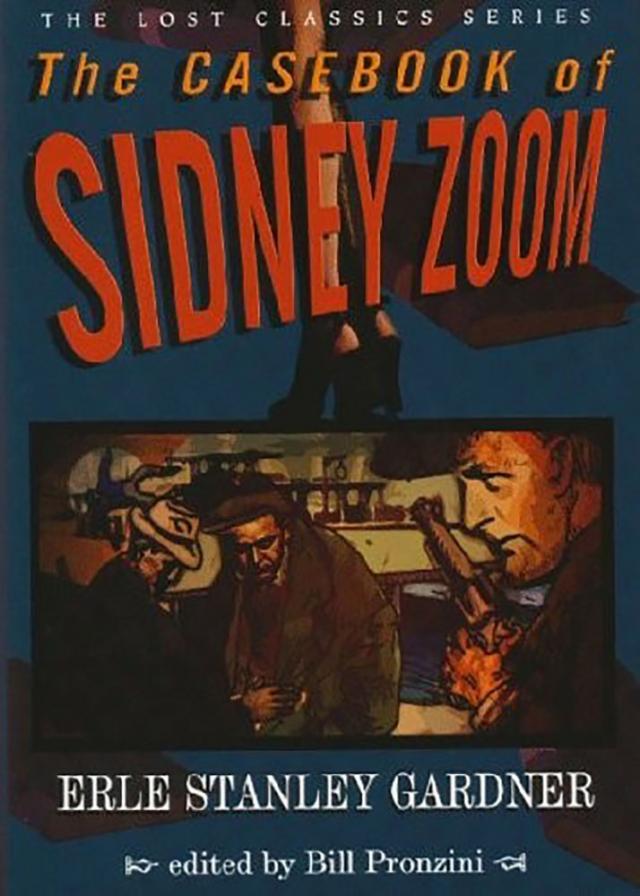
The casebook of sidney z.., p.10
The Casebook of Sidney Zoom,
p.10


Between Chinatown and the theatrical district there was a street which glowed with lighted windows. This was the pawnshop district. Human misery, like human pain, becomes more acute at night, and the pawnbrokers in this district did much of their business around midnight.
Drab shadows flitted through this district on furtive feet, pausing now and again momentarily, then plunging into one of the lighted interiors, shortly to emerge and slink back into the realm of darkness which bordered the pawnshop lane.
Midnight boomed the hour.
The financial district, which was to the east, gave forth the sound of foot-steps. These steps contained nothing of the furtive. They echoed from the cold pavements with the rhythmic regularity of some metronome of fate. The footsteps were audible some seconds before the figure became visible. Then he strode into the half illumination of pawnshop lane, six feet odd of whip corded strength, grim, gaunt, uncompromising. At his side padded a police dog.
That strange personality, known as Sidney Zoom, pacing the midnight streets, police dog at his side, hawk eyes utterly untamed, paused to scan the furtive figures which glided through the district where human misery might secure temporary relief, for sufficient collateral.
For some half minute he stood, surveying, appraising. Then he strode through the length of the narrow thoroughfare and was about to vanish into the darkness once more, when a figure arrested his attention.
She was young, attractive, well formed. A shabby coat was hugged about her figure with something of an air, as though it had been a coat of sable instead of cheap shoddy. The face was held rigidly, impersonally to the front, as becomes a young lady who must walk the night streets unescorted, yet wishes to convey no false impression.
Outwardly she was calm, cool, poised. Yet there was something about her which spoke of anxiety. Perhaps it was in the swiftly nervous beat of her tiny feet upon the pavement; perhaps it was in the way she hugged the coat about her figure, as though it had been a shield.
Sidney Zoom’s eyes, as colorless as those of a hawk, and as keen, fastened upon her. At his side, the dog whined. Sidney Zoom turned, followed.
For two blocks they walked. The girl’s feet patting the pavement with short, nervous steps, as rapid and sharp as the beating of an excited heart. Behind her, Sidney Zoom’s feet banged upon the pavement at explosive intervals as his long legs swung through the night.
The girl paused at a door above which hung the conventional gilded balls. It was as though she waited to muster courage. Then her hand pushed the door open.
Sidney Zoom entered behind her. The dog crouched upon the pavement, tawny muzzle dropped to his paws, yellow eyes watchfully alert.
A thin figure with stooped shoulders and a bald head, upon the back of which was a black skull cap, came shuffling to the counter from a back room.
His eyes were watery, showing a great fatigue with life, yet there was uncanny wisdom in their watery depths. They were eyes that could flicker to a face and appraise character.
A cigarette drooped from the thin lips. Yet the air of the place was thick with heavy cigar smoke.
Sidney Zoom sniffed that cigar smoke, let his eyes fasten upon the cigarette, and then his lips clamped together. He knew the meaning of that cigar smoke. The detectives were waiting for something “hot.”
The girl half turned, shot an anguished glance at Sidney Zoom. It was evident that she would have preferred to transact her business without an audience.
“Wait on him first,” she said.
The thin man with the slithering feet and the drooping cigarette started to shuffle toward Sidney Zoom. That individual waved his hand.
“I shall be some little time,” he said. “I want to see about purchasing a watch,” and he bent over the counter upon which the watches were displayed under glass, giving every outward indication of being so utterly absorbed in his inspection as to be oblivious of what was going on in the place.
The thin man raised his watery eyes to the girl’s face. “Well?” he asked.
The girl’s hand darted from beneath the folds of her shabby coat. She held it over the glass of the show case, then made a little flinging gesture.
Hard pellets of frozen fire rattled over the glass, sent coruscating beams of glittering light flaming about the place. There were half a dozen diamonds, and they were of sufficient size to make a respectable showing.
“How much,” said the girl in a voice that quavered, “for the lot?”
The thin man swooped out a swift hand, scooping the pellets into a little group, as though his cautious soul rebelled at the liberal gesture with which the girl’s hand had flipped them away.
“They are unset,” he said.
The girl made no comment. None was necessary. The fact was self-evident.
The pawnbroker fastened a jeweler’s glass to his right spectacle, picked up the stones, examined them.
“But,” he said slowly, “they have been set, and have been pried from their settings.” Leaning over the watch counter, Sidney Zoom noticed that the man had raised his voice, knew that this was for the benefit of the man who remained in the back room,
smoking heavy cigars.
The girl asked her question again, in a monotone. “How much for the lot?”
The pawnbroker’s voice was quite loud now.
“You are the same girl who has been in here before, yes? And these stones are of peculiar sizes. They weren’t stones from a necklace. They were taken from rings and stickpins, and they have been pried …”
CHAPTER II
Hot Ice
THE SMOKY entrance to the back room framed a hulking figure. A hat was back on one side of his head. From beneath the hat showed a shock of black hair. Insolent eyes surveyed the world in scornful appraisal. Thick lips held a half-smoked cigar clamped rigidly. Broad shoulders swung half sideways to clear the narrow doorway.
“All right, sister,” he said; “where did you get ’em?”
And he flipped back a casual hand to his coat lapel, let her eyes catch the gleam of a silvered badge.
“Oh!” she said, and the exclamation was almost a scream. Her hand darted for the diamonds.
They moved with quickness, those two. The pawnbroker swooped his claw like fingers upon the diamonds. The detective did not reach for the stones. He slammed his great paw down upon the lean wrist, held it in the grip of a vise.
“Say-y-y-y!” he said, the word having a snarling emphasis, “none o’ that! I asked you where you got ’em.”
The girl’s face showed conflicting emotions. “I—I can’t tell.”
“She the one that’s been in here before, Moe?”
“Yeah.”
“All right, sister, you’re goin’ by-by in a wagon with wire over it. Better kick through right now. If you come clean we might give you a break.”
“I—No, no—I won’t!”
The detective laughed. The laugh was a sneer, coarse, grating. “Th’ hell you won’t,” he said.
And he pulled glittering bracelets of steel from the vicinity of his left hip. His right hand still held the girl’s wrist.
“Take a look at these,” he invited. The girl shook her head.
“I won’t tell. I don’t care what you do to me.” The detective grunted.
“S’pose I tell then, if you won’t?”
His eyes were scornful, sneering. The girl’s face showed panic. “You know?” she asked.
“Sure, I know. You’re a friend of Sally Barker, an’ Sally Barker’s the housekeeper out at Jake Goldfinch’s place. And Goldfinch got bumped off about five thirty this evening and there is a hell of a lot of diamonds missing. Now are you goin’ to talk?” The effect of his words was magical. The girl began to talk, swiftly, almost hysterically. “Yes, yes, now I’ll talk. I wasn’t going to get Sally into trouble. I wasn’t going to mention her name. But if you know of her it’s all right. Only I don’t want her to think
that I was the one that told. You must explain that to her.
“It was yesterday that Mr. Goldfinch called Sally into his room. He told her that he was getting to be an old man. He said he hadn’t made any provision for her in his will. He said that he was leaving these diamonds in a vase over his desk, that if anything happened to him Sally was to take these diamonds at once and pawn them.
“He made her promise that she wouldn’t wait a minute, that she’d take the stones and sell them for the best price she could get. He said he wanted her to have them instead of taking anything from his estate. She’d been with him for years, you know.”
The detective grunted.
“Yeah,” he said, “I know.” And he winked at the pawnbroker, then moved toward the telephone, picked up the receiver.
“Gimme police headquarters,” he said.
There was a moment of silence, then the detective’s voice rumbled through a formula. “Let me talk with Sergeant Gilfillan … Hello, sergeant. This is Renfoe talking. I’ve got the frail in the Goldfinch case and she was loaded with the hot ice. Came into the
pawnshop. Yeah, I’m bringin’ her down … Okay … Okay, g’by.” He hung up the telephone.
The thin man with the stooped shoulders and the bald head moved shufflingly over to where Sidney Zoom leaned against the counter.
“Watches?” he asked.
“I want,” said Sidney Zoom, “a watch that is of a particular make, and you do not seem to have one.”
The thin man lost interest in the detective and the girl in order to make a sale. “I have here,” he proclaimed, “the best watches in the country. Don’t you want a good watch?”
Sidney Zoom raised his voice.
“I want a square deal, and I want to see that everyone else gets a square deal.”
The girl started at the timbre of that voice, as solemnly resonant as the tone of a rich violin.
The pawnbroker looked puzzled.
“Don’t you believe my watches are the best in the country?” he asked. Sidney Zoom’s voice retained its solemn timbre.
“I disbelieve in nothing,” he remarked, “not even in a divine justice which works through strange channels to see that wrongs are righted.”
And he strode calmly to the outer door, pushed it open, and walked into the night, leaving behind him a startled, sagging jawed pawnbroker, a very puzzled young woman, and a scowling detective.
CHAPTER III
The Murder Room
SERGEANT HUNTINGTON regarded Sidney Zoom speculatively. Little puckers appeared at the corners of the keen eyes.
“I don’t know too much about it. Sergeant Gilfillan’s been handling most of the case. It broke around supper time to-night. Understand the old man was murdered, stabbed with a knife, I believe. We’ve got one of the brightest detectives on the force working on it. Think he came in a little while ago.”
He jabbed a button with his forefinger. A head bobbed in through a doorway. “Tell Jack Hargrave to come in here,” rumbled the sergeant.
The head was withdrawn, the door closed. Seconds lengthened into minutes. Neither Zoom nor Huntington made any further comment.
The door abruptly opened. A young man with keen eyes, a whimsical smile at the corners of his mouth, walking lightly, easily upon the balls of his feet, stepped into the room.
“Hargrave, shake hands with Sidney Zoom. Hargrave’s the brightest young detective on the force. Zoom’s a man who butts into a case once in a while, makes everybody sore, and usually turns out to be one hundred per cent right.”
The two men shook hands.
“Want to show Zoom around on the Goldfinch case?” asked Sergeant Huntington.
Jack Hargrave turned on the balls of his feet, his every motion as swiftly efficient as a prize fighter going into action.
“Let’s go,” he said.
It was the first word he had said since entering the room.
Sidney Zoom reached for his hat, grinned, strode his long length of gaunt strength toward the door. Jack Hargrave moved at his side, as smoothly and easily as water running along a flume.
They went down a flight of stairs, stale with the stench of poor ventilation, out into the crisp air of the night. Hargrave indicated a roadster with red spotlight and police siren.
Sidney Zoom got into the car. “My dog,” he said.
The tawny police dog was watching his master with expectant eyes. He had been waiting just outside the door of police headquarters.
The detective flipped back a rumble seat.
The dog gathered his feet, crouched, sailed through the air, lit neatly and accurately upon the rumble seat. Hargrave crawled in behind the wheel, slammed the door, stepped on the starter.
The car ripped into speed, skidded at the corner. The siren was wailing by the time it hit the center of the car tracks and tore through the almost deserted street. Hargrave handled the wheel with the easy precision of one who is utterly certain of his muscular coordination.
Fifteen minutes and they drew up before a dark, forbidding mansion which sat back from the road, surrounded by a gloomy iron fence. A policeman was strolling at the gate of this fence on patrol. A police car was in the driveway, back of the swinging gates which had provided a carriage entrance in earlier days.
Hargrave switched off the ignition, stepped to the curb. “Hello, Haggerty.”
The uniformed policeman stepped to one side. “Evening, sir.”
They went up the walk, Jack Hargrave first, stepping with the latent power of a coiled spring; Zoom second, striding grimly, purposefully; the dog third, padding behind his master with that cautious strength which a wolf might display in stalking a deer.
They went up the wooden steps of the porch, through the door into a corridor which smelled musty. The atmosphere of the house reeked of death and decay.
A man with broad shoulders and a bull neck stepped out of a room, looked at Hargrave.
“Hello, Jack.”
“Hello, Phil. Are you working on this case?”
“Yeah. They asked me to take it over.”
Hargrave nodded. His manner showed something of a chill of formality. “I’m working on it,” he said.
The bull-necked one grinned. “You was,” he stated. “I am.” Hargrave turned to Sidney Zoom. “Mr. Zoom, meet Mr. Brazer.”
The bull-necked one did not offer to shake hands. Sidney Zoom bowed. The bow was uncordial. Brazer didn’t bother to bow.
“Whatcha want?” he asked.
“We’re taking a look around,” said Hargrave. “This way, Zoom.”
Sidney Zoom placed his dog in a convenient corner of the hallway. Brazer, the bull-necked individual, glowered at the dog.
“He can’t stay here!”
Sidney Zoom’s smile was close clipped in its cool insolence.
“I wouldn’t advise you to try to put him out,” he remarked, and followed Hargrave up a flight of stairs, around a turn, through a short corridor and into a room.
“This,” said Hargrave, “is the murder room.”
It was a room which peculiarly adapted itself to scenes of violence and death. A gable formed an “A” at one end. A big window showed black and bleak. The furniture was old-fashioned, rickety.
Hargrave talked, and the words rattled like bullets.
“Goldfinch was a millionaire, many times over. Bought diamonds. He was a miser with diamonds just as some folks are misers with money. Every gem dealer in the country knew Goldfinch. He’d buy any sort of gems, smuggled or not. One thing he drew the line at. He wouldn’t buy stolen gems, wouldn’t deal with anyone who might be even suspected of handling hot stuff.
“His housekeeper, Sally Barker, knew him better than anyone. She told friends she thought he’d provided for her in his will. She wished he’d hurry up and die. The woman’s one of those half-cracked babies. She’s got a friend who’s class, Myrtle Crane. Myrtle’s been visiting pawnshops some lately.
“Goldfinch is found, stabbed with a knife. No diamonds are found. We’ve searched the house from cellar to garret. Goldfinch was killed about four o’clock, not discovered for an hour or so. The housekeeper skipped out when she discovered the body. That is, she claims that was what startled her. We have our own ideas.
“Anyhow, the body was discovered by the butler and general utility man. He telephoned us. We made a round up, found the housekeeper gone, threw out a dragnet and picked her up as she was taking a train out of the city. We put a watch on the pawnshops, and they picked up her friend, Myrtle Crane, trying to hock some diamonds that were taken from the Goldfinch collection.
“She says the housekeeper told her she was afraid they’d try to pin the murder on her, so she was going to skip out, that the housekeeper asked Myrtle to hock the stones and send her the money.
“That’s the lay. We’ve searched everywhere. No diamonds. No motive for the death except gain. Goldfinch was a funny crab. No one knew him. Had a manager to handle all his property affairs, chap by the name of Jed Slacker. He’ll be in, maybe. He’s been running around back and forth, all worked up. Seems he and Goldfinch had gone into some sort of a partnership deal on some stocks. Slacker put his own money up. Came out to get Goldfinch to check out his half and found him dead.
“Slacker’s a lawyer. Says that under the law he can’t testify to the transaction because death having sealed Goldfinch’s lips the law won’t let him testify.
“Guess he’s right, at that. That means Goldfinch’s estate gets the benefit of Slacker’s money, and maybe Goldfinch didn’t leave a will. We haven’t found one.”
Sidney Zoom grunted.
“Do you think the housekeeper did the stabbing?” he asked Hargrave. The detective lowered his voice.
“No, I don’t. That’s why I’m getting switched off the case. It looks like an easy case to pin it on the woman and have the girl as an accomplice. It’ll make a quick solution. That’s what some of the department heads want—quick solutions and newspaper publicity. Understand, that’s confidential.”
Sidney Zoom nodded again.
“Taken any finger-prints?” he asked.
“Yes. You can see where I’ve brought out some latents and photographed them. The identification department is working on them. Haven’t got the finger-prints of all the people in the place yet, though. We have the housekeeper and the dead man. We’ll get the others later. The department has trouble sometimes getting folks to pose for their finger-prints. We don’t do it unless they’re pretty willing or else suspected of crime.”