The case of the blonde b.., p.12
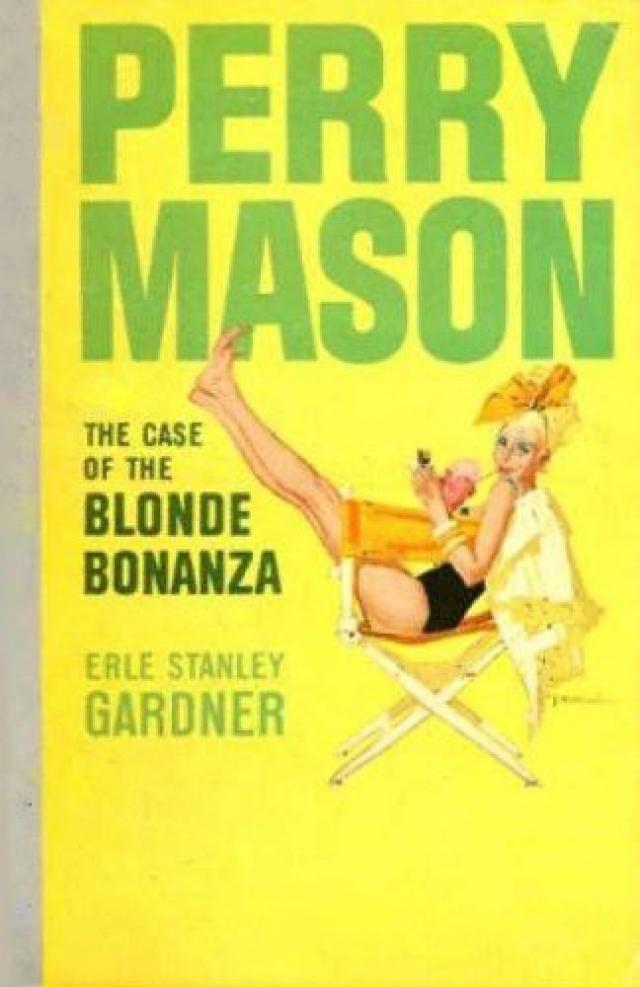
The Case of the Blonde Bonanza,
p.12


“Would that have anything to do with the subject under discussion?”
“A great deal.”
“I’m afraid I fail to follow you, Mr. Mason. Eunice Alder is now dead. Property acquired during marriage is community property, but on the death of the wife that property automatically vests in the husband, subject, of course, to certain formalities. If you had approached me prior to the death of Eunice, the situation might have been very different. As matters now stand, I am quite definitely in the saddle.”
“You may think you’re in the saddle,” Mason said, “but you’re riding a bucking bronco and you can be thrown for quite a loss. Under the law the wife’s interest in the community vests in the husband on her death unless she makes a will disposing of her interest in the community property. Your wife made such a will. Dianne is the beneficiary.”
Winlock frowned thoughtfully. “How much would you want for Dianne?” he asked.
“How much have you got?”
“It depends on how it is evaluated.”
“How do you evaluate it?”
“Perhaps three million, if you consider all of my equities.”
“All right, what’s your proposition?”
“I’ll liquidate enough holdings to give Dianne five hundred thousand dollars. I will give her fifty thousand dollars in cash. I will pay her a hundred thousand dollars within ninety days. I’ll pay the balance within a year.”
“And in return for that?”
“In return for that I want absolute, complete silence about our relationship, about my past.”
“All right,” Mason said. “You’re of age. You’re supposed to know what you’re doing. Now I’ll tell you about Dianne. I’m not going to give you any answer. I’m not going to make you any proposition. I’m going to think things over and I’m going to play the cards in the way that will be in the best interests of Dianne Alder.
“If the police find out about her connection with Harrison T. Boring and question her about her business with Boring, it may well be to Dianne’s advantage to disclose the relationship with you and the whole background.”
“Just so I can have the picture straight,” Winlock said, “Will you summarize briefly Dianne’s business with Boring, just what it was?”
Mason said, “Boring found out about the relationship. He came to Dianne with a lot of legal hocus-pocus pretending he was interested in her as a model who was to appear on television and in movies in connection with the introduction of a new style in women’s garments.
“Back of all that legal hocus-pocus, however, and the bait of television appearances, was the hook that he was to get one half of all of her gross income from any source, inheritance or otherwise. In return for that he was to pay her a hundred dollars a week.
“Last Saturday he sent her notice that the payments would be discontinued. That means he decided it would be better and more profitable as far as he was concerned to sink his hooks into you for blackmail rather than to let Dianne collect and then engage in litigation as to whether his contract was any good, whether it had been entered into under false pretenses, etc., etc.
“Dianne consulted me about the termination of the contract and the loss of the hundred-dollar-a-week income. She knew nothing about the reason back of the contract.
“I had my suspicions aroused because I was having Harrison Boring shadowed, and so I came to you earlier this evening. Dianne knew nothing about what I was doing. When Montrose Foster found her and convinced her that in order to protect her good name she must get the other signed copy of the contract back from Boring, she very foolishly failed to consult me but tried to take matters into her own hands.”
“What did she do? Did she call on Boring?”
“I don’t think I care to amplify my statement,” Mason said. “However, the police are following up what apparently was an anonymous telephone tip and want to question her about Boring. They came here and tried to take her to headquarters. I refused to let her go. If they question her, it is quite possible the cat will be out of the bag. I’ll do whatever will protect Dianne’s best interests.”
“And if they don’t question her?” Winlock asked.
“Then,” Mason said, “I’ll take your proposition under advisement and discuss it with Dianne.”
Winlock said, “Let me use the telephone, if I may.”
He walked over to the telephone, called police headquarters, then after a few moments said, “Hello, this is George D. Winlock. I want to talk with Chief Preston. It’s quite important that I- Oh, he is? Well, put him on, will you, please?”
There was a moment of silence, then Winlock said, “Hello, Chief? This is George Winlock. Look here, Chief, you sent someone to question a Dianne Alder at the Mission Inn. What did you want to see her about?”
Winlock was silent for nearly a minute while the telephone made harsh metallic sounds through the receiver.
Then Winlock said, “That’s all it was? Just an anonymous telephone tip?”.… All right, Chief, look here. I happen to know something about Dianne Alder. Some people have been attempting to annoy her in connection with a television modeling contract which she has signed. There are matters of professional jealousy involved, and this anonymous telephone tip, I am satisfied, was inspired by reasons of personal spite and it wouldn’t do the slightest good to question her but would embarrass her personally and- Well; thanks a lot, Chief. I, thought I’d let you know.… All right, you speak to your men, will you? … Thanks a lot, good night.”
Winlock hung up the telephone. ‘Does that answer your question, Mason?”
“That answers my question,” Mason said.
“Get her out of town,” Winlock said.
“Right at the present time,” Mason said, “she’s under sedation.”
“Well, get her out first thing in the morning.”
“Don’t you want to see her?”
“She knows all about me?”
“She does now.”
Winlock said, “Yes, I want to see her, but not here. The situation is too hot. I want her to return to Bolero Beach. I will get in touch with you about a meeting and talk with both you and her about a property settlement.
“In the meantime I trust that I can count on your discretion.”
Mason said, “You can count on my doing what is best for Dianne’s interests.”
Winlock said, “Please tell her that I called, that she was under sedation, that it was therefore hardly a proper time or a proper place for me to see her. Please tell her that I am using my influence to protect her from any disagreeable publicity, and that I would like to have her reserve judgment about what I have done until she has a chance to hear my side of the story.
“And you might also explain to her,” Winlock went on, “that I have interceded personally with the police to see that she is not annoyed.”
“That much I can promise you I’ll do,” Mason said.
Winlock extended his hand. “Thank you very much, Mr. Mason, and good night.”
“Good night,” Mason said, and escorted him to the door.
Chapter 13
Winlock had not been gone more than three minutes when Mason heard the chimes and opened the door. A strikingly beautiful woman stood there smiling seductively.
“May I come in, Mr. Mason?” she asked. “I’m Mrs. Winlock and I knew my husband was calling on you. I waited behind some potted palms in the lobby until he had left. I want to see you privately.”
“Come in,” Mason invited, “and sit down.”
“Thanks. I’ll come in but I won’t sit down. I’ll tell you what I want and what I have to offer in a very few words.”
“What do you have to offer?” Mason asked.
“Freedom for Dianne Alder.”
“And what do you want?”
“What I want is to retain my social position, my respectability and my property interests. Is that clear enough?”
“It’s clear enough,” Mason said. “Now give me the details. What makes you think Dianne Alder’s freedom is at stake?”
“Don’t be naïve, Mr. Mason. Dianne came to Riverside to see Boring. She saw him. She was probably the last person to see him alive.”
“How do you know this?”
‘The police have received an anonymous telephone tip to that effect.”
“How do you know that?”
“Through a friend of mine who is in a position to know.”
“You seem to know a great deal.”
“Knowledge is power.”
“And you want power?”
“Power and more power. I won’t try to deceive you, Mr. Mason. There is a concealed microphone in our library. My son is at a romantic age. There have been times when girls have sought to blackmail him. I deemed it wise to have the house wired so conversations could be monitored.”
“And so you heard my conversation with your husband this evening?”
“Every word.”
“All right. Just what is your proposition?”
“If you could prove Harrison Boring was injured—fatally injured—before Dianne called on him, it would establish your client’s innocence, would it not?”
“Presumably it would,” Mason said.
“I can give you that proof.”
Mason said, “Perhaps you’d better sit down, Mrs. Winlock, and we’ll talk this over.”
“Very well.” She moved over to a chair, seated herself and crossed her knees, adjusting her skirt so that the hemline was where it would be most effective in showing to advantage a pair of very neat nylon-clad legs. She settled back in the chair and smiled at Mason with calm confidence.
“Just how would we go about proving this?” Mason asked.
“That,” she said, “is a matter of detail which we will discuss later on. The main question is whether you agree with me in principle that if you can establish this matter by definite proof, I am entitled to keep my name, my position, my respectability and the bulk of my property.”
“What else are you prepared to offer in return?” Mason asked.
“What do you mean by the words, ‘What else?’
“What about Dianne’s property rights?”
“Does she have any?”
“Yes.”
“What did my husband want?”
“I think perhaps you had better discuss the matter with him.”
“Well, I will put it this way. Whatever proposition my husband made in regard to a division of property would be acceptable to me.”
Mason said, “I’d have to know a little more about how you intend to make this proof and I’d have to discuss it with my client.”
“Very well,” she said. “Let us suppose that Harrison T. Boring was a blackmailer, a crook and a promotor. Let us suppose that there were wheels within wheels, that sometime during the evening he became engaged in an altercation with someone who was trying to share in the spoils and, as a result, Boring was fatally injured.
“Now then, let us suppose that my son called on Boring, found him lying injured, but made no specific examination. In fact he assumed that the man was dead drunk, and left. Let us suppose that I called on Boring, found him injured and came to the conclusion my son had been engaged in an altercation and left the place; that sometime later I phoned the manager of the motel, told her to look in on the man in Unit 10 and hung up.
“Let us assume that my husband followed me in a visit to Boring, found him injured, assumed that I had inflicted the injuries and left.”
“That would require your testimony, the testimony of your husband and the testimony of your son, and you would be censured for not calling for aid as soon as you saw the injured man.”
“All of that might be arranged. Tell me, what would be the penalty?”
“If your son thought the man was drunk and had reason so to believe, there would be no violation of the law. If you knew that a crime had been committed and failed to report it, the situation might be rather serious.”
“Suppose that I also thought he was drunk?”
“That,” Mason said, “would present a story which might well tax the credulity of the listener. Two coincidences of that sort would be rather too much.”
“Suppose my husband should admit that he knew the man was injured but thought I had been the one who had struck him with some weapon and that the injury was not serious, the Boring was knocked out. Would the offense be serious enough so that my husband could not be let off with probation and perhaps some admonition and rebuke from the court?”
“Remember,” Mason said, “that the man died. A great deal would depend on the nature of his injuries, whether a more prompt hospitalization would have resulted in saving his life. Remember also I am Dianne’s attorney and am not in a position to advise either you or your husband.”
“Under those circumstances,” she said, “my proposition had better remain in abeyance.
“I might also mention, Mr. Mason, something that you don’t seem to have realized—that the room where Mr. Boring was found fairly reeked with the smell of whiskey.”
Mason raised his eyebrows.
“I gather that you didn’t know that.”
“It is always dangerous to jump to conclusions,” Mason said, “but I am interested in the fact that you noticed it.”
She smiled and said, “You play them rather close to your chest, don’t you, Mr. Mason?”
“At times I think it is advisable,” Mason said.
Abruptly she arose. “I have told you generally what I have in mind,” she said, “and you might think it over. I trust that under the circumstances Dianne will not make any rash statements which would tend to make any meeting of the minds impossible?”
“Are you suggesting,” Mason asked, “that I suborn perjury?”
“Certainly not, Mr. Mason.” She smiled. “Any more than I am suggesting that I commit perjury. I am simply speculating with you on what would happen under certain circumstances and whether or not it would be possible to bring a situation into existence which would cause those circumstances to be established by evidence.”
“It’s an interesting conjecture,” Mason said. “Now will you tell me-exactly what happened when you entered the motel unit rented by Harrison T. Boring?”
“I never even said I was there.”
“I know you were there,” Mason said.
She smiled archly and said, “Then what you don’t know is what I found when I entered the room.”
“Exactly.”
“And under normal circumstances, when would be the first time you would discover this, Mr. Mason?”
“When you were placed on the witness stand and examined by the prosecution and I had an opportunity to cross-examine you.”
“And you think you could discover the true facts by cross-examination?”
“I would try.”
“It’s an interesting thought,” she said. “And now, Mr. Mason, having given you a brief statement as to the purpose of my visit, I am not going to let you try to trap me by any further conversation.”
She arose, crossed the room with the gracious manner of royalty bestowing a favor, gave Mason her hand, smiled up into his eyes and said, “It’s been a pleasure meeting you, Mr. Mason.”
“I trust we will meet again,” Mason said.
“Oh, I’m sure of it,” she told him. “My telephone is listed in the book and you can reach me at any time. I will always be available to your call.”
Mason watched her down the corridor, then slowly and thoughtfully closed the door.
Chapter 14
At three o’clock in the morning Mason was awakened by the persistent ringing of his telephone.
Sleepily, he groped for the instrument, said “Hello,” and heard Sid Nye’s voice.
“Unlock your door. I’m coming up and don’t want anyone to see me.”
The connection was severed before Mason could say a word.
The lawyer rolled out of bed, went to the parlor of the suite and unlocked the door.
A few minutes later Sid Nye slipped into the room.
“You’re not going to like this,” he warned.
“Shoot,” Mason said.
“They caught Moose Dillard, evidently nabbed him several hours ago.”
“What do you mean they caught him?”
“He was trying to make a getaway and they nabbed him.”
“How come?”
“Well, the police wanted to make a check on persons in adjoining units in the motel to see if any of them had seen or heard anything unusual. They made a door-to-door canvass and everything checked out until they came to the door of Unit 5. Then they found no one home, the door unlocked, the key on the dresser, the bed hadn’t been slept in and Dillard had left the drapes slightly parted and the chair in place where he had been sitting looking across at Unit 10 with a whole ashtray full of cigarette stubs on the floor.”
“Keep talking,” Mason said, as Nye hesitated.
“Well, of course, we hadn’t figured they’d search the other units, but they did. The story was there just as plain as if Dillard had left a written statement of what he’d been doing. There was the chair by the window, the drapes slightly parted, the tray full of cigarette stubs giving an indication of how long he’d been watching.”
Mason nodded.
“The police checked on the license number of Dillard’s automobile, found out it was registered to Paul Drake, alerted the California Highway Patrol giving them the license number of Dillard’s automobile and a description of the driver. They also alerted the city police with a radio bulletin. As it happened, one of the city police picked up Dillard at a service station on the outskirts of town where he was gassing up.”
“Then what happened?”
“Well, they checked on Dillard’s driving license, his occupation, found he was a private detective, started asking him why he was so anxious to get out of town, and intimated that he might have a little more license trouble if he didn’t cooperate.
“That was all Dillard needed. He’d been through the mill once and he didn’t want any more beefs.”
“So he spilled everything he knew?”
“Everything. He even took them to the place where we’d ‘lost’ the notebook. It was still there lying by the curb. They nailed it. Of course, that showed Dianne was the last one to see Boring alive, or presumably alive; that she had dashed out of the place, her manner showing great excitement and emotional disturbance.