

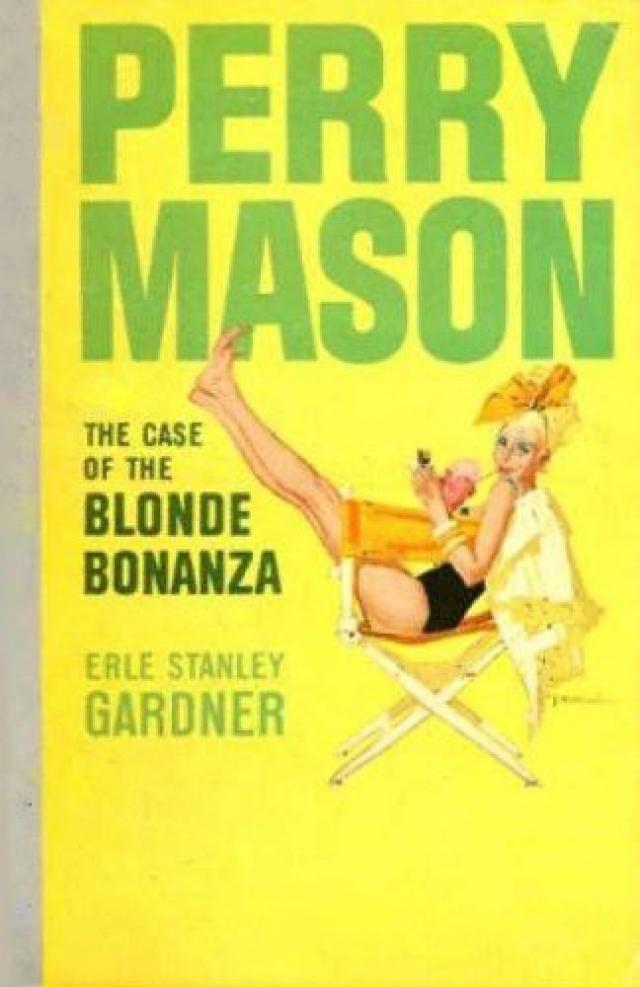
The case of the blonde b.., p.5
The Case of the Blonde Bonanza,
p.5


Della Street ushered Harrison Boring into the office.
Boring was rather distinguished-looking, with broad shoulders, sideburns, keen gray eyes, and a certain air of dignity. He was somewhere in his late thirties, slim-waisted and spare-fleshed, despite his broad shoulders. He had a close-clipped mustache which firmed his mouth.
“Good afternoon, Mr. Mason,” he said. “I came to see you. You asked me to get in touch with you, and since I was here in the neighborhood on another matter I decided to come in.”
“Sit down,” Mason invited.
Boring accepted the seat, smiled, settled back, crossed his legs.
“Dianne Alder,” Mason said.
There wasn’t the faintest flicker of surprise on Boring’s face.
“Oh, yes,” he said. “A very nice young woman. I’m sorry the plans we had for her didn’t materialize.”
“You had Plans?”
“Oh, yes, very definitely.”
“And made a contract.”
“That’s right—I take it you’re representing her, Mr. Mason?”
“I’m representing her.”
“I’m sorry she felt that it was necessary to go to an attorney. That is the last thing I would have wanted.”
“I can imagine,” Mason said.
“I didn’t mean it that way,” Boring interposed hastily.
“I did,” Mason said.
“There is nothing to be gained by consulting an attorney,” Boring said, “and there is, of course, the extra time, trouble and expense involved.”
“My time, your trouble, your expense,” Mason said.
Boring’s smile seemed to reflect genuine amusement. “I’m afraid, Mr. Mason, there are some things about the facts of life in Hollywood you need to understand.”
“Go ahead,” Mason said.
“In Hollywood,” Boring said, “things are done on front, on flash, on a basis of public relations.
“When a writer or an actor gets to the end of his contract and his option isn’t taken up, he immediately starts spending money. He buys a new automobile, purchases a yacht, is seen in all the expensive night spots, and lets it be known that he is at liberty but is thinking of taking a cruise to the South Seas on his yacht before he considers any new contract.
“The guy probably has just enough to make a down payment on the yacht and uses his old automobile as a down payment on the new car. He has a credit card which is good for the checks at the night spots and he’s sweating in desperation, but he shows up regularly with good-looking cuties and buys expensive meals. He radiates an atmosphere of prosperity.
“During that time his public relations man is busily engaged in trying to plant stories about him and his agent is letting it be known that while his client has his heart set on a nine to twelve months vacation on his yacht in the South Seas, he might be persuaded to postpone the vacation long enough to take on one more job if the pay should be right.
“That’s Hollywood, Mr. Mason.”
“That’s Hollywood,” Mason said. “So what?”
“Simply, Mr. Mason, that I live in Hollywood. I work with Hollywood. I had some elaborate plans. I backed those plans up with what cash I had available and I was able to interest a backer.
“Late Friday night my backer got cold feet on the entire proposition. I hope I can get him reinterested, but I can’t do it by seeming to be desperate. I have to put up a good front, I have to let it appear that the loss of his backing was merely a minor matter because I have so many other irons in the fire that I can’t be bothered over just one more scheme which could have earned a few millions.”
“And so?” Mason asked.
“And so,” Boring said, “Dianne would have shared in my prosperity. Now she has to share in my hard luck. If the girl is willing to keep right on going, if she’s willing to develop her curves and try to glamorize herself in every way possible, I am hoping that the deal can be reinstated.”
“How soon?”
“Within a matter of weeks—perhaps of days.”
“You mean you hope the backer will change his mind?”
“Yes.”
“Do you have any assurance that he will?”
“I think I can— Well, I’ll be perfectly frank, Mr. Mason. I think I can guarantee that he’ll come around.”
“If you’re so certain of it, then keep up your payments to Dianne Alder.”
“I can’t do it.”
“Why?”
“I haven’t the money.”
Mason said, “We’re not interested in your hard luck. You made a definite contract. For your information, upon a breach of that contract my client could elect to take any one of certain remedies.
“She has elected to consider your repudiation of the contract as a breach of the contractual relationship and a termination of all future liability on her part under the contract. She will hold you for whatever damages she has sustained.”
“Well, I sympathize with her,” Boring said. “If I were in a position to do so, I’d write her a check for her damages right now, Mr. Mason. I don’t try to disclaim my responsibility in the least. I am’ simply pointing out to you that I am a promoter, I am an idea man. I had this idea and I had it sold. Something happened to unsell my backer. I think I can get him sold again. If I can’t, I can get another backer. But every dollar that I have goes into keeping up the type of background that goes with the line of work I’m in. My entire stock-in-trade is kept in my showcases. I don’t have any shelves. I don’t have any reserve supplies.”
“And you’re trying to tell me you don’t have any money?” Mason asked.
“Exactly.”
Mason regarded the man thoughtfully. “You’re a salesman.”
“That’s right.”
“A promoter.”
“That’s right.”
“You sell ideas on the strength of your personality.”
“Right.”
“So,” Mason said, “instead of talking with me over the telephone, instead of referring me to your attorney, you came here personally to put on your most convincing manner and persuade me that you had no cash and therefore it would be useless for my client to start suit.”
“Correct again, Mr. Mason.”
“Do you have an attorney?”
“No.”
“You’d better get one.”
“Why?”
“Because I’m going to make you pay for what you’ve done to Dianne Alder.”
“You can’t get blood out of a turnip, Mr. Mason.”
“No,” Mason said, “but you can get sugar out of a beet—if you know how—and in the process you raise hell with the beet.”
Boring regarded him speculatively.
“Therefore,” Mason said, “I would suggest that you get an attorney and I’ll discuss the situation with him rather than with you.”
“I don’t have an attorney, I don’t have any money to hire an attorney, and I’m not going to get one. With all due respect to you, Mr. Mason, you’re not going to get a thin dime out of me; at least, as long as you act this way.”
“Was there some other way you had in mind?” Mason asked.
“Frankly, there was.”
“Let’s hear it.”
“My idea is just as good as it ever was. Sooner or later I’m going to get another backer. When I do, Dianne will be sitting on Easy Street. I tell you, Mr. Mason, the idea is sound. People are tired of starving their personalities along with their bodies.
“You let some well-nourished, firm-fleshed, clear-eyed model come along that has lots of figure, and we’ll start a style change overnight.”
“I’m not an expert on women’s styles,” Mason said. “I try to be an expert on law. I’m protecting my client’s legal interests.”
“Go ahead and protect them.”
“All fight,” Mason said. “My client has a claim of damages against you for whatever that may be worth. We won’t argue about that now. My client also has the right to consider your repudiation of the contract as a termination of all future liability on her part.”
“I am not a lawyer, Mr. Mason, but that would seem to be fair.”
“Therefore,” Mason said, “regardless of what else may be done, you have no further claims on Dianne Alder or on her earnings.”
“I’d like to see the situation left in status quo,” Boring said.
“Status quo calls for the payment of a hundred dollars a week.”
“I can’t do it.”
“Then there isn’t any status quo.”
Boring held out his hand to Mason with a gesture of complete friendship. “Thank you, Mr. Mason, for giving me your time. I’m glad we had this talk. Dianne is a nice girl. You do whatever you can to protect her interests, but I just wanted to let you know that trying to collect from me would simply be throwing good money after bad.”
Boring kept talking while he was shaking hands. “If I ever get any money of my own, Mason, you won’t need to sue me for it because I’d back this idea of mine with every cent I had. It’s a red-hot idea and I know it’s going to pay off. I realize that the situation is a little discouraging at the moment as far as Dianne is concerned, but I know that sooner or later my idea is going across. I feel in my bones that within a few short months Dianne will be the toast of the town.”
“Let’s be very careful,” Mason said, moving Boring toward the exit door, “that the toast doesn’t get burnt.”
“I can assure you, Mr. Mason, with every ounce of sincerity I possess, that I have her best interests at heart.”
“That’s fine,” Mason said, “and you can be assured that I have them at heart.”
Mason held the exit door open for Boring, who smiled affably then turned and walked down the corridor.
Mason turned to Della Street as the door closed. “You got Paul Drake?” he asked.
“That’s right. He’ll be under surveillance from the time he leaves the building. One of Drake’s operatives will probably be in the elevator with him as he goes down.”
Mason grinned.
“Quite a promoter,” Della Street said.
Mason nodded. “That damned contract,” he said.
“What about it?”
“I wish I knew what Boring was after. I wish I knew the reason he drew up that contract in the first place.”
“You don’t believe his story about a new type of model and—”
Mason interrupted to say, “Della, I don’t believe one single damn thing about that guy. As far as I’m concerned, even his mustache could be false— Get me that contract, will you, Della? I want to study it once more.”
Della Street brought him the file jacket. Mason took out the contract and read it carefully.
“Any clues?” Della Street asked.
Mason shook his head. “I can’t figure it out. It’s…”
Suddenly he stopped talking.
“Yes?” Della Street prompted.
“Well, I’ll be damned.!” Mason said.
“What?” Della Street asked.
“The red herring is what fooled me,” Mason said.
“And what’s the red herring?”
“The avoirdupois, the diet, the twelve pounds in ten weeks, the curves.”
“That wasn’t the real object of the contract?” Della Street asked.
“Hell, no,” Mason said. “That was the window dressing. That was the red herring.”
“All right, go ahead,” she said. “I’m still in the dark.”
“Take that out of the contract,” Mason said, “and what do you have left? We’ve seen these contracts before, Della.”
“I don’t get it.”
“The missing-heir racket,” Mason said.
Della Street’s eyes widened.
Mason said, “Somebody dies and leaves a substantial estate, but no relatives. No one takes any great interest in the estate at the moment except the public administrator.
“Then these sharpshooters swoop down on the situation. They start feverishly running down all the information they can get on the decedent. They find that some relatives are living in distant parts, relatives who have entirely lost track of the family connection.
“So these sharpshooters contact the individual potential heirs and say, ‘Look here. If we can uncover some property for you which you didn’t know anything at all about, will you give us half of it? We’ll pay all the expenses, furnish all the attorneys’ fees out of our share. All you have to do is to accept your half free and clear of all expenses of collection.’”
“But who’s the relative in this case?” Della Street asked. “Dianne’s family is pretty well accounted for. Her father died, and all of the estate, such as it was, was distributed to her mother, and then her mother died, leaving everything to Dianne.”
“There could be property inherited from the more remote relatives,” Mason pointed out. “That’s where these sharpies make their money.”
“Then why would he quit making the payments to her and forfeit all right to her share of the money?”
“Either because he found out she wasn’t entitled to it,” Mason said, “or because he’s found another angle he can play to greater advantage.”
“And if he has?” Della Street asked.
“Then,” Mason said, “it’s up to us to find out what he’s doing, block his play and get the inheritance for Dianne, all without paying him one thin dime.”
“Won’t that be quite a job?” Della Street asked.
“It’ll be a terrific ob,” Mason said. “We’re going to have to get hold of Dianne and start asking her about her family on her father’s side and her mother’s side, her cousins, aunts, second cousins, uncles and all the rest of it. Then we’ve got to start running down each person to find out where they’re located, when they died, how they died, where they died, what estate was probated and all the rest of it.
“There is, however, one method of short-cutting the job.”
“What’s that?”
“By shadowing Boring, checking back on where he’s been, what he’s been doing, and, if possible, with whom he’s corresponding—and that’s a job for Paul so we’ll let Paul wrestle with it until he gets a lead.
“Come on, Della, let’s close up the office and forget about business for a change. We may as well call it a day.”
Della Street nodded.
Mason opened the exit door, started to go out, suddenly paused and said, “Della, there’s someone rattling the knob of the door of the reception office—would you mind slipping out and telling him that we’re closing up and see if we can make an appointment with this man for tomorrow.”
A few moments later she was back in the office. “You may want to see this man, Chief,” she said.
“Who is it?”
“His name is Montrose Foster and he wants to talk to you about Harrison T. Boring.”
“We’ll, well!” Mason said, grinning. “Under the circumstances, Della, I guess we’ll postpone closing the office until we’ve talked with Mr. Montrose Foster, following which we could, if so desired, dine uptown and perhaps invite Paul Drake to go to dinner with us.
“Bring him in.”
Within a few seconds, Della Street was back with a wiry, thin-faced individual whose close-set, black, beady eyes were restlessly active. He had high cheekbones, a very prominent pointed nose, quick, nervous mannerisms and rapid enunciation.
“How do you do, Mr. Mason, how do you do?” he said, “I recognize you from your photographs. I’ve always wanted to meet you.
“Tops in the field, that’s what you are, sir, tops in the field. It’s a pleasure to meet the champion.”
“What can I do for you?” Mason asked, sizing the man up with good-natured appraisal.
“Perhaps we can do something for each other, Mr. Mason. I’ll put it that way.”
“Well, sit down,” Mason said. “It’s after hours and we were just closing up. However, if you’ll be brief, we can make a preliminary exploration of the situation.”
“My interest is in Harrison T. Boring,” Foster said, “and I have an idea that you’re interested in him.”
“And if so?” Mason asked.
“I think we could pool our information, Mr. Mason. I think I could be of some assistance to you and you might be of some assistance to me.”
“Where do we begin?” Mason asked.
“I happen to know—and never mind how I happen to know it—that you left word for Harrison Boring to get in touch with you. I happen to know that Mr. Boring picked up that message and in place of calling you on the telephone as apparently you wished him to do, came here in person. I happen to know that he left here only a short time ago. And, if you’ll forgive me, that was the reason I was so persistently trying to attract attention by knocking at the door of your reception room. I felt certain you were still here.”
“I see,” Mason said.
“Now then,” Foster went on, “if you’ll let me have the name of your client, Mr. Mason, I think I can perhaps be of help to you.”
“And why do you wish the name of my client?”
“I’m simply checking, Mr. Mason, to make certain that I’m on the right track.”
Mason’s eyes narrowed slightly. “I fail to see what good it would do to divulge the name of my client. If, of course, you wish to tell me anything about Boring, I’m ready to listen.”
“Boring,” Foster said, “is an opportunist, a very shrewd character, very shrewd.”
“Unscrupulous?” Mason asked.
“I didn’t say that,” Foster said.
“May I ask how you know so much about him?”
“The man worked for me for a period of two years.”
“In what capacity?” Mason asked.
“He was a—well, you might say an investigator.”
“And what is your line of work?” Mason asked.
Foster became elaborately casual. “I have several activities, Mr. Mason. I am a man of somewhat diverse interests.”
“The principal one of which,” Mason said, making a shot in the dark, “is locating missing heirs. Is that right?”
Foster was visibly shaken. “Oh,” he said, somewhat crestfallen, “You know about that, do you?”
“Let’s put it this way, I surmised it.”
“And why did you surmise that, may I ask?”















