

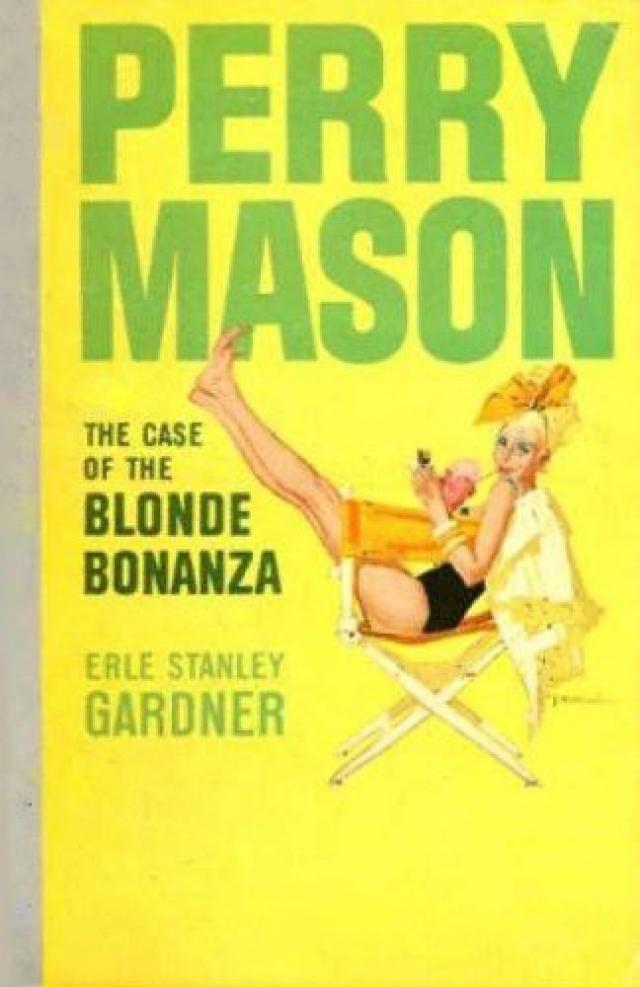
The case of the blonde b.., p.13
The Case of the Blonde Bonanza,
p.13


“The bad thing is that Dillard insists Dianne was in the room almost fifteen minutes. The police didn’t like that.”
“And I don’t like it,” Mason said. “She swears she wasn’t.”
“Time could pass pretty fast if she was looking for something,” Nye said.
“Not that fast,” Mason said, frowning. “There’s no chance Moose Dillard could have been mistaken?”
“Hell, no. Not on a deal like that. Moose is a little slow thinking sometimes. He’s quick-tempered and he makes mistakes, but as an operative he’s tops. He knows what he’s doing, he keeps notes, he’s a good observer and you can depend on his data.”
Mason was thoughtfully silent.
“It’s a hell of a mess,” Sid Nye said.
“It’s tough,” Mason admitted, “but we’re going to have to face conditions as they are and not the way we’d like to have them. You can’t argue with a fact.
“Why haven’t they arrested Dianne, Sid?”
“I don’t know. Perhaps they’re waiting for—”
The telephone rang.
Mason answered it.
Della Street said, “There’s a policewoman here in the room and she has a warrant for Dianne.”
“Let Dianne go with her,” Mason said. “And tell Dianne not to make any statement except in my presence. Tell her to say nothing—nothing.”
“I’ll tell her,” Della Street said.
‘Stall along as much as you can, Della. I’ll be down as soon as I can get some clothes on.”
“Will do,” she promised.
Mason started dressing, talking to Sid Nye as he hurried into his clothes.
“Sid, I want you to get out of town while, the getting’s good. You’re not a witness to anything and therefore it won’t be concealing evidence to have you hard to find. However, right at the moment I don’t want the police inquiring into my activities after I came to Riverside.”
“You don’t want anyone to know you called on Winlock?”
Mason buttoned his shirt. “That’s right, and I don’t care about having the police know Winlock called on Boring.… Will Dillard be able to tell them it was Winlock, his wife and stepson who called on Boring?”
“No. He doesn’t have their license numbers or names. He has the general descriptions of two of the automobiles and descriptions of the people. The only license number he has is that on Dianne’s car. He can, of course, make an identification if they confront him with the persons but there’s nothing that would lead them to the Winlocks from his description; in fact, the Winlocks would be the last persons they’d suspect in a case of this sort.”
Mason fastened his belt. “And remember, in case you’re questioned, you don’t know who Boring’s callers were. You’ve only surmised—and the same is true of me.”
Mason hurried down to Della Street’s room and a policewoman answered his knock.
“Good morning,” Mason said. “I’m Perry Mason. I’m Dianne Alder’s attorney. Do I understand you’re taking her into custody?”
“Yes.”
“I want to talk with her.”
“She isn’t dressed. I’m taking her into custody. You’ll have to talk with her at headquarters.”
Mason raised his voice. “I’ll talk to her through the door. Say absolutely nothing, Dianne. Don’t tell the police about your name, your past, your parents or—”
The door slammed in the lawyer’s face.
Mason waited some ten minutes in the corridor until the policewoman, accompanied by Della Street and Dianne Alder, emerged into the corridor.
“Can you take it, Dianne?” Mason asked. “Can you keep quiet?”
Dianne nodded.
The policewoman turned on him. “I don’t want lawyers addressing my prisoner,” she said. “If you want to consult with your client, you can come to the jail and do it in a regular manner.”
“What’s wrong with this?” Mason asked.
“It’s against my orders. If you persist I’ll have to charge you with interfering with an arrest.”
“Is it a crime,” Mason asked, “to advise a client in the presence of an arresting officer, that if she once starts answering any questions the point at which she stops will be considered significant, but if she doesn’t answer any questions at all on the advice of her counsel, and demands an immediate hearing, she is—”
“That will do,” the policewoman said angrily. “You’re talking to her.”
“I’m talking to you.”
“Well, your words are aimed at her. I’m going to ask you and Miss Street to leave now. That’s an order.”
Mason smiled. “My, but you’re hard to get along with,”
“I can be,” she said angrily.
Dianne Alder dropped a pace behind so that, she was looking over the officer’s shoulder at Perry Mason. She raised her forefinger to her lips in a gesture of silence.
Mason bowed to the officer. “I accede to your wishes, Madam. Come on, Della.”
Chapter 15
Carter Leland, the district attorney of Riverside County, said to the magistrate, “If the Court please, this is a simple matter of a preliminary hearing. We propose to show that the defendant in this case had a business arrangement with the decedent, Harrison T. Boring; that she became convinced Boring had swindled her, that she was exceedingly indignant, that she went to the Restawhile Motel in order to see him and did see him; that she was the last person to see Boring alive and that when she left the room Boring was in a dying condition.
“That is all we need to show, in fact more than we need to show, in order to get an order binding the defendant over for trial.”
“Put on your case,” Judge Warren Talent said.
“My first witness is Montrose Foster,” Leland announced.
Montrose Poster came forward, held up his right hand, was sworn, seated himself nervously on the witness stand.
“Your name is Montrose Foster, you reside in Riverside and have for some two years last past? You are the president of Missing Heirs and Lost Estates?”
“That is true.”
“On last Tuesday, the day of the murder as charged in the complaint, did you have occasion to talk with the defendant?”
“I did.”
“Where did this conversation take place?”
“At Bolero Beach.”
“Did the defendant make any statement to you about her feeling toward Harrison T. Boring?”
“She did.”
“What did she say?”
“She said she could kill him.”
Leland turned abruptly and unexpectedly to Perry Mason. “Cross-examine,” he said.
“Is that all you’re going to try to bring out on direct examination?” Mason asked.
“It’s enough,” Leland snapped. “I don’t intend to let this, preliminary hearing become a three-ring circus.”
Mason turned to the witness. “Did you,” he asked, “say something to the defendant that was well calculated to cause her to make that statement?”
“Objected to,” Leland said, “as calling for a conclusion of the witness. He can’t testify as to what was in the defendant’s mind or what was calculated to arouse certain emotions, but only to facts.”
“Sustained,” Judge Talent said. “I think you can reframe the question, Mr. Mason.”
“I’ll be glad to, Your Honor,” Mason said, and turned to the witness. “Did you try to say something that would be calculated to arouse her rage toward the defendant?”
“Why, Your Honor,” Leland said, “that’s exactly the same question. That’s a repetition of the same question calling for a conclusion of the witness and in defiance of the ruling of the Court.”
“No, it isn’t,” Mason said. “This question now relates to the state of mind of the witness.”
“And that’s completely immaterial,” Leland said.
Mason grinned. “You mean I can’t show his bias?”
Leland started to say something, caught himself.
Judge Talent smiled and said, “The question has been skillfully reframed. The objection is overruled.”
“I told her certain things about Boring,” Foster said.
“The question, Mr. Foster, was whether you tried to arouse her anger against Boring by what you told her.”
“Very well. The answer is yes.”
“You deliberately tried to arouse the defendant’s anger?”
“I told you, yes.”
“Did you tell her that Boring had been attempting to sell her into white slavery?”
“Well—that was her idea.”
“You agreed with it?”
“I didn’t disagree with it.”
“At no time during the conversation did you mention that Boring’s purpose in his dealings with her was one of immorality?”
“Well she brought that subject up herself.”
“And you, in your conversation, encouraged her in that belief?”
“Yes.”
“And told her that Boring had deceived her in order to get her to sign an agreement which was intended to enable him to sell her into white slavery?”
“I didn’t tell her that. She told me that.”
“You agreed with her?”
“Yes.”
“And then, after that, you told her that was Boring’s objective?”
“All right, I did.”
Mason smiled. “Now, you knew what Boring was after, didn’t you, Mr. Foster? Didn’t you tell me that Boring had located some property and ah estate to which the defendant could establish title?”
“That’s what he was after, yes.”
“And you knew what he was after?”
“Of course I did.”
“Then that was his real objective?”
“Yes.”
“Therefore when you told the defendant that the purpose of Boring’s contract with her was to get her in his power for other reasons, you lied to her.”
“I let her deceive herself.”
“Answer the question,” Mason said. “When you told her that, you lied to her.”
“That’s objected to—it’s not proper cross-examination,” Leland said. “It also assumes facts not in evidence.”
“Objection overruled on both counts,” Judge Talent said.
“All right,” Foster snapped, “I lied to her.”
“You did that in order to get an advantage for yourself?”
“Yes.”
“You are, then, willing to lie as a part of your everyday business transactions in order to get an advantage for yourself.”
“I didn’t say that,” the witness said.
“I’m asking it,” Mason said.
“The answer is no.”
“You don’t generally lie in order to get an advantage for yourself?”
“That certainly is objectionable, Your Honor,” Leland said.
“I think so. The objection is sustained,” Judge Talent ruled.
“But you did tell such a lie in order to get such an advantage in this case,” Mason said.
“Yes,” the witness snapped.
“Now, on the evening of the murder, you yourself saw Harrison T. Boring at the Restawhile Motel, did you not?”
“Yes.”
“And had an interview with the decedent?”
“Yes.”
“Your Honor,” Leland said, “the prosecution wishes to object to any testimony as to what took place at that interview. It was not brought out on direct examination, and if counsel wants to go into it, he must make this witness his own witness.”
“I think it shows motivation and bias,” Mason said.
“I’m inclined to agree with you,” Judge Talent said. “I think you can at least show the bias and interest of this witness, and if it appears that he himself was in contact with the decedent on the day of the murder, that may well establish an interest.”
Mason turned to the witness. “Did you lie to Boring at the time you had that interview with him?”
“No.”
“You didn’t tell him that this defendant was going to repudiate any arrangement she might have with him, but that if Boring would let you in on the secret of what he had discovered, you would co-operate with Boring and would keep the defendant in line and you would share whatever property she was entitled to fifty-fifty—words to that effect?”
“That was generally the nature of my proposition.”
“But you didn’t have the defendant tied up with any agreement?”
“I felt I could secure such an agreement.”
“But you told Boring you had her tied up?”
“Something of that sort.”
“So you lied to Boring?”
“All right!” the witness shouted. “I lied to Boring. He lied to me and I lied to him.”
“Whenever it suits your advantage, you’re willing to lie?” Mason asked.
“If the Court please,” Leland said, “that’s the same question that has already been ruled on. I object to it.”
“Sustained,” Judge Talent said.
“So, on last Tuesday,” Mason said, “in connection with your ordinary business activities, in two interviews you told lies in order to get an advantage for yourself.”
“Same objection,” Leland said. “It’s the same question.
Your Honor.”
“I don’t think it is,” Judge Talent said. “It is now a specific question as to two interviews with two people. However, I’m going to sustain the objection on the ground that the question has already been asked and answered. The witness had admitted lying to each of two people on the same day.”
Mason turned to the witness. “And are you lying now?”
“No.”
“Would you lie if it suited your advantage?”
“Objected to as not proper cross-examination, and as argumentative,” Leland said.
“Sustained,” Judge Talent said.
“Did you have any physical altercation with Boring at the time you saw him?”
“I—it depends on what you mean by a physical altercation.”
“Did Boring hit you?”
“No.”
“Did he grab you by the coat or other garment?”
“He pushed me.”
“Did he throw you out?”
“He tried to.”
“But wasn’t man enough to do it?”
“No.”
“Because you resisted him?”
“Yes.”
“And how did you resist him?”
“I poked him one.”
“So,” Mason said, smiling, “on the day of Boring’s death, on this Tuesday evening, you went to see the decedent shortly before his death. You had lied to the defendant, you lied to Boring, you engaged in a struggle with him and you poked him. Is that right?”
“All right, that’s right,” Foster said.
“You had reason to believe Boring had a large sum of money on him and you demanded that he surrender a part of all of that money to you-that he divide it with you?”
“Objected to as not proper cross-examination,” Leland said.
Judge Talent thought the matter over, then said, “I’m going to sustain that objection.”
“Did you get some money from him?” Mason asked.
“Same objection.”
“Same ruling.”
“No further questions,” Mason said.
“That’s all,” Leland said. “I’ll call Steven Dillard as my next witness.”
Moose Dillard lumbered to the stand, his huge frame seeming to sag inside of his coat. His eyes were downcast and he studiously avoided Perry Mason.
“What’s your name?” Leland asked.
“Steven Dillard.”
“What’s your occupation?”
“I’m a detective.”
“A private detective?”’
“Yes, sir.”
“Were you employed as such on last Tuesday?”
“Yes.”
“Did you know the decedent, Harrison T. Boring?”
“I had seen him.”
“When had you first seen him?”
“On Monday.”
“Where?”
“Leaving Perry Mason’s office.”
“And what did you do with reference to following him?”
“I had put an electronic bug on his automobile.”
“By that you mean an electronic device for the purpose of enabling you to follow the automobile?”
“Yes.”
“Can you describe this device?”
“It is a battery-powered device which was attached to his car and which sends out-signals which are received by a companion device attached to the car I was driving. By using it I didn’t need to get close to the car I was tailing.”
“And you thereafter shadowed Mr. Boring?”
“Yes.”
“You followed him to the Restawhile Motel in Riverside?”
“Yes.”
“And as a part of your shadowing operations secured a unit directly across from him?”
“That’s right.”
“What time did you check into that unit on last Tuesday?”
“At about six o’clock in the evening.”
“Did you keep Unit 10, in which Harrison Boring was registered, under surveillance?”
“I did.”
“During that evening did you see the defendant?”
“I did.”
“At what time?”
“I kept some notes. May I look at those notes?”
“Those notes were made by you?”
“Yes.”
“They are in your handwriting?”
“Yes.”
“And were made at the time?”
“Yes.”
The district attorney nodded. “You may consult the notes for the purpose of refreshing your recollection.”
Dillard said, “The defendant came to his cabin at about nine o’clock and left at nine-twelve.”
“Are you certain of your time, Mr. Dillard?”
“Absolutely.”
“Do you know that your watch was correct?”
“It is my custom to carry an accurate watch, and when I am on a job I make it my habit to check the watch with the radio.”















