

The case of the irate wi.., p.19
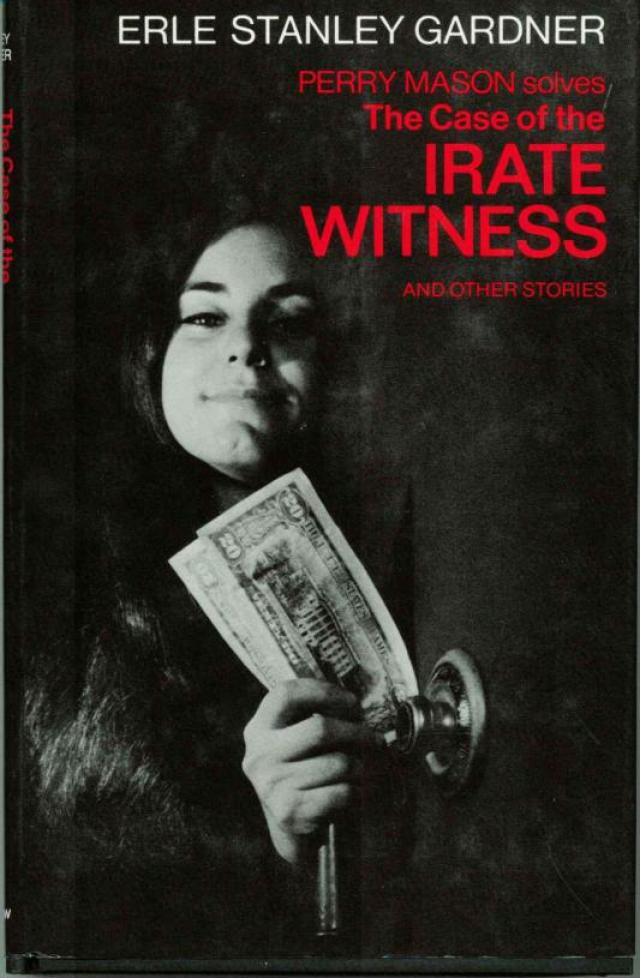
The Case of the Irate Witness and Other Stories,
p.19


Dewitt said, “For heaven’s sake, are you crazy? I don’t care about the damn packhorse.”
“Well, now,” the sheriff went on, “you’d ought to know the mountains, if you’re going to work in ’em. Of course, in packing a lot of dude duffel, even a good man will sometimes get sore backs on one or two of the pack string. You just can’t help that. But when you’re packing just one horse, and when you’re leading him on foot, which is generally a slower proposition than working from horseback, a man that knew anything about packing wouldn’t get a sore back on his packhorse.
“Now, another thing. The murderer tried to leave the cabin so that anybody that happened to stumble onto it wouldn’t think there was anything wrong. Everything would seem to be all nice and shipshape, just the way the trappers would have left it at the close of the winter season.
“But up here in this country we have a custom that’s an unwritten law. When a man leaves a cabin, he always leaves dry stovewood and kindling in by the stove. That’s so that if he happens to come back in a rainstorm or a blizzard, he’s got dry wood to start the fire with. And if somebody else happens to come in looking for shelter, there’s always dry wood with which to build a fire.
“Now, I don’t want to bore you by telling you all these local customs, but this one in particular is pretty rigidly enforced. Now do you get it?”
“Get what?” Dewitt asked.
“There were two men in that cabin. One of them was a tenderfoot, a city dude. The other was a woodsman. One of them killed the other and pulled out. Whoever it was that slicked the cabin up and washed the dishes and made it look as though everything was the way two trappers had left it certainly wasn’t the murdered man; it was the guy who did the killing.”
“Naturally,” Dewitt said.
“And,” Bill Catlin pointed out, “in this case, the man who did that was the tenderfoot.”
The idea hit Dewitt suddenly and hard. “But look here,” he said. “His wife identified the body. There was a ring on—”
“Sure, sure, she ‘identified the body,’” Catlin said. “Naturally, the murderer saw to it that the right ring was there to be identified. But she’d have made a positive identification in any event. You remember what you said about the crime having to be premeditated and someone having to be at the right place to meet the packhorse on a definite date.”
Corliss Adrian pushed her chair back from the table. “Are you,” she demanded angrily, “trying to insinuate that I—?”
“Now, just take it easy, ma’am,” the sheriff said. “I’m trying to straighten Dewitt out on the facts of this here case…. One other thing, Dewitt. Hank tells me this note was sticking out from behind the cupboard. I asked him if a good mountain man would have seen it easy, and he said over the telephone, ‘My God, Bill, even a dude would have seen it.’ So there you are. You see, Adrian was just a little too anxious. He wanted to be certain that note would be found.
“Well, now, when Hank telephoned me about this here crime and the things he found, I did a lot of thinking, and then I got hold of the judge and got me a search warrant so I could search the baggage that Mrs. Adrian had left there in the hotel. And, sure enough, there was a 3-A folding camera with a rapid rectilinear lens. And when we took it into Tom Morton’s darkroom and put an electric light bulb inside the bellows, you could see that one little pinhole in the bellows just as plain as day….
“Now, don’t try to make any breaks, Mrs. Adrian. You’re all tired out from having a long ride and a long trip. And, even if you tried to run away in this country, you couldn’t get anywhere. It isn’t like just ducking outdoors in a city and trying to get lost in a crowd. You’ve got to stay right here and take your medicine. One thing about it, our menfolks up here are sort of chivalrous to women and, while they won’t turn you loose, they may make you sort of an accessory or something that wouldn’t quite take the extreme penalty.”
“You’re crazy,” she said. “You’ve got nothing on me. This is some bucolic travesty of justice.”
“I’m afraid we’ve got quite a bit on you,” the sheriff said. “You and your husband fixed this up quite a while ago. Both of you prospected around last summer and found that cabin. It had been abandoned, but it was pretty new and in good shape. You even took that picture when you found the cabin, a month or two before your husband pulled his disappearing act. You’ve played it pretty foxy. You’d taken out the insurance policies years ago. It was all as slick as a wet pavement.”
“Wait a minute,” Dewitt said. “Let me handle this, Corliss…. Sheriff, your own reasoning defeats itself.”
“How come?”
“You admit that the man who left that cabin last tried to fix it up so it would look as though the trappers had moved out for the winter.”
“That’s what Hank told me,” the sheriff said.
“Yet Hank also told you that this note was left in such a prominent place that anyone, even a dude, couldn’t have failed to see it.”
The sheriff chuckled. “Well, now, that’s an interesting thing,” he said. “That’s the clue that struck me the minute Hank told me about it over the telephone. So I did a little thinking.”
“I haven’t seen any evidence of it yet,” Dewitt said, now openly hostile.
“Well,” the sheriff said, “you have to think that one over a little bit. Have to sort of put yourself in the shoes of the murderer, and then you get it.”
“I’m afraid,” Dewitt said, with deep sarcasm, “my mental processes are too far inferior to yours to get these fine points. Suppose you explain it to me.”
“Well, now,” the sheriff said, “just put yourself in the shoes of the murderer. You don’t want the body to be discovered until after it’s pretty hard to make a positive identification. You’ve buried the body in a shallow grave. You want it to stay there and decompose for just about so long. Then you’re ready to have the thing discovered. Now, then, if it’s discovered too soon, you’re sunk. Well, you can figure out what that means, Dewitt.”
“What does it mean?”
“It means that the murderer, or someone that was in cahoots with him, had to come back to that cabin and put that note there where it would be discovered at just about the right time. The idea was to get someone to go to that cabin, and when he reached the cabin he had to find the note and the body. So the person who put the note there wanted to be sure it’d be found. Now, Adrian could have put it there all right, just the way he says. But, if Benton had killed him, he’d have seen that note and naturally burnt it up. A mountain man wouldn’t have overlooked that note—not in a million years.
“So when Hank told me about the note and about the way it had been found, I asked him about the color of the ink. Seems like the ink was still sort of blue. Now, you take ink that way and, as I understand it, there’s some sort of a chemical in it that unites with oxygen and turns black after it oxidizes, and that’s what gives you the permanent color in ink. But until that chemical has had a chance to oxidize, they put a blue dye in the ink, so you can see what’s been written down. That’s why ink will be sort of blue for a while and then, after it gets old, it’ll turn black. You take a man that’s accustomed to judging colors pretty careful, and he can come pretty close to telling whether pen-writing is old or new. Hank said this looked pretty new to him.
“Well, that started me thinking some more, and so I asked Hank over the phone how Mrs. Adrian stood the trip. Did she ride pretty good in a saddle? And he said she was just like most of the dudes, riding with short stirrups, gripping with her knees, and pushing back against the cantle of the saddle. So I figure she’d hardly be the kind that could make a quick round trip to the cabin to plant a note in there, and maybe slash her finger and leave some bloodstains around. And, the way I sized it up, there was only one other person who could have done it.
“Well, I had a pretty good description of Frank Adrian, thanks to the stuff my friend, Ed Harvel, had sent on. So I sort of figured, if he sneaked into that cabin and put a note in there, he’d have had to go in through the ranger station or down through the Middle Fork. But it would have been a pretty hard trip, because he was a tenderfoot too. And it didn’t look like they’d take chances having three people in on it. However, they’re bringing in a few planes lately, and there’s a forest service emergency landing field only about five miles from the cabin now.
“So I got busy on the telephone and rang up the cities around that have charter air service, asking them about whether they took a man of a certain description into that landing field within the last month or so. And, sure enough, I struck pay dirt.”
“What did you find?” Dewitt asked, interested now despite himself.
“Well,” the sheriff said, “a man chartering an airplane has to give a lot of information about himself. Of course, this man was using an assumed name. He’s working in a garage now. Probably thought he was all good and safe and nobody was going to bother him. Well, I telephoned down to my friend, the sheriff, there, and we picked him up.
“And when I’d picked him up, I talked with him over the phone and told him about how his wife had already collected the insurance money and run away with a playboy, name of Gridley. That was sort of reading her mind a little in advance. May have been sort of a mean trick, but it worked like a charm. This here Adrian has a quick temper, and seems like he really blew up and started talking fast. He’d evidently heard something about this Gridley chap.
“So now, Mrs. Adrian, I hate to do it, but I’ve just got to give you lodging in the jail. I’ve sent over to the hotel and had your bags taken over, and, while the matron will be watching you to see what you take out, you can get some clean clothes and— My gosh!” Bill Catlin said, his voice edged with sympathy. “Darned if she ain’t fainted. Hank, will you wet a towel over there at the washstand, and let’s see if we can’t snap her out of it? And there’s a bottle of whiskey in that locker.
“And I reckon you can use a drink too, Miss Benton. It’s too bad about your brother, but, after all, it’s better that way than to have him turn out to be a murderer.
“And as far as Ed Harvel’s concerned, Dewitt, I rang him up and told him we’d got the case solved and the murderer in jail.
“And now, if you folks feel like it, we’ll get Mrs. Adrian disposed of, and then I guess we can have a little something to eat. I’ve been up pretty nearly all night working on this thing, and I ain’t as young as I used to be. When I go without sleep, I’ve got to have lots of food to keep the energy up.
“I told Harvel you’d done a fine job of detective work up here, Dewitt. And Harvel was proud as punch. ’Course I told him that us country fellows had to put a few little finishing touches on, here and there. Just because it’s our county, you know, and the voters sort of look to us to keep things in line. But I told him you’d done most of the work.
“Okay, Hank, let’s get the matron over here, and then we’ll go down and see what we can find. Deer season’s open now, and a friend sent me a loin of venison. I took it down to Ted Collins’ place and told him to have things all ready to give us a good venison feed when we showed up.
“Oh, yes, another thing. The insurance companies that had the policies on Adrian’s life, in favor of his wife, are pretty grateful. Ed Harvel tells me they want to make sort of a contribution. So I guess, come to figure it all out, we done a pretty fair day’s work. Whatta ya think, boys?”
About the Author
Courtesy of the Harry Ransom Center, The University of Texas at Austin
Erle Stanley Gardner (1889-1970) is a prolific American author best known for his works centered on the lawyer-detective Perry Mason. At the time of his death in March of 1970, in Ventura, California, Gardner was “the most widely read of all American writers” and “the most widely translated author in the world,” according to social historian Russell Nye. He was cited by the Guinness Book of World Records as the #1 Bestselling Writer of All Time. The first Perry Mason novel, The Case of The Velvet Claws, published in 1933, had sold twenty-eight million copies in its first fifteen years. In the mid-1950s, the Perry Mason novels were selling at the rate of twenty thousand copies a day. There have been six motion pictures based on his work and the hugely popular “Perry Mason” television series starring Raymond Burr, which aired for nine years and 271 episodes.
Erle Stanley Gardner, The Case of the Irate Witness and Other Stories















