

The case of the irate wi.., p.2
The Case of the Irate Witness and Other Stories,
p.2
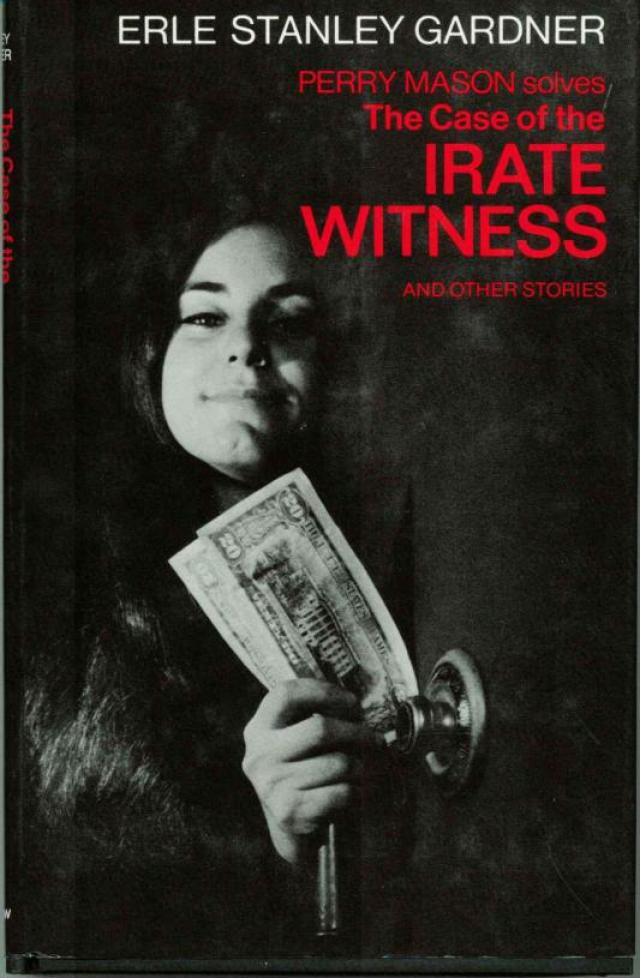


“I’ll put it this way, Mr. Sheriff,” the district attorney said. “Did you, on the morning of the fifteenth, take any money from Mrs. Corbin?”
“Objected to as incompetent, irrelevant, and immaterial,” Mason said.
“Your Honor,” Flasher said irritably, “that’s the very gist of our case. We propose to show that two of the stolen twenty-dollar bills were in the possession of Mrs. Corbin.”
Mason said, “Unless the prosecution can prove the bills were given Mrs. Corbin by her husband, the evidence is inadmissible.”
“That’s just the point,” Flasher said. “Those bills were given to her by the defendant.”
“How do you know?” Mason asked.
“She told the sheriff so.”
“That’s hearsay,” Mason snapped.
Judge Haswell fidgeted on the bench. “It seems to me we’re getting into a peculiar situation here. You can’t call the wife as a witness, and I don’t think her statement to the sheriff is admissible.”
“Well,” Flasher said desperately, “in this state, Your Honor, we have a community-property law. Mrs. Corbin had this money. Since she is the wife of the defendant, it was community property. Therefore, it’s partially his property.”
“Well now, there,” Judge Haswell said, “I think I can agree with you. You introduce the twenty-dollar bills. I’ll overrule the objection made by the defense.”
“Produce the twenty-dollar bills, Sheriff,” Flasher said triumphantly.
The bills were produced and received in evidence.
“Cross-examine,” Flasher said curtly.
“No questions of this witness,” Mason said, “but I have a few questions to ask Mr. Bernal on cross-examination. You took him off the stand to lay the foundation for introducing the bank list, and I didn’t have an opportunity to cross-examine him.”
“I beg your pardon,” Flasher said. “Resume the stand, Mr. Bernal.”
His tone, now that he had the twenty-dollar bills safely introduced in evidence, was excessively polite.
Mason said, “This list which has been introduced in evidence is on the stationery of the Ivanhoe National Bank?”
“That’s right. Yes, sir.”
“It consists of several pages, and at the end there is the signature of the assistant cashier?”
“Yes, sir.”
“And each page is initialed by the assistant cashier?”
“Yes, sir.”
“This was the scheme which you thought of in order to safeguard the company against a payroll robbery?”
“Not to safeguard the company against a payroll robbery, Mr. Mason, but to assist us in recovering the money in the event there was a holdup.”
“This was your plan to answer Mr. Nesbitt’s objections that the vault was an outmoded model?”
“A part of my plan, yes. I may say that Mr. Nesbitt’s objections had never been voiced until I took office. I felt he was trying to embarrass me by making my administration show less net returns than expected.” Bernal tightened his lips and added, “Mr. Nesbitt had, I believe, been expecting to be appointed manager. He was disappointed. I believe he still expects to be manager.”
In the spectators’ section of the courtroom, Ralph Nesbitt glared at Bernal.
“You had a conversation with the defendant on the night of the fourteenth?” Mason asked Bernal.
“I did. Yes, sir.”
“You told him that for reasons which you deemed sufficient you were discharging him immediately and wanted him to leave the premises at once?”
“Yes, sir. I did.”
“And you paid him his wages in cash?”
“Mr. Nesbit paid him in my presence, with money he took from the petty-cash drawer of the vault.”
“Now, as part of the wages due him, wasn’t Corbin given these two twenty-dollar bills which have been introduced in evidence?”
Bernal shook his head. “I had thought of that,” he said, “but it would have been impossible. Those bills weren’t available to us at that time. The payroll is received from the bank in a sealed package. Those two twenty-dollar bills were in that package.”
“And the list of the numbers of the twenty-dollar bills?”
“That’s in a sealed envelope. The money is placed in the vault. I lock the list of numbers in my desk.”
“Are you prepared to swear that neither you nor Mr. Nesbitt had access to these two twenty-dollar bills on the night of the fourteenth?”
“That is correct.”
“That’s all,” Mason said. “No further cross-examination.”
“I now call Ralph Nesbitt to the stand,” District Attorney Flasher said. “I want to fix the time of these events definitely, Your Honor.”
“Very well,” Judge Haswell said. “Mr. Nesbitt, come forward.”
Ralph Nesbitt, after answering the usual preliminary questions, sat down in the witness chair.
“Were you present at a conversation which took place between the defendant, Harvey L. Corbin, and Frank Bernal on the fourteenth of this month?” the district attorney asked.
“I was. Yes, sir.”
“What time did that conversation take place?”
“About eight o’clock in the evening.”
“And, without going into the details of that conversation, I will ask you if the general effect of it was that the defendant was discharged and ordered to leave the company’s property?”
“Yes, sir.”
“And he was paid the money that was due him?”
“In cash. Yes, sir. I took the cash from the safe myself.”
“Where was the payroll then?”
“In the sealed package in a compartment in the safe. As cashier, I had the only key to that compartment. Earlier in the afternoon I had gone to Ivanhoe City and received the sealed package of money and the envelope containing the list of numbers. I personally locked the package of money in the vault.”
“And the list of numbers?”
“Mr. Bernal locked that in his desk.”
“Cross-examine,” Flasher said.
“No questions,” Mason said.
“That’s our case, Your Honor,” Flasher observed.
“May we have a few minutes’ indulgence?” Mason asked Judge Haswell.
“Very well. Make it brief,” the judge agreed.
Mason turned to Paul Drake and Della Street. “Well, there you are,” Drake said. “You’re confronted with the proof, Perry.”
“Are you going to put the defendant on the stand?” Della Street asked.
Mason shook his head. “It would be suicidal. He has a record of a prior criminal conviction. Also, it’s a rule of law that if one asks about any part of a conversation on direct examination, the other side can bring out all the conversation. That conversation, when Corbin was discharged, was to the effect that he had lied about his past record. And I guess there’s no question that he did.”
“And he’s lying now,” Drake said. “This is one case where you’re licked. I think you’d better cop a plea and see what kind of a deal you can make with Flasher.”
“Probably not any,” Mason said. “Flasher wants to have the reputation of having given me a licking— Wait a minute, Paul. I have an idea.”
Mason turned abruptly, walked away to where he could stand by himself, his back to the crowded courtroom.
“Are you ready?” the judge asked.
Mason turned. “I am quite ready, Your Honor. I have one witness whom I wish to put on the stand. I wish a subpoena duces tecum issued for that witness. I want him to bring certain documents which are in his possession.”
“Who is the witness, and what are the documents?” the judge asked.
Mason walked quickly over to Paul Drake. “What’s the name of that character who has the garbage-collecting business,” he said softly, “the one who has the first nickel he’d ever made?”
“George Addey.”
The lawyer turned to the judge. “The witness that I want is George Addey, and the documents that I want him to bring to court with him are all the twenty-dollar bills that he has received during the past sixty days.”
“Your Honor,” Flasher protested, “this is an outrage. This is making a travesty out of justice. It is exposing the court to ridicule.”
Mason said, “I give Your Honor my assurance that I think this witness is material and that the documents are material. I will make an affidavit to that effect if necessary. As attorney for the defendant, may I point out that if the court refuses to grant this subpoena, it will be denying the defendant due process of law.”
“I’m going to issue the subpoena,” Judge Haswell said testily, “and for your own good, Mr. Mason, the testimony had better be relevant.”
George Addey, unshaven and bristling with indignation, held up his right hand to be sworn. He glared at Perry Mason.
“Mr. Addey,” Mason said, “you have the contract to collect garbage from Jebson City?”
“I do.”
“How long have you been collecting garbage there?”
“For over five years, and I want to tell you—”
Judge Haswell banged his gavel. “The witness will answer questions and not interpolate any comments.”
“I’ll interpolate anything I dang please,” Addey said.
“That’ll do,” the judge said. “Do you wish to be jailed for contempt of court, Mr. Addey?”
“I don’t want to go to jail, but I—”
“Then you’ll remember the respect that is due the court,” the judge said. “Now you sit there and answer questions. This is a court of law. You’re in this court as a citizen, and I’m here as a judge, and I propose to see that the respect due to the court is enforced.” There was a moment’s silence while the judge glared angrily at the witness. “All right, go ahead, Mr. Mason,” Judge Haswell said.
Mason said, “During the thirty days prior to the fifteenth of this month, did you deposit any money in any banking institution?”
“I did not.”
“Do you have with you all the twenty-dollar bills that you received during the last sixty days?”
“I have, and I think making me bring them here is just like inviting some crook to come and rob me and—”
Judge Haswell banged with his gavel. “Any more comments of that sort from the witness and there will be a sentence imposed for contempt of court. Now you get out those twenty-dollar bills, Mr. Addey, and put them right up here on the clerk’s desk.”
Addey, mumbling under his breath, slammed a roll of twenty-dollar bills down on the desk in front of the clerk.
“Now,” Mason said, “I’m going to need a little clerical assistance. I would like to have my secretary, Miss Street, and the clerk help me check through the numbers on these bills. I will select a few at random.”
Mason picked up three of the twenty-dollar bills and said, “I am going to ask my assistants to check the list of numbers introduced in evidence. In my hand is a twenty-dollar bill that has the number L 07083274 A. Is that bill on the list? The next bill that I pick up is number L 07579190 A. Are either of those bills on the list?”
The courtroom was silent. Suddenly Della Street said, “Yes, here’s one that’s on the list—bill number L 07579190 A. It’s on the list, on page eight.”
“What?” the prosecutor shouted.
“Exactly,” Mason said, smiling. “So, if a case is to be made against a person merely because he has possession of the money that was stolen on the fifteenth of this month, then your office should prefer charges against this witness, George Addey, Mr. District Attorney.”
Addey jumped from the witness stand and shook his fist in Mason’s face. “You’re a cockeyed liar!” he screamed. “There ain’t a one of those bills but what I didn’t have it before the fifteenth. The company cashier changes my money into twenties, because I like big bills. I bury ’em in cans, and I put the date on the side of the can.”
“Here’s the list,” Mason said. “Check it for yourself.”
A tense silence gripped the courtroom as the judge and the spectators waited.
“I’m afraid I don’t understand this, Mr. Mason,” Judge Haswell said after a moment.
“I think it’s quite simple,” Mason said. “And I now suggest the court take a recess for an hour and check these other bills against this list. I think the district attorney may be surprised.”
And Mason sat down and proceeded to put papers in his briefcase.
Della Street, Paul Drake, and Perry Mason were sitting in the lobby of the Ivanhoe Hotel.
“When are you going to tell us?” Della Street asked fiercely. “Or do we tear you limb from limb? How could the garbage man have …?”
“Wait a minute,” Mason said. “I think we’re about to get results. Here comes the esteemed district attorney, Vernon Flasher, and he’s accompanied by Judge Haswell.”
The two strode over to Mason’s group and bowed with cold formality.
Mason got up.
Judge Haswell began in his best courtroom voice. “A most deplorable situation has occurred. It seems that Mr. Frank Bernal has—well—”
“Been detained somewhere,” Vernon Flasher said.
“Disappeared,” Judge Haswell said. “He’s gone.”
“I expected as much,” Mason said.
“Now will you kindly tell me just what sort of pressure you brought to bear on Mr. Bernal to …?”
“Just a moment, Judge,” Mason said. “The only pressure I brought to bear on him was to cross-examine him.”
“Did you know that there had been a mistake in the dates on those lists?”
“There was no mistake. When you find Bernal, I’m sure you will discover there was a deliberate falsification. He was short in his accounts, and he knew he was about to be demoted. He had a desperate need for a hundred thousand dollars in ready cash. He had evidently been planning this burglary, or, rather, this embezzlement, for some time. He learned that Corbin had a criminal record. He arranged to have these lists furnished by the bank. He installed a burglar alarm and, naturally, knew how to circumvent it. He employed a watchman he knew was addicted to drink. He only needed to stage his coup at the right time. He fired Corbin and paid him off with bills that had been recorded by the bank on page eight of the list of bills in the payroll on the first of the month.
“Then he removed page eight from the list of bills contained in the payroll of the fifteenth, before he showed it to the police, and substituted page eight of the list for the first-of-the-month payroll. It was that simple.
“Then he drugged the watchman’s whiskey, took an acetylene torch, burned through the vault doors, and took all the money.”
“May I ask how you knew all this?” Judge Haswell demanded.
“Certainly,” Mason said. “My client told me he received those bills from Nesbitt, who took them from the petty-cash drawer in the safe. He also told the sheriff that. I happened to be the only one who believed him. It sometimes pays, Your Honor, to have faith in a man, even if he has made a previous mistake. Assuming my client was innocent, I knew either Bernal or Nesbitt must be guilty. I then realized that only Bernal had custody of the previous lists of numbers.
“As an employee, Bernal had been paid on the first of the month. He looked at the numbers on the twenty-dollar bills in his pay envelope and found that they had been listed on page eight of the payroll for the first.
“Bernal only needed to extract all the twenty-dollar bills from the petty-cash drawer, substitute twenty-dollar bills from his own pay envelope, call in Corbin, and fire him. His trap was set.
“I let him know I knew what had been done by bringing Addey into court and proving my point. Then I asked for a recess. That was so Bernal would have a chance to skip out. You see, flight may be received as evidence of guilt. It was a professional courtesy to the district attorney. It will help him when Bernal is arrested.”
The Jeweled Butterfly
There was an office rumor that Old E.B. locked the door of his private office on Wednesday mornings so he could practice putting. This had never been confirmed, but veteran employees at the Warranty Exchange & Fidelity Indemnity, known locally as WEFI, made it a rule either to take up important matters on Tuesday or to postpone them until Thursday.
Peggy Castle, E.B.’s secretary, didn’t inherit the Wednesday breathing spell from her predecessors. When Old E.B. found out that before Peggy came to WEFI she had worked on a country newspaper upstate, he inveigled her into starting a gossip column in the WEFI house organ.
Peggy was interested in people, had a photographic memory for names and faces, and a broad-minded, whimsical sense of humor. The result was that her column, which she called Castle’s in the Air, attracted so much attention that Old E.B., beaming with pride, insisted she devote more and more time to it.
“It’s just what we’ve needed,” he said. “We’ve had too much money to spend on the damn paper. We made it too slick, too formal, too dressed up. It looked impressive, but who the hell wants a house organ to be impressive? We want it to be neighborly. We want it to be interesting. We want the employees to eat it up. We want something that’ll attract customer attention on the outside. You’re doing it. It’s fine. Keep it up. One of these days it’ll lead to something big.”
Old E.B. carried a bunch of clippings from Peggy’s column in his wallet. Very often he’d pick out priceless gems and sidle up to cronies at the club. “Got a girl up at the office—my secretary, smart as a whip,” he’d begin. “You ought to see what she’s done to the gossip column in our house organ. This is it. Castle’s in the Air. Listen to this one:
“ ‘The identity of the practical joker in the Bond Writing Department has not as yet been discovered. When Bill Fillmore finds him he insists he’s going to choke him until his eyeballs protrude far enough to be tattooed with Bill’s initials. It seems that Bill and Ernestine have been keeping pretty steady company. At noon on last Thursday, Bill decided to pop the question, did so, and was accepted. That afternoon he was walking on air. However, it seems that Bill had confided his intentions to a few friends, showing them the ring he had bought to slip on Ernestine’s finger if she said yes. So some wag managed to dust the knees of Bill’s trousers immediately after lunch. Bill doesn’t know how it was done. He didn’t even know it had been done. While Ernestine was telling the news and showing her sparkler, observant eyes were naturally looking Bill over. People couldn’t refrain from seeing the two well-defined dust spots on the knees of Bill’s trousers. Ernestine thought it was cute, but Bill— Well, let’s talk about something else.’















