The case of the irate wi.., p.5
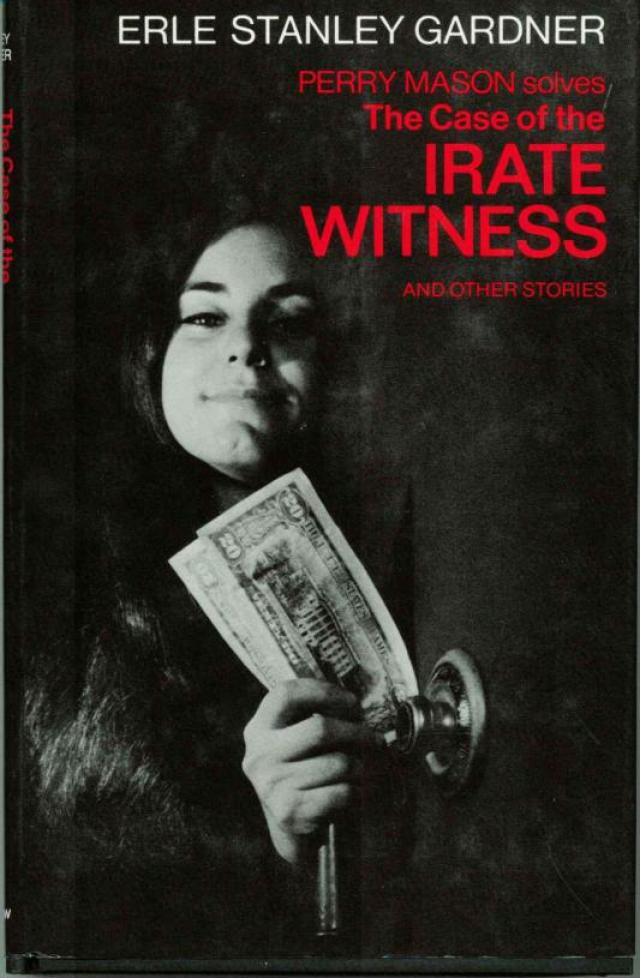
The Case of the Irate Witness and Other Stories,
p.5


“I’m sorry,” she said.
He cleared his throat. “Now. I know you did newspaper work before coming here.”
“A little, on a small paper.”
“You have sense. I’m going to get another secretary. From now on you’re going to be public relations counselor for this company. Your first job is to see that there’s no more bad publicity of the sort that’s in the papers this morning.
“Your new position carries with it a substantial increase in salary. You will, of course, keep on with your column in the house organ. I like the chatty, humorous way you make the office gossip interesting, make employees sound important.
“No, no, don’t thank me. This appointment is in the nature of a trial. I’ll have to see what you can do to kill the sort of talk that we’re sure to get about Stella Lynn’s death. Now tell me about what happened last night. Tell it all, every detail.”
He paused, peering at her over the top of his glasses as though she were in some way personally responsible for Stella Lynn’s death.
Peggy Castle told him about the anonymous letter, about going to the Royal Pheasant, and her conversation with Don Kimberly.
“Then you weren’t with Don Kimberly?” E.B. asked.
“Not in the sense of having a date with him.”
“The papers say you had a dinner date. The police told me the same thing.”
“That was a mistake.”
E.B. pursed his lips. “Since they think you and Don Kimberly were on a date and merely dropped in on Stella on a friendly call, I think it would be better to let it stay that way.”
“May I ask why?”
“It’s better not to change a story that has appeared in the press. It puts you in a bad position.”
“The mistake was made by the police in assuming we were out together.”
E.B. beamed at her. “So that leaves us with a clear conscience, eh? All right, we’ll leave it that you and Don had a dinner date.”
“But that story won’t hold up. The headwaiter knows we didn’t come in together. So do the table waiters.”
E.B. frowned, then yielded the point reluctantly. “Very well, then, I suppose you’ll have to tell them the truth.”
Peggy waited. She had said nothing of the jeweled butterfly she had taken from Stella’s stocking.
E.B. put the tips of his fingers together. “The pieces of the letter?” he asked.
“I have them in my desk.”
“I think we’d better take a look,” he said.
She brought them in to him.
“You’re sure these pieces are from the envelope?”
“Yes. You can see the handwriting is the same, and this was the only handwritten letter addressed to me in the afternoon mail.”
E.B. thoughtfully poked at the pieces of paper.
“How does Kimberly explain this letter?” he asked abruptly.
“He doesn’t. He can’t.”
The telephone on E.B.’s desk rang sharply three times.
E.B. picked up the receiver and said, “Yes, E. B. Halsey.”
He frowned for a moment, then said, “This call should have gone to Miss Castle’s desk in the ordinary way. However—yes, I understand … Very well, I’ll see him. Yes, bring him down here.”
Halsey hung up the telephone and once more looked at Peggy over his glasses. “A Detective Nelson is out there. Know anything about him?”
“No.”
“He wants to talk with me. The receptionist became flustered and rang me personally. The call should have gone through your office. However, the damage is done now. I don’t want to antagonize the police in any way. You might step out to receive him.”
She nodded and went to the reception room just as the receptionist held the door open for E.B.’s visitor.
He wasn’t the type she had expected. He might have been a successful accountant or a bond salesman. He was slender, quietly dressed, and when he spoke his voice was melodious.
“I’m Fred Nelson,” he said, “from Headquarters.”
He was holding a card case in his hand as though expecting to be called on to produce credentials. He exhibited a gold shield and gave Peggy a card, a neatly embossed card with a police shield in gold in the upper left-hand corner.
“Mr. Halsey is expecting you.”
“You’re his secretary, Miss Castle?”
“That’s right.”
“I think I want to see you both,” he said. “I believe you and your escort discovered the body.”
“I was with Mr. Kimberly.”
He nodded.
“Do you wish to see Mr. Kimberly at the same time?” she asked.
He shook his head. “Just you and Mr. Halsey.”
“Will you step this way, please.”
She ushered him into Halsey’s office. Nelson shook hands with E.B. and said, “I took the liberty of asking your secretary to remain during the interview, Mr. Halsey.”
E.B. beamed at him. “That’s fine. Quite all right. Sit right down. Anything we can do for you we’ll be glad to do. A most unfortunate occurrence. Always hate to have these tragedies. We’re something like a big family here and these things cut pretty close to home.”
“You knew Miss Lynn on a personal basis, then?” Nelson asked.
E.B.’s steady eyes surveyed the detective over the top of his glasses. He hesitated for approximately two seconds, as though debating just how to answer the detective’s question, then said curtly, “Yes.”
“Had you known Miss Lynn before she came to work here?”
“That is the point I was about to bring up,” Halsey said.
“Go ahead. Bring it up.”
“I knew Miss Lynn before she came to this city. As a matter of fact, she asked me about a position and I told her that I would be glad to refer her to the head of our Personnel Department and suggest that other things being equal—you understand, Mr. Nelson?”
Nelson nodded.
“—other things being equal,” Halsey went on, “I’d like to have her taken on. Of course, in a business the size of this the Personnel Department handles the entire thing. They know the vacancies and the abilities that are required. They have, I believe, tests for—”
“The point is that you interceded for her with the Personnel Department and Stella Lynn got a job?”
“That’s putting it in a rather peculiar way.”
Nelson turned to Peggy. “Did Stella Lynn seem to be brooding, worried, apprehensive?”
“I didn’t know her well, Mr. Nelson. I saw her off and on and chatted with her when I saw her. She was always cheerful. I’d say she was probably the least likely candidate for suicide—”
“I wasn’t thinking about suicide.”
“Well, a person doesn’t worry about murder.”
“I wasn’t thinking about murder.”
E.B. cleared his throat. “Well, then, may I ask what you were thinking about?”
Nelson glanced at Peggy Castle. “Something else,” he said. “Something Miss Lynn could well have worried about.”
“Heavens!” Peggy said impatiently. “I understand English, and I understand the facts of life. Are you trying to tell us that she was pregnant?”
Nelson nodded.
E.B. put his elbows on the desk, his chin in his hands. “Good Lord!” he murmured.
“You seem upset,” Nelson said.
“He’s thinking of the good name of the company,” Peggy explained, “of the publicity.”
“Oh, I see,” Nelson said in a dry voice. He turned to Peggy. “I’d like to have your story, Miss Castle, right from the beginning.”
“There isn’t any story. Mr. Kimberly and I decided to look in on Stella Lynn, and we found her lying dead on the floor. We called the police.”
“That certainly is a succinct statement,” Nelson said.
“I don’t know how I could elaborate on it.”
“You didn’t know Stella Lynn well?”
“Not particularly well, no.”
“How did it happen that you went to call on her, then?”
“It was Mr. Kimberly’s suggestion.”
“And why did he want to call on her last night?”
She said, “I’m afraid Mr. Kimberly doesn’t think it necessary to confide in me.”
“Perhaps he’ll be a little less reticent with me,” Nelson said.
“Perhaps.”
Nelson turned toward the door. “Well, I just wanted to find out what you knew about Stella Lynn’s background,” he said. “I’ll talk with Kimberly, and then I’ll be back.”
He walked out without a word of farewell.
As the door closed, E.B. picked up the telephone and said to the receptionist, “A man by the name of Nelson is leaving my office. He wants to see Mr. Kimberly. I want him to be delayed until I can get Kimberly on the phone and— What’s that? … Oh, I see … Well, that explains it. All right.”
E.B. hung up, looked at Peggy, and said, “That’s why he didn’t ask to have Kimberly in on our conference. Mr. Kimberly is not in the office this morning. No one seems to know where he is.”
He paused for a moment, digesting that information, then said, “Of course, that is a temporary expedient. It gives him a certain margin of time—I notice you didn’t tell Detective Nelson about that letter, Miss Castle.”
“I couldn’t.”
“Why not?”
“It doesn’t fit in with Kimberly’s version of what happened. Kimberly says Stella Lynn called him up around ten-thirty in the morning and told him that she had to see him. He’s the one who suggested the Royal Pheasant. Yet this letter, which was postmarked the day before, informed me that Kimberly and Stella Lynn were going to be dining at the Royal Pheasant.”
E.B. regarded Peggy thoughtfully for a moment. “You have a remarkably shrewd mind, Miss Castle.”
She flushed. “Thank you.”
“Now, just what do you have in your mind?”
She said, “Stella Lynn’s desk. I’d like to clean it out. She’ll have some private stuff in there. I’d like to look through it before the police do. No one has said anything about—”
“A splendid idea,” E.B. said. “Get busy. And don’t tell me what you’re doing. I’d prefer not to know all the steps you’re taking. That desk, for instance. In case you should find a diary or something—well, you’ll know what to do.”
E.B. regarded her over the tops of his glasses. “I’m sure you’ll know what to do.”
Peggy placed a cardboard carton on top of Stella Lynn’s desk and began to clean out the drawers, fully realizing that the typists at the adjoining desks were making a surreptitious check on all her actions.
There was an old magazine, a pair of comfortable shoes to be worn at work, a paper bag containing a pair of new nylons, a receipt for rent on her apartment, a small camera in a case, and a half-empty package of tissues.
There was no diary. But the drawers were in disarray, as if they might have been hurriedly searched at an earlier hour.
Peggy wondered what had led E.B. to believe there might be a diary in the desk. She dumped the contents of the desk into the carton, tied the carton with heavy string, and then, with a crayon, printed the name Stella Lynn on the side. Having done all this to impress the typists at adjoining desks, Peggy carried the carton back to her own office.
When the door was safely closed she opened the package and inspected the camera. The figure “10” appeared through the little circular window on the back of the camera, indicating that nine pictures had been taken.
Peggy turned the knob until the roll had been transferred to the take-up spool, removed it from the camera, and carefully wiped off the camera to remove her fingerprints. She slipped the camera back into its case, put the case into the carton, tied the carton up with string, and stepped to the door of E.B.’s private office.
She tapped on the door. When she received no answer, she tried the knob; it turned and she gently opened the door.
E.B. was not in his office.
She went back to her desk. A piece of paper that had been pushed under the blotter caught her eye. She pulled it out.
It was a note from E.B., scrawled hastily.
Miss Castle:
As soon as you left my office I recalled an urgent matter that had escaped my attention in the excitement incident to the interruption of our regular morning program. It is a matter of greatest importance and must be kept entirely confidential. I am working on that matter and expect to be out of the office for some time. I will get in touch with you as soon as I have a definite schedule. In the meantime I will be unavailable.
It was signed with the initials E.B.
Peggy looked at it. “Well,” she said, “Kimberly and Halsey. That makes it unanimous.”
Peggy batted her eyes and turned her most charming manner on Mrs. Maxwell, the apartment-house manager.
“I certainly hope you don’t think I’m too ghoulish, Mrs. Maxwell, but, after all, a girl has to live.”
Mrs. Maxwell nodded almost imperceptibly, studying her visitor through narrowed eyes around which pools of flesh had been deposited so that the eyes seemed to be about half normal size. Her hair had been dyed a brilliant orange-red, and her cheeks had been rouged too heavily.
“Apartments are so hard to get,” Peggy went on, “and, of course, I read in the paper about Stella Lynn’s unfortunate death. So I know that the apartment is untenanted, and I know that you’re going to have to rent it. Some people might be superstitious about moving into an apartment of that sort, but I definitely am not, and, well, I thought I’d like to be the first applicant.”
Again the nod was all but imperceptible.
“I’m not too well fixed,” Peggy said. “I’m an honest working girl, and I don’t have any—protector—in the background, but I do have fifty dollars saved up that I’d planned to use as a bonus in getting exactly the right kind of apartment. If this apartment suits me, since I wouldn’t have any need for the bonus, I’ll give it to you in gratitude for the personal inconvenience of showing me the apartment.”
This time the nod of the head was definitely more pronounced, then Mrs. Maxwell said, “My hands are tied right at the moment.”
“In what way?”
“I can’t get in to show the apartment.”
“Oh, surely you have a key—”
“The police have put a seal on both doors, front and back. They’ve been looking for fingerprints—”
“Fingerprints!” Peggy exclaimed. “What do they expect to find out from fingerprints?”
“I don’t know. They’ve put powder over the whole apartment. They’ve ordered me to keep out. They’ve sealed up the doors so they can’t be opened without breaking the seal.”
“Well, you can tell me about the apartment?”
“Oh, yes.”
“How about milk?”
“Milk can be delivered at the back.”
“And the collection of garbage and cans?”
“There are two receptacles, one for cans and glass, one for garbage. The garbage is collected every other day, the cans and glass twice a week. The tenant has to deposit the material in receptacles on the ground floor in the back.”
“I believe this apartment is on the fifth floor,” Peggy said.
“That’s right.”
“I have to walk down five flights of stairs to—”
“Four flights, dearie.”
“Well, four flights of stairs to deposit cans and garbage?”
“I’m sorry. There isn’t any dumbwaiter service.”
“May I take a look at the back stairs?”
“Certainly. Just go through that door at the end of the corridor. Look around all you want, dearie.”
When the going got tough, Peggy Castle sometimes appealed for help to her Great-uncle Benedict.
Benedict Castle had lived a highly checkered career. One of Peggy’s earliest memories was of hearing the mellifluous voice of Uncle Benedict reminiscently extolling the virtues of Benedict’s Body Builder.
“… Not a chemical, ladies and gentlemen, that tries to achieve health by whipping the worn glands, the tired muscles, the jaded nerves to greater and greater effort until finally the whole machine breaks down, but a tonic, ladies and gentlemen, that helps Mother Nature renew worn glands, create new cells, build new muscles, and make new blood. Now, who’s going to be the first to get one of these bottles of B.B.B., offered tonight not at the regular price of ten dollars, not even at the half price of five dollars, not at the special advertising introductory price of two dollars and a half, but at the ludicrously low price of one dollar! Only one dollar to build the body into renewed health!”
That had been twenty years before. Peggy, four years old, had been an orphan—too young to appreciate the tragedy that had deprived her of both father and mother—an orphan picked up and raised as their own child by Uncle Benedict and Aunt Martha.
The days of the patent-medicine vender had long passed, but Uncle Benedict loved to review the patter he had used in his prime, the patter that had enabled him to travel around, living, as he expressed it, “on the fat of the yokels.” It was before the days of Federal Trade Commission supervision, the Pure Food and Drug Act, and the income tax.
Uncle Benedict had had a horse-drawn van that by day served as living quarters and laboratory, at night opened to provide a stage on which his magic fingers performed feats of sleight of hand while his magic tongue brought in a steady stream of silver coins on which there was no income tax and no necessity to account to anyone.
No one knew how much Uncle Benedict took in. He went where he wished, did what he wished, and spent his money as he wished.
When the patent-medicine business began to die, other infinitely more lucrative fields opened up. It was the era of mining stock and the wildcat oil speculator. Gradually Uncle Benedict drifted into a gang of clever sharpshooters, a gang in which Uncle Benedict was referred to as “The Sleeper.” Never was there another man who could put on such a convincing act of sleeping while his ball-bearing mind was working out plans for fleecing suckers.
Uncle Benedict was at his best in the club car of a transcontinental train. He’d sit down, drink a beer, then let his head droop forward in slumber which became gently audible. People sitting next to him would discuss their business affairs with enough detail so that Uncle Benedict could figure out the correct approach.