The case of the sleepwal.., p.20
The Case of the Sleepwalker’s Niece (Perry Mason Series Book 8),
p.20
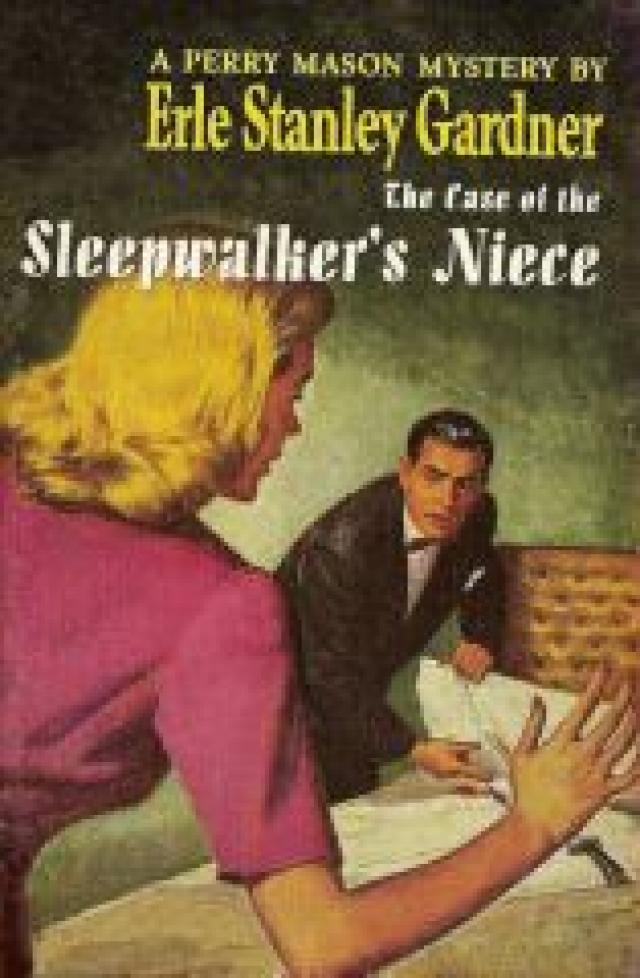


Mason inquired, almost casually, “By the way, you’re secretly married to Edna Hammer, the witness who was just on the stand, aren’t you?”
The courtroom, which had been tensely silent for some minutes, rustled with motion as the spectators leaned forward to catch Harris’s answer.
Harris hesitated a moments, then said, “Yes, I am.”
“When were you married to her?”
“On the tenth of last month.”
“Where?”
“In Yuma, Arizona.”
“That marriage was kept a secret?”
“Yes, sir.”
“Following that marriage Edna Hammer placed a spring lock on her bedroom door, did she not?”
“Yes, sir.”
“You,” Mason asked, “had a key to that door?”
Harris showed his embarrassment. Burger jumped to his feet and said, “That, Your Honor, is objected to. It’s improper cross-examination.
“I’ll withdraw the question,” Mason said, “subject right to ask it later, after I have laid a proper foundation.”
Burger once more slowly sat down, his manner being ready to leap instantly to his feet. Mason, sprawled out in his chair with his long legs crossed in front of him, seemed to be enjoying himself immensely.
“So you went to-Santa Barbara on the night of the murder?” asked.
“Yes, sir.”
“And that was at my suggestion?”
“It was.”
“Who went with you?”
“Miss Warrington, Mr. Kent’s secretary.”
“Anyone else?”
“No, sir.”
“You’re positive of that?”
“Yes, sir.
“You went, I believe, to the residence of Mrs. Doris Sully Kent?”
Burger said, “Just a moment, Your Honor, I think that question is plainly incompetent, irrelevant and immaterial and not proper cross-examination. It makes no difference where he went or what he did while he was in Santa Barbara.”
Mason smiled and said, “Counsel, himself, has opened the door, Your Honor. In endeavoring to show the jury that I was in charge of things at the house and had sent this witness to Santa Barbara, he asked him where he was at the time of the murder. I, therefore, have the right to inquire most painstakingly and in the greatest detail in order to explore this phase of his testimony.”
Judge Markham started to say something, then checked himself and said, “Objection overruled.”
“Answer the question, Mr. Harris. Did you go to Mrs. Doris Sully Kent’s residence?”
“I did.”
“What did you do on arriving in Santa Barbara?”
“I went to Mrs. Kent’s house. A Mr. Jackson from Mr. Mason’s office was watching the house. He offered to stay on duty until two o‘clock, but I knew he had work to do in court in the morning so I told him to take Miss Warrington to a hotel and I’d stay there to watch the house. He and Miss Warrington drove away in Mr. Jackson’s car and I parked my car where I could see the house, and waited until I was relieved by a private detective some time around eight or nine o’clock in the morning.”
“Were you there in front of Mrs. Kent’s residence at three o’clock in the morning?”
“Yes, sir.”
“What happened?”
“Mrs. Kent received a telephone call.”
“Could you hear what she said over the telephone?”
“Yes.”
“What was it?”
“Your Honor,” Hamilton Burger protested, “the vice of this entire line of questioning now becomes apparent. This witness is hostile to me, friendly to the Defense, as was plainly evidenced by his manner in answering the one important question for which I called him. Now, under the guise of cross-examination, and by the use of leading questions, the defendant is seeking to establish something which could not be established on direct examination.”
“But, Your Honor,” Mason pointed out, “Counselor himself asked this witness where he was at the time of the murder, and...”
“And you desire to test his recollection by cross-examination upon this particular point?”
“Yes, Your Honor.”
“I think,” Judge Markham said, “that the ruling of the Court will be that you may examine him as to where he went, what he did and what he saw, and generally what he heard, but not specifically as to what other persons may have said in his presence; I think that’s going too far afield, particularly if it covers matters which may either be inadmissible, or may only be admissible as a part of the defendant’s case.”
“Very well, Your Honor.”
There was a moment’s silence.
“Proceed, Counselor,” Judge Markham said to Perry Mason.
“At the time that telephone conversation took place, where were you?” Mason asked.
“Across the street from Mrs. Doris Sully Kent’s residence.”
“Do you know her personally?”
“Yes.”
“Did she answer the phone in person?”
“Objected to,” Hamilton Burger snapped, “on the same grounds. Counselor Mason can’t prove his case by cross-examining my witness.”
“I can if he opens the door on his direct examination,” Mason insisted.
“I think I’ll overrule that objection,” Judge Markham said. “It might test the recollection and credibility of the witness. However, I’ll not permit his recollection to be tested by a showing of what that conversation consisted of. I think that’s a part of the defendant’s case.”
“Did she answer the telephone?” Mason asked.
“Yes.”
“Did you see her clearly?”
“Yes.”
Mason said, “By the way, did you know... Mason stopped abruptly in midsentence, as, swinging about in his swivel chair, his eyes rested on the crowded courtroom. Suddenly he was on his feet. “Your Honor,” he said, “I happen to notice that Mrs. Doris Sully Kent is in the courtroom. I understand that Mrs. Kent was originally subpoenaed by the Prosecution but, in view of the fact that certain legal proceedings had been instituted by her seeking to set aside a divorce decree, there is some question as to whether she is competent to testify as a witness against the defendant in this action. A short time ago a complete settlement of the various claims under dispute was negotiated, so that the final decree of divorce in the case of Doris Sully Kent versus Peter B. Kent has now dissolved the marriage between them. Inasmuch as Mrs. Kent is now in the courtroom, I wish to use her as a witness for the Defense. May I ask the Court to instruct Mrs. Kent not to leave the courtroom until I can have a subpoena served upon her’?”
Judge Markham frowned, said, “Mrs. Doris Sully Kent, will you please stand up?”
The blonde young woman arose while necks craned toward her.
“You will not leave the courtroom,” Judge Markham ordered, “until Counsel has an opportunity to serve a subpoena upon you, and in order to facilitate the immediate service of such a subpoena, the Court will take a recess of ten minutes, during which Mrs. Kent will be instructed not to leave the courtroom. During the recess the jury will remember the usual admonition of the Court not to discuss the case with anyone nor permit it to be discussed in your presence, and not to form or express any opinion as to the guilt or innocence of the accused until the case is finally submitted to you. Court will take a ten-minute recess.”
Judge Markham started for his chambers.
The courtroom became a babble of noise. Mason, stepping to the Clerk’s desk, had the subpoena issued, handed it to the bailiff with instructions to serve it upon Mrs. Kent.
Casually, Perry Mason strolled toward the door which led to the judge’s chambers. He was joined by Hamilton Burger, who said, with frigid formality, “I think it would be well for us to visit Judge Markham together, Mr. Mason.
“Oh, very well,” Mason assented.
Together, the pair entered the judge’s chambers. Judge Markham, seated behind a desk which was piled high with law books, looked up from the index of the Penal Code which he was reading. His manner was that of one who has been interrupted in a hasty search for something important.
“I didn’t want to make the suggestion in front of the jury, Judge Markham,” Burger said, with cold formality, “but I feel that Mr. Mason’s conduct amounts to a contempt of Court.”
“My conduct?” Mason asked.
“Yes.”
“In doing what?”
“In deliberately planting that duplicate knife in board drawer in order to confuse the authorities in the case.”
“But I didn’t plant any knife with any such purpose,” Mason said.
Judge Markham frowned, his face was grave with concern.
“I am afraid, Counselor, he began.
At something he saw in Mason’s face he paused abruptly.
Burger said vehemently, “You can’t get away with that, Mason. Edna Hammer has sworn absolutely, on her oath, that such were your intention.”
“But she doesn’t know anything about my intentions,” Mason pointed out. “She isn’t a mind reader. She didn’t qualify as a telepathic expert.”
“But she testified that you told her what your intentions were.”
“Oh, yes,” Mason admitted, “I told her that.”
“Am I to understand,” Judge Markham asked, “that you now claim you made a false statement to her?”
“Why, certainly,” Mason said, lighting a cigarette.
“What the devil are you getting at?” Burger inquired.
Mason said, “Oh, I knew she must have been walking in her sleep. You see, Burger, she had the only key to the sideboard drawer, and yet the knife had disappeared. Of course, there was some chance that Kent might have picked the lock or had a duplicate key, so while Kent was in jail, I thought I’d make another test.
“My theory was that Edna Hammer was herself a sleepwalker; that she was worried about her uncle, and went to bed with the thought of that carving knife preying on her mind. My experience with her, when she hid a cup in the receptacle under the coffee table, convinced me she had used that place to conceal things in before. So what more natural than that she should worry about the knife in her sleep, decide the sideboard drawer was not a safe hiding place, arise and, clad only in a nightgown, unlock the sideboard drawer, take out the knife, lock the drawer again and hide the knife in the receptacle under the table?”
“I felt that the only way I could find out about this duplicating the circumstances, so I gave her another carving knife and impressed upon her how important it was that it should be locked in the drawer. It was a moonlight night and she went to sleep with the knife on her mind. Habit reasserted itself. When I start introducing my case, Mr. Burger, I shall show that this knife marked Defendant’s Exhibit A was the same knife which I gave her to place in the sideboard drawer, and that it was subsequently discovered by one of Paul Drake’s detectives in the oblong receptacle under the top of the coffee table.”
“Do you mean you’re going to claim she killed Rease?” Burger shouted. “Why, that’s preposterous! It’s absurd!”
Mason inspected the end of his cigarette. “No,” he said, “I don’t think I’ll make any such claim. My case will doubtless be developed as we go along, Mr. Burger, but this discussion was confined to a suggestion on your part that I be considered in contempt of Court and also, I presume, held for disciplinary action on the part of the Bar Association. I merely mentioned this in order to explain that I had simply been conducting a test.”
Mason turned and strolled from the chambers.
Slowly Judge Markham closed the Penal Code, put it back into place in the row of books along one side of his desk. He looked at Burger’s face and tried to keep from smiling.
“I,” the district attorney said, “will be damned.”
Turning, he stamped from the chambers.
Judge Markham, looking over the courtroom, said, “You have now served your subpoena, Mr. Mason?”
“I have.”
“I believe Mr. Harris was being cross-examined?”
“Yes.”
“Come forward, Mr. Harris.”
There was no response.
Burger, craning his neck, said, “Perhaps he has stepped out for a moment.”
“I had one more question I wanted to ask on cross-examination of Mr. Maddox,” Mason said, “we might fill in time by having Mr. Maddox come forward, if the Court would permit me to reopen the cross-examination for the purpose of asking that one question.”
“Any objection?” Judge Markham asked of Hamilton Burger.
“I may say for the benefit of Counsel,” Mason said, “that the question has become necessary because of unforeseen developments, to wit, the fact that Mrs. Doris Sully Kent is going to be a witness.”
“No,” the District attorney said, “I’ll make no objection to having the witness recalled. I think I have a question that I would like to ask him on redirect examination.”
“Mr. Maddox will please come forward,” the bailiff said.
Once more there was no answering stir from the witnesses in the courtroom.
“Have you some other witness you can call?” Judge Markham inquired.
“Begging the Court’s pardon,” Mason said, “I would like to finish with the cross-examination of Mr. Harris before the case goes any further. The only exception I think I would care to make would be to ask a single question of Mr. Maddox.”
“Very well,” Judge Markham said.
There were several seconds of uncomfortable silence, then Judge Markham whirled around in his chair. “The Court will take a brief recess, during which the bailiff will find the missing witnesses,” he said.
Mason turned around to Peter Kent, slapped his hand down on Kent’s knee, whispered, “All right, Peter. Within thirty minutes you’ll walk out of this courtroom a free man.
Chapter 22
Mason, entering his office, scaled his hat at a marble bust of Blackstone. The hat struck squarely, spun half around, and slid over on the statue’s head at a rakish angle.
Della Street tried to be casual, but her eyes were starry.
“Over the goal line, eh, Chief?”
“Right between the goal posts.”
“When did you get wise?” she asked.
“Darned if I know,” he told her, sitting on the edge of the desk and grinning boyishly. “Little facts kept pricking away at my consciousness. Why the devil should Edna Hammer have been reading up on sleepwalking? Why should she have put a lock on her door? Why did the figure that Duncan saw walk across the patio stop at the little coffee table; and why did the knife that was locked in the sideboard drawer disappear? Why did Maddox call Mrs. Kent at three o’clock in the morning, when he knew that a conference had already been arranged?”
“I discounted most of Duncan’s testimony because I figured he was just one of those egotistical ducks who would commit unconscious perjury. Give him a button and he’d sew a vest on it. But he’d undoubtedly seen someone walking around in a nightgown. When he said he put on his glasses he was a damn liar. He hadn’t. All he’d seen was a whiterobed figure walking around in the moonlight. When he surmised, from subsequent events, that this figure must have been Kent, he hypnotized himself into believing he’d recognized Kent. He was sufficiently partisan to make himself more and more positive. But that didn’t clear up the mysterious telephone conversation.
“Maddox was shrewd enough to avoid committing himself on the telephone call which Duncan put in around eleven o‘clock in the evening to Mrs. Kent. His answers on direct examination didn’t give me any inkling that he’d been present. I intended, of course, to cross-examine Duncan about any prior telephone calls, because Mrs. Kent’s statement over the telephone that a conference had already been arranged through Maddox’s lawyer indicated Duncan had been in touch with her. But Maddox did definitely state he hadn’t telephoned Mrs. Kent at three o’clock in the morning. I didn’t figure he’d perjure himself about something which could be checked up on.
“That made me start concentrating on Harris, and the minute I did that, I realized I was on the right trail. Harris was the one who had upset the apple cart all the way along the line. He’d been trying to get Kent convicted. When he realized Kent might have a good sleepwalking defense, he tried to blow it up by stating that the knife wasn’t in the drawer when Edna locked it. He allowed himself to be subpoenaed as a witness. He’d evidently telephoned in an anonymous tip or two to the district attorney’s office. Someone tipped Holcomb off that I’d been getting a duplicate knife to introduce to the case. When I asked Edna, she said she hadn’t told anyone; but later on she must have told Harris.”
“You weren’t really trying to mix the knives up, were you, Chief?”
“Of course not. All I was trying to do was to impress on Edna’s mind the importance of that knife in the sideboard drawer, so that she’d go to sleep with that thought uppermost in her mind.”
“And then you figured she’d walk in her sleep again?”
“Yes.”
“And take the knife?”
“Yes.”
“And what did you think she’d do with it?”
“If my reasoning was right, she’d do the same thing she did before, of course–put it under the top of the coffee table. It was her little private hiding place for things she didn’t want discovered.”
“And Harris knew that?”
“Of course he knew it. He’d been surreptitiously living with her as her husband for over a month. He had a key to the house and a key to the new lock Edna had installed on her bedroom door.
“Moreover, the clues which pointed to him fairly screamed for attention. He’d been watching the house in Santa Barbara. If he’d been where he said he was, he’d have seen Mrs. Kent leave the house, get out her car and start for Los Angeles. He didn’t see it. Therefore, he wasn’t there. But, if he wasn’t there, where was he? He could give the exact time of the telephone call which Mrs. Kent received at three o’clock in the morning. He could tell what she said over the wire. How could he have done that if he hadn’t been there? There was only one other explanation: He’d been the one who had put in the telephone call.