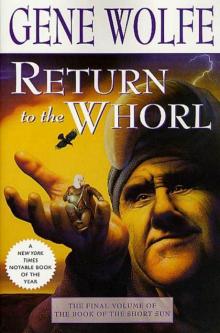
The giant, p.158
The Giant,
p.158



“Westing,” I said. “It’s a silly name, really—like naming a human Tommy or Jimmy. But the old ‘Westinghouse’ was out of style when I was assembled.”
“Which makes you about fifty-six, confirmed by the degree of wear I see at your knee seals, which are originals. You’re a bio-mechanic, by your bag—which should be handy. You haven’t much money; you’re honest—and obviously not much of a talker. You came here by mono, and I’d almost be willing to swear you presently live high up in a fairly new building.”
“How in the world—”
“Quite simple, really, Westing. You haven’t money or you wouldn’t be interested in an apartment. You’re honest or you’d have money—no one has more and better chances to steal than a bio-mechanic. When a passenger with a transfer boards the mono the conductor rips up the ticket and, half the time, drops it on the floor—and one is stuck to your foot with gum. And lightened concrete and plastic facades have given us buildings so tall and spindly-framed that the upper floors sway under the wind load like ships. People who live or work in them take to bracing themselves the way sailors used to—as I notice you’re doing on that settee.”
“You are an extraordinary person,” I managed to say, “and it makes me all the more surprised—” And there I am afraid I stopped speaking and leaned forward to stare at him.
“Extraordinary in more ways than one, I’m afraid,” Street said. “But although I assure you I will engage you as my physician if I am ever ill, I haven’t done so yet.”
“Quite so,” I admitted. I relaxed, but I was still puzzled.
“Are you still interested in sharing my little apartment, then? Shall I show you about?”
“No,” I said.
“I understand,” Street said, “and I apologize for having wasted your time, Doctor.”
“I don’t want to be shown the door, either.” Though I was upset, I must admit I felt a thrill of somewhat guilty pleasure at being able to contradict my host. “I want to sit here and think for a minute.”
“Of course,” Street said, and was silent.
Living with a declassed human (and there was no use in my deceiving myself—that was what was being proposed) was a raffish sort of thing. It was bound to hurt my practice, but then my practice was largely among declassed humans already and could not get much worse. The vast spaces of the apartment, even littered as they were, were attractive after years in a single cramped room.
But most of all, or so I like to think, it was the personality of Street himself which decided me—and the fact that I detected in him, perhaps only by some professional instinct not wholly rational, a physical abnormality I could not quite classify. And there was, in addition, the pleasing thought of surprising my few friends, all of whom, I knew, thought me much too stuffy to do any such outlandish thing. I was giving Street my money—half a month’s rent on the apartment—when he froze, head cocked, to listen to some sound from the foyer.
After a moment he said, “We have a visitor, Westing. Hear him?”
“I heard someone out there.”
“The light and tottering step is that of our good landlady, Mrs. Nash. But there is another tread—dignified, yet nervous. Almost certainly a client.”
“Or someone else to ask about the apartment,” I suggested.
“No.”
Before I could object to this flat contradiction the door opened to show the birdlike woman who had admitted us. She ushered in a distinguished-looking person well over two meters tall, whose polished and lavish solid chrome trim gave unmistakable evidence, if not of wealth, then at least of a sufficiency I—and millions of others—would only envy all our lives.
“You are Street?” he asked, looking at me with a somewhat puzzled expression.
“This is my associate, Dr. Westing,” Street said. “I am the man you came to see, Commissioner Electric. Won’t you sit down?”
“I’m flattered that you know my name,” Electric said.
“Over there past the nickelodeon,” Street told him, “you’ll see a cleared spot for tri-D displays. There are several cameras around it. Whenever a man I don’t know appears I photograph the image for later reference. You were interviewed three months ago in connection with your request for expanders for the hiring hall, made necessary by the depressed state of the economy.”
“Yes.” Electric nodded and it was plain that Street’s recital of these simple facts, accurate as it was, had depressed still further spirits already hovering at the brink of despair. “You have no conception, Mr. Street, of how ironic it seems that I should hear now—here—of that routine request for funds, and so be reminded of those days when our hall was filled to bursting with the deactivated.”
“From which,” Street said slowly, “I take it that the place is empty—or nearly so. I must say I am surprised; I had believed the economy to be in worse condition—if that is possible—than it was three months past.”
“It is,” Electric admitted. “And your first supposition is also correct—the hall, though not empty, is far from crowded.”
“Ah,” said Street.
“This thing has been driving me to the brink of reprogramming for six weeks now. The deactivated are being stolen. The police pretend to be accomplishing something; but it’s obvious they are helpless—they’re only going through the motions now. Last night a relative of mine—I won’t name him, but he is a highly placed military officer—suggested that I come to you. He didn’t mention you were a declassed human, and I suppose he knew that if he had I wouldn’t have come, but now that I’ve seen you I’m willing to take a chance.”
“That’s kind of you,” Street said dryly. “In the event I succeed in preventing further thefts by bringing the criminals to justice my fee will be—” He named an astronomical sum.
“And in the event further thefts are not prevented?”
“My expenses only.”
“Done. You realize that these thefts strike at the very fabric of our society, Mr. Street. The old rallying cry, Free markets and free robots, may be a joke now to some, but it has built our civilization. Robots are assembled when the demand for labor exceeds the supply. When supply exceeds demand—that is, in practical terms, when the excess cybercitizens can’t make a living—they turn themselves in at the hiring hall, where they’re deactivated until they’re needed again. If news of these shortages should leak out—”
“Who would turn himself in to be stolen?” said Street. “I see what you mean.”
“Precisely. The unemployed would resort to begging and theft, just as in the old days. We already have—I hope you’ll excuse me—enough of a problem with declassed humans. You yourself are obviously an exception, but you must know what most of them are like.”
“Most of us,” Street replied mildly, “are like my landlady: people who lost class because they refused death at the end of their natural lifespans. It’s not very easy to learn to earn your living when for a hundred years of life society has handed you an income big enough to make you rich.”
It wasn’t really my affair, but I couldn’t help saying, “But if you can help Commissioner Electric, Street, you’ll be helping your own people in exactly this area.”
Street turned his eyes—which were of an intense blue, as though his photosensors were arcing—to me. “Is that so, Doctor? I’m afraid I don’t quite follow you.”
Electric said, “I should think it’s obvious. Surely the motive for stealing our deactivated workers must be the desire to use them as forced labor, presumably in a secret factory of some sort. If this is being done, the criminals are competing illegally with everyone trying to earn an honest living—including the declassed.”
I nodded my emphatic agreement. The thought of an illicit factory, perhaps in a cavern or abandoned mine, filled with dim figures laboring without cease under the threat of destruction, had already come to haunt my imagination.
“Slaves of silver,” I muttered half aloud, “toiling in the dark.”
“Possibly,” Street said. “But I can think of other possibilities—possibilities you might find more shocking still.”
“In any event,” Commissioner Electric put in, “you will want to visit the hiring hall.”
“Yes, but not in company with you. I consider it possible that the entrance may be watched. Human beings do visit the hall from time to time, I assume?”
“Yes, usually to engage domestics.”
“Excellent. Under what circumstances would you deal with such visitors personally?”
“I would not ordinarily do so at all, unless all my subordinates were engaged.”
Street looked at me. “You seem to want to be a party to this, Westing. Are you game to visit the hiring hall with me? You must consider that you may disappear—for that matter we both may.”
“Oh, no,” Electric protested, “the disappearances occur only after dark, when the hall is closed.”
“Certainly I’ll come.”
Street smiled. “I thought you would. Commissioner, we will follow you in one half hour. See to it that when we arrive your subordinates are engaged.”
When the commissioner had gone I was able to ask Street the question that had been nagging at my mind during the entire interview.
“Street, for God’s own sake, how was it you knew Commissioner Electric hadn’t come about the apartment before Mrs. Nash had opened the door?”
“Be a good fellow and look in the drawer of the inlaid rosewood table you’ll find on the other side of that camera obscura to the left of the tri-D stage, and I’ll tell you. You ought to find a recording ammeter in there. We’ll need it.”
I didn’t know what a camera obscura was, but fortunately the rosewood table was a rather striking piece and only one instrument was in its drawer, lying amid a litter of tarot cards and bridge score pads. I held it up for Street to see and he nodded. “That’s it. You see, Westing, when someone arrives in answer to a newspaper ad he almost invariably—ninety-two point-six percent of the time, according to my calculation—carries the paper with him and shows it to the person who answers the door. When I failed to hear the telltale rattle of the popular press as our visitor addressed Mrs. Nash I knew there was little chance that he had come about the apartment.”
“Astounding!”
“Oh, it’s not so much,” Street said modestly. “But get a move on, won’t you? It wouldn’t do to ride down in the same elevator with Electric—but on the other hand it’s seldom a waste of askance to view a public official with it. We’re going to shadow him.”
Despite Street’s suspicions, Commissioner Electric did nothing untoward that I could see while we followed him. To give him time to prepare for us, as Street said, we idled for a quarter of an hour or more at the window of a tri-D store near the hall. The show being carried on the display set inside was utterly banal and I could swear that Street did not give it even a fraction of his attention. He stood, absorbed in his own thoughts, while I fidgeted.
The hiring hall, when Electric guided us around it, we found to be a huge place; impressive from outside but immensely larger within and filled with the hum of expanders. The corridors were lined with persons of every age and state of repair—they stretched for slightly curved miles like the vistas seen in opposed mirrors. Gaping spaces showed where the disappearances had taken place, but, sinister as they were, in time they seemed a relief from the staring regard of those thousands of unseeing eyes. Street asked for data on each theft and recorded the date and the number of persons missing in a notebook; but there seemed to be no pattern to the crimes, save that all the disappearances took place at night.
At last we came to the end of that vast building. Commissioner Electric did not ask Street for his opinion of the case (though I could see he wanted to), nor did Street give it. But once we were fairly away from him, Street pacing impatiently alongside the sidewalk while I trotted to keep up, he broke forth in an irascible tirade of self-abuse: “Westing, this thing is as simple as a two-foot piece of aluminum conduit and I’m confident I know everything about it—except what I need to know. And I have no idea of how I’m going to find the answer. I know how the robots are taken—I think. And I believe I know why. The question is: Who is responsible? If I could get the patrol to cooperate—”
He lapsed into a sour silence, unbroken until we were once more back in the huge, littered apartment I had not yet learned to call “ours.” Indeed, my arrangement with Street was so recent that I had not yet had an opportunity to shift my possessions from my old room or to terminate my tenancy there. I excused myself—though Street seemed hardly to notice—and attended to these things.
When I returned nothing had changed. Street sat, as before, wrapped in gloom. And I, reduced to despondency by his example and with nothing better to do in any case, sat watching him. After an hour had passed he rose from his chair and for a few moments wandered disconsolately about the apartment, only to return to the same seat and throw himself down, his face blacker—if that were possible—than before.
“Street—” I ventured.
“Eh?” He looked up. “Westing? That’s your name, isn’t it? You still here?”
“Yes. I’ve been watching you for some time. While I realize you have, no doubt, a regular medical advisor, you were once kind enough to say that you might call me. On the strength of that—”
“Well, out with it, man. What is it?”
“There will be no fee, of course. I was going to say that though I don’t know what means of chemical reality enhancement you employ, it would appear to me that it has been a considerable time—”
“Since my last fix? Believe me, it has.” He laughed, a reaction I thought encouraging.
“Then I would suggest—”
“I don’t use drugs, Westing. None at all.”
“I didn’t mean to suggest anything strong—just a few pinks, say, or—”
“I mean it, Westing. I don’t use pinks. Or blues. Or even whites. I don’t use anything except food, and little enough of that, water and air.”
“You’re serious?”
“Absolutely.”
“Street, I find this incredible. We were taught at medical school that human beings—being, after all, a species evolved for a savanna landscape rather than our climax civilization—were unable to maintain their sanity without pharmaceutical relief.”
“That may well be true, Westing. Nevertheless, I do not use any.”
This was too much for me to absorb at once and while I tried to encode it Street fell back into his former gloom.
“Street,” I said again.
“What is it this time?”
“Do you remember? When we first met I said that I detected in you, perhaps only by some professional instinct not wholly rational, a physical abnormality I could not quite classify?”
“You didn’t say anything of the sort. You may have thought it.”
“I did. And I was right. Man, you don’t know how good this makes me feel.”
“I have some comprehension of the intellectual rewards attendant on successful deduction.”
“I’m sure you do. But now, if I may say so, a too-avid pursuit of those rewards has led you to a severe state of depression. A stimulant of some sort—”
“Not at all, Westing. Thought is my drug—and believe me it is both stimulating and frustrating. My need is for a soporific, and your conversation fills the bill better than anything you could prescribe.”
This was said in so cheerful and bantering a way, albeit with a barely perceptible touch of bitterness, that I could not resent it—and, indeed, the marked improvement this little spate of talk had brought to Street’s mien emboldened me to continue at whatever risk to my vanity.
So I answered, “Your powers of concentration, admirable as they are, may yet be your undoing. Do you remember the quarter-hour we spent in front of a store window? Where the tri-D had such poor reception? I addressed you several times, but I would swear you heard none of my questions.”
“I heard every one of your questions,” Street said, “and since none admitted to intelligent responses I ignored them all. And that tri-D, if not of the most exquisite quality, was at least better than passable. I apologize if I sound peevish, but really, Westing, you must learn to observe.”
“I am not an engineer,” I replied, perhaps rather too stiffly, “and so I cannot say if the reception in fact was at fault—but acute observation is a necessity in my profession and I can assure you that the color stability of the set on display was abominable.”
“Nonsense. I was looking directly at it for the entire time and I could, if necessary, describe each stupidity of programming in sequence.”
“Maybe you could,” I said. “And I don’t doubt your assertion that you were watching with commendable attention while we waited outside the hiring hall. But you quite obviously failed to observe it when we left. You were talking excitedly, as I recall—and as you spoke we passed the window again. The actors were blushing—if I may use that expression here—a sort of reddish-orange. Then they turned greenish blue, then really blue, and finally a shade of bright, cool green. In fact, they went through that whole cycle several times just during the time it took us to walk past the window.”
The effect of this perhaps overly detailed and argumentative statement on Street was extraordinary. Instead of countering with argument or denial, as I confess I expected, for a few moments he simply stared silently at me. Then he jumped to his feet and for half a minute or more paced the room in silent agitation, twice tripping over the same ball-clawed foot of the same late Victorian commode.
At last he turned almost fiercely back to me and announced: “Westing, I believe I can recall the precise words I addressed to you as we passed that display. I will repeat them to you now and I want you to tell me the exact point at which you noticed the color instability you mentioned. I said: ‘Westing, this thing is as simple as a two-foot piece of aluminium conduit and I’m confident I know everything about it—except what I need to know. And I have no idea of how I’m going to find the answer. I know how the robots are taken—I think. And I believe I know why. The question is: Who is responsible? If I could get the patrol to cooperate—’ at which point I broke off, I believe. Now, precisely where did you notice the reddish orange color you mentioned—I believe that was the hue you noticed originally?”