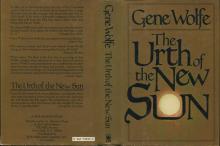
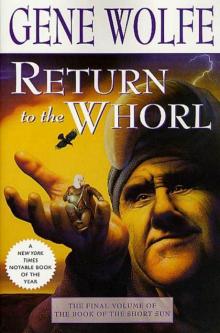
The giant, p.17
The Giant,
p.17



“Go ahead,” he called. “What are you going to do—jump?”
The figure silhouetted against the sky only stared at him dumbly.
Upright Joe walked forward, down the curving inside of the sphere that led to the level bottom, then slowly up until the man he had followed all these thousands of feet into the air and he were no more than a few yards apart. The spearlike fragment of metal rod remained poised; but the corners of the man’s mouth drew down and down with each step he took until the yellowish skin must have been ready to tear under the strain and the mouth was drawn open to show the square white teeth.
Then, with a gesture that was almost casual, the metal sliver was flipped into the void. With his shoulder down Joe rushed forward, struck the man, and drew him away from the edge.
The man’s resistance revived at the moment of contact, and for a few seconds he struggled desperately. He still held four or five pieces of metal similar to the one he had thrown away in his left hand; but Joe pinned it, then jerked one from him to drive against his throat. The struggling stopped.
“What’s happening,” someone behind him asked. “What are those things?”
VI
From the corner of an eye he saw the girl who had called herself Mary Hogan. Behind her came the girl with the beaded bag; then, as he watched, a third girl who wore a skirt that reached her ankles. And behind her, some stepping agilely from the belt, some staggering clumsily, came woman after woman.
Many were young, and some were pretty and even beautiful, but others were neither and a few were monstrously fat. Several wore silks, but most were in plain dresses not much better than rags.
“What are those things?” Mary Hogan asked again. She was standing close to his shoulder now. “What are you going to do?”
“Steel construction strips he’s ripped out of something,” Joe told her. “And I’m going to kill him with this one—rip him wide open. Want to watch?” He pushed one jagged end of the piece he held against the other’s body.
“Don’t!”
Joe stared down at the impassive face of the man under him and drove the splinter tighter still; the face contorted under the pressure until malice blasted from it like heat from the top of an open crucible.
The girl in the long skirt dropped to her knees beside him. “Don’t you know who that is?” she asked. She was not pretty, but somehow clean looking and attractive.
“It’s a robot.” Joe’s voice was stubborn, although he found himself gasping for breath in the thin air. “Another crummy, clanking robot; a robot with my face. I’m going to wreck him.”
“I wasn’t sure you knew who it was,” the girl murmured.
“You think I don’t know my own face? What I’d like to know is what sort of dirty joke is being played here.”
“I think I can tell you,” Mary Hogan said; she stooped beside the kneeling girl, pushing her long hair away from her face. “It involves who all of us are too. Have you guessed yet?”
“You’re robots too,” Joe said bitterly. “That’s why the robot pretending to be a priest would bless you and not me. You aren’t a real person any more than this thing is.”
“We’re more—I’m more than that. Don’t you know who I am yet?”
He said something inaudible.
“I couldn’t hear you.” She bent closer, the other women crowding around her.
“You’re supposed to be my mother; my mother the way she looked when I was born. My real mother is still alive in Brooklyn.”
· · · ·
“This is the way I was when you were conceived,” the girl said. “It’s at conception that the heritage is passed.”
Joe nodded. “I knew it once I’d thought of it. That skirt-and-blouse outfit of yours: miniskirts and op-art prints mean ’67 or ’68. I’m twenty-four, so that puts you just about right, and I guess the girl with the bag back there is your mother, and this one,”—he looked at the kneeling woman in the long skirt—“is her mother.”
Mary Hogan nodded. “Your grandmother and great-grandmother, really; it was from your cells that the transducers took the patterns. It used to be believed that only the parents’ own heredity could be transmitted, but recently we’ve discovered that Lamarck was correct in certain respects—every characteristic, as it exists at conception, is to some extent transmitted to the new generation. That’s what he was supposed to explain to you in his atom.”
Joe said stubbornly, “But you’re really a robot.” “Physically, yes. But mentally—spiritually if you will—I am a replica of the young woman who became your mother. Tomorrow I will be someone else.” There was sadness in her voice.
“You change?”
“Yes; that’s the point of this entire complex. There are a hundred of us here who constitute what might be called a repertory company. As visitors enter the master computer reads a component of some randomly selected individual’s genetic heritage, then programs one of us as that person’s forebear.”
“But over and over?” Joe looked at the crowd of women. “Generation after generation? From the same person?”
The girl in the long skirt said, “It wasn’t supposed to work this way. But an automatic program sequence was installed that demands maximum utilization of us. With a whole crowd of visitors coming in each of us would have been assigned to a different one, but with only you in the complex…”
“I got read every time I went past a thingamajig, and they’re in all the tubes. I see. But what about him?”
“He was the first one, really,” the girl with the beaded bag said unhappily. “Only something went haywire.”
“Well, what went haywire? How does he fit into this?” The other girls looked at Mary Hogan.
“You have a death wish. Do you realize that, Joe?”
He shook his head. “I want to live as much as anyone else.”
“Consciously, yes. But not subconsciously. No one who didn’t want to die would make up that story of refusing surgery for his wife’s sake.”
“How did you know…?”
“I’ve been contained in your body all your life; there’s a carryover of information—don’t you remember that I knew your name when we first met? In so far as I am your mother—and till my program is changed that’s very far—that carryover is all that holds me sane. Without it I would be finding myself suddenly here without an explanation at all.”
Joe looked down at the man he held pinned. “And that’s the way you know about him too?”
“Partly, and I can guess the rest. For a long time it’s been known that a person’s will to die could actually produce the death, and to do that it must effect a change in certain cell structures. Somehow the first time the transducers tried to read your DNA they produced this. The master computer corrected for the error on subsequent readings by automatically rejecting all male data matrices, but it could do nothing about this one which was already programmed. He is your own personal hope for death personified.”
Joe clenched his teeth. “He’ll get what he wants; because I’m going to kill him.”
“I wouldn’t do that, if I were you.”
“Why not?”
“Your death wish is strong now. I can only guess what destroying an image of yourself will do to it. You’ve been using that metal thing to hold him down—look at your own chest.”
He looked. The opposite end of the steel sliver was as sharp as the one with which he was threatening his double. It had torn his shirt and scratched his chest until it was covered with his own blood. For a long time he stared at it.
VII
They found him sitting outside The Thing, waiting for them. Chuck yelled, “See! I told you he’d be here. He’s just got too much sense to wear himself out walking around the grounds with us.”
In Father Mendel’s room he was able to get Bonnie alone long enough to explain that he had decided to have the spike removed after all and had already telephoned the doctor from Howard Johnson’s while he was waiting. When she asked if he were not afraid he shook his head, remembering suddenly that Bonnie was pregnant.
Our Neighbour by David Copperfield
Some earlier sketches of mine having been received with some slight approbation by the public, my good friend the Editor has asked me, for the benefit of the previously named influential group, to prefix this one with some explanation of the means by which the affecting circumstances here related reached my attention—a thing I would not otherwise undertake to do, the relation being of so commonplace a nature that only my esteemed friend’s request could embolden me to inflict it on my readers.
I am lately married, and dwell with my dear wife Dora and a single servant in a beautiful little house. It fronts upon a beautiful road; and on the other side of the beautiful road stands another beautiful house—not as beautiful as ours, perhaps, but somewhat larger. As certain of my indulgent readers may know, I am engaged in the business of reporting the debates of Parliament for a Morning Newspaper; but when I am not recording predictions that never come to pass, professions that are never fulfilled, and explanations that are only meant to mystify, I busy myself with tales of my own, things no more false, and much more innocent, than those I must often report as fact. My desk is in the parlour, where the light from the mullioned window renders writing easy and pleasant. That same window provides me with an excellent view of our road—when I care to use it—and of all the carriages and wagons, and travellers on foot and horse.
There is danger in such a window, and particularly to one like myself, whose trade it is to scribble down the doings of mankind. One wants a character—very well, a suitable one will soon pass by… Then it is time for tea, which Dora and her dog Jip bring in, together with an hour and a half of conversation. I was sinking into just this ooze of difficulty, chewing on my pen and staring out the window, and wondering—without daring to look at my watch—if it were not time for my two afternoon visitors, when I noticed a lean and shabby young fellow lounging against my gate and staring (as it appeared to me) at the traffic in the street with far more concentration than myself.
Of course, that was the end of passer-by watching for me. From that time forward, for the better part of an hour, I watched him—and those who passed before him only incidentally. By the time my darling Dora had entered with her little blue delft pot in its cozy, and the biscuits, and the bread spread with fish-paste and butter, I was quite certain that the fellow had no interest whatsoever in the carters and peddlers and porters and costermongers passing up and down our street, however fascinating this gentry seemed to me. He was looking instead, I felt certain, at the house opposite; and was only vexed when a wagonload of old furniture or one of those useful but wildly mis-named vehicles called hansoms blocked his view of it.
Now this was a more serious matter. I had not the least idea who our neighbour might be, and no desire to know. But I conceived a responsibility to him based on our recent propinquity. In an excess of intimate spirit, I supposed the watcher might have been dispatched by some sinister enemy to spy on him, or might mean to rob his house. Thus, as soon as my darling Dora was gone, leaving (as her custom is) what remained of the tea things behind her, I went outside, where, laying a firm hand on the fellow’s shoulder, I invited him in.
He came willingly enough, and seemed bemused rather than dismayed. “Sir,” said I, “you must give me your name. There’s nothing else for it.”
“Tom Tipsing,” said he; and he gave me his hand as well. It was a large hand, and rather soft, but it had the small callus upon the index finger that betrays those who wield a pen by night and day. I know that callus well, for I bear it myself. “You are a clerk,” said I.
“Of Lincolns Inn,” said he.
And now, dear reader, it is time, almost, for me to bow out of this story, which I have already encumbered far too long. Suffice it to say that my visitor was tall and thin and not more than three-and-twenty; that he had ink-stains on his waistcoat, and a round, smiling face; and that though I discharged him as innocent when he explained to me the origin of his interest in my neighbour, yet he returned thereafter to share a late tea with Dora and me, and recount his adventures.
I have already alluded to Tom’s employment. He was an articled clerk. I shall not mention it again—or at least, no more than is necessary. Suffice it to say that it required long hours of tedious work, and left him just enough money for the maintenance of what he chose to call a suite of rooms, in a tumble-down building near Oldham Stairs. It was there that he repaired when he left me at last. He found a ragged old woman waiting him, and asked her in.
“This is good of you, Master Thomas,” she said when she had seated herself in Tom’s second-best chair. “For an old body like myself. There’s not many young people that would do it. Do you think I’m mad? I own that suspicion occurs to me sometimes—particular bad, it is, just before I sleeps. For how could a living man contrive such a thing?”
“You’re sound as a nut,” Tom told her stoutly, “and will be until the day you die.”
“Have you learnt ought?”
Tom shook his head.
“Another day wasted then. Had he no one in?”
“Four visitors,” Tom told her. He wore a long, snuff-coloured bodycoat, and was unbuttoning it as he spoke. “A poor woman with a child, a City merchant, and a gentleman of the legal profession—his name is Brass, I know, for he comes to our offices sometimes.”
“Could you ask him what he did there?” the old woman inquired eagerly.
Tom shook his head. “I doubt that he would speak to me on the street.”
“He’s rich?”
“Very rich.” Tom’s round cheeks, red from the chill without, seemed to wax redder still. He seated himself opposite the old woman, and leaned toward her, rubbing his hands. “There’s money in the law, Mrs. Nedels. Heaps of it. Why, some of these cases drag on for fifty years. A hundred years!”
“I know, Master Tom.”
“One or two good ones—that’s all a fellow requires, once he has passed the bar. You may see me riding in my carriage yet.”
“I hope and pray so. Master Thomas, I think we must question some of them.”
“The poor ones, you mean,” said Tom. “It would be a rash action, Mrs. Nedels.”
Outside, the light had nearly faded; but the last of it fell on the old woman’s hands, picking at her skirt. “We can’t ask the rich, Master Thomas—they don’t even tell the truth to each other, for all I hear. And think of all the time you’ve spent, and nothing to show for it.”
“Is Jenny telling us everything that passed while she was there?”
“I do think so,” said the old woman. “She’s not a truthful girl—I know that for all she’s my own daughter. But I believe she’s been truthful about that. And she never touched a drop, I swear, for a fortnight after she left that house. It’s all back again now; but that fortnight was the happiest of my life. Never touched it, and said she didn’t want it, she didn’t know why. And him? The servants won’t even let me talk to him. I took what we had, and bought flowers—oh, I’ve told you all this.” She had begun to rock back and forth in her chair, with an excitement that was strange to see in one so old and sere.
“That’s all right,” Tom told her.
“You don’t know what it is to go looking after a daughter at night—hoping to find her asleep under a bench in some cellar, and nothing worse. You don’t know, Master Thomas. The butler, he wouldn’t even allow me to bring them in—the flowers, I mean. Daisies they were, chiefly; I had them from a friend in Covent Garden Market. He took them from me.” She sighed. “I’ll go now, though, and let you sleep. You must be tired after watching all day. Will you follow one of the poor ones next time, though, and ask questions of her? Promise me?”
“If the chance allows,” Tom said. He got up to open the door for the old woman. When she had gone, he took a rusty match box from his waistcoat pocket and struck a light to kindle the room’s one lamp. An open law-book lay on the table before it; for his supper he applied himself to that and a pipe of tobacco.
· · · ·
For three days, his employment kept Tom’s eye from my neighbour’s door; but on the fourth he was back again, leaning on my gatepost. Winter was setting in, and the weather had turned dark as well as chill. For an hour or more his stoicism went unrewarded—then, like a shower of gold, the rich came. Four equipages, one after another, drew up to the door that had been the object of his faithful scrutiny. Then it began to rain—one of our fine, cold autumn rains. He knocked on my door hoping for shelter (so he told us later) but Dora and I had gone a-visiting, and Mary Anne, our “ordinary,” would not admit him. She reported afterward that he had said something about a poor man coming; she thought that he meant himself, but I by that time knew enough of the mystery that engaged him to understand that he referred to the destitute person whom he expected to see admitted to my neighbour’s house, together with the wealthy callers.
Tom was just leaving my premises, as it would happen, when he was accosted by my neighbour himself. He had never seen the man before, but he knew his name (which was Dr. McApple) from inquiries he had made of the tradesmen; and his appearance from the testimony of Mrs. Nedels’ daughter Jenny—a tall, sharp-faced, hollow-cheeked old man, with snapping black eyes. He wore a fine hat, Tom said, but had a square of oilcloth draped over it to keep off the rain; so that he looked like a Spanish duenna in a play.
“Sir!” this Dr. McApple called out, as if Tom were a furlong off instead of a foot away. “Sir, what do you here?”
“Why,” said Tom, who thought himself discovered, “I came to call on my acquaintance Mr. Copperfield, but I find him not at home.”
“So?” Dr. McApple stepped back and seemed to examine the unfortunate clerk as though he intended to buy him. “May I ask your business, sir, and place of lodging?”