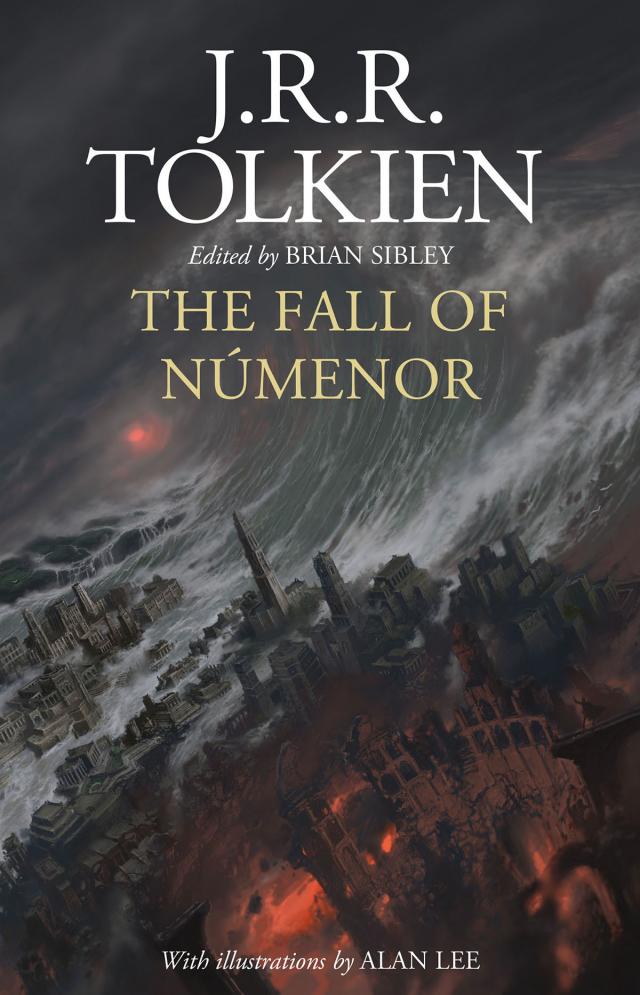
The fall of numenor, p.13
The Fall of Númenor,
p.13


Thus it is, Ancalimë, and we cannot alter it. For men fashioned Númenor: men, those heroes of old that they sing of – of their women we hear less, save that they wept when their men were slain. Númenor was to be a rest after war. But if they weary of rest and the plays of peace, soon they will go back to their great play, manslaying and war. Thus it is; and we are set here among them. But we need not assent. If we love Númenor also, let us enjoy it before they ruin it. We also are daughters of the great, and we have wills and courage of our own. Therefore do not bend, Ancalimë. Once bend a little, and they will bend you further until you are bowed down. Sink your roots into the rock, and face the wind, though it blow away all your leaves.
Moreover, and more potently, Erendis had made Ancalimë accustomed to the society of women: the cool, quiet, gentle life of Emerië without interruptions or alarms. Boys, like Îbal, shouted. Men rode up blowing horns at strange hours, and were fed with great noise. They begot children and left them in the care of women when they were troublesome. And though childbirth had less of ills and peril, Númenor was not an ‘earthly paradise’, and the weariness of labour or of all making was not taken away.
Ancalimë, like her father, was resolute in pursuing her policies; and like him she was obstinate, taking the opposite course to any that was counselled. She had something of her mother’s coldness and sense of personal injury; and deep in her heart, almost but not quite forgotten, was the firmness with which Aldarion had unclasped her hand and set her down when he was in haste to be gone. She loved dearly the downlands of her home, and never (as she said) in her life could she sleep at peace far from the sound of sheep. But she did not refuse the Heirship, and determined that when her day came she would be a powerful Ruling Queen; and when so, to live where and how she pleased.
It seems that for some eighteen years after Aldarion became King he was often gone from Númenor; and during that time Ancalimë passed her days both in Emerië and in Armenelos, for Queen Almarian took a great liking to her, and indulged her as she had indulged Aldarion in his youth. In Armenelos she was treated with deference by all, and not least by Aldarion; and though at first she was ill at ease, missing the wide airs of her home, in time she ceased to be abashed, and became aware that men looked with wonder upon her beauty, now come to its full. As she grew older she became ever more wilful, and she found irksome the company of Erendis, who behaved like a widow and would not be Queen; but she continued to return to Emerië, both as a retreat from Armenelos and because she desired thus to vex Aldarion. She was clever, and malicious, and saw promise of sport as the prize for which her mother and her father did battle.
Now in the year 892, when Ancalimë was nineteen years old, she was proclaimed the King’s Heir (at a far earlier age than had previously been the case); and at that time Tar-Aldarion caused the law of succession in Númenor to be changed. It is said specifically that Tar-Aldarion did this ‘for reasons of private concern, rather than policy’, and out of ‘his long resolve to defeat Erendis’. The change of the law is referred to in The Lord of the Rings, Appendix A (I, i):
The sixth King [Tar-Aldarion] left only one child, a daughter. She became the first Queen [i.e. Ruling Queen]; for it was then made a law of the royal house that the eldest child of the King, whether man or woman, should receive the sceptre.
But elsewhere the new law is formulated differently from this. The fullest and clearest account states in the first place that the ‘old law’, as it was afterwards called, was not in fact a Númenórean ‘law’, but an inherited custom which circumstances had not yet called in question; and according to that custom the Ruler’s eldest son inherited the Sceptre. It was understood that if there were no son the nearest male kinsman of male descent from Elros Tar-Minyatur would be the Heir.1 But by the ‘new law’ the (eldest) daughter of the Ruler inherited the Sceptre, if he had no son (this being, of course, in contradiction to what is said in The Lord of Rings). By the advice of the Council it was added that she was free to refuse.2 In such a case, according to the ‘new law’, the heir of the Ruler was the nearest male kinsman whether by male or female descent.3
It was also ordained at the instance of the Council that a female heir must resign, if she remained unwed beyond a certain time; and to these provisions Tar-Aldarion added that the King’s Heir should not wed save in the Line of Elros, and that any who did so should cease to be eligible for the Heirship. It is said that this ordinance arose directly from Aldarion’s disastrous marriage to Erendis and his reflections upon it; for she was not of the Line of Elros, and had a lesser life-span, and he believed that therein lay the root of all their troubles.
Beyond question these provisions of the ‘new law’ were recorded in such detail because they were to bear closely on the later history of these reigns; but unhappily very little can now be said of it.
At some later date Tar-Aldarion rescinded the law that a Ruling Queen must marry, or resign (and this was certainly due to Ancalimë’s reluctance to countenance either alternative); but the marriage of the Heir to another member of the Line of Elros remained the custom ever after.4
At all events, suitors for Ancalimë’s hand soon began to appear in Emerië, and not only because of the change in her position, for the fame of her beauty, of her aloofness and disdain, and of the strangeness of her upbringing had run through the land. In that time the people began to speak of her as Emerwen Aranel, the Princess Shepherdess. To escape from importunity Ancalimë, aided by the old woman Zamîn, went into hiding at a farm on the borders of the lands of Hallatan of Hyarastorni, where she lived for a time the life of a shepherdess. The accounts (which are indeed no more than hasty jottings) vary as to how her parents responded to this state of affairs. According to one, Erendis herself knew where Ancalimë was, and approved the reason for her flight, while Aldarion prevented the Council from searching for her, since it was to his mind that his daughter should act thus independently. According to another, however, Erendis was disturbed at Ancalimë’s flight and the King was wrathful; and at this time Erendis attempted some reconciliation with him, at least in respect of Ancalimë. But Aldarion was unmoved, declaring that the King had no wife, but that he had a daughter and an heir; and that he did not believe that Erendis was ignorant of her hiding-place.
What is certain is that Ancalimë fell in with a shepherd who was minding flocks in the same region; and to her this man named himself Mámandil. Ancalimë was all unused to such company as his, and she took delight in his singing, in which he was skilled; and he sang to her songs that came out of far-off days, when the Edain pastured their flocks in Eriador long ago, before ever they met the Eldar. They met thus in the pastures often and often, and he altered the songs of the lovers of old and brought into them the names of Emerwen and Mámandil; and Ancalimë feigned not to understand the drift of the words. But at length he declared his love for her openly, and she drew back, and refused him, saying that her fate lay between them, for she was the Heir of the King. But Mámandil was not abashed, and he laughed, and told her that his right name was Hallacar, son of Hallatan of Hyarastorni, of the line of Elros Tar-Minyatur. ‘And how else could any wooer find you?’ he said.
Then Ancalimë was angry, because he had deceived her, knowing from the first who she was; but he answered: ‘That is true in part. I contrived indeed to meet the Lady whose ways were so strange that I was curious to see more of her. But then I loved Emerwen, and I care not now who she may be. Do not think that I pursue your high place; for far rather would I have it that you were Emerwen only. I rejoice but in this, that I also am of the Line of Elros, because otherwise I deem that we could not wed.’
‘We could,’ said Ancalimë, ‘if I had any mind to such a state. I could lay down my royalty, and be free. But if I were to do so, I should be free to wed whom I will; and that would be Úner (which is “Noman”), whom I prefer above all others.’
It was however to Hallacar that Ancalimë was wedded in the end. From one version it appears that the persistence of Hallacar in his suit despite her rejection of him, and the urging of the Council that she choose a husband for the quiet of the realm, led to their marriage not many years after their first meeting among the flocks in Emerië. But elsewhere it is said that she remained unmarried so long that her cousin Soronto, relying on the provision of the new law, called upon her to surrender the Heirship, and that she then married Hallacar in order to spite Soronto. In yet another brief notice it is implied that she wedded Hallacar after Aldarion had rescinded the provision, in order to put an end to Soronto’s hopes of becoming King if Ancalimë died childless.
However this may be, the story is clear that Ancalimë did not desire love, nor did she wish for a son; and she said: ‘Must I become like Queen Almarian, and dote upon him?’ Her life with Hallacar was unhappy, and she begrudged him her son Anárion, and there was strife between them thereafter. She sought to subject him, claiming to be the owner of his land, and forbidding him to dwell upon it, for she would not, as she said, have her husband a farm-steward. From this time comes the last tale that is recorded of those unhappy things. For Ancalimë would let none of her women wed, and although for fear of her most were restrained, they came from the country about and had lovers whom they wished to marry. But Hallacar in secret arranged for them to be wedded; and he declared that he would give a last feast at his own house, before he left it. To this feast he invited Ancalimë, saying that it was the house of his kindred, and should be given a farewell of courtesy.
Ancalimë came, attended by all her women, for she did not care to be waited on by men. She found the house all lit and arrayed as for a great feast, and men of the household attired in garlands as for their weddings, and each with another garland in his hands for a bride. ‘Come!’ said Hallacar. ‘The weddings are prepared, and the bride-chambers ready. But since it cannot be thought that we should ask the Lady Ancalimë, King’s Heir, to lie with a farm-steward, then, alas! she must sleep alone tonight.’ And Ancalimë perforce remained there, for it was too far to ride back, nor would she go unattended. Neither men nor women hid their smiles; and Ancalimë would not come to the feast, but lay abed listening to the laughter far off and thinking it aimed at herself. Next day she rode off in a cold rage, and Hallacar sent three men to escort her. Thus he was revenged, for she came never back to Emerië, where the very sheep seemed to make scorn of her. But she pursued Hallacar with hatred afterwards.
Of Erendis it is said that when old age came upon her, neglected by Ancalimë and in bitter loneliness, she longed once more for Aldarion; and learning that he was gone from Númenor on what proved to be his last voyage but that he was soon expected to return, she left Emerië at last and journeyed unrecognised and unknown to the haven of Rómenna. There, it seems, she met her fate; but only the words ‘Erendis perished in water in the year 985’ remain to suggest how it came to pass.
Of the life-span granted the Númenóreans, Erendis had once said that the women ‘became a kind of Imitation Elves; and their Men had so much in their heads and desire of doing that they ever felt the pressure of time, and so seldom rested or rejoiced in the present. Fortunately their wives were cool and busy – but Númenor was no place for great love.’5
c. 1000 – SAURON, ALARMED BY THE GROWING POWER OF THE NúMENóREANS, CHOOSES MORDOR AS A LAND TO MAKE INTO A STRONGHOLD. HE BEGINS THE BUILDING OF BARAD-DÛR.
News of [the founding of Eregion and the friendship and shared craftsmanship between the Elves who dwelt there and the Dwarves of Khazad-dûm] came to the ears of Sauron, and increased the fears that he felt concerning the coming of the Númenóreans to Lindon and the coasts further south, and their friendship with Gil-galad; and he heard tell also of Aldarion, son of Tar-Meneldur the King of Númenor, now become a great ship-builder who brought his vessels to haven far down into the Harad. Sauron therefore left Eriador alone for a while, and he chose the land of Mordor, as it was afterwards called, for a stronghold as a counter to the threat of the Númenórean landings.1
Sauron’s choice of Mordor for his stronghold was likely based on its geographic location. It was enclosed within a naturally defensive, three-sided and roughly rectangular wall provided by two great mountain ranges: to the north was the Ered Lithui or Ash Mountains; to west and south was the Ephel Dúath, also known as the Mountains of Shadow or the Outer Fence, within the north-western escarpment of which ran an additional lower ridge ‘its edge notched and jagged with crags like fangs that stood out black against the red light behind them: it was the grim Morgai, the inner ring of the fences of the land.’2 Almost encircled by these mighty barriers in the north and to the east lay a high, desolate plain, the Plateau of Gorgoroth a name derived from the Sindarin word gorgor (‘horror’, ‘dread’), and dominated by the towering presence of Mount Doom, or Orodruin (‘burning mountain’)3, ‘a huge mass of ash and slag and burned stone, out of which a sheer-sided cone was raised into the clouds.’4 The lands all about were scarred from its violent volcanic eruptions, ‘which were not made by Sauron but were a relic of the devastating works of Melkor in the long First Age.’5 This frightful prospect was to remain for many years, even until the Third Age:
Ever and anon the furnaces far below [Orodruin’s] ashen cone would grow hot and with a great surging and throbbing pour forth rivers of molten rock from chasms in its sides. Some would flow blazing towards Barad-dûr down great channels; some would wind their way into the stony plain, until they cooled and lay like twisted dragon-shapes vomited from the tormented earth.6
As a site for the fortress of Barad-dûr, the Dark Tower, Sauron chose the end of a long southern spur of the Ered Lithui that ran down into the northern part of the Plain of Gorgoroth. There, during a period of 600 years and long-hidden from the Eldar and Edain, Sauron raised a mighty structure, a ‘vast fortress, armoury, prison, furnace of great power… which suffered no rival, and laughed at flattery, biding its time, secure in its pride and its immeasurable strength.’7 In both the Second and Third Ages, Barad-dûr represented ‘the dreadful menace of the Power that waited, brooding in deep thought and sleepless malice behind the dark veil about its Throne… like the oncoming of a wall of night at the last end of the world.’8
Of the later years of [Númenor’s king] Tar-Aldarion nothing can now be said, save that he seems to have continued his voyages to Middle-earth, and more than once left Ancalimë as his regent. His last voyage took place about the end of the first millennium of the Second Age.9
1075 – TAR-ANCALIMË BECOMES THE FIRST RULING QUEEN OF NÚMENOR.
KINGS AND QUEENS OF NÚMENOR VII:
Tar-Ancalimë
Born: SA 873; Died: SA 1285 (age 412)
Rule: SA 1075-1280 (205 years)
Tar-Ancalimë reigned for 205 years, longer than any ruler after Elros… She long remained unwed; but when pressed by [her cousin] Soronto to resign, in his despite she married in the year 1000 Hallacar son of Hallatan, a descendant of Vardamir. After the birth of her son Anárion there was strife between Ancalimë and Hallacar. She was proud and wilful. After Aldarion’s death she neglected all his policies, and gave no further aid to Gil-galad.
Her son Anárion, who was afterwards the eighth Ruler of Númenor, first had two daughters. They disliked and feared the Queen, and refused the Heirship, remaining unwed, since the Queen would not in revenge allow them to marry.1 Anárion’s son Súrion was born the last, and [would, in his time, become] the ninth Ruler of Númenor.
1200 – SAURON ENDEAVOURS TO SEDUCE THE ELDAR. GIL-GALAD REFUSES TO TREAT WITH HIM; BUT THE SMITHS OF EREGION ARE WON OVER. THE NÚMENÓREANS BEGIN TO MAKE PERMANENT HAVENS.
Very great changes came to pass as the Second Age proceeded. The first ships of the Númenóreans appeared off the coasts of Middle-earth about Second Age 600, but no rumour of this portent reached the distant North. At the same time, however, Sauron came out of hiding and revealed himself in fair form. For long he paid little heed to Dwarves or Men and endeavoured to win the friendship and trust of the Eldar. But slowly he reverted again to the allegiance of Morgoth and began to seek power by force, marshalling again and directing the Orks [Orcs] and other evil things of the First Age, and secretly building his great fortress in the mountain-girt land in the South that was afterwards known as Mordor.1
Men he found the easiest to sway of all the peoples of the Earth; but long he sought to persuade the Elves to his service, for he knew that the Firstborn had the greater power; and he went far and wide among them, and his hue was still that of one both fair and wise. Only to Lindon he did not come, for Gil-galad and Elrond doubted him and his fair-seeming, and though they knew not who in truth he was they would not admit him to that land.2