The fall of numenor, p.19
The Fall of Númenor,
p.19
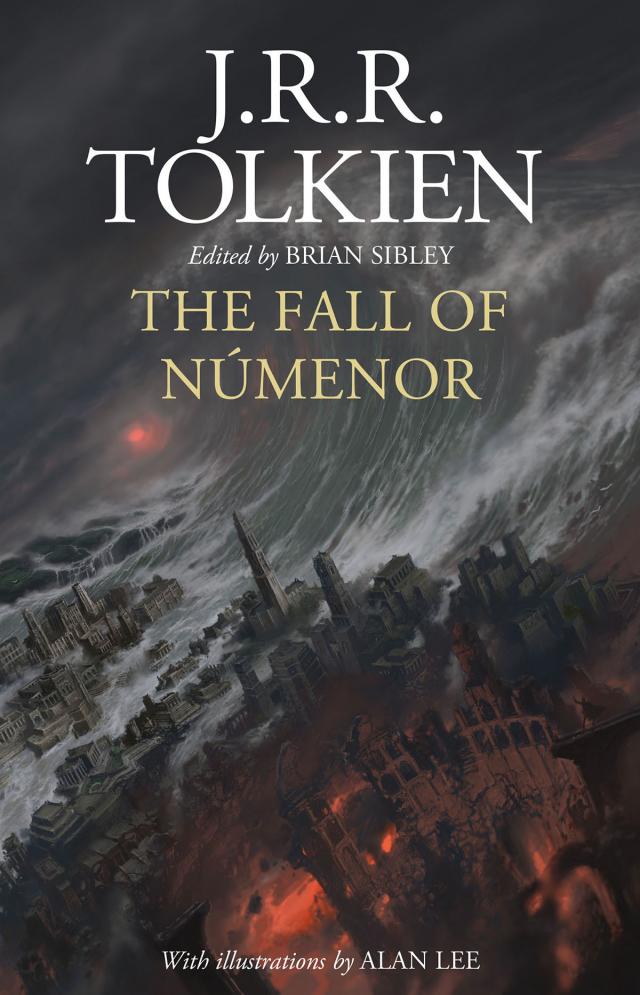


Then Manwë upon the Mountain called upon Ilúvatar, and for that time the Valar laid down their government of Arda. But Ilúvatar showed forth his power, and he changed the fashion of the world; and a great chasm opened in the sea between Númenor and the Deathless Lands, and the waters flowed down into it, and the noise and smoke of the cataracts went up to heaven, and the world was shaken. And all the fleets of the Númenóreans were drawn down into the abyss, and they were drowned and swallowed up for ever. But Ar-Pharazôn the King and the mortal warriors that had set foot upon the land of Aman were buried under falling hills: there it is said that they lie imprisoned in the Caves of the Forgotten, until the Last Battle and the Day of Doom.
But the land of Aman and Eressëa of the Eldar were taken away and removed beyond the reach of Men for ever. And Andor, the Land of Gift, Númenor of the Kings, Elenna of the Star of Eärendil, was utterly destroyed. For it was nigh to the east of the great rift, and its foundations were overturned, and it fell and went down into darkness, and is no more. And there is not now upon Earth any place abiding where the memory of a time without evil is preserved. For Ilúvatar cast back the Great Seas west of Middle-earth, and the Empty Lands east of it, and new lands and new seas were made; and the world was diminished, for Valinor and Eressëa were taken from it into the realm of hidden things.
In an hour unlooked for by Men this doom befell, on the nine and thirtieth day since the passing of the fleets. Then suddenly fire burst from the Meneltarma, and there came a mighty wind and a tumult of the earth, and the sky reeled, and the hills slid, and Númenor went down into the sea, with all its children and its wives and its maidens and its ladies proud; and all its gardens and its halls and its towers, its tombs and its riches, and its jewels and its webs and its things painted and carven, and its laughter and its mirth and its music, its wisdom and its lore: they vanished for ever. And last of all the mounting wave, green and cold and plumed with foam, climbing over the land, took to its bosom Tar-Míriel the Queen, fairer than silver or ivory or pearls. Too late she strove to ascend the steep ways of the Meneltarma to the holy place; for the waters overtook her, and her cry was lost in the roaring of the wind.
But whether or no it were that Amandil came indeed to Valinor and Manwë hearkened to his prayer, by grace of the Valar Elendil and his sons and their people were spared from the ruin of that day. For Elendil had remained in Rómenna, refusing the summons of the King when he set forth to war; and avoiding the soldiers of Sauron that came to seize him and drag him to the fires of the Temple, he went aboard his ship and stood off from the shore, waiting on the time. There he was protected by the land from the great draught of the sea that drew all towards the abyss, and afterwards he was sheltered from the first fury of the storm. But when the devouring wave rolled over the land and Númenor toppled to its fall, then he would have been overwhelmed and would have deemed it the lesser grief to perish, for no wrench of death could be more bitter than the loss and agony of that day; but the great wind took him, wilder than any wind that Men had known, roaring from the west, and it swept his ships far away; and it rent their sails and snapped their masts, hunting the unhappy men like straws upon the water.
Nine ships there were: four for Elendil, and for Isildur three, and for Anárion two; and they fled before the black gale out of the twilight of doom into the darkness of the world. And the deeps rose beneath them in towering anger, and waves like unto mountains moving with great caps of writhen snow bore them up amid the wreckage of the clouds, and after many days cast them away upon the shores of Middle-earth. And all the coasts and seaward regions of the western world suffered great change and ruin in that time; for the seas invaded the lands, and shores foundered, and ancient isles were drowned, and new isles were uplifted; and hills crumbled and rivers were turned into strange courses.
Of the changes brought about in ‘the tumult of the winds and seas that followed the Downfall’ it is written in ‘The Tale of Years of the Second Age’, but nowhere else:
…in some places the sea rode in upon the land, and in others it piled up new coasts. Thus while Lindon suffered great loss, the Bay of Belfalas was much filled at the east and south, so that Pelargir which had been only a few miles from the sea was left far inland, and Anduin carved a new path by many mouths to the Bay. But the Isle of Tolfalas was almost destroyed, and was left at last like a barren and lonely mountain in the water not far from the issue of the River.2
Sauron himself was filled with great fear at the wrath of the Valar, and the doom that Eru laid upon sea and land. It was greater far than aught he had looked for, hoping only for the death of the Númenóreans and the defeat of their proud king. And Sauron, sitting in his black seat in the midst of the Temple, had laughed when he heard the trumpets of Ar-Pharazôn sounding for battle; and again he had laughed when he heard the thunder of the storm; and a third time, even as he laughed at his own thought, thinking what he would do now in the world, being rid of the Edain for ever, he was taken in the midst of his mirth, and his seat and his temple fell into the abyss. But Sauron was not of mortal flesh, and though he was robbed now of that shape in which he had wrought so great an evil, so that he could never again appear fair to the eyes of Men, yet his spirit arose out of the deep and passed as a shadow and a black wind over the sea…
But these things come not into the tale of the Drowning of Númenor, of which now all is told. And even the name of that land perished, and Men spoke thereafter not of Elenna, nor of Andor the Gift that was taken away, nor of Númenórë on the confines of the world; but the exiles on the shores of the sea, if they turned towards the West in the desire of their hearts, spoke of Mar-nu Falmar that was whelmed in the waves, Akallabêth the Downfallen, Atalantë in the Eldarin tongue.3
So ended the Glory of Númenor.4
Among the Exiles many believed that the summit of the Meneltarma, the Pillar of Heaven, was not drowned for ever, but rose again above the waves, a lonely island lost in the great waters; for it had been a hallowed place, and even in the days of Sauron none had defiled it. And some there were of the seed of Eärendil that afterwards sought for it, because it was said among loremasters that the farsighted men of old could see from the Meneltarma a glimmer of the Deathless Land. For even after the ruin the hearts of the Dúnedain were still set westwards; and though they knew indeed that the world was changed, they said: ‘Avallónë is vanished from the Earth and the Land of Aman is taken away, and in the world of this present darkness they cannot be found. Yet once they were, and therefore they still are, in true being and in the whole shape of the world as at first it was devised.’
For the Dúnedain held that even mortal Men, if so blessed, might look upon other times than those of their bodies’ life; and they longed ever to escape from the shadows of their exile and to see in some fashion the light that dies not; for the sorrow of the thought of death had pursued them over the deeps of the sea. Thus it was that great mariners among them would still search the empty seas, hoping to come upon the Isle of Meneltarma, and there to see a vision of things that were. But they found it not. And those that sailed far came only to the new lands, and found them like to the old lands, and subject to death. And those that sailed furthest set but a girdle about the Earth and returned weary at last to the place of their beginning; and they said: ‘All roads are now bent.’
Thus in after days, what by the voyages of ships, what by lore and star-craft, the kings of Men knew that the world was indeed made round, and yet the Eldar were permitted still to depart and to come to the Ancient West and to Avallónë, if they would. Therefore the loremasters of Men said that a Straight Road must still be, for those that were permitted to find it. And they taught that, while the new world fell away, the old road and the path of the memory of the West still went on, as it were a mighty bridge invisible that passed through the air of breath and of flight (which were bent now as the world was bent), and traversed Ilmen which flesh unaided cannot endure, until it came to Tol Eressëa, the Lonely Isle, and maybe even beyond, to Valinor, where the Valar still dwell and watch the unfolding of the story of the world. And tales and rumours arose along the shores of the sea concerning mariners and men forlorn upon the water who, by some fate or grace or favour of the Valar, had entered in upon the Straight Way and seen the face of the world sink below them, and so had come to the lamplit quays of Avallónë, or verily to the last beaches on the margin of Aman, and there had looked upon the White Mountain, dreadful and beautiful, before they died.5
In his letter to Milton Waldman, written three years before the publication of The Fellowship of the Ring, the author wrote of the disaster: ‘Númenor itself on the edge of the rift topples and vanishes for ever with all its glory in the abyss. Thereafter there is no visible dwelling of the divine or immortal on earth. Valinor (or Paradise) and even Eressëa are removed, remaining only in the memory of the earth. Men may sail now West, if they will, as far as they may, and come no nearer to Valinor or the Blessed Realm, but return only into the east and so back again; for the world is round, and finite, and a circle inescapable – save by death. Only the “immortals”, the lingering Elves, may still if they will, wearying of the circle of the world, take ship and find the “straight way”, and come to the ancient or True West, and be at peace.’6
The flight of Elendil and the Exiles following the Downfall was memorialized in a song about the tall kings and their nine tall ships. It was a rhyme that came into the mind of Gandalf as he and Pippin rode on Shadowfax towards Minas Tirith:
Tall ships and tall kings
Three times three,
What brought they from the foundered land
Over the flowing sea?
Seven stars and seven stones
And one white tree.7
The calamitous events of the Downfall would live long in the memories of the peoples of Middle-earth. In the Third Age, as all awaited the final outcome to the War of the Ring, Faramir and Éowyn stood upon the walls of Minas Tirith, the City of Gondor, looking toward the east and Mordor:
It seemed to them that above the ridges of the distant mountains another vast mountain of darkness rose, towering up like a wave that should engulf the world, and about it lightnings flickered; and then a tremor ran through the earth, and they felt the walls of the City quiver. A sound like a sigh went up from all the lands about them; and their hearts beat suddenly again.
‘It reminds me of Númenor,’ said Faramir, and wondered to hear himself speak.
‘Of Númenor?’ said Éowyn.
‘Yes,’ said Faramir, ‘of the land of Westernesse that foundered, and of the great dark wave climbing over the green lands and above the hills, and coming on, darkness unescapable. I often dream of it.’8
3320 – FOUNDATIONS OF THE REALMS IN EXILE: ARNOR AND GONDOR. THE STONES ARE DIVIDED. SAURON RETURNS TO MORDOR.
So the end of the Second Age draws on in a major catastrophe; but it is not yet quite concluded. From the cataclysm there are survivors…1
The last leaders of the Faithful, Elendil and his sons, escaped from the Downfall with nine ships, bearing a seedling of Nimloth, and the Seven Seeing-stones (gifts of the Eldar to their House); and they were borne on the wind of a great storm and cast upon the shores of Middle-earth.2
Et Eärello Endorenna utúlien. Sinome maruvan ar Hildinyar tenn’ Ambar-metta!
And those were the words that Elendil spoke when he came up out of the Sea on the wings of the wind: ‘Out of the Great Sea to Middle-earth I am come. In this place will I abide, and my heirs, unto the ending of the world.’3
THE NÛMENÓREAN KINGS IN EXILE:
Elendil of Númenor, High King of Gondor and Arnor4
Born: SA 3119; Died: SA 3441 (age 322)
Rule: SA 3320-3441 (121 years)
In that time those of the Númenóreans who were saved from destruction fled eastward, as is told in the Akallabêth. The chief of these were Elendil the Tall and his sons, Isildur and Anárion. Kinsmen of the King they were, descendants of Elros, but they had been unwilling to listen to Sauron, and had refused to make war on the Lords of the West. Manning their ships with all who remained faithful they forsook the land of Númenor ere ruin came upon it. They were mighty men and their ships were strong and tall, but the tempests overtook them, and they were borne aloft on hills of water even to the clouds, and they descended upon Middle-earth like birds of the storm.
Elendil was cast up by the waves in the land of Lindon, and he was befriended by Gil-galad. Thence he passed up the River Lhûn, and beyond Ered Luin he established his realm, and his people dwelt in many places in Eriador about the courses of the Lhûn and the Baranduin; but his chief city was at Annúminas beside the water of Lake Nenuial. At Fornost upon the North Downs also the Númenóreans dwelt, and in Cardolan, and in the hills of Rhudaur; and towers they raised upon Emyn Beraid and upon Amon Sûl; and there remain many barrows and ruined works in those places, but the towers of Emyn Beraid still look towards the sea.
Isildur and Anárion were borne away southwards, and at the last they brought their ships up the Great River Anduin, that flows out of Rhovanion into the western sea in the Bay of Belfalas; and they established a realm in those lands that were after called Gondor, whereas the Northern Kingdom was named Arnor. Long before in the days of their power the mariners of Númenor had established a haven and strong places about the mouths of Anduin, in despite of Sauron in the Black Land that lay nigh upon the east. In the later days to this haven came only the Faithful of Númenor, and many therefore of the folk of the coastlands in that region were in whole or in part akin to the Elf-friends and the people of Elendil, and they welcomed his sons. The chief city of this southern realm was Osgiliath, through the midst of which the Great River flowed; and the Númenóreans built there a great bridge, upon which there were towers and houses of stone wonderful to behold, and tall ships came up out of the sea to the quays of the city. Other strong places they built also upon either hand: Minas Ithil, the Tower of the Rising Moon, eastward upon a shoulder of the Mountains of Shadow as a threat to Mordor; and to the westward Minas Anor, the Tower of the Setting Sun, at the feet of Mount Mindolluin, as a shield against the wild men of the dales. In Minas Ithil was the house of Isildur, and in Minas Anor the house of Anárion, but they shared the realm between them and their thrones were set side by side in the Great Hall of Osgiliath. These were the chief dwellings of the Númenóreans in Gondor, but other works marvellous and strong they built in the land in the days of their power, at the Argonath, and at Aglarond, and at Erech; and in the circle of Angrenost, which Men called Isengard, they made the Pinnacle of Orthanc of unbreakable stone.
Many treasures and great heirlooms5 of virtue and wonder the Exiles had brought from Númenor; and of these the most renowned were the Seven Stones and the White Tree. The White Tree was grown from the fruit of Nimloth the Fair that stood in the courts of the King at Armenelos in Númenor, ere Sauron burned it; and Nimloth was in its turn descended from the Tree of Tirion, that was an image of the Eldest of Trees, White Telperion which Yavanna caused to grow in the land of the Valar. The Tree, memorial of the Eldar and of the light of Valinor, was planted in Minas Ithil before the house of Isildur, since he it was that had saved the fruit from destruction6; but the Stones were divided.
Elendil, Isildur and Anárion divided among them the seven Seeing-stones:
Three Elendil took, and his sons each two. Those of Elendil were set in towers upon Emyn Beraid, and upon Amon Sûl, and in the city of Annúminas. But those of his sons were at Minas Ithil and Minas Anor, and at Orthanc and in Osgiliath. Now these Stones had this virtue that those who looked therein might perceive in them things far off, whether in place or in time. For the most part they revealed only things near to another kindred Stone, for the Stones each called to each; but those who possessed great strength of will and of mind might learn to direct their gaze whither they would. Thus the Númenóreans were aware of many things that their enemies wished to conceal, and little escaped their vigilance in the days of their might.
It is said that the towers of Emyn Beraid were not built indeed by the Exiles of Númenor, but were raised by Gil-galad for Elendil, his friend; and the Seeing Stone of Emyn Beraid was set in Elostirion, the tallest of the towers. Thither Elendil would repair, and thence he would gaze out over the sundering seas, when the yearning of exile was upon him; and it is believed that thus he would at whiles see far away even the Tower of Avallónë upon Eressëa, where the Master-stone abode, and yet abides. These stones were gifts of the Eldar to Amandil, father of Elendil, for the comfort of the Faithful of Númenor in their dark days, when the Elves might come no longer to that land under the shadow of Sauron. They were called the Palantíri, those that watch from afar; but all those that were brought to Middle-earth long ago were lost.7
Speaking of the Seeing-stones, Gandalf said: ‘The palantíri came from beyond Westernesse, from Eldamar. The Noldor made them. Fëanor himself, maybe, wrought them, in days so long ago that the time cannot be measured in years. But there is nothing that Sauron cannot turn to evil uses… Perilous to us all are the devices of an art deeper than we possess ourselves…’8