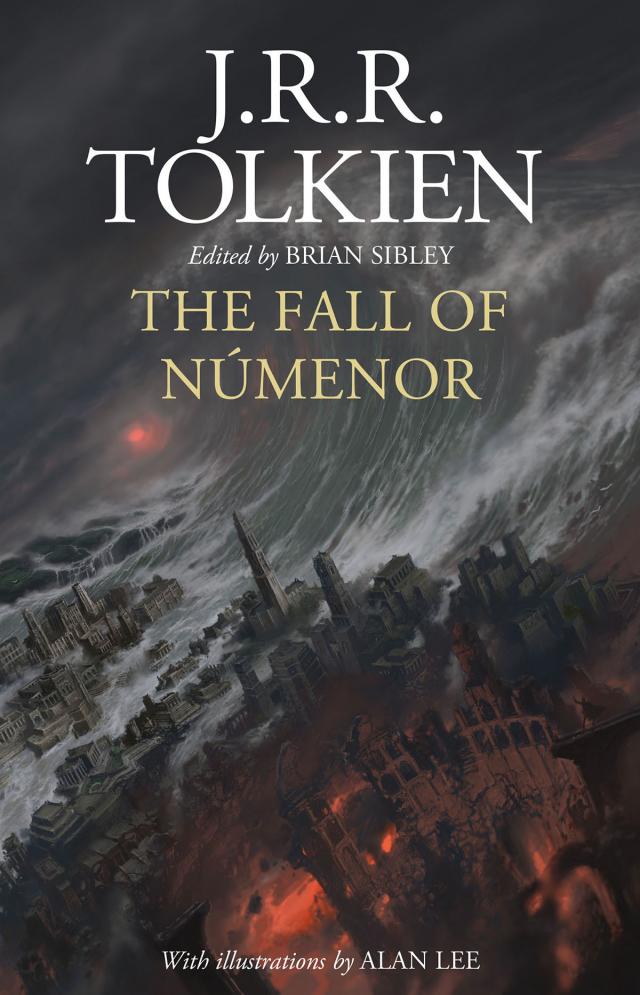
The fall of numenor, p.22
The Fall of Númenor,
p.22


To this Curunír now assented, desiring that Sauron should be thrust from Dol Guldur, which was nigh to the River, and should have leisure to search there no longer. Therefore, for the last time, he aided the Council, and they put forth their strength; and they assailed Dol Guldur, and drove Sauron from his hold, and Mirkwood for a brief while was made wholesome again.
But their stroke was too late. For the Dark Lord had foreseen it, and he had long prepared all his movements; and the Úlairi, his Nine Servants, had gone before him to make ready for his coming. Therefore his flight was but a feint, and he soon returned, and ere the Wise could prevent him he re-entered his kingdom in Mordor and reared once again the dark towers of Barad-dûr. And in that year the White Council met for the last time, and Curunír withdrew to Isengard, and took counsel with none save himself.
Orcs were mustering, and far to the east and the south the wild peoples were arming. Then in the midst of gathering fear and the rumour of war the foreboding of Elrond was proved true, and the One Ring was indeed found again, by a chance more strange than even Mithrandir had foreseen; and it was hidden from Curunír and from Sauron. For it had been taken from Anduin long ere they sought for it, being found by one of the small fisher-folk that dwelt by the River, ere the Kings failed in Gondor; and by its finder it was brought beyond search into dark hiding under the roots of the mountains. There it dwelt, until even in the year of the assault upon Dol Guldur it was found again, by a wayfarer, fleeing into the depths of the earth from the pursuit of the Orcs, and passed into a far distant country, even to the land of the Periannath, the Little People, the Halflings, who dwelt in the west of Eriador. And ere that day they had been held of small account by Elves and by Men, and neither Sauron nor any of the Wise save Mithrandir had in all their counsels given thought to them.
Now by fortune and his vigilance Mithrandir first learned of the Ring, ere Sauron had news of it; yet he was dismayed and in doubt. For too great was the evil power of this thing for any of the Wise to wield, unless like Curunír he wished himself to become a tyrant and a dark lord in his turn; but neither could it be concealed from Sauron for ever, nor could it be unmade by the craft of the Elves. Therefore with the help of the Dúnedain of the North Mithrandir set a watch upon the land of the Periannath and bided his time. But Sauron had many ears, and soon he heard rumour of the One Ring, which above all things he desired, and he sent forth the Nazgûl to take it. Then war was kindled, and in battle with Sauron the Third Age ended even as it had begun.
THE TALE CONTINUES IN
THE LORD OF THE RINGS
APPENDIX B
THE NÚMENÓREAN CHAPTERS FROM THE LOST ROAD
Within the manuscripts of J.R.R. Tolkien’s unfinished novel, The Lost Road, begun some time prior to 1937, there are many foreshadowings of themes later realised in his writings concerning the Fall of Númenor. In the second chapter there is a verse, in translation from Anglo-Saxon, which clearly describes places akin to the lands of Númenor and the Blessed Realm and the yearning of Men for the West:
‘There is many a thing in the West-regions unknown to men, marvels and strange beings, a land fair and lovely, the homeland of the Elves, and the bliss of the Gods. Little doth any man know what longing is his whom old age cutteth off from return.’
And, elsewhere, appear the names ‘Númenor’, ‘Sauron’, ‘Morgoth’, ‘Melko’ [Melkor] and ‘Eärendel’ [Eärendil]. The many-layered ‘time travel’ device is complex and was, doubtless, the reason for the novel being abandoned, proving, as Tolkien was to later express it, ‘too long a way round to what I really wanted to make, a new version of the Atlantis legend’.
When, in 1987, Christopher Tolkien published the surviving elements of his father’s manuscript in The Lost Road and Other Writings, he singled out what he referred to as ‘The Númenórean Chapters’ as a discrete section to be given appropriate prominence in consideration of the text.
Whilst not easily incorporated into the chronological form used in this volume, these chapters merit inclusion here by virtue of their containing a masterly summary of the First Age, the creation of Númenor, the Rise of Sauron and the coming of the Shadow, presented as a Socratic dialogue richly embellished in Tolkien’s most majestic and epic style.
In terms of where in the chronology it might be notionally located, it would seem to sit most easily at that point in the Akallabêth where Ar-Pharazôn is promulgating his plans for assaulting the Blessed Realm and Amandil, the loyal counsellor to the King, has left his home in Rómenna and set sail into the West in order to appeal to the Valar for assistance, leaving his son, Elendil, waiting and looking for his father’s return.
In this version it is Orontor, not Amandil, who has embarked on that mission. Elendil’s son is here named ‘Herendil’ (as opposed to Tolkien’s later choice of Isildur), while Elendil himself is said to be the son of ‘Valandil’ rather than ‘Amandil’; Tolkien later giving the name Valandil to the youngest of Isildur’s sons. Ar-Pharazôn is here referred to as ‘Tarkalion’, an earlier iteration of his Númenórean name, Tar-Calion.
The Númenórean chapters
Christopher Tolkien provides the following introduction:
My father said in his letter of 1964 on the subject that ‘in my tale we were to come at last to Amandil and Elendil leaders of the loyal party in Númenor, when it fell under the domination of Sauron.’ It is nonetheless plain that he did not reach this conception until after the extant narrative had been mostly written, or even brought to the point where it was abandoned. At the end of Chapter II the Númenórean story is obviously just about to begin, and the Númenórean chapters were originally numbered continuously with the opening ones. On the other hand the decision to postpone Númenor and make it the conclusion and climax to the book had already been taken when The Lost Road went to Allen and Unwin in November 1937.
Since the Númenórean episode was left unfinished, this is a convenient point to mention an interesting note that my father presumably wrote while it was in progress. This says that when the first ‘adventure’ (i.e. Númenor) is over ‘Alboin is still precisely in his chair and Audoin just shutting the door.’ [This refers to the foregoing chapters as published in The Lost Road and Other Writings.]
With the postponement of Númenor the chapter-numbers were changed, but this has no importance and I therefore number these ‘III’ and ‘IV’; they have no titles. In this case I have found it most convenient to annotate the text by numbered notes.
Chapter III
Elendil was walking in his garden, but not to look upon its beauty in the evening light. He was troubled and his mind was turned inward. His house with its white tower and golden roof glowed behind him in the sunset, but his eyes were on the path before his feet. He was going down to the shore, to bathe in the blue pools of the cove beyond his garden’s end, as was his custom at this hour. And he looked also to find his son Herendil there. The time had come when he must speak to him.
He came at length to the great hedge of lavaralda1 that fenced the garden at its lower, western, end. It was a familiar sight, though the years could not dim its beauty. It was seven twelves of years2 or more since he had planted it himself when planning his garden before his marriage; and he had blessed his good fortune. For the seeds had come from Eressëa far westward, whence ships came seldom already in those days, and now they came no more. But the spirit of that blessed land and its fair people remained still in the trees that had grown from those seeds: their long green leaves were golden on the undersides, and as a breeze off the water stirred them they whispered with a sound of many soft voices, and glistened like sunbeams on rippling waves. The flowers were pale with a yellow flush, and laid thickly on the branches like a sunlit snow; and their odour filled all the lower garden, faint but clear. Mariners in the old days said that the scent of lavaralda could be felt on the air long ere the land of Eressëa could be seen, and that it brought a desire of rest and great content. He had seen the trees in flower day after day, for they rested from flowering only at rare intervals. But now, suddenly, as he passed, the scent struck him with a keen fragrance, at once known and utterly strange. He seemed for a moment never to have smelled it before: it pierced the troubles of his mind, bewildering, bringing no familiar content, but a new disquiet.
‘Eressëa, Eressëa!’ he said. ‘I wish I were there; and had not been fated to dwell in Númenor3 half-way between the worlds. And least of all in these days of perplexity!’
He passed under an arch of shining leaves, and walked swiftly down rock-hewn steps to the white beach. Elendil looked about him, but he could not see his son. A picture rose in his mind of Herendil’s white body, strong and beautiful upon the threshold of early manhood, cleaving the water, or lying on the sand glistening in the sun. But Herendil was not there, and the beach seemed oddly empty.
Elendil stood and surveyed the cove and its rocky walls once more; and as he looked, his eyes rose by chance to his own house among trees and flowers upon the slopes above the shore, white and golden, shining in the sunset. And he stopped and gazed: for suddenly the house stood there, as a thing at once real and visionary, as a thing in some other time and story, beautiful, beloved, but strange, awaking desire as if it were part of a mystery that was still hidden. He could not interpret the feeling.
He sighed. ‘I suppose it is the threat of war that maketh me look upon fair things with such disquiet,’ he thought. ‘The shadow of fear is between us and the sun, and all things look as if they were already lost. Yet they are strangely beautiful thus seen. I do not know. I wonder. A Númenórë! I hope the trees will blossom on your hills in years to come as they do now; and your towers will stand white in the Moon and yellow in the Sun. I wish it were not hope, but assurance – that assurance we used to have before the Shadow. But where is Herendil? I must see him and speak to him, more clearly than we have spoken yet. Ere it is too late. The time is getting short.’
‘Herendil!’ he called, and his voice echoed along the hollow shore above the soft sound of the light-falling waves. ‘Herendil!’
And even as he called, he seemed to hear his own voice, and to mark that it was strong and curiously melodious. ‘Herendil!’ he called again.
At length there was an answering call: a young voice very clear came from some distance away – like a bell out of a deep cave.
‘Man-ie, atto, man-ie?’
For a brief moment it seemed to Elendil that the words were strange. ‘Man-ie, atto? What is it, father?’ Then the feeling passed.
‘Where art thou?’
‘Here!’
‘I cannot see thee.’
‘I am upon the wall, looking down on thee.’
Elendil looked up; and then swiftly climbed another flight of stone steps at the northern end of the cove. He came out upon a flat space smoothed and levelled on the top of the projecting spur of rock. Here there was room to lie in the sun, or sit upon a wide stone seat with its back against the cliff, down the face of which there fell a cascade of trailing stems rich with garlands of blue and silver flowers. Flat upon the stone with his chin in his hands lay a youth. He was looking out to sea, and did not turn his head as his father came up and sat down on the seat.
‘Of what art thou dreaming, Herendil, that thy ears hear not?’
‘I am thinking; I am not dreaming. I am a child no longer.’
‘I know thou art not,’ said Elendil; ‘and for that reason I wished to find thee and speak with thee. Thou art so often out and away, and so seldom at home these days.’
He looked down on the white body before him. It was dear to him, and beautiful. Herendil was naked, for he had been diving from the high point, being a daring diver and proud of his skill. It seemed suddenly to Elendil that the lad had grown over night, almost out of knowledge.
‘How thou dost grow!’ he said. ‘Thou hast the makings of a mighty man, and have nearly finished the making.’
‘Why dost thou mock me?’ said the boy. ‘Thou knowest I am dark, and smaller than most others of my year. And that is a trouble to me. I stand barely to the shoulder of Almáriel, whose hair is of shining gold, and she is a maiden, and of my own age. We hold that we are of the blood of kings, but I tell thee thy friends’ sons make a jest of me and call me Terendul4 – slender and dark; and they say I have Eressëan blood, or that I am half-Noldo. And that is not said with love in these days. It is but a step from being called half a Gnome to being called Godfearing; and that is dangerous.’5
Elendil sighed. ‘Then it must have become perilous to be the son of him that is named elendil; for that leads to Valandil, God-friend, who was thy father’s father.’6
There was a silence. At length Herendil spoke again: ‘Of whom dost thou say that our king, Tarkalion, is descended?’
‘From Eärendel the mariner, son of Tuor the mighty who was lost in these seas.’7
‘Why then may not the king do as Eärendel from whom he is come? They say that he should follow him, and complete his work.’
‘What dost thou think that they mean? Whither should he go, and fulfil what work?’
‘Thou knowest. Did not Eärendel voyage to the uttermost West, and set foot in that land that is forbidden to us? He doth not die, or so songs say.’
‘What callest thou Death? He did not return. He forsook all whom he loved, ere he stepped on that shore.8 He saved his kindred by losing them.’
‘Were the Gods wroth with him?’
‘Who knoweth? For he came not back. But he did not dare that deed to serve Melko, but to defeat him; to free men from Melko, not from the Lords; to win us the earth, not the land of the Lords. And the Lords heard his prayer and arose against Melko. And the earth is ours.’
‘They say now that the tale was altered by the Eressëans, who are slaves of the Lords: that in truth Eärendel was an adventurer, and showed us the way, and that the Lords took him captive for that reason; and his work is perforce unfinished. Therefore the son of Eärendel, our king, should complete it. They wish to do what has been long left undone.’
‘What is that?’
‘Thou knowest: to set foot in the far West, and not withdraw it. To conquer new realms for our race, and ease the pressure of this peopled island, where every road is trodden hard, and every tree and grass-blade counted. To be free, and masters of the world. To escape the shadow of sameness, and of ending. We would make our king Lord of the West: Nuaran Númenóren.9 Death comes here slow and seldom; yet it cometh. The land is only a cage gilded to look like Paradise.’
‘Yea, so I have heard others say,’ said Elendil. ‘But what knowest thou of Paradise? Behold, our wandering words have come unguided to the point of my purpose. But I am grieved to find thy mood is of this sort, though I feared it might be so. Thou art my only son, and my dearest child, and I would have us at one in all our choices. But choose we must, thou as well as I – for at thy last birthday thou became subject to arms and the king’s service. We must choose between Sauron and the Lords (or One Higher). Thou knowest, I suppose, that all hearts in Númenor are not drawn to Sauron?’
‘Yes. There are fools even in Númenor,’ said Herendil, in a lowered voice. ‘But why speak of such things in this open place? Do you wish to bring evil on me?’
‘I bring no evil,’ said Elendil. ‘That is thrust upon us: the choice between evils: the first fruits of war. But look, Herendil! Our house is one of wisdom and guarded learning; and was long revered for it. I followed my father, as I was able. Dost thou follow me? What dost thou know of the history of the world or Númenor? Thou art but four twelves,10 and wert but a small child when Sauron came. Thou dost not understand what days were like before then. Thou canst not choose in ignorance.’
‘But others of greater age and knowledge than mine – or thine – have chosen,’ said Herendil. ‘And they say that history confirmeth them, and that Sauron hath thrown a new light on history. Sauron knoweth history, all history.’
‘Sauron knoweth, verily; but he twisteth knowledge. Sauron is a liar!’ Growing anger caused Elendil to raise his voice as he spoke. The words rang out as a challenge.
‘Thou art mad,’ said his son, turning at last upon his side and facing Elendil, with dread and fear in his eyes. ‘Do not say such things to me! They might, they might…’
‘Who are they, and what might they do?’ said Elendil, but a chill fear passed from his son’s eyes to his own heart.
‘Do not ask! And do not speak – so loud!’ Herendil turned away, and lay prone with his face buried in his hands. ‘Thou knowest it is dangerous – to us all. Whatever he be, Sauron is mighty, and hath ears. I fear the dungeons. And I love thee, I love thee. Atarinya tye-meláne.’
Atarinya tye-meláne, my father, I love thee: the words sounded strange, but sweet: they smote Elendil’s heart. ‘A yonya inye tye-méla: and I too, my son, I love thee,’ he said, feeling each syllable strange but vivid as he spoke it. ‘But let us go within! It is too late to bathe. The sun is all but gone. It is bright there westwards in the gardens of the Gods. But twilight and the dark are coming here, and the dark is no longer wholesome in this land. Let us go home. I must tell and ask thee much this evening – behind closed doors, where maybe thou wilt feel safer.’ He looked towards the sea, which he loved, longing to bathe his body in it, as though to wash away weariness and care. But night was coming.
The sun had dipped, and was fast sinking in the sea.
There was fire upon far waves, but it faded almost as it was kindled. A chill wind came suddenly out of the West ruffling the yellow water off shore. Up over the fire-lit rim dark clouds reared; they stretched out great wings, south and north, and seemed to threaten the land.
Elendil shivered. ‘Behold, the eagles of the Lord of the West are coming with threat to Númenor,’ he murmured.
‘What dost thou say?’ said Herendil. ‘Is it not decreed that the king of Númenor shall be called Lord of the West?’