Empty graves, p.19
Empty Graves,
p.19
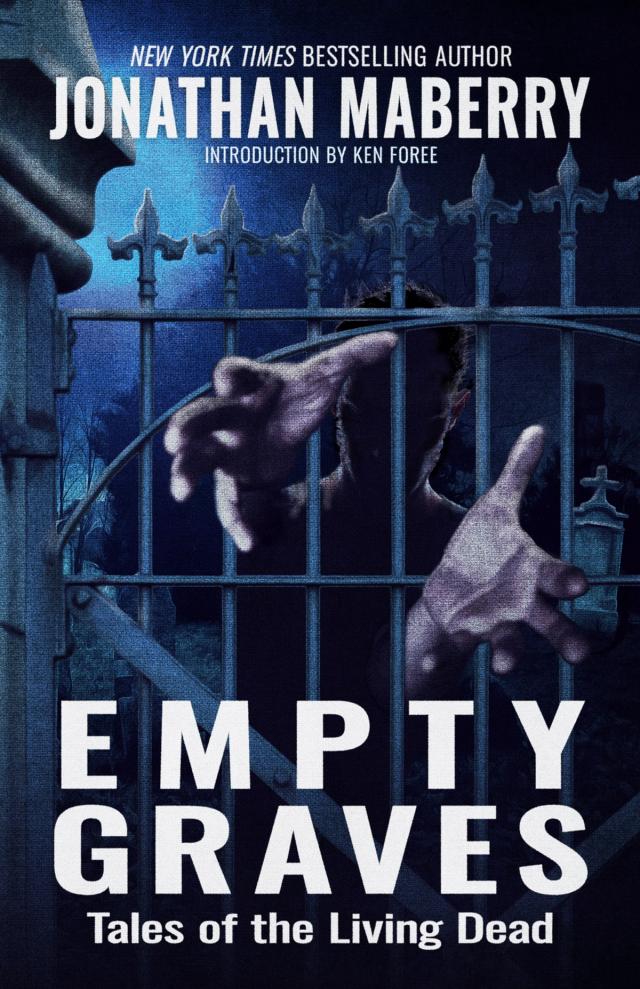


George always came back. He was the only one who ever did. Pushing a wheelbarrow full of cans from someone else’s kitchen. Bringing clothes and toilet paper and toys and books. Always books.
Bringing weapons, too.
Never bringing other people. There were none. They were all sure of that. No one but George, Lilah, and little Annie.
Childhood was learning to be quiet, learning to hide, learning to trick the dead. George taught them to fight as soon as they could hold tools. They spent long nights together turning wood and duct tape and kitchen knives into weapons. Quiet weapons. George wasn’t a fighter. He told the girls that he used to sell shoes. He wasn’t a hero like the princes and champions in the books he taught them to read. He wasn’t big and full of muscle. He wasn’t as handsome as Prince Charming or Aladdin or Captain America. He never took karate or anything like that. Everything he taught them was what he could make up, and some stuff he learned from books he found that weren’t Disney books or comics. They all read as much as they could. They read everything. It was how George taught them about the world that was. A world Lilah and Annie would never know. Could never know because the dead rose and ate it all up.
Eight years. Just the three of them.
When Lilah was ten and Annie was eight George met a man in the woods. Not another biter. A living man. He was dressed like a hunter from pictures they’d seen. Camouflage clothes. But he smelled like one of the biters because he smeared something on his clothes that made the monsters think he was like them, and they didn’t eat each other.
George almost killed the man, because at first he couldn’t believe that he was alive. He couldn’t be alive because the world had ended and everyone died. Every single person except the three of them.
But the man was alive. Really and truly alive.
When George realized that, he went running from cover and grabbed the man and embraced him, weeping, kissing his face and hands, sobbing out loud.
The hunter was happy to see him, too, but unlike George he hadn’t believed the world was destroyed. Not completely.
“There’s a lot of us left,” he said. “We’re taking the world back from these zoms.”
Zoms. He called them zoms. Short for zombies. A strange word that Lilah had read in books and which didn’t seem to fit. Zombies were dead people brought back to life to be slaves. These dead people ate the living. George usually called them biters or ghouls. Zoms was a new word.
George was so happy that he brought the hunter back to the house to meet the girls.
Lilah remembered that. She was absolutely terrified of the big man with all the guns and knives who smelled like a biter. And he was strange looking. The man had the palest skin, almost as white as a corpse, and he had one blue eye and the other was as red as blood. He had lots of scars and he smiled all the time.
Lilah hated him and tried to stab him with a spear. Annie threw stones at him. It took George a long time to convince them it was safe.
Safe.
Funny word.
For Lilah ‘safe’ meant the three of them inside the house with the doors and windows shut. That was safe. It was the only safety she’d ever known.
After a long, long time of talk and promises and even some yelling on George’s part—something he almost never did—Lilah stopped fighting. It took Annie a little longer to settle down. Unlike her big sister, Annie had never seen any adults other than George. They’d all died when she was a baby.
They all sat in the living room, and the big hunter with the red eye sat on the floor. He’d taken off all of his weapons and given them to George to hold, just to prove that he wasn’t going to hurt them. Lilah and Annie crouched like dogs on either side of George, ready to run, ready to bite.
“It didn’t all fall down,” said the big man. “We lost a lot of land, sure, but we’re taking it back. This is one of the last areas that hadn’t been cleared out yet, but my guys are out here doing just that.”
“Your guys …?” asked George, and as she squatted next to him, Lilah could feel him tremble with excitement.
The hunter took a couple of candy bars from his pocket and reached over to offer them to the girls, but Lilah recoiled. Annie hissed at him. The man’s smile flickered and he placed the candy on the floor and shifted back away from them.
“They haven’t had much candy,” said George. “And I trained them to be careful.”
“Stranger-danger,” laughed the big man. “I get it. It’s cool, and that’s smart. Big ol’ dangerous world and you can never be too careful.”
The candy bars lay there, untouched.
“You said you have people out here?”
“Sure. Part rescue team and part hunters. We’re quieting the last of the zoms as we go.”
George repeated the word, “‘Quieting.’”
“Yeah, it’s what we call it when we put the zoms down. Bullet in the motor cortex or a blade through the brain stem. Only way to get ’er done.”
“Quieting,” murmured Lilah, and then Annie repeated it.
“Look,” said the big hunter, “these woods are still pretty thick with zoms. Not safe for you to be here. My camp’s a few hours walk, but we have food, a stockade, horses, and a hell of—oops, I mean a heck of a lot of guns. We could go there and get oriented, then I can have a team take you and the kids to the closest town.”
“Town …” said George and he swayed as if he was going to faint.
“Yeah. Towns all over. Closest is Mountainside, which they set up just after the problems started. Built around a reservoir and backed up against a mountain. And it’s up high because the zoms won’t walk uphill unless they’re chasing something. Big fence and a lot of people. That’s one of the places I hang out, but there are other towns. Like I said, we’re taking it all back.”
George began crying again. Annie, always so sensitive, wrapped her little arms around him and started crying, too. Lilah did not. She read a lot of fairy stories that had happy endings, but she never believed that any of those stories ever really happened. There were no happy endings.
In the morning, George agreed to go with the big hunter. He filled his wheelbarrow with food, the girls’ favorite toys, some of their precious books, and lots of weapons. The hunter seemed to be impressed with the handmade weapons.
“You some kind of ninja?” he asked, bending to inspect the spears and other deadly tools.
George laughed. “Not even close. I figured it out as we went. Try something on a biter and if it works you try it on another one. You don’t need to know a lot, but you need to be good at what you do know.”
“Ain’t that the honest truth,” agreed the hunter.
“George says we’re not supposed to say ‘ain’t,’” said Annie, and that made the hunter laugh out loud.
“Well, I guess Mr. George is one-hundred percent correct, little sweet pea,” he told her. “I never did have much schooling, but it looks like you learned your lessons.”
“I taught them as best I could,” said George, his face flushing with embarrassment.
The hunter nodded and then turned sharply to Lilah who was reaching for her favorite spear. “Whoa, now, kiddo, you shouldn’t play with grown up toys.”
Lilah snatched the spear up, spun the shaft faster than the eye could see and passed the tip of the blade through a loose fold of the big man’s shirt. Then she held the spear ready, feet wide and braced, weight on the balls of her toes. Ready.
The hunter’s smile vanished to be replaced with a snarl that was as cold and mean as a hungry bear. “I can see you learned more than your ABCs from ol’ George. That’s mighty interesting. Now put that toothpick down before I—”
George, greatly alarmed, stepped between them. “Oh, God, I’m so sorry! She doesn’t know any better. You’re the first adult she’s met since … since …”
The smile came back slowly. “Hey, it’s all good,” said the hunter. Then he chuckled. “Truth to tell I’m pretty impressed with little spitfire here. She’s something to see, yes, she is. How old is she? Ten? My, my, pretty as a Georgia peach and mean as a snake. Got to love that combination. Yes, sir, Miss Lilah, you can go far in this world. Even in a world as big and bad as what we got.”
“What we have,” said Annie.
The big hunter guffawed. “Got me again. Haw! Not too many people pull a fast one on ol’ Charlie Matthias,” he said. “No sirree bob, and here I am having a ten-year-old kid cut her mark on me and her little sister correct my grammar. I am humbled. I truly am.”
He laughed until tears ran down his cheeks.
He was still chuckling when they opened the back door and stepped out. There were biters out there because there were always biters. Seven of them. George edged up with his own spear, but Charlie waved him back. “Don’t get your panties in a bunch,” he said. “I got this.”
He had a thick leather gauntlet on his left arm that covered him from fingers to shoulder, and with his less heavily padded right he drew a broad-bladed machete. Because he still smelled of rot the biters didn’t swarm him, and even seemed bemused while Charlie waded into them. The big hunter used his armored left hand to grab the zoms and hold them still for the whistling blade of the machete. He moved with the effortless efficiency of someone who’d done exactly this a thousand times. Or ten thousand. In seconds, the zoms were cut to pieces. Most were still alive, but none were whole. None were a threat.
George looked down at the twitching torsos and snapping jaws and raised his spear to finish them.
“What for?” asked Charlie, annoyed.
“To give them peace.”
Charlie laughed as George, Lilah, and Annie quieted the dead. Killing the dead was important, almost a ritual for their family. George told them that ever since the plague started everyone who died, no matter how they died, came back as a biter. Every single person. It was important to give everyone who needed it a chance at real peace. Even the biters, whom they all feared. After all, it wasn’t their fault they’d become monsters.
George looked uneasy because of Charlie’s laughter, but he shook it off. Then they took their wheelbarrow and followed the big man through the woods. His camp was five miles away and it was starting to drizzle by the time they got there. Even with the rain Lilah could smell the smoke from cooking fires, and soon they saw the plumes of smoke rising into the cloudy sky.
There were forty men in the camp.
All of them tough-looking, big, brutal, and smiling. They milled around George and the girls, laughing, slapping Charlie on the back, staring at the little girls, appraising George.
One man, a massive man with immensely broad shoulders and a badly scarred face pushed his way through the crowd. He wore matched automatic pistols at his hips and had a long length of bloodstained black pipe swinging from his belt. He stopped next to Charlie, one hand on the big hunter’s shoulder and studied the girls.
“What’ve you got here, Charlie?”
“A couple of fighters.”
“Do tell?”
“The tall one’s quick as lightning,” said Charlie and he showed the cut on his shirt. “Never even saw that blade coming. Rattlesnake quick.”
“Nice,” said the other man, who some of the others called ‘the Motor City Hammer,’ or just ‘the Hammer.’ “You thinking of training her some more or putting her right into the games?”
“Oh, the games, no doubt,” said Charlie. “Raw talent like that? Shoot. She’s ready to rock and roll.”
Lilah had no idea what they were talking about. These men didn’t seem to be the kind who would want to play games. Not Monopoly or dolls or Legos. And, besides, what did that have to do with fighting?
George caught it, too. His smile faded. “What are you talking about? Games? What’s that mean?”
Charlie squinted up into the rain, which was beginning to fall heavier now, fat drops popping on the leaves of the trees around the camp. “Storm’s coming,” he said. “Could be bad.”
As if to emphasize his observation lightning forked across the sky and thunder rumbled like laughter behind the trees. Lilah glanced up, too. She’d rarely been outside during the rain because it was hard to hear the biters during a storm. Because she was looking up, she never saw who it was that hit George.
She heard the sound. Heavy and wet and wrong, and then George fell against her, slumping, collapsing, his weapon falling away, his flopping hands knocking the spear from Lilah’s hands. His improbably heavy weight dragged her down into the mud. Lilah hit her head the ground, jolting her neck, making stars explode in her eyes. She heard Annie scream.
Then there were hands on her, grabbing her wrists and elbows and ankles. Someone forced a thick pillowcase over her head. She caught one last glimpse of George, his face wet with rainwater and blood, sprawled on the ground.
That’s when the world ended again.
And it was raining.
Because it always rained when the world ended.
-4-
It was starting to rain.
“We have to try,” said Annie. “He’ll be back soon.”
“Shhh,” Lilah said, “let me think.”
The girls knelt by the door and looked out through the bars. The hall was empty. The guard’s chair stood against the far wall, a magazine opened face-down on it, a half-empty beer bottle on the crate he used as a table. Lilah knew the routine. This guard, Henry, drank too much and he went out to the bathroom at least six times during his shift. Lilah had no watch, but she’d learned to count time. After all these months here, she’d learned the feel of seconds and minutes and hours. They crawled like worms over her skin. Familiar and yet hateful. Another of the prisoners here—one of the few adults who lived in a cage down the hall—called it stacking time. You took those increments of time and built walls around you. Lilah understood it. The more time here in the cages the more she understood this world and what it was. In a way it was like reading a book because she learned something new every day.
Not just the rules of the games, but other stuff. How to watch. How to understand what she saw. How to understand the guards and what they wanted and what they thought. Knowing what the guards would do if Charlie and the Hammer let them. Knowing which ones might even have let them go if the world was a different world. Knowing which ones would do bad things to them if they could. Lilah and Annie knew all about those bad things. They’d seen them happen, and it had torn holes in the version of the world they’d always understood. Some of that stuff wasn’t even in the books George let them read. It was sick stuff. Bad stuff. Awful stuff.
It was stuff that might happen to Annie and her if they started losing their fights down in the pits. Charlie told them that. So did the Hammer. They knew it made them want to fight harder. They knew it made them cooperative. It was simple math, too. Go into the pits and fight the zoms with whatever weapons they let the girls have, or get beaten up and handed over to the guards. No third choice.
Annie was nine now and Lilah was eleven, at least by Lilah’s reckoning. As best she could estimate they had been here in Gameland for eleven months. Maybe a full year. It was cold again and the rains had started the way they usually did in January and February. It had been three weeks after New Year’s Day when George had met Charlie and decided to bring him back to the house.
There had been two weeks of travel with Charlie’s hunting party. Terrible days marked by beatings and starvation to teach manners. Then Charlie had learned that if he threatened Annie then Lilah would do anything, follow any order. After that there were fewer beatings but a lot of threats.
Except for the escape attempts. There had been savage beatings after those. Twice Lilah peed blood, and that scared her and Annie so bad they couldn’t speak for days.
Experience is a great teacher. That’s one of the things George had said a long time ago. Lilah made sure she learned from everything they experienced. Every single thing.
Like the timetable of the guards posted here in the Fighters’ House. That’s what they called it. From what Lilah had been told by other prisoners, the Fighters House used to be the Funhouse of an amusement park. Those were things the girls had read about. Places where people went to be shocked and scared for fun. How weird was that?
“He’s going to be back soon,” whined Annie.
“I know,” said Lilah, keeping her voice low. “It’s still early. He hasn’t had that much to drink.”
“But—”
“We have to wait until he goes for a long bathroom break.”
“He doesn’t always do that,” protested her sister.
Lilah wrapped her arm around Annie’s thin shoulders. “He does most of the time. He will tonight.”
“How do you know?”
“I know,” lied Lilah. Actually, she hoped she was right. Most nights Henry went out for a longer break, and when he did, he took his magazine or a book with him. Pee breaks were too quick. If he took something to read, he’d be gone for at least twenty minutes, sometimes more. This was a new magazine for him, one Lilah hadn’t seen. Maybe he’d settle down on the toilet and read it for a while.
The rain pinged against the plywood walls of the Fighters House. In the other cages she could hear kids crying or talking or snoring. One of them, a boy who had nearly lost the last couple of fights in the pits, kept talking to himself in a language of made-up words. Lilah almost envied him. His mind was broken, and he’d escaped into a nonsense world. Maybe he thought he was dreaming.
There was a fourteen-year-old girl in the cage next to them who was shivering in her sleep. The guards thought she’d gotten through her two-on-one pit fight without getting hurt, but Lilah knew better. The girl had been bitten and the fever was taking her. Maybe the guards would come for her tomorrow and open the cage without checking first. That would be nice. It would be even nicer if it was Charlie or the Hammer, but Lilah didn’t think they’d be fooled. Not them. They were smart. Not book smart like George had been, but animal smart.
She glanced at the shivering girl in the next cage. Her name was Christine and she’d been hiding with a group of nuns in a building in the hills. Lilah heard rumors of what had happened to the nuns. She really hoped Christine got to bite someone after she turned.