The perfect summer, p.25
The Perfect Summer,
p.25


The Calkin boys’ excitement at the prospect of their holiday was tempered by the loathsome grey powders their nanny forced them to swallowbefore the journey, the disgusting taste scarcely concealed by the added teaspoon of jam. This vile medicine was intended to loosen the bowels, for it was feared that the excitement of the journey combined with sudden exposure to the sea air might wreak havoc with their ‘systems’. The boys dreaded the inevitability of spending several unhappy hours on arrival in Felixstowe in the pink carbolic-reeking water-closet. Brian had another reservation about this annual expedition: he was secretly terrified that one day the donkeys on the beach would break into a sudden canter and carry him towards the waves. But donkeys and donkey-rides were part of the essence of a summer holiday, and he knewbetter than to protest.
Services on the London, Victoria to Brighton line had also returned to normal – which was just as well, for Brighton, with its specially-built three mile protected sea front and its tantalising Victorian aquarium, had recently become the most frequented resort in the British Isles. The town’s popularity had waned briefly at the beginning of the century, its associations with Queen Victoria seeming to give it an outdated air. Most of the tourist attractions had been built during her reign, and she had sold the Pavilion itself to the town in 1850 for £53,000. By the time of her death the imposing houses on the sea front suddenly seemed too huge to manage, the expense of bringing the necessary number of servants down for a few days prohibitive. But Edward VII became a regular visitor in 1908, and the town’s statuswas restored. In gratitude Marine Parade was renamed ‘Kingscliffe’, and Brunswick Terrace, in the adjacent town of Hove, was thenceforward known as ‘Kingsway’. Baedeker revised his guidebook entry, refuting the town’s old reputation as a place made up of ‘wind, glare and fashion’by describing the newly planted windbreak of thousands of shrubs, and recommending the grounds of the Pavilion for shelter from the sun. ‘On a fine day’, the guide pronounced, ‘the scene here is of a most animated character.’ The Palace Pier built in 1899, 1,760 feet long, with filigree arches and minaret corner towers, had that summer extended the repertoire offered in its 1500-seat auditorium to include concerts as well as the usualmusic hall turns, plays both modern and Shakespearean, opera, ballet, and boxing matches. With a resident population of 173,000 and an average annual influx of 50,000 tourists, Brighton’s chief attractions as recommended by Baedeker were ‘clear and bracing air, a fine expanse of sea bordered by white chalk cliffs, its bathing facilities and its gay crowd of visitors.’
In 1911, 55 per cent of the British population were taking the minimum of a one-day trip to the sea in the summer. Some work places, including paradoxically the railway companies themselves, had begun to introduce paid holidays longer than the customary half-day, and the double advantages of good weather and financial security for sometimes as much as a week combined with the ever-improving transport services to make England’s coastline a crowded place that August. There, in the simple, cost-free pleasures of sunshine, sand and water, a fleetingly realisable equality was to be found by the poor, the suffra-gettes, the trade unionists, and even the parliamentarians.
As with everything in a class-structured England, inevitably the standard of resorts was graded. The 1911 Baedeker stresses for example that Margate is ‘one of the most popular though not one of the most fashionable watering places in England’, while Ramsgate, just along the coast, is ‘a somewhat less cockneyfied edition of Margate.’ Blackpool and Skegness were considered by gentry to be unquestionably vulgar, and the charms of towns like Bootle and Swansea were ruined by their proximity to industrial development.
For many years the rich had spent their August holidays taking a fashionable ‘Spa-Cure’. Most spa towns were based inland, but the treatments they offered began to spring up in the coastal resorts. At the best hotels the staff included medical attendants to supervise those embarking on ‘the Cure’. Ladies and gentlemen ingested quantities of sulphurous water four times a day, and also immersed themselves in the water itself, and sat with their hands packed in sulphurous mud. ‘Electropathic reper-toria’ and treatments involving the use of ozone were also offered. The food served was usually somewhat at odds with the health-giving properties of the waters. Mouth-watering menus included salmon, sweetbread, duck, salad, and ices; those taking ‘the Cure’were advised to avoid these delights, and some found the monotony of plain chicken and a lightly grilled sole a very poor alternative.
When they were not swallowing the sulphurous waters people relaxed in the pretty hotel gardens and read, or listened to music, and sometimes made expeditions to places of local interest. In the evening they might go to the theatre. At Harrogate, The Prisoner of Zenda was proving popular that August. The inland spa cure tended to be preferred by the older generation, who saw more disadvantages than advantages in a seaside holiday. Sun-darkened skin was still considered most undesirable, the give-away sign of an outside labourer, and special creams to counteract accidental tanning were advertised in the women’s magazines. The Lady helpfully advised the use of ‘Sulpholine’ lotion, ‘a simple remedy for clearing the skin of eruptions, roughness and skin discoloration.’ A greater hazard even than sunburn was the risk of exposing naked flesh in public. On many bathing beaches the sexes were still segregated, although at Bexhill the experiment of mixed bathing had attracted much excited comment.
A cautious entry from a bathing-machine was the recognised means of making bodily contact with the sea, though at a shilling a time it was not cheap. In the Town Hall at Broadstairs, a conservative-minded town (in 911 it was still being promoted in the South Eastern and Chatham Railway Handbook as Charles Dickens’s favourite resort), a large unmissable notice in the hall cautioned that ‘No female over eight years shall bathe from any machine except within the bounds marked for females.’ It hung next to a second poster warning that ‘Bathing dresses must extend from the neck to the knees.’ These rules were accepted unquestioningly and were clearly not seen as restrictions, for the editor of the Handbook felt able to boast that Broadstairs was ‘one of the freshest and freest little places in the world.’
The fully enclosed bathing machine was a sort of garden shed with wheels at one end, its walls and roof made either of wood or canvas. Sunlight Soap advertised their product on the side of some machines, cleverly targeting consumers whose awareness of personal hygiene might be enhanced when in a state of undress. Men and women would enter the machine from the back, while it was parked high up from the water line on the gender-segregated beach. In the pitch black hut, windowless in order to discourage any peering in, bathers would remove their clothes and put them up high on a shelf inside the machine to keep them dry, before struggling in the dark with the elaborate costume required for swimming.
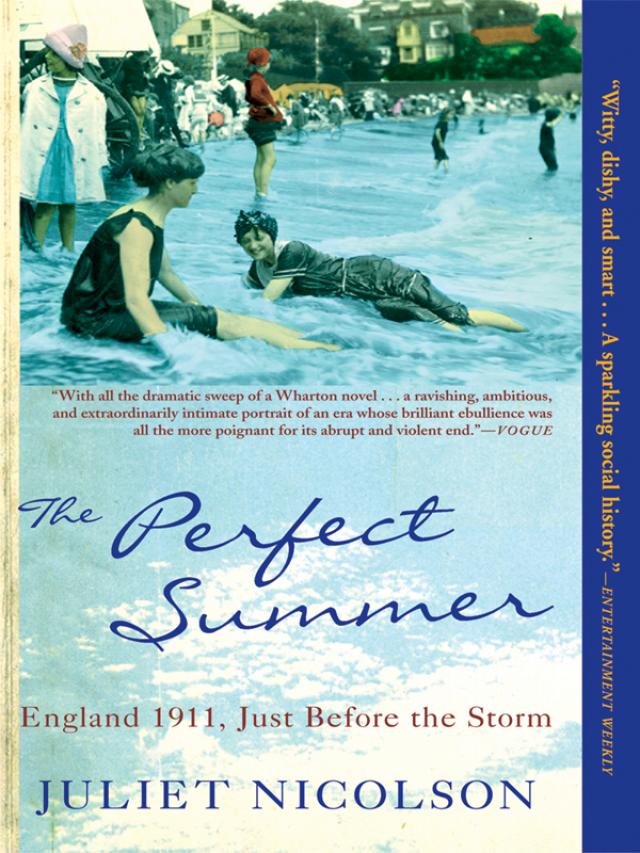
The corseted bathing-dress, mirroring the corseted daywear, was beginning to loosen its laces, although until 906 some had considered the wearing of stockings and shoes necessary for adequate decorum. But stockings as well as the full-length sleeves and knickerbockers beneath the bathing skirt had gradually been abandoned. In 1911 floaty pairs of shorts, which peeped out no more than three or four inches below the skirt, were enough to preserve modesty while the sleeve had shrunk from wrist to elbow. The weight of the clothes when wet ensured that swimming, at least for ladies, was impractical as a competitive sport. Men on the other hand wore far less cumbersome outfits, in a material that when wet clung to the body in a way that made some wonder why men bothered to dress for swimming at all. A sharp tap from inside was the agreed signal for a horse, a muscley man or even occasionally a mechanical pulley-contraption to drag the whole machine and its human contents to a line just beyond the surf. There the bather could slip discreetly into water up to the neck, with no chance of any part of the body being exposed to the view of those who remained on the beach. At the point of entry there was usually an attendant, irrationally sometimes of the opposite sex and some ladies looked forward to the moment of being lifted into the sea by strong local arms more than any other part of their holiday. After the swim, a little flag raised at the side of the machine indicated that it was time for welcoming arms to lift the bather back into the dark sanctuary of the dry, beach-bound dressing room.
As ever, rules were made to be broken and Clemmie Churchill was not one to allow any gold-chained Town Hall official to restrict her enjoyment of the water. Neville Lytton, brother-in-law of Winston’s first girlfriend Pamela, was much struck by Clemmie’s emancipated ways during a short break at his brother Victor’s house in stuffy Broadstairs itself: ‘It was a broiling day,’ he recorded, ‘and the water was heavenly. Clemmie came forth like the re-incarnation of Venus re-entering the sea. Her form is most beautiful. I had no idea she had such a splendid body. She joined in a game of water polo with Victor and me and then she and I swam half-way across the channel and had an animated conversation bobbing up and down in the waves.’
The Home Secretary’s wife was unusual in the social ease she demonstrated in the water; other more modest holidaymakers were more comfortable on dry land. Royalty could be deliciously accessible there, and The Lady was delighted to report that during the week of 20 August Princess Victoria, the King’s sister, was frequently to be observed walking her black Aberdeen terrier up and down the promenade at Harrogate. Kings and queens, princes and princesses went frequently to the sea-side and to spa towns, and their presence was a recommendation to and attraction for visitors. The social press had correspondents in every fashionable resort, and local newspapers would publish the names of the aristocracy and the places where they were staying, to alert those who enjoyed gawping at the rich and famous. The promenade was the place to be seen, and the place to watch those wishing to be seen. Ladies floated past in white summer gowns, beneath matching silk parasols. The relaxed holiday mood of their immaculately turned-out male companions was reflected in an unaccustomed jauntiness in dress, their striped blazers, white flannels and boater hats all originally made fashionable by the late King. The rich promenaded on foot, in carriages or by motor-car as humbler onlookers played the game of identifying them as they passed by. The Lady published a splendid photograph of Queen Alexandra and her party gathered outside her commodious bungalow at Snettisham Beach, a few hundred yards from Sandringham, but by that time the dowager Queen was on her way up to Yorkshire to join her friend Lady Ripon at Studley Royal. Victoria Eugenia, Queen of Spain, a granddaughter of Queen Victoria, was staying on at Osborne Cottage in the Isle of Wight, where an enjoyable garden party was given by Mr and Mrs Douglas Hall at Ryde. Tea was served on the Douglases’ lower lawns in the cool shade of the trees, and a programme of tennis, croquet and bowls was overseen by the hostess, who according to The Lady was ‘effectively gowned in bright blue, and a black hat trimmed with ostrich feathers.’
Inconveniences such as the drought and the railway strikes were stoically handled. The King left Bolton Abbey by car since the train he had planned to take was still not running, but he managed to catch a connection at Carlisle that set him well on his way to Inverness and his next host, The Mackintosh of Mackintosh. The Duke of Sutherland’s polo match in Shropshire went ahead as planned despite the unfortunate absence of the Royal Scots Greys’ team: the regiment had been on strike duty in Liverpool, and found they could not get there in time.
The Lady reported from Brighton that Mrs Norman of Holcombe had drifted across the lawn at her own party wearing ‘crushed strawberry charmeuse’ while her guests admired the late summer flowers and trees laden with fruit ‘in spite of the drought which is affecting the country rather badly’, and in Liverpool the pretty wedding of Miss Winifred Mabel Horsefall on 24 August ‘afforded an agreeable break in the social stagnation of the past weeks.’ The lawn tennis tournament in Folkestone opened on the 28th with a record 126 entries.
It was on the beach that the more humble holidaymaker found true liberation, mingling on an equal footing with those in a class or two above. Here on the crowded sands a children’s paradise was on offer to all, though chimney-sweep lads were cautioned by Punch to keep their smudged faces from the cleansing water or risk accusations of being ‘inauthentic’ at their trade. The infinite pleasure of clambering over rock pools, shrimping nets and wooden spades clutched in the hand, collecting sea anemones and shells and building castles in the sand was to be had in resorts all along the English coastline. As well as the rides on often unkempt and ill-tempered donkeys that Brian Calkin so dreaded – and in some cases an uncomfortable canter on a reluctant harnessed and saddled goat – there were numerous entertainments and refreshments available for children. Here was the Punch and Judy stall, where screams of laughter accompanied the marital battering of poor resilient Judy, here were the conjurors, the whelk vendors, the ice-cream seller with his cart, the ginger-beer men, the hawkers with sweet sticks of rock, lollipops and bullseyes, and here were women selling straw baskets covered in small ridged cream-coloured scallop shells. Here, hustling for business, were the newspaper boys, the weighing-machine men, and the evangelists. The travelling photographer was particularly popular for his ability to turn a snapshot quickly into a much-valued picture-postcard. During that last week of August, test runs were being carried out for the first aerial post, between Hendon and Windsor, due to be launched officially on 9 September. The onlookers watching excitedly saw a postman in full Royal Mail uniform and cap clinging on precariously behind the pilot as they wobbled through the sky.
At the edge of the beach next to the helter-skelter, which was clamped in mockTudor beams,were the candy-striped stalls advertising palmistry, crystal-ball gazing, phrenology, and the chance to see a two-headed mermaid. The century-old practice of phrenology, the interpretation of the lumps and bumps to be found by rubbing the hand over the skull, was an extremely busy attraction. Deep, clearly-defined lines on the forehead might indicate a high degree of mental concentration, while an elevation of the crown of the head signified decision-making powers and evidence of self esteem. At the age of 20 the butler Eric Horne had consulted a phrenologist about his future career. The expert’s view, after he had ‘felt my bumps’, was that Eric was fit to be ‘an actor, a lawyer or a parson’. Although ‘fate destined that I should be neither’, Eric appreciated in hindsight that the predicted acting skills had come in useful for concealing his views about certain employers.
The tent containing mermaids induced awe in the young and scepticism in the old. A careful examination would reveal these fish-women to be real live girls with rubber tails stretched over their legs. One particularly famous and convincing example, discovered years before and embalmed by Japanese fishermen, was brought from the Pacific to London for authentication. When Sir Everard Home, President of the Royal College of Surgeons, examined the creature he discovered it to have been made up from the head and arms of an orang-utan, with human finger nails attached to the ape’s fingers, human teeth inside the jawbone of a baboon, a torso of stuffed hose, and the tail and fins of a large Pacific fish. The head had been ingeniously covered with synthetic skin, with the eyes and nose added in paint. But Sir Everard’s exposure of the fake mermaid did nothing to obliterate the fascination such mythic beauties held for those who strolled the Margate sands.
Adults did different things on the beach. Men rarely removed their hats, and the poorer female holidaymaker, possessing neither a special holiday outfit nor light-weight summer clothes, was constrained by the weight of her ‘Sunday best’ – since women dressed for a holiday as they did for a strike – from scrambling over the rocks. These women made an arresting sight against the backdrop of a sparkling blue sea in their elaborate artificial-flower-laden hats, their long black skirts brushing the sand as they stood, stifling, in their sturdy black shoes.
There was a good deal of standing about, for not all could afford to rent a deck chair. Those lucky enough to have 3d. to sparewould sit comfortably with a book or a newspaper. Here was a place for chatting, dozing, flirting, reading, gazing, sleeping. Older gentlemen of some means might bring out their telescopes and train them on the horizon, contentedly looking at nothing. If at last they saw a cloud of smoke they were able, fancying a steamer behind it, to feel the day’s activity had been worthwhile. Younger blades might train their telescopic eyes on the activity surrounding the female bathing-machines, or put a penny in the saucy strip-tease slot machines.
Oh just let me be beside the seaside!
I’ll be beside myself with glee.
There are lots of girls, besides, That I’d like to be beside,
Beside the seaside, beside the sea.
The noise of music and song emanating from a holiday resort could sometimes be overwhelming; even in the 880s, Charles Dickens had considered staying away from his own Bleak House at Broadstairs because of ‘the most excruciating organs, fiddles, and bells, violins, music boxes and voices.’ But for most people, music emphasised the merriment of the seaside. Therewasmusic to listen to, and music to dance to. Dancing was a famous highlight of the Blackpool Pier, known for its all-encompassing gaiety as ‘The People’s Pier’. Revellers whirled away the holiday evening hours in polkas, barn dances, lancers and quadrilles. A military brass band was a familiar sight in all resorts, playing at regular intervals on piers, in the bandstands, and in the steamy fern and palm tree conservatories known as ‘Winter Gardens’. As a schoolboy on holiday Osbert Lancaster was fond of these soldierly musicians, ‘plump elderly gentlemen with long hair and thick glasses clad rather improbably in tight braided hussar uniforms.’ In competition with them were the equally noisy white-ruffed, pierrot-costumed players who blacked up their faces and appeared as ‘Nigger Minstrels’. Strumming their banjos and squeezing their concertinas, theywere immensely popular, and merited a line of their own in one jolly sing-along song: