The perfect summer, p.28
The Perfect Summer,
p.28


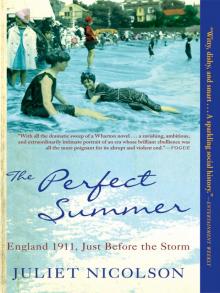
On 1 September 1911 the early-morning autumnal mist began gradually to clear, like the dry ice used for dramatic effect on a stage, leaving the sky as blue as a gentian. All along the hedgerows spider webs elaborate as spinnakers glistened with dew in the low sunlight. The day marked the beginning of two popular seasons: partridges and oysters would soon be appearing on all the most gastronomically-inclined tables. Essex oyster farmers agreed that there had rarely been a better spatting season in the famous Pyefleet beds. The 370-year-old ceremony of toasting the Sovereign in gin and gingerbread was successfully conducted by the Mayor of Colchester, who felt a flicker of personal greatness when he sent a telegram to the King at Balmoral to announce that ‘According to ancient Custom and Charter dating back to Norman times, the Mayor and Councillors of the Colchester Borough Council will formally proclaim the Opening of the Colne Oyster Fishery for the coming season and will drink to your Majesty’s long life and health and request respectfully to offer to your Majesty their expressions of dutiful loyalty and devotion.’
Ingredients for breakfast were suddenly deliciously available to the early-morning country riser, who found the lanes full of ripe blackberries and the undergrowth at the outer edges of the woods packed with fleshy mushrooms. The bright green aftermath was pushing up between the stubble in the harvested fields, and for a few weeks before ploughing began there was a strange sense that a couple of seasons had been skipped over, and spring was already on the way.
In the cities, however, summer was not quite ready to release its long hold on the year. In London’s Hyde Park the bandstands were still humming with theWednesday and Saturday concerts, elderly and deaf members of the audience sitting in deck chairs as close as possible to the musicians while the younger men and women flirted on the perimeter. In Kensington Gardens children played around Sir George Frampton’s newstatue of Peter Pan. Only a few of the smarter carriages had returned to the Park after the summer holiday, their habitual occupants still away on the grouse moors, as in London the temperatures continued to defy normal expectations for mid September. Some enthusiasts were still looking for opportunities to swim, and the Spectator was a little concerned by the news that ‘the once decorous shores of the Serpentine have been invaded by bathers at unwonted hours’, imagining the consequences of a second hot summer – it ‘would probably see the practice of mixed bathing imported from the coast to our metro politan waters!’ The magazine was also anxious that the monotonous blue skies would result in an erosion of the natural flow of an Englishman’s ‘customary conversational resource’. With the unnatural climate that had descended on this island, ‘when weeks and months pass by with no variation in the tropical heat, and the Sahara-like dryness, when drought follows drought and every atmospheric record is distanced again and again’, the magazine feared circumstances when ‘the humblest talker begins to doubt whether even for him the weather has not lost its novelty.’
For Lady Cynthia Asquith, a young woman of the slightly insecure temperament that comes from social inexperience, the shooting season brought with it a whole set of social challenges. Some robust members of her sex seemed to enjoy accompanying the men out to the field. The sort of girl who might be branded a ‘good sort’, she explained, ‘took immense vicarious pride in the number of birds brought down by the particular gun she stood behind.’But Lady Cynthiawas sickened by the ‘holocaust of birds’ and reluctant to deal with ‘a disappointed hence surly sportsman’, being quite uncertain of the etiquette, not knowing whether she should engage the ‘Gun’ in conversation, or if it was wiser not to make any comment at all. Something seemed required but, unable to tell whether skill or chance had been in play when a bird was hit, she hesitated to cry out her congratulations. ‘Bad luck:’ did not sound the right sort of response to a missed bird, ‘yet silence seemed so unsympathetic’.
New challenges were confronting those even younger than Lady Cynthia. Children expected for the start of the new term were reluctant to let the summer slip away, and for it to be replaced by schoolbooks. One exasperated Kentish headmaster reported that ‘owing to hop tying, attendance is very bad indeed. I have visited the school managers and parents and also sent lists of irregularities to the board meeting but with the exception of the kind help from the Rector I am not backed up in any way.’ He was not the only frustrated headmaster to be dealing with rebellion at the start of the new academic year: another, puzzled to know why his geography class was so lethargic, was told on investigation that ‘Percy Topliss brought in a bottle of laudanum, sir, and passed it round the class.’ An opportunity not only to express their views about school discipline but to be listened to was what the schoolboys of Llanelli were after. When the new timetables were handed out, the boys discovered that their lunchtime break had been eroded by a full quarter of an hour, and a group of incipient Ben Tilletts decided to act (coincidentally, their inspiration was himself in Wales at the time, soothing and encouraging the union men still sore from the antagonisms and tragedies of the last month).
The strikes of August had given the schoolboys irresistible role models, and they had serious grievances. Conditions in some schools were as unacceptable as the conditions in which they worked were unacceptable to their parents. Brian Calkin, survivor of a summer free of malevolent donkeys, was happy in the authority of his new role as editor of the St Paul’s Choir School Magazine, but at his school near Bristol his younger brother was not so content. Kenneth Calkin had suffered from severe claustrophobia since being punished for some minor offence by being locked in a basement cupboard. He felt picked on and lonely. He did not know who to talk to about the persistent stares directed at him by the Latin master during prayers. Once, during a walk on Durdham Downs not far from the school, the housemaster knocked Kenneth’s straw hat off his head and twirled it in the air on the end of his walking stick. Alarmed by this behaviour, Kenneth bolted. On his return to school he was given six strokes for running away, the reason for his punishment ‘unseemly behaviour in public’.
There was no means of voicing the general grievances harboured by schoolboys, among which unfair and extreme penalties and excessive homework headed the list. On 5 September, the second day of term, the schoolboys of Llanelli went into action. Thirty-two boys failed to turn up for their history lesson, appearing instead on Murray Street, dancing and singing and causing something of a local stir. They were objecting to corporal punish ment as well as the cut in their lunch break, and demanding payment of a halfpenny a week for the monitors. The ring-leader climbed onto the top of the park railing to make himself heard, and The South Wales Press reported a speech delivered in commendable, though flowery, language. Marching through the streets the boys, Pied-Piper-like, reminiscent of the robust lady leader of the striking jam-workers of Bermondsey only a few weeks earlier, persuaded two other schools to join in. Only when the headmaster appeared, flexing in threat the very weapon against which they had been protesting, did the oratory dry up.
But the power of adolescent dissatisfaction was not exhausted; it spread. The Educational Times ticked off local papers for encouraging such action by reporting every development. Boys in Hartlepool were the next to make their complaints heard. At Newcastle’s Sandyford Road Council School the total abolition of homework was called for; at Middlesbrough, where demands for the abolition of both canes and homework were chalked neatly onto the pavement, the meetings were dispersed by the police. At Stoke-on-Trent there was talk of military intervention. Convinced that maturity and adulthood were theirs for the taking, schoolboys from Hull burst into a local hotel and helped themselves to cigars, whisky and stout. Some wags marvelled jokingly over the Home Secretary’s absence from the scene of all this excitement. But according to the The Times’s Court Circular, Churchill had left the country on 6 September ‘for the Continent’.
Burton-on-Trent was the next school to rebel, followed by Portsmouth. Adolescent unrest was racing through the country. Six county council schools in the London districts of Shoreditch and Islington sent a hundred boys into the streets, drumming up local support by chanting ‘Fall in and follow me’. At the Latchmere school in Battersea the arrival of the most muscular policemen on the force sent the children rushing for the safety of the school playground. Eventually a group possessing even more authority than the powerful armof the law appeared to resolve the unrest: mothers arrived at the school gates. Clutching them by the ear, they dragged their reluctant children home. Further humiliation awaited many who returned to school on 15 September, carrying notes assuring the staff that suitable punishments had already been delivered. The strikes came to an end without any negotiation. Trade Union recruiting officers noted that senior schools might make a good enrolling ground.
There was a feeling that September of a youthful boldness, a feeling which stretched beyond the school walls. On 6 September Thomas W. Burgess, aged 37, covered in lard and stark naked except for a pair of thick motorist’s goggles and a black rubber bathing cap, stepped into the sea at Folkestone to make his sixteenth attempt to reach France by swimming across the Channel. Despite numerous attempts over the last 36 years, no one had succeeded in this since MatthewWebb reached Calais in August 1875. Webbwas not on the beach towave Burgess into thewater; he had been killed in 1881 trying to swim the Niagara Falls in Canada.
Averaging a mile and three-quarters an hour and accompanied by a boat whose crewfed him a grape from time to time and eleven drops of Champagne every thirty minutes, Burgess followed the irregular course dictated by the tide, a route he described as ‘a figure of a badly written capital M with a loop on first down stroke’. After 37 miles and with only two and a half left to swim he sensed himself entering foreign waters, and was promptly stung badly by a cluster of poisonous pink French jellyfish. To show he was in no way offended, he asked the boat crew to start singing ‘La Marseillaise’, and to their accompaniment he landed on the beautiful deserted beach at Le Chatelet near Sangatte.
On the day of the swim the temperature recorder at South Kensington registered 92°F, and people found themselves crossing over to the shady side of the street. There was still a severe water shortage in pockets of the country,woolworkers in Bradford Mills being laid off because there was no water for the night-time cleaning of the wool.
The debonair pilot Gustav Hamel, ‘gold haired intrepid Swede’, darling of the Corrupt Coterie and so handsome that Diana Manners still shuddered with desire at the very thought of him, had been given the job of carrying the first-ever aerial post. On 9 September he arrived at the small bi-plane parked beside a Royal Mail collection point in the middle of the tarmac runway at Hendon, just 30 minutes by car from central London. His destination was the East Lawn atWindsor Castle. Inside the mail box on the tarmac were letters gathered from the aerial mail collection points that had been installed in the leading London stores. Harrods in Knightsbridge, Arding and Hobbs in Clapham, Whiteleys in Westbourne Grove, Gamages in Holborn and Barkers in Kensington had all collected letters from the public to send to Hendon; they included one from the Suffragette headquarters marked for the attention of the Prime Minister, prompting him to keep his promise and ‘Remember Votes for women 1912’. As Hamel climbed on board, the gusting wind suddenly dropped, the spectators raised their hats, and the band struck up the National Anthem. When the closing bars sounded, at two minutes to four in the afternoon, Hamel lifted the plane from the ground, the postbag strapped firmly round his waist.
Twelve minutes later the plane was seen hovering over the East Terrace, but the wind suddenly strengthened, and Hamel was forced to bring his plane down in a meadow next to the Mausoleum at Frogmore House where Queen Victoria lay buried, beside a rather surprised cow chewing a few blades of late-summer grass. The dashing airman sauntered through the meadow and arrived unruffled on the East Terrace to present the mailbag to a beaming Lord Mayor of Windsor. The brass band burst into a lively rendition of ‘See the Conquering Hero Comes’. Anxious to get back to base, Hamel refused a cup of tea. He returned safely to Hendon, and a telegram of congratulation was sent down from Balmoral. The deputy pilot attempted to repeat the triumph the following day, but the wind was stronger and the plane crashed, crushing the pilot beneath it, lucky to escape with two broken legs. On 13 September the fledgling service was still having trouble keeping to the timetable. Neither weather nor engine could be relied upon, and the pilot took three attempts to land in deep fog at Hendon, having guessed at his whereabouts by the lights of the White City sports stadium below him.
Lady Diana Manners was not at Windsor to see her hero’s great achievement. She had returned to London from Yorkshire anxious to begin her own new term, having enrolled in The Slade School of Art, an institution 40 years old that summer. Diana was to take lessons from Ambrose McEvoy, a ‘dear myopic man’ and alumnus of the art college, a graduate of the same year as Augustus John and his first wife Ida. One-time lover of Augustus’s sister Gwen, Ambrose was used to being teased by Augustus for his declared ambition to paint every holder of the Victoria Cross, and every debutante beautiful enough to be commemorated on canvas. In the spring of 1911 he had grown a moustache, which according to Augustus resembled ‘an old blacking brush’, and with his ‘cracked voice, limp body, dancing pumps, monocle and high collar’ his appearance was eccentric enough for him to command a special place in Diana’s affections. He had a tiny makeshift studio, and was so short-sighted that he had hung a naked light bulb dangerously low and alarmingly near his canvases. His favourite and most beautiful students were invited to visit him: these included Diana, and they ‘prattled and laughed’ about ‘the infinitely inexhaustible subjects of scandal and art and love’ as he smoothed an almost finished portrait into his characteristically lovely ‘strange etherealness’ with the help of a battered toothbrush.
Another Slade teacher, Professor Henry Tonks, inspired terror in some of the students. Diana dreaded his approach down the corridor, for it ‘set me trembling as though he were Justice itself.’ As she sat in the Life Class in front of dispiriting models (which she described as ‘cold and livid and sagging and goose fleshed’), Tonks’s corpse-like yet commanding appearance reminded her of a nineteenth-century cardinal. He would stand, apparently baffled, in front of a nervous student’s easel, enquiring ‘WHAT is it? . . . Is it an insect?’, reducing the poor deflated artist to tears. Henry Tonks had been a Fellow of the Royal College of Surgeons and through his work had become fascinated with drawing the bodies both alive and dead that came his way, and eventually a highly accomplished teacher of figurative portraiture. While he tolerated the petrified Diana, not all Slade students were allowed to flourish in his teaching studio. One look at Augustus John’s landlady Mrs Everett, who arrived to enrol carrying a bag that contained a bible, a loaf of bread, a Spanish dagger, a spirit lamp and a saucepan was enough for him to banish her at once to the cellar, where she remained for years, becoming the doyenne of the Slade Skeleton Room. But Tonks was a marvellous teacher and Augustus John, also subjected on occasion to his withering scorn, had been among those to benefit from his tutelage. Indeed, he was such a favoured pupil that Tonks once told him, to his embarrassment, that he would become the greatest draughtsman since Michelangelo.
On the 11th the average temperature suddenly dropped by 20 degrees and The Times forecast good news: ‘The condition over the kingdom as a whole is no longer of the fine settled type of last week and the prospects of rain before long appear to be more hopeful for all districts.’ The Lady magazine was already devoting several pages to the new autumn fashions. The hobble skirt seemed to have vanished entirely, and a distinctive fitted and streamlined shape with a slight kick at the hem was making the headlines. Sumptuous furs had arrived on the rails of Peter Robinson’s. The break in the weather coincided with the end of the cricket season, and the press offered the English team their best wishes for a safe and successful journey: they were departing imminently for Australia, where they would try to win back the Ashes, after two series in which the Australians had beaten them. There were high hopes this year of the British batsman Jack Hobbs, who was determined to bring back the tiny symbolic sporting trophy for his country.
The flat dry pitches of that summer had made it a vintage year for batsmen. The season had been as enjoyable for Siegfried Sassoon’s village team as for the national players, in large part because of the endless unbroken sunny days, but a disturbing new habit had been observed which The Times felt should be addressed. ‘The modern practice of the batsman covering the wicket with their legs’, the newspaper advised, ‘ought to make the authorities re-open the old question of leg before wicket.’ Dismissal for LBW had first been introduced in the late eighteenth century, but the labyrinthine debate over the rule had never been concluded. Lately the increased bulk of the leg pads worn by batsmen had made the precise interpretation of when ball made contact with body even more ambivalent, and during the Gentlemen v. Players matches at Lords the unpopular LBW dismissal rate had risen from six in the 1870s to five times as many in the preceding few years. As the English team prepared to travel to the other side of the world, no satisfactory resolution had yet been found to the debate over the LBW rule.
The English sporting calendar moved into its autumnal phase. At Renishaw, the Sitwell family house twenty miles from Doncaster Racecourse, the annual race meeting in the second week of September provided a focal point for a late-summer house party. This was an event Osbert Sitwell’s father deplored, finding no amusement at all in racing, but Sir George tolerated the week for the sake of Lady Ida, who loved a flutter as it injected amusement into the monotony of a life of indolence and boredom. A house party was assembled, and The Blue Hungarian Hussars would arrive by train to spend theweek in digs at the nearby Sitwell Arms. Each morning they walked through the village and up the drive towards the big house, carrying suitcases containing their ‘frogged sling-jackets and cherry-coloured britches.’ Locals took the sallow-skinned, dark-haired musicians for Armenian carpet-pedlars. They played for the entertainment of the guests at every meal except breakfast, and Sir George was very pleased with the temporary addition to the staff. ‘The music makes things go,’ he beamed, ‘and prevents people from feeling they have to make con versation.’ In the late afternoon, as the race-goers returned from the track for a sustaining tea before going upstairs to change for dinner, the summer seemed to Osbert ‘to return in epitome so that it was impossible to believe we stood on the very brink of Autumn in this high country.’Outside in the garden, where the rose bushes were still ‘swooning under a special weight of flowers’, elderly guests would collapse onto garden benches as the scent of summer flowers still filled the air ‘while the fruit ripening on the dark redbrick walls appeared to shine in its own radiance and heat.’ Refusing like the season to acknowledge their age, they ascribed their creaking joints to the day’s activity. ‘Racing makes one very rheumatic,’ they would mutter to one another as they sat in the warmth of the setting sun.