The perfect summer, p.31
The Perfect Summer,
p.31


Laver, James, Taste and Fashion, Harrap, 1937
Lee, Christopher, This Sceptred Isle, BBC Worldwide, 1999
Lee, Hermione, Virginia Woolf, Chatto & Windus, 1996
Lehman, John, Rupert Brooke, Weidenfeld & Nicolson, 1980
Leslie, Anita, Edwardians in Love, Hutchinson, 1972
—— Jennie Churchill, Hutchinson, 1959
Londonderry, Edith, Retrospect, Frederick Muller, 1938
Lycett, Andrew, Rudyard Kipling, Weidenfeld & Nicolson, 1999
Martin, Ralph G., Lady Randolph Churchill: Volume 2, Cassell, 1971
Masters, Brian, Great Hostesses, Constable, 1982
Melba, Nellie, Melodies and Memories, Liberty Weekly Inc., 1925
de Mendelssohn, Peter, The Age of Churchill, Thames & Hudson, 1961
Morrell, Lady Ottoline, A Study in Friendship 1871–1915, Faber, 1963
Mosley, Nicholas, Julian Grenfell, Weidenfeld & Nicolson, 1976
Nash, E.N., and Newth, A.M., Britain in the Modern World: The Twentieth Century, Penguin, 1967
Nicholson, Virginia, Among The Bohemians, Viking, 2002
Nicolson, Adam, Bateman’s, The National Trust, 1996
Nicolson, Harold, King George V, Constable, 1952
—— Small Talk, Constable, 1937
—— Curzon: The Last Phase, Constable, 1934
Nijinsky, Vaslav, The Diary of Vaslav Nijinsky, Gollancz, 1937
Nowell-Smith, Simon, Edwardian England, Oxford University Press, 1964
Official Guide to the London & South Western Railway, Cassell, 1913
Official Guide to the South Eastern & Chatham Railway, Cassell, 1912
Oxford Companion to Edwardian Fiction, The, Oxford University Press, 1997
Paterson, Alexander, Across the Bridges, Edward Arnold, 1911
Pearsall, Ronald, Edwardian Life and Leisure, David & Charles, 1973
Pearson, John, Stags And Serpents: A History of the Cavendish Family and the Dukes of Devonshire, Macmillan, 1983
—— Façades: Edith, Osbert and Sacheverell Sitwell, Macmillan, 1978
Pember-Reeves, Maud, Round About a Pound a Week, G. Bell & Sons, 1913
A Pictorial and Descriptive Guide to the Isle of Wight, Ward, Lock and Co. Ltd, 1913
A Pictorial and Descriptive Guide to the Thames, Ward, Lock and Co. Ltd, 1909
Pimlott, J.A.R., The Englishman’s Holiday: A Social History, Faber, 1947
Poiret, Paul, My First 50 Years, Gollancz, 1931
Pope-Hennessy, James, A Lonely Business, Weidenfeld & Nicolson, 1981
—— Queen Mary, Allen & Unwin, 1959
Priestley, J.B., The Edwardians, Heinemann, 1970
Read, Donald, Edwardian England, Harrap, 1972
Rose, Kenneth, King George V, Weidenfeld & Nicolson, 1983
Rowse, A. L., A Cornish Childhood, Jonathan Cape, 1942
Sackville-West, Vita, The Edwardians, Hogarth Press, 1930
Sambrook, Pamela A., The Country House Servant, Sutton Publishing, 1999
Sassoon, Siegfried, The Weald of Youth, Faber & Faber, 1942
Schneer, Jonathan, Ben Tillett, Croom Helm, 1982
Searle, G.R., A New England?, Oxford University Press, 2004
Seeling, Charlotte, Fashion, Konemann, 2000
Seymour, Miranda, Ottoline Morrell, Hodder & Stoughton, 1992
Shone, Richard, The Art of Bloomsbury, Trustees of the Tate Gallery, 1999
Sitwell, Osbert, Great Morning, Macmillan and Co., 1948
—— The Scarlet Tree, Macmillan, 1946
Smith, Eleanor, Life’s a Circus, Longman, 1939
Soames, Mary (ed.), Speaking for Themselves: The Personal Letters of Winston and Clementine Churchill, Doubleday, 1998
—— Clementine Churchill, Cassell, 1979
Souhami, Diana, Mrs Keppel and Her Daughter, HarperCollins, 1996
Steele, Valerie, The Corset: A Cultural History, Yale University Press, 2001
Streatfeild, Noel (ed.), The Day Before Yesterday, Collins, 1956
Sturt, [Bourne – pseudonym] George, Change in the Village, Duckworth, 1912
Sykes, Christopher Simon, The Big House, HarperCollins, 2004
—— Country House Camera, Weidenfeld & Nicolson, 1980
Tillett, Ben, Memories and Reflections, John Long, 1931
Trussler, Simon, British Theatre, Cambridge University Press, 1994
Tuchman, Barbara, The Proud Tower, Hamish Hamilton, 1966
—— August 94, Constable, 1962
Turner, E.S., What The Butler Saw, Michael Joseph, 1962
Williams, Mrs Hwfa, It Was Such Fun, Hutchinson, 1935
Wilson, Jean Moorcroft, Siegfried Sassoon 1886–1918, Duckworth, 1998
Windsor, Duke of, A King’s Story: Memoirs of the Duke of Windsor, Putnam, 1947
Wollheim, Richard, Germs, Waywiser Press, 2004
Wood, Leslie, The Romance of the Movies, Heinemann, 1937
Woolf, Leonard, Beginning Again, Hogarth Press, 1964
Ziegler, Philip, Britain Then and Now, Weidenfeld & Nicolson, 1999
—— Diana Cooper, Hamish Hamilton, 1981
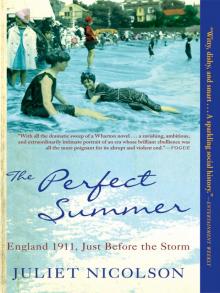
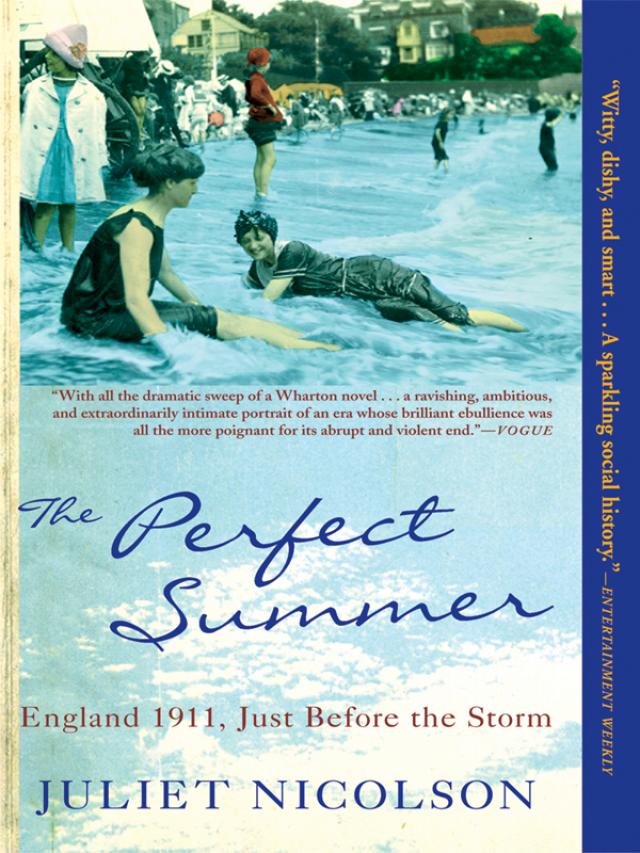
THE PERFECT
SUMMER
Juliet Nicolson
A G R O V E P R E S S R E A D I N G G R O U P G U I D E BY BARBARA PUTNAM
ABOUT THIS GUIDE
We hope that these discussion questions will enhance your reading group’s exploration of Juliet Nicolson’s The Perfect Summer. They are meant to stimulate discussion, offer new viewpoints, and enrich your enjoyment of the book.
More reading group guides and additional information, including summaries, author tours, and author sites for other fine Grove Press titles, may be found on our Web site, www.groveatlantic.com.
If England was what England seems
An’ not the England of our dreams,
But only putty, brass, an’ paint,
’Ow quick we’d drop ’er! But she ain’t!
“The Return,” Rudyard Kipling
QU E S T I O N S F O R D I S C U S S I O N
1. What is the paradox in the title of Nicolson’s book?
“It was a summer when, as the Countess of Fingall put it, ‘We danced on the edge of an abyss.’ There was a sense of urgency about that summer. Socialites crammed in their gaiety as intensively as the poor made their grievances apparent. It was as if time was running out” (p. 2). Talk about examples of the sense of urgency . . . and the lack of it. This life on the edge had one expression in Vita Sackville-West: “Why worry? Why not enjoy the present? We may all be dead tomorrow, or there may be a war or an earthquake…I think one never enjoys life so much as when it becomes dangerous” (p. 88). Is this attitude usually or always associated with those of privilege? Can you think of exceptions?
2. In a country with a reputation for being straight-laced, this book pulls the curtains apart for some delightful aberrant behavior. Talk about some of the high jinks, discovered and undiscovered. (Remember those gapping curtains and the ignored 6:00 a.m. warning bell.)
3. How does Juliet Nicolson’s voice affect our understanding of this post-Edwardian summer? Does her living at Sissinghurst lend undeniable authority to stories of her ancestors’ world? Do you detect a sympathetic delight in her tales of Diana Manners and the Corrupt Coterie? (see pp. 88-89).
4. Do you sense any nostalgia for those days of 1911, even with all the class rigidity and the vast gap between rich and poor? What is it the writer—and reader—might miss in latter-day England? At the same time, do the “rumblings” reflect a democratic trend for the better? After the coronation of George V, “Lady Ottoline returned home to Bedford Square, ‘utterly exhausted by that puppet show,’ declaring further that ‘It was hateful and I am more Republican than ever’” (p. 117). Do you feel ambivalence about the past as opposed to the present? What are sticking points for you?
5. “Cornflakes and tea bags had arrived on breakfast tables” (p. 15). Are you surprised the United States plays such a minimal role in Nicolson’s England of 1911? Can you recall any Americans who appear in these stories?
6. Does The Perfect Summer give you the idea that events of years following might have gone another direction? What might have made a difference?
7. Tina Brown says that Juliet Nicolson has invented a new kind of social history. What is it that feels fresh? Can you think of other books, even historical novels, that use research and detail in ways Nicolson does?
8. Do you feel Nicolson provides enough information about the coming cataclysm in Europe? Or is it more effective to leave the reader with the unsuspecting majority in the summer of 1911? Does her understated foreshadowing create a balance of suspense and momentum?
9. How does the weather become a central character?
What begins as a blithe, even perfect summer, becomes catastrophic for crops and perhaps tempers. Do you think the strikes were provoked by the miseries of people that summer? “To the young novelist D. H. Lawrence, from the Midlands, London seemed like ‘some hoary massive underworld, a hoary ponderous inferno.The traffic flows through the rigid grey streets like the rivers of hell through the banks of rocky ash’” (p. 127). What other responses do you recall to this record-breaking heat of 1911? In contrast, the Royals seem to have found ways of coping. According to the Mistress of the Robes, as she accompanied the King and Queen to Ireland: “The yacht was too delicious after the heat in the train, though even that was quite bearable with fans and lumps of ice” (p. 127). What helps you to understand this oppressive heat? Widespread summer blackouts? Other experiences?
10. One aspect of this perfect summer is Siegfried Sassoon’s memory: “Sitting under the Irish yew, we seemed to have forgotten that there was such a thing as the future” (p. 135). Sassoon could play cricket, write poems, and walk among the tea roses, tree peonies, and lavender, and drink iced coffee and claret cup between tennis games. His biggest problem was beginning to sort out his sexual proclivity. But his coachman’s son, John, saw the drudgery, poor sanitation, and disease behind the romanticized view of life in the country (see p. 138). Are these discrepancies exacerbated by industrialization and the flight of the young from the land? Rider Haggard said, “Nature, in my opinion, only appeals to the truly educated” (p. 139). Do you agree?
11. Do you emerge from this book with a clear idea of what it is to be English . . . at least in 1911? Is there still a coherent norm at the time of the book? Are there vestiges of this world today among the English you know or read about?
12. What do we learn about the royal family, especially in the transition from Edward VII to George V? Does Queen Mary come alive for you? What are we told about the Prince of Wales (later Edward VIII)? Are there intimations of 1936?
13. The Winston Churchill of these pages may be different from the elder statesman you know better. “At thirty-six, Winston Churchill was the youngest Home Secretary since Robert Peel nearly a hundred years earlier. Eloquent, inexhaustible, and a radical risk-taker, Winston was a man both personally and professionally in full flight” (p. 41). Violet Asquith, daughter of the prime minister, “found him striking not only in his ‘magnificent and effortless use of language’ but for his impressive and ambitious arrogance. ‘We are all worms’, he said, ‘but I do believe I am a glow worm’” (pp. 41-42). Not surprisingly, he was often resented for his self-absorption. (Do you find that people of mission often are?) At the Coronation, Rudyard Kipling noted that “Churchill, full of all his own self-importance and showiness, seemed ‘like an obscene paper back French novel in the Bodleian’ ” (p. 115). What are pieces of Churchill history that humanize him? What about his relationship with his legendary mother, Jennie Jerome? And his marriage? And fatherhood—the Winston who couldn’t wait to go build sandcastles with his family on the coast of Kent?
14. As a public person, Winston was invited by the Kaiser (first cousin of George V) to visit Germany. Sir Edward Grey, foreign minister and lodger with the Churchills in Eccleston Square, realized that Winston was “exhilarated by the air of crisis and high events” in these days (p. 57). How did the establishment of The Other Club reflect his character? Churchill and F. E. Smith could go hammer and tong in the House of Commons and then repair to The Other Club for serious drinking, dining, repartee, and friendship. What did each give the other that was irreplaceable?
15. Is the Rudyard Kipling of the book the one you recognize from his writings? What is his reputation at the time?
16. When Eric Horne, the butler, takes the stage (pp.148-154), do you find it a tonic after the hothouse aristocrats? What are the talents that both appeal to his employers and sustain him personally? What are some astonishing examples of the upper class use and abuse of servants? Are your Masterpiece Theater ideas of upstairs-downstairs lives confirmed?
17. Change was both inevitable and necessary in this world, as some saw it. Virginia Stephen (later Woolf) wrote about the ripples among domestic servants: “The Victorian cook lived like a leviathan in the lower depths, formidable, silent, obscure, inscrutable; the Georgian cook is a creature of sunshine and fresh air; in and out of the drawing room, now to borrow The Daily Herald, now to ask advice about a hat. All humanrelations have shifted—those between masters and servants, husbands and wives, parents and children. And when human relations change there is at the same time a change in religion, conduct, politics, and literature” (p. 156). Do you think Virginia Stephen was being optimistic or at least observing through the prism of her liberal Bloomsbury set? Is she at least prescient?
18. How is it that new members of the House of Lords included the writers J. M. Barrie, Bernard Shaw, and Thomas Hardy?
19. What are the reforms of the National Insurance Act proposed by Lloyd George? Why is it so controversial? (see pp. 173-174).
20. What kind of person is Ben Tillett? How would you explain his influence? (see pp. 180 ff.) Do you find him a compelling figure?
21. Talk about the power of women in 1911. For the high-born, what are the privileges and where are the closed doors? What are the conditions for poor women in the work place and at home? (see pp. 198 ff.) Who was Mary Macarthur?
22. In late July in England, drought scorched the earth and no birds sang. Rumblings on the docks and threats of German aggression added to England’s woes. What provokes Lloyd George to thunder, “I say emphatically that peace at that price would be a humiliation intolerable for a great country like ours to endure” (p. 171). What are the ensuing consequences for the military and the infrastructure?
23. What is the impact of Diaghilev’s bringing les Ballets Russes to London? Rupert Brooke made fifteen trips to see it, and actress Ellen Terry thought the Russian Ballet had elevated dance to its “primal nobility” (p. 121).What qualities in the dance, particularly in the sublime Nijinsky, appealed to restless intellectuals? Do you find it ironic that the same society that had condemned Oscar Wilde very few years ago now wined and dined Diaghilev and his dancers?
24. What kinds of technology were making inroads?
Automobiles? Airplanes? Wouldn’t you have liked to see a test run for aerial mail delivery with “a postman in full Royal Mail uniform and cap clinging on precariously behind the pilot as they wobbled through the sky”? (p. 223). Motion pictures? What else? How was the arrival of electricity, for instance, a mixed blessing for the working class?
25. Incidental and entertaining intelligence romps through the pages. What, for instance, was the origin of the term “the Loo”? (p. 80).
26. Appearances of many characters, including bit players in this book, make it seem a glittering world. Who were some of your favorites? Which ones surprised you? One thinks of A. A. Milne, John Singer Sergeant, Nellie Melba, Enrico Caruso, Georges Escoffier, the whole Bloomsbury crowd . . . and on and on. From the world of the Sitwells to the young singer and finally soldier, Brian Calkin, who closes the book, we are immersed in a world both somewhat familiar and still new to us.
27. How is the Titanic an emblem for events in the book, technological advance, aristocratic privilege, and supreme confidence? Does its proposed maiden voyage in April of 1912 after the Perfect Summer make us think also of the Perfect Storm?
S U G G E S T I O N S F O R F U R T H E R R E A D I N G :
The Go-Between by L. P. Hartley; The Edwardians by Vita Sackville-West; Howards End by E. M. Forster; The Strange Death of Liberal England by George Dangerfield; The Edwardians by Roy Hattersley; The Proud Tower by Barbara W. Tuchman; Queen Mary by James Pope-Hennessy; Nijinsky by Richard Buckle
Juliet Nicolson, The Perfect Summer