L ron hubbard presents w.., p.13
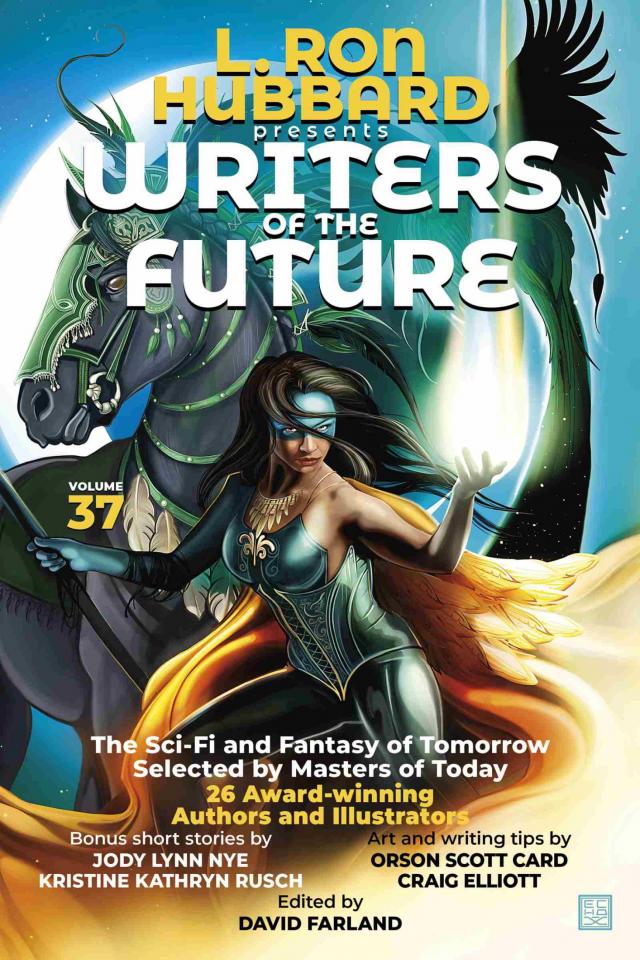
L. Ron Hubbard Presents Writers of the Future Volume 37,
p.13


The background of “The Dangerous Dimension” is philosophic.
It is quite authentic. The Veda, Yogism, long, long ago found its first chela going into a trance from which he could project himself, the life essence of himself, into far realms and ranges. This Indian basis is quite valid when one considers that all our religions and a great deal of our science has wandered in from India, and that is part of a vast creed.
The next thought comes from Berkeley’s Principles of Human Knowledge where he gives the impression that all is a divine intelligence. This is only a side play on an ancient idea that everything is a Mind and therefore there exists nothing but Mind and, hence, no space.
We can go to Hume who denies everything on the assumption that we only perceive things through our senses and that the world, therefore, either has no validity or else we can never have any knowledge of it.
Kant actually confirms Hume no matter how hard the “old Chinaman of Königsberg” (as Nietzsche called Kant) fought Hume. Kant says we will never have any true idea of the “thing-as-it-is” because man can only see it, touch it, taste it or smell it, and hear it. This is no guarantee of the actual state of the phenomena and so we can only know it as we sense it, not as it very well might be in actuality. Kant was afraid to allow any space anywhere (because we only perceive this sensorially) as he would then have had to have relegated God to space. If there is no space then and if we cannot ever contact the “thing-as-it-is,” we only have to progress a step to fling a man around a Universe where there is actually no space, or, as Kant says, time either because we also perceive that.
Spinoza’s works give several leads to such a thing, mainly his assumption that All is Force which is, after all, but a step from the Unity of All of the Veda of many centuries before. In addition there is the modern denial of matter in Christian Science.
There is much more testimony in favor of mental projection of a body through space than there is in favor of mitogenetic eyes and yet the latter will be more readily accepted since it is “science.”
But this is almost beside the point as the question led much further. We are all interested in these speculations about matter, space and time than we will care to admit to the professors who sometimes prove “something less than kind.” I began to wonder about the validity of this inner circle of “science fiction.” Was it science at all? Or was it something else, even greater? Are we children of science or, to be blunt, philosophers? What would be the difference between them?
A treatise followed entitled “Tomorrow’s Miracles” exploring philosophy, science and the inherent quality of writers creating new worlds and existences far beyond what is known or possible. That article can be read in Writers of the Future Volume 35.
Here we present the story that incited this thought, “The Dangerous Dimension.”
ABOUT THE ILLUSTRATOR
Anh Le was born in Ho Chi Minh City, Vietnam, in 1998. Anh’s name is pronounced like the letter N. His family migrated from Vietnam to the United States in 2007 for a chance at a better life.
Ever since Anh can remember, he loved drawing and creating fantastical characters and monsters from his imagination. He didn’t even have a concept of what art was—he just drew whatever came to mind. His love eventually evolved into a passion to become a concept artist and illustrator.
Anh started his journey by creating complex colored pencil and marker drawings but was introduced to digital painting several years ago and hasn’t been able to stop since. His objective is to immerse viewers in his breathtaking worlds and his own unique view of visual development for films, games, and animations.
Anh was a winner of the L. Ron Hubbard’s Illustrators of the Future Contest and was first featured in Volume 36.
To see more of his work, go to www.anhleart.com.
The Dangerous Dimension
Author’s Note
For reasons pertinent to the happiness of Mankind, by request from the United States Philosophic Society and the refusal of Dr. Henry Mudge, Ph.D., of Yamouth University, the philosophic equation mentioned herein is presented as only Equation C without further expansion.
—L. Ron Hubbard
The room was neither mean nor dingy. It was only cluttered. The great bookcases had gaps in their ranks and the fallen members lay limp-leaved on floor and table. The carpet was a snowdrift of wasted paper. The stuffed owl on the mantel was awry because the lined books there had fallen sideways, knocking the owl around and over to peck dismally at China on the globe of the world. The writing desk was heaped with tottering paper towers.
And still Dr. Mudge worked on.
His spectacles worried him because they kept falling down in front of his eyes; a spot of ink was on his nose and his right hand was stained blue black.
The world could have exploded without in the least disturbing Yamouth’s philosophic professor. In his head whirled a maelstrom of philosophy, physics and higher mathematics and, if examined from within, he would have seemed a very brave man.
Examined from without it was a different matter. For one thing Dr. Mudge was thin, for another he was bald. He was a small man and his head was far too big for his body. His nose was long and his eyes were unusually bright. His thin hands gripped book and pen as every atom of his being was concentrated upon his work.
Once he glanced up at the clock with a worried scowl. It was six-thirty and he must be done in half an hour. He had to be done in half an hour. That would give him just time enough to rush down to the university and address the United States Philosophic Society.
He had not counted on this abrupt stab of mental lightning. He had thought to deliver a calm address on the subject, “Was Spinoza Right in Turning Down the Professorship of …” But when he had begun to delve for a key to Spinoza, a truly wonderful idea had struck him and out he had sailed, at two that day, to dwell wholly in thought. He did not even know that he was cramped from sitting so long in one place.
“Henrrreeee!” came the clarion call.
Henry failed to hear it.
“HENrrrry!”
Again he did not look up.
“HENRY MUDGE! Are you going to come in here and eat your dinner or not?!”
He heard that time, but with less than half an ear. He did not come fully back to the world of beefsteak and mashed potatoes until Mrs. Doolin, his housekeeper, stood like a thundercloud in the study door. She was a big woman with what might be described as a forceful personality. She was very righteous, and when she saw the state of that study she drew herself up something on the order of a general about to order an execution.
“Henry! What have you been doing? And look at you! A smudge on your nose—and an ink spot on your coat!”
Henry might fight the universe, but Mrs. Doolin was the bogeyman of Henry’s life. Ten years before, she had descended upon him and since that time …
“Yes, Lizzie,” said Henry, aware for the first time of his stiffness and suddenly very tired.
“Are you coming to dinner or aren’t you? I called you a half-hour ago and the beefsteak will be ruined. And you must dress. What on earth’s gotten into you, Henry Mudge?”
“Yes, Lizzie,” said the doctor placatingly. He came slowly to his feet and his joints cracked loudly.
“What have you done to this place?”
Some of the fire of his enthusiasm swept back into Henry. “Lizzie, I think I have it!” And that thought swept even Lizzie Doolin out of the room as far as he was concerned. He took a few excited steps around the table, raised his glasses up on his forehead and gleamed. “I think I’ve got it!”
“What?” demanded Lizzie Doolin.
“The equation. Oh, this is wonderful. This is marvelous! Lizzie, if I am right, there is a condition without dimension. A negative dimension, Lizzie. Think of it! And all these years they have been trying to find the fourth positive dimension and now by working backwards …”
“Henry Mudge, what are you talking about?”
But Henry had dove into the abstract again and the lightning was flashing inside his head. “The negative dimension! Epistemology!”
“What?”
He scarcely knew she was there. “Look, think of it! You know what you can do with your mind. Mentally you can think you are in Paris. Zip, your mind has mentally taken you to Paris! You can imagine yourself swimming in a river and zip! you are mentally swimming in a river. But the body stays where it is. And why, Lizzie? Why?”
“Henry Mudge—!”
“But there is a negative dimension. I am sure there is. I have almost formulated it and if I can succeed—”
“Henry Mudge, your dinner is getting cold. Stop this nonsense.…”
But he had not heard her. Suddenly he gripped his pen and wrote. And on that blotted piece of paper was set down Equation C.
He was not even aware of any change in him. But half his brain began to stir like an uneasy beast. And then the other half began to stir and mutter.
And on the sheet before him was Equation C.
“Henry Mudge!” said Lizzie with great asperity. “If you don’t come in here and eat your dinner this very minute …” She advanced upon him as the elephant moves upon the dog.
Henry knew in that instant that he had gone too far with her. And half his brain recognized the danger in her. For years he had been in deadly terror of her.…
“I wish I was in Paris,” Henry shivered to himself, starting to back up.
Whup!
“Cognac, m’sieu?” said the waiter.
“Eh?” gaped Henry, glancing up from the sidewalk table. He could not take it in. People were hurrying along the Rue de la Paix, going home as the hour was very late. Some of the cafés were already closed.
“Cognac o vin blanc, m’sieu?” insisted the waiter.
“Really,” said Henry, “I don’t drink. I— Is this Paris?”
“Of a certainty, m’sieu. Perhaps one has already had a sip too much?”
“No, no! I don’t drink,” said Henry, frightened to be in such a position.
The waiter began to count the saucers on the table. “Then m’sieu has done well for one who does not drink. Forty francs, m’sieu.”
Henry guiltily reached into his pocket. But his ink-stained jacket was not his street coat. He had carpet slippers on his feet. His glasses fell down over his eyes. And his searching hands told him that he possessed not a dime.
“Please,” said Henry, “I am out of funds. If you would let me—”
“SO!” cried the waiter, suavity vanishing. “Then you will pay just the same! GENDARME! GENDARME!”
“Oh,” shivered Henry and imagined himself in the peaceful security of his study.
Whup!
Lizzie was gaping at him. “Why … why, where … where did you go? Oh, it must be my eyes. I know it must be my eyes. Those fainting spells did mean something then. Yes, I am sure of it.” She glanced at the clock. “Look, you haven’t eaten dinner yet! You come right into the dining room this instant!”
Meekly, but inwardly aghast, Henry tagged her into the dining room. She set a plate before him. He was not very hungry, but he managed to eat. He was greatly perplexed and upset. The negative dimension had been there after all. And there was certainly no difficulty stepping into it and out of it. Mind was everything, then, and body nothing. Or mind could control body.… Oh, it was very puzzling.
“What are you dreaming about?” challenged Lizzie. “Get upstairs and get dressed. It’s seven this very minute!”
Henry plodded out into the hall and up the stairs. He got to his room and saw that all his things were laid out.
Oh, it was very puzzling, he told himself as he sat down on the edge of the bed. He started to remove one carpet slipper and then scowled in deep thought at the floor.
Twenty minutes later Lizzie knocked at his door. “Henry, you’re late already!”
He started guiltily. He had not even taken that slipper off. If Lizzie found him in here— She was starting to open the door.
“I ought to be there this very minute,” thought Henry, envisioning the lecture hall.
Whup!
It startled him to see them filing in. He stood nervously on the platform, suddenly aware of his carpet slippers and ink-stained working jacket, the spot on his nose and his almost black hand. Nervously, he tried to edge back.
The dean was there. “Why … why, Dr. Mudge. I didn’t see you come in.” The dean looked him up and down and frowned. “I hardly think that your present attire …”
Henry visualized the clothes laid out on his bed and started to cough an apology.
“I … er …”
Whup!
“What’s that, Henry?” said Lizzie. “My heavens, where are you?”
“In here, Lizzie,” said Henry on the edge of his bed.
She bustled into the room. “Why, you’re not dressed! Henry Mudge, I don’t know what is happening to your wits. You will keep everybody waiting at the university—”
“Ohhh,” groaned Henry. But it was too late.
Whup!
“My dear fellow,” said the dean, startled. “What … er … what happened to you? I was saying that I scarcely thought it proper—”
“Please, I—” But that was as far as Henry got.
Whup!
“I know it’s my eyes,” said Lizzie.
“Stop!” wailed Henry. “Don’t say anything! Please don’t say anything. Please, please, please don’t say anything!”
She was suddenly all concern. “Why, you’re pale, Henry. Don’t you feel well?”
“No— I mean yes. I’m all right. But don’t suggest anything. I …” But how could he state it? He was frightened half to death by the sudden possibilities which presented themselves to him. All he had to do was visualize anything and that scene was the scene in which he found himself. All anybody had to do was suggest something and zip! there he was.
At first it had been a little difficult, but the gigantic beast Thought had risen into full power.
“You dress,” said Lizzie.
But he was afraid to start disrobing. What if he thought—
No, he must learn to control this. Somehow he had missed something. If he could get the entire equation straight and its solution, he would have the full answer. But Thought was drunk with power and would not be denied.
Henry rushed past Mrs. Doolin and down the steps to his study. He quickly sat in his chair and gripped his pen with determination. There was Equation C. Now if he could solve the rest of it he would be all right. He only had to substitute certain values …
Lizzie had followed him down. “Henry, I think you must be going crazy. Imagine keeping all those men waiting in the lecture hall—”
Whup!
Henry groaned and heard the dean say, “It was to be our pleasure this evening that we hear from Dr. Mudge on the subject—”
Somebody twitched at the dean’s sleeve. “He’s right beside you.”
The dean looked and there was Henry, tweed jacket, ink stains, carpet slippers and all. Beads of perspiration were standing out on Henry’s bulging forehead.
“Go right ahead,” whispered the dean. “I do not approve of your attire, but it is too late now.”
Henry stood up, fiery red and choked with stage fright. He looked down across the amused sea of faces and cleared his throat. The hall quieted slowly.
“Gentlemen,” said Henry, “I have made a most alarming discovery. Forgive me for so appearing before you, but it could not be helped. Mankind has long expected the existence of a state of mind wherein it might be possible to follow thought. However—” His lecture presence broke as he recalled his carpet slippers. Voice nervous and key-jumpy, he rushed on. “However, the arrival at actual transposition of person by thought alone was never attained because mankind has been searching forward instead of backward. That is, mankind has been looking for the existence of nothing in the fourth dimension instead of the existence—” He tried to make his mind clear. Stage fright was making him become involved. “I mean to say, the negative dimension is not the fourth dimension but no dimension. The existence of nothing as …”
Some of the staid gentlemen in the front row were not so staid. They were trying not to laugh because the rest of the hall was silent.
“What idiocy is that man babbling?” said the dean to the university president behind his hand.
Dr. Mudge’s knees were shaking. Somebody tittered openly in the fourth row.
“I mean,” plunged Mudge, desperately, “that when a man imagines himself elsewhere, his mind seems to really be elsewhere for the moment. The yogi takes several means of accomplishing this, evidently long practiced in the negative dimension. Several great thinkers such as Buddha have been able to appear bodily at a distance when they weren’t there but …” he swallowed again, “but elsewhere when they were there. The metaphysicist has attributed supernatural qualities to the phenomenon known as an ‘apport,’ in which people and such appear in one room without going through a door when they were in the other room.…”
Dear me, he thought to himself, this is a dreadful muddle. He could feel the truth behind his words, but he was too acutely aware of a stained jacket and carpet slippers and he kept propping up his glasses.
“If a man should wish to be in some other place, it is entirely possible for him to imagine himself in that place, and, diving back through the negative dimension, to emerge out of it in that place with instantaneous rapidity. To imagine oneself—”
He swallowed hard. An awful thought had hit him, big enough to make him forget his clothes and audience. A man could imagine himself anyplace and then be in that place, zip! But how could a man exert enough willpower to keep from imagining himself in a position of imminent destruction? If he thought— Mudge gritted his teeth. He must not think any such thing. He must not! He knew instinctively that there was one place he could not imagine himself without dying instantly before he could recover and retreat. He did not know the name of that place in the instant, would not allow himself to think of it—