L ron hubbard presents w.., p.31
L. Ron Hubbard Presents Writers of the Future Volume 37,
p.31
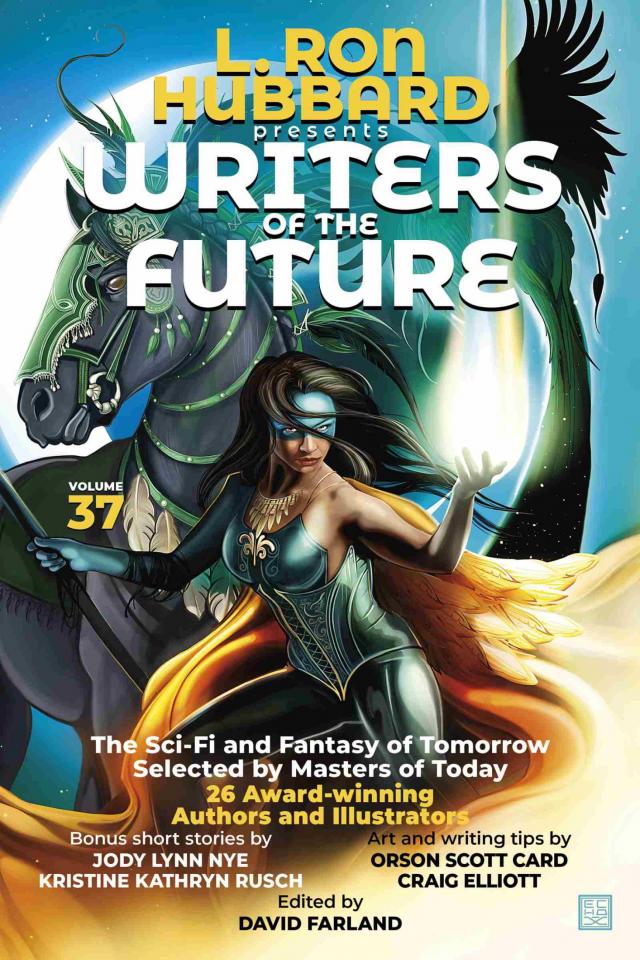


As I write this, the world is exceptionally full of stressors that need balancing. A global pandemic, terrible fires in my native state of California and across the western United States, economic disasters, joblessness, and much more. Without artists and imagination, we would all be so much worse off, and have far fewer tools with which to cope, and no place to escape to in order to feel normal, even for an hour or two. Imagine if there were no movies, TV shows, books, or video games for escape. I think you can see how important this is to the people of our planet.
Yes, there are a world of skills to learn to be able to express our ideas, but the benefit for all people is clear, and worth the effort it takes. You can reach others, heal them, thrill them, make them cry with joy, and lift their hearts with your imagination and ideas. You can make new worlds that have never existed before, and your audience can feel calm and relaxed as they stroll through your landscapes and worlds in their minds.
Many people ask me how they too can dream up worlds like the ones I have created, such as the underworld in Disney’s Hercules or the Victorian high-tech alien landscapes, language, and symbols of Disney’s Treasure Planet. I always try to explain that there is not just one kind of imaginative artwork, and that the process is fairly simple when you understand the procedure.
Imaginative art lies on a spectrum ranging from fully borrowed to reinvented to completely novel. A film such as Avatar clearly borrowed many of its imaginative visual ideas from the artwork of Roger Dean, and so much so that there is a legal battle around it!
Most imaginative works fall somewhere in the middle of the spectrum, in the reinvented range. A company such as Disney reinvents its films intentionally, most often borrowing from elements of previous films to merge with new ideas. This is done so that the look and feel of Disney films are maintained more or less throughout their catalog, and their audience knows what to expect when they see something associated with the Disney brand.
At the extreme novel end of the spectrum lies artistic ideas that are either inspired by completely unrelated ideas or are created with no inspiration point. The former is a far more common and easy way to arrive at a novel idea. Combining things that are not normally associated with one another to create novel ideas takes advantage of how the human mind actually works. It is thought that the mind organizes any new stimulus in relation to previous stimuli. The mind is a relational database of sorts. The smell of burnt toast might have associations with things like a toaster, breakfast, or your grandfather who liked his toast well done. A carrot could be associated with salads, gardening, chicken pot pie, and more. These associations help us navigate the world. If we hear screeching tires and smell burning rubber behind us, our previous associations help us quickly realize that it might be a car about to hit us and we had better get out of the way—even if we do not actually see the car yet.
These associations cause a hindrance when we are trying to think of a novel idea. Our minds can become trapped, only associating carrots with salad and dogs with pets. But what about a dog made of carrots? We have no previous reason to associate these things to one another. This is a novel idea.
One or more ideas, objects, smells, sounds, etc., that in most people’s minds are not normally associated with one another create a novel idea when combined. It is often even better for something like illustrating a story or a script for a film if those associations are not just randomly unassociated things but also have meaning to the story in some way.
An example of this from my career is the language and symbology that I designed into the alien technology for Disney’s Treasure Planet. The directors asked me to design many alien buildings and the planet itself as a machine. There were possible needs in the script to show words in a foreign tongue. And I thought it would work well to extend that design into a decoration or a language so complex to us that the language looked more like alien decoration. I could have pulled ideas from several sources that were not normally associated with language, but I wanted to derive my symbols from something that had meaning or a connection to the story itself. The inspiration for Treasure Planet’s story came from the Scottish novelist Robert Lewis Stevenson’s book Treasure Island. In prehistoric Scotland and England, stones were carved with concentric circular motifs and lines. Later, in the 1990s, a number of late-night artists repurposed these symbols to create the famous English crop circles. This seemed like a perfect symbology that was not associated with any type of language yet and had a wonderful connection to the origin of the Treasure Planet story. This is the kind of ideal and novel imaginative concept that I strive for. One cannot expect to always be able to join these things together, but it can happen if you try!
Even with the rewards of striving to be imaginative, the path of an artist can be a bumpy one at times. Because of the very way our minds work, and as I explained above, people can find imagination jarring. Something out of the ordinary or unexpected is a way that horror filmmakers and writers scare us! Some people will be wary of your art at first or even put off by it. Film studios and publishers will usually reject imaginative ideas in favor of concepts they know and understand or that have made money before. As a result, the imaginative approach has always been an uphill battle in some way.
The creative world is filled with stories of creators butting heads with studios, publishers, or patrons. George Lucas had Twentieth Century Fox shaking in their boots, and they even fired the executive in charge of Star Wars in the process, most likely due to fear and anger over something they didn’t associate with something they already understood. I tell you this so you know that it happens to everyone, even the greats.
The rewards of being creative are so wonderful and long lasting that the bumps in the road are truly minuscule in comparison. Works such as Star Wars and Lord of the Rings, and the work of artists such as Hieronymus Bosch or Moebius are creations that have lasted and will likely last forever.
In the end, the pleasure given and the endless fascination created for people are some of humanity’s most precious treasures; they bring calm happiness and momentary escape through which we can all rebuild our strength and psyche. L. Ron Hubbard himself clearly understood and summarized what I have said when he wrote that “A culture is as rich and capable of surviving as it has imaginative artists.” You are vital, and you are needed. Without artists to hold a mirror to it, society cannot see its weaknesses and failings and overcome them. Artists can see what the average person cannot. Heed the call and give strength and wisdom to us all. This is your birthright and function as artists!
The Museum of Modern Warfare
written by
Kristine Kathryn Rusch
illustrated by
Isabel Gibney
* * *
ABOUT THE AUTHOR
International bestselling writer Kristine Kathryn Rusch has won awards in almost every fiction genre. She writes romance as Kristine Grayson and mystery under the name Kris Nelscott (as well as under the Rusch name). She’s the first female editor of The Magazine of Fantasy & Science Fiction. She retired from that job at the age of thirty-seven, although she still edits anthologies in her spare time. She owns a number of businesses, including a publishing company. She’s the only person to ever win a Hugo for both editing and writing. She also writes a popular publishing blog. The latest installment appears on her website, every Thursday. Every Monday, on the same website, she puts up a short story for free for one week only.
A few years ago, Kris published “The Museum of Modern Warfare” as the free short story on her website for Memorial Day. That became the most popular story she’d ever put on the website. The story hits a chord, so she figured WotF readers would like it as well.
ABOUT THE ILLUSTRATOR
Isabel Gibney is also the illustrator for “The Redemption of Brother Adalum” in this volume. For more information about her, please see her bio here.
The Museum of Modern Warfare
Flew into Craznaust on an orbit-to-ground vehicle. I don’t plan my own schedule, so I had no idea we’d be traveling in an upgraded C-73. I would have protested more, if I knew.
The guts of the C-73 are completely different nowadays, and—they say—so’s the interior. But the advance team used the C-73 because of its innate stability, something any vehicle needs around Craznaust.
Craznaust, the central island in the largest chain on Gephherd, has its own microclimate. Daily winds of eighty kilometers per hour, sustained.
Drove us crazy when we deployed there forty years ago. I still remember the grit in my hair, on my tongue, in my nose. The wind left my skin chapped and my ears raw. Hats didn’t help, nothing helped, and the goggles we had to wear over our eyes, they left their marks too.
I still have a tiny white scar from those goggles beneath my right lid, puckering the skin slightly. Doctors always touch their right eye, and nod toward me silently to tell me they can repair that scar with the brush of some magical medical device. I always walk away from docs like that. They’re younger than me now, and they don’t understand badges of honor.
I got that scar before the Battle of Craznaust, and consider the scar my badge because living on Craznaust day to day was harder than that battle, and in its own way, more devastating.
I’ve lived through dozens of battles, lost hundreds of friends to combat, but none of it haunts me like that year before the Battle of Craznaust broke out, when we were training the locals, coping with the wind, and pretending that nothing was going to happen to us.
I told my husband (the first one) when I finally left active duty (the first time) that the waiting was the hardest. He was career military too, but admin mostly, and he just looked at me like I’d grown a third head.
“You were lucky you weren’t in combat the entire time,” he said. “Some units fought for their full eighteen months.”
I suppose he didn’t mean to be dismissive. At the time, I even knew he was right. We had lost a quarter of our people that year because they were sent to other units, to replace folks who died.
Even back then we tried to fight our wars remotely, but some things can’t be done by drones or bots or whatever form of fighting machine we come up with. Sometimes, when you’re fighting an enemy as technologically talented as the Dylft, you don’t send in unmanned equipment at all, for fear that equipment will get repurposed within the hour and deployed against you.
Yeah, we learned that the hard way, and yeah, it was ugly. Read the accounts of the war if you don’t believe me. Because I’m not rehashing it here.
In fact, the only reason I’m reporting this now is because I’m required to. I waited until the last minute to compose this, partly out of a habit I learned in the Dylft Wars and partly because I needed to get away from Gephherd so that I could think clearly.
I know I’ll touch this thing up, take out half the personal crap—hell, take out all of the personal crap—but I learned when I took this job almost a decade ago that I had to do a primary draft, because the personal always creeps in.
And there’s a lot more personal than the official record shows.
For starters, I lied at my confirmation hearing for my nomination as Ambassador to the Dylft System. I didn’t lie about the “important” stuff, like my politics or my inability to be influenced by money, or fame. I lied about the war’s impact on me.
The Members of Parliament’s questions—CYA questions—echo in my mind as I dictate this draft:
—Ma’am, do you have any lingering emotional scars from your experiences in the Dylft Wars?
—Mr. Minister, according to the reports which you received in my nomination packet from the doctors in the various institutes of health, I have no lingering emotional scars from any war in which I served.
—Yes, Ma’am. We’re familiar with your documentation. But we’re asking you now, under oath, if you believe you have any lingering emotional scars.
—No, sir, Mr. Minister. I do not believe I have any lingering emotional scars, and it would be improper to offer to show you the physical ones I’ve opted to keep as reminders of my service.
[general laughter]
I do not believe I have any lingering emotional scars. I know I have lingering emotional scars. In my defense, I also believed at the time of the hearing that I could conquer those emotions. Ambassador to the Dylft System mostly meant dealing with protocols and fussy meetings with members of my own species. I could—and did—designate underlings to handle negotiations with the various aliens of the system, holding meetings with the representatives of those alien groups only after the topics had been vetted, the discussions preapproved right down to the handshake (or tentacle rub).
Once appointed, I got to design my position, so I didn’t have to worry about the nitty-gritty of cultural investigation, the tiny moments of introduction before a topic was broached in which anything could go wrong, the inevitability of bad translations or communications errors.
My staff dealt with those things, and I appeared for the document approvals, the live-on-camera record of a preplanned event, the state dinners (in which half the diners sat in a different room with completely different atmosphere), the balls, the formal speeches, the ceremonies—the things that needed a figurehead, and I was the figurehead that would do.
My actual work consisted of meetings with my staff, listening to arguments, approving things—things that I could handle, even with my emotional scars.
I was appointed, and ultimately sent to the Dylft System because I understood it, because I spoke five of its languages fluently (and understood fifteen more without an in-person or automated translator), and because I did ceremony well.
I did not expect (nor had I experienced) a meeting that wasn’t vetted, approved, and rehearsed. For that reason, I tried to get someone else to handle the crisis on Craznaust.
I failed.
Which was why I was heading to Craznaust with an entourage of five, a security detail of ten, and a mountain of lingering emotional scars clawing at my heart.
The thing about Craznaust:
It’s beautiful. Golden-white sand beaches, emerald-fronded trees with golden bark, the bluest lagoons I’ve ever seen, and rich, powerful sunlight that bathes everything in a bright but forgiving light.
On my first approach decades ago, I thought I had received the best posting anyone possibly could, particularly in a time of war. An island paradise with warm temperatures, Earth-like vistas, and naturally grown food that I could actually eat.
Then I stepped outside the arrival vehicle into the dry air and felt the water leach from my skin. The wind buffeted my body and I staggered sideways, thinking the gust was part of a storm, not part of a normal day.
I later learned that the storms were something else entirely, with winds that could literally shred anything in their path. We barely had shelter that stood up to storms, and finally learned how the locals survived.
They burrowed.
They had gorgeous cities belowground, reforming water-made caverns into well-lit, well-apportioned rooms that seemed to go on forever.
But for our first few months we didn’t know that and the Cranks, as we call the locals, didn’t tell us.
They didn’t tell us most things.
The Cranks were humanoid bipeds with two arms and four hands. The second pair of hands could emerge from a slit in their arms, almost as if someone had given them all automated limbs. Those second pair of hands allowed the Cranks to carry large items on one side of their bodies without raising one arm and allowed them to hold weapons while moving machinery or rocks or whatever we needed.
The Cranks also had a second set of eyes, but we didn’t learn that for months either. The eyes were literally on the back of their heads, and their hair—or that straw-like stuff that passed for hair—separated like curtains being pulled apart when the Cranks needed to look at something behind them. The elbows on their regular arms bent in either direction, although when the Cranks were near us, they rarely used the arms in that backward way.
The extra arms swiveled from that arm slit, so if the Cranks needed to hold something behind their backs, they could.
There were other differences in their anatomy that we didn’t learn until a few Cranks died in maneuvers and our resident doctor decided to act like a coroner—causing one of the most disturbing incidents at the base.
The Cranks hated having someone unsanctioned touch their dead.
We had a mutiny on our hands, and I had been the one to quell it—only because I was the only one who had attempted to learn Naust, the Cranks’s language. I talked to them as best I could, told them (as best I could) that we hadn’t meant harm, and convinced them that we had simply made a logical error based on our own customs.
And then we went back to our not-quite-harmonious existence.
The Cranks weren’t that interested in fighting the Dylft. The Cranks just wanted everyone off their island chain and we had gotten there first, with a promise of aide, personnel, and equipment.
Until this past week, I thought that if the Dylft had arrived first, the Cranks would’ve fought with them.
No matter.
What matters is this: we arrived first, we trained the Cranks, and together we fought—and won—one of the turning-point battles of the war, if not the turning-point battle.
Once Craznaust was secure, we parted as allies who had gone through something harrowing and escaped to the other side with our lives more or less intact.