L ron hubbard presents w.., p.21
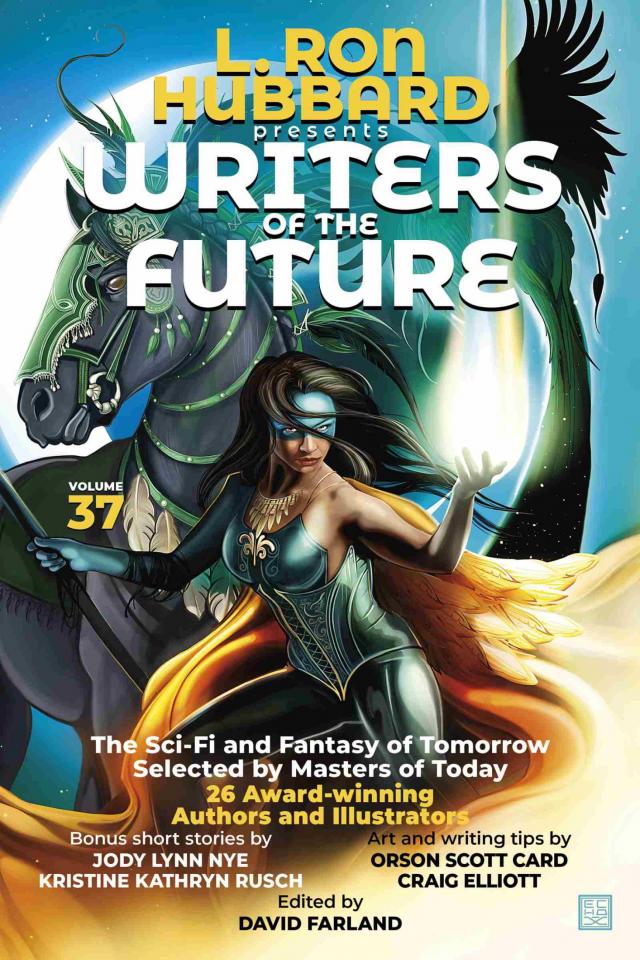
L. Ron Hubbard Presents Writers of the Future Volume 37,
p.21


“Everything is all so much more vivid in this body, especially when I’m near you. I should be able to maintain this form for longer intervals if I practice.”
“To what purpose, Argent?”
“To experience what it’s like to be human. Could I try that? With you?”
Logical arguments are born and die in the space of an eye blink. It’s not rational, but I accept this situation the way I reconcile science and faith.
Due to protocols following a survey, I have a mandatory forty hours off. Argent and I walk through the older part of Nadeyus, where the first apartments were built out of shipping containers, green stacked upon blue stacked upon red. Most are overgrown with devil’s ivy, a vine that survives off water and air, their roots in the condenser vats. I grew up in three maroon containers on the top level, arranged in an “L” and welded together, plus a shared roof garden.
I point it out to Argent as we walk past, explain the corporate sponsor logos on the container exteriors, only of historical significance now.
There’s a small market in the old town where people barter handicrafts and roof-garden vegetables. Someone has made strawberry-flavored ice pops, and I use some of my free ration points to buy some. As we’re complimenting each other on the redness of our lips, we run into Maia and Ty.
Maia grins widely. I’m caught and have no choice but to make introductions.
“Nani’s making samosas,” Ty says. “You should come.”
This is directed to Argent, who defeats me with a look.
Dad used his personal weight allotment for books; Mum used hers to pack a lifetime of spices. Cardamom and curry and turmeric and delicate red strands of saffron and star-shaped anise. She’s a surgeon and pragmatic in her vices. Words, she said, could be transported in digital form; flavor could not.
I lead Argent up to my parents’ apartment, Ty bounding up ahead of us. Inside, Electra is working the dough, and the rooms smell like hot oil and spices. Argent takes in the braided rag carpet that covers the living room floor, the packed bookshelf, the patchwork lamp I made in basic metallurgy.
Maia ducks into the kitchen, and a moment later Mum comes out and shakes Argent’s hand.
“It is always a pleasure to meet one of Merope’s friends,” she says with a smile that makes up for the others’ grins.
Argent hovers over Mum’s shoulder while she mixes the filling, smells each spice and listens to her explanation of how it’s grown on Earth. He picks up our digital photo cube and inquires about the grainy scanned photographs of our great-grandparents. He seems genuinely delighted while Ty gives him a lecture on the history project she’s doing at school.
Mum sets down the first batch of golden-brown triangles.
“Eat them quick before the neighbors smell them and ‘happen’ to stop by,” she tells Argent with a wink.
In what little spare time I have, I try to unravel the science behind Argent’s ability to physically manifest. I don’t ask him to explain. I want to understand at my own pace. The quantum physics text I download from the database seems to go hand in hand with Dad’s beloved mythology, powered more by belief than math. Matter is just another aspect of energy, convertible from one state to the other. It sounds like the relationship between body and soul, life and afterlife.
Theoretically, a being made of energy, with the ability to manipulate that energy at will, could absolutely convert some of that energy to matter. Could, with enough study and patience and time, replicate the intricacies of the human body. We are our DNA, and what is DNA but a string of code? Apply the right code to raw material, and one could print infinite complexities.
The uranium deposit eludes us. Trace deposits in every core sample, but never in the concentrations we theorize should be there. Tem, Lopez, Stein, Jameson, Eun-ji, and I are all off-shift and riding the Argentum home, and it’s the topic of the hour. Tem ropes everyone into going to “happy hour,” an Earth tradition that Jameson and Stein have kept alive in our crew. We get off at Temerity Station, and Argent materializes beside me, attaching himself naturally to the end of our train. We go to our usual place, a pub that Jameson maintains isn’t entitled to the name until they get beer on tap, order a bottle of vodka and one of soda, plates of potato latkes and fries, which never put too large a dent in one’s ration quotient. During the second round, Eun-ji pulls out her notebook and projects the geological map of the cave over the table, and we resume our ever-ongoing argument of where to dig next.
“I think here,” I say, marking a spot with a half-eaten fry. “There’s a discrepancy in age between this rhodochrosite deposit and the flint next to it. I think it’s an indication of an unconformity.”
“Nope,” Stein argues, countering with a quarter latke. “Outside the cave, where we found that sandstone.”
“There were only micrometers of that sandstone!” Eun-ji scoffs. And so it goes.
Throughout this, Argent sits quietly, a vacant expression on his face. The others assume they’ve lost his interest.
“Sorry, man.” Tem notices first and slaps Argent on the back. “Terra would have thrown down a red flag by now. Come on, guys, ix-nay on the mining talk in mixed company.”
“You should dig where Merope says,” Argent says, coming out of his funk.
“Oy, lover boy, look at you racking up the points,” cries Jameson. “If that’s the case, I say we dig where Stein wants.”
The conversation devolves. Only Lopez stays aloof, her eyes glued to the holo-display still superimposed over the latkes and glasses.
Argent’s hand finds mine on the bench.
Argent and I are in my apartment. I feel shy as he inspects my rock collection. He doesn’t glow like he used to, though his skin is still too clean. This is because he rebuilds his body from scratch every time he manifests.
He sits next to me on the bed, and I note the depression from his weight. I feel like I’m always looking for evidence of his physicality. He touches my cheek, kisses me. It feels real. There’s a twisting pain in my heart. I know, logically, that as closely as Argent can mimic, he isn’t human. I have no idea how his mind works, whether he even has emotions, whether he sees me as anything more than an experiment. It’s foolish to fall in love with a ball of energy that can power a starship, traverse time and space, and print matter at will.
Argent breaks the kiss, and we look into each other’s eyes. His eyes still glow, yet they seem the most human part of him, and I know that I’ve already fallen off the edge. All I can do now is enjoy the trip down.
His lips trace the line of my pulse, his fingers wander. I feel his weight atop me, but it’s my own anticipation that is crushing me, making it hard to breathe.
And then, he’s gone. I punch my pillow in frustration.
My hunch is substantiated by Lopez’s nose, and we hit uranium. Accordingly, we’re all working doubles, catching sleep in the lead-lined, pressurized bivouac we’ve erected on the plains near the dig site and living off iodine-laced mush. We take two-hour naps in the bivouac; otherwise, we’re in our suits, and we feel like sardines stewing in cans.
When I finish decontamination and walk into the bivouac for my nap, Argent is sitting on my bunk, no protective suit, looking perfectly clean and untouched and so different from my tired, sweaty self, that something Dad used to say flashes through my mind. He used to say that if people truly wanted grace, they should look not to the gods but to their fellow man. A god, by definition, is perfect. A perfect being doesn’t feel pain, doesn’t make mistakes or have regrets. And if one doesn’t know regret, how can one forgive? If one doesn’t know pain or want or need, how can one feel compassion or love?
“Why are you here?” I ask waspishly.
“I wanted to talk to you,” Argent says, smiling.
“You don’t even have a suit. There’s radiation.”
“The radiation doesn’t bother me. And this body is actually relatively easy to adjust to different atmospheres. I might have to grow something like gills to filter out toxins.”
“Argent, if you want to experience being human, you can’t just grow gills when it suits you. Being human means being vulnerable. It means you need breath masks and radiation suits. It means you get sick and old and one day die, and it means …”
He reaches for me, but I shy away.
“Are you angry with me?” he asks.
“No, I just need some time alone. Please?”
Our eyes meet, and there is an expression I’ve never seen in them before. He nods, mute, and dematerializes.
I lie red-eyed for an hour, trying to pinpoint the source of my anger. I realize, as I pull my suit back on, that I’m a self-fulfilling prophecy. I’m afraid of Argent hurting me, so I hurt him first.
And then, I realize, I hurt him. I’ve rendered my own argument invalid.
I’m inside the cave, operating the drill. Tem and Lopez are down in the shaft, digging out what the drill has loosened and loading the ore into a cart for the drone to lift out. Eun-ji is arguing with Czerny over preservation of cave integrity.
“You two, fight on a private channel,” Lopez snaps.
I smile as, instead of switching off, they draw Lopez into the fray. Belatedly, I focus on what the bots are telling me.
“Tem, stop drilling,” I say over the chatter, noticing something that I don’t have time to register because there is only the briefest of rumbles before the earth rushes toward my faceplate.
A great, suffocating weight. Hot, yellow darkness like sulfur. I think of hell and believe I’m there.
Then the weight lifts. I see Argent peering down at me. He is different. Human in form and yet not human at all. His skin glows. He picks me up and lays me upon a slope of rubble that didn’t exist before. I watch him dig, wrenching up boulders that fill the circumference of his arms and setting them gently aside as if they weigh nothing. Then I fall back into darkness.
In the small hospital on Temerity Station, I regain consciousness. My mother sits at my bedside, professional and comforting in her crisp white coat, and tells me that Tem and Lopez didn’t make it. Later, Chief Singh comes by and explains that we hit a pressurized pocket of hydrogen. It blew the shaft and caused a cave-in.
“I was the spotter, I should have caught it,” I say.
“Some things are out of our control, Merope. Sometimes fate takes a hand.” Singh’s the same age Dad would be if he’d lived. They were friends from the colony ship, and I hear Dad’s words in his. Permission to forgive myself someday. Maybe.
Several of my ribs are fractured, and my left leg is shattered from the knee down. Mum thinks my spine will be fine, but they are keeping me in traction to be safe. Jameson, Czerny, and Eun-ji are all here too, nursing varying degrees of injury.
Lopez and Tem both suffocated. The weight of the rock above them crushed the air from their lungs.
No one mentions Argent, except indirectly as they go on and on about the miracle of how they found all six of us aboveground, laid out in a row, survivors and corpses side by side.
Terra comes by. Singh visited her, too. She sits at my bedside and tells me she’s glad I survived, that she couldn’t have lost both of us. I start to apologize, but the words choke in my mouth. She holds my hand, unspeaking, and we cry together. I go back and forth, a pendulum swinging between self-loathing and blame, sadness and acceptance. My sisters visit in a constant stream. They ask about Argent at first, but it gets around that he hasn’t visited, so they stop.
I’m fitted with an exoskeleton that allows me to walk while my body is adjusting to the artificial patella Mum installed. My first solo excursion is to ride the Argentum.
I ride from Nadeyus to Temerity, from Temerity to the Svart, but he doesn’t appear.
When the doors close again at Svart Station, I say, “Argent, please come out. I need to speak with you.”
A breath, then two, then he appears. He glows at first then, as if with great effort, the glow fades.
“I’ve been looking for them,” he says. “But I can’t find them anywhere.”
“Looking for whom?”
“Lopez and Tem.”
“You did find them, Argent. Thank you, by the way, for saving us, for recovering their bodies.”
“No, I mean I looked for them. What I found under the rock was inanimate matter, but you all have an energy that powers you. Energy can’t just disappear.”
“Argent, you’ve studied us. Surely you know we die.”
“Yes, I know about the state of death, but almost all your literature says at that point your energy transforms into the soul. That is the true part of you, a higher energy state.”
I realize that the tales of the afterlife must sound to Argent like his own existence. “You thought of it as evolution?”
“Isn’t it? Your books say it is. Even the Bhagavad Gita says, ‘The body is mortal, but he who dwells in the body is immortal and immeasurable.’” He looks at me like a child, desperate to understand.
Tears sting my eyes. I’m still in grief’s grip, but Argent … Argent bleeds. I was wrong when I thought he couldn’t be hurt, couldn’t want or need or love. He just never had the opportunity. And now he is overwhelmed by the finality of a truth for which his experience has given him no context.
I step outside my own sorrow, my own disbelief in a future where my leg has healed, and I go back to the mines where there is no Tem joking over the comms, no Lopez going silent to listen to her legendary “nose.” I take his hands in mine and quote lines of scripture that I only half believed before. But I believe them as I say them, with all my heart.
“‘O mighty Arjuna, even if you believe the Self to be subject to birth and death, you should not grieve. Death is inevitable for the living; birth is inevitable for the dead. Since these are unavoidable, you should not sorrow.’ ‘All goes onward and outward, nothing collapses, and to die is different from what any one supposed, and luckier.’”
“That last part isn’t from the book,” he says.
“No, it’s Walt Whitman. Argent, Tem and Lopez as we know them are gone. Each person, each life is a … an accumulation of miraculous coincidence. Beautiful because there has never been anything like them before and will never be again. But I don’t believe their energy is gone just because you can’t find it; it’s just converted into something you can’t recognize. Maybe into a new life. Maybe as part of the cosmic energy that binds the universe together. What you’re feeling now, this pain, it’s you finally experiencing what it is to be human. Because to be human means living and falling in love and working hard and dreaming of the future, knowing all the while that at any moment you might have to say goodbye.”
Tears glisten in his gray eyes. I wipe them with my thumbs, leaving dark streaks on his pale cheeks. The dust of Canis touching him at last.
“I didn’t know it would be like this,” he whispers. “And you, someday you’ll die as well.”
“Yes.”
Hope lights his face. “I could study, experiment. Perhaps I can change your matter, teach you how to regenerate.…”
He trails off, reading the revulsion in my face.
“No, Argent,” I say. “You mustn’t do that.”
“But why?”
“It would make me into something not human, and I don’t think I’d like that. And you shouldn’t feel like you need to be different either. I’m sorry I pressured you to act more human.”
Argent is disturbed, and it’s affecting his concentration. He’s starting to fade, and there’s a distance in his eyes as his hold on his physical form loosens.
“It was better before. I was alone, but I didn’t feel lonely. I didn’t hurt.” He puts a hand to his chest and rubs. His fingers meld with the fabric.
My grip on his other hand slips; no, slips through. He looks at me. “I don’t want to say goodbye to you.”
“Then don’t,” I say.
But still he disappears.
When I graduate from the exoskeleton to a brace, I’m cleared for work, though I’m housebound to Svart Station until Mum clears me for climbing mountains. Mostly, I’m glued to a console, monitoring the heap-leaching process. After a long shift, instead of catching a flight home, I climb the maintenance ladder to one of the rooftops, my leg aching in a way it never did before.
If I face north, I can watch the great smokestacks belching into the sky. But I sit facing westward and watch the Canis sunset, which has been going on for the last three hours. Not that I can actually see the sun. Sunset is only apparent by the color of the haze. Usually, it’s a deep, bloody red, shading to violet. Sometimes it’s orange and green. But today it’s a pale, yellowish silver with bright rays illuminating the hidden features of the Svart like the radiance of God.
Illustration by Rupam Grimoeuvre
The Argentum, the tireless train, runs no more. The mysterious energy that powered it has gone. And though I know it will puzzle our engineers for generations to come, I don’t share what I know.
If I could see Argent one more time, I would tell him I understand. I think love must be the most terrifying thing in existence. When I view things from Argent’s perspective, I marvel that we can all go around day after day, loving spouses and parents, siblings and children, without reserve, all the while knowing that each goodbye could be the last. But humans have developed an evolutionary capacity to survive—the ability to forget, to believe in our delusions of hope. I don’t blame Argent for running. How impossible it must be to be human without that ability. Argent, with his perfect memory, would never be able to forget, to deceive himself.
If he’d stayed, maybe I could’ve helped him develop that ability. Maybe it’s something that can be learned.