Scarlet carnation a nove.., p.20
Scarlet Carnation: A Novel,
p.20


I do not condone the response of my fellow soldiers, but I do understand the anger. We have been humiliated and disrespected from the moment we arrived in Houston. Our United States uniforms mean nothing to the white men who are continually “putting us in our place.” I thought I understood the depths of contempt for our race, but nothing has prepared me for this.
One of the leaders of the rebellion is also named Joseph Smith. Do not fear that I am unsafe should you read his name in the newspaper. I remained at our base on August 24th and I am still here, doing my duty to my country even though it does not return the favor. I am showing the dignity of our race, in spite of the difficulties.
As always I remain your dutiful and loving son,
Joseph
PS. Give my love to Gramma Jordan and Maggie.
Naomi’s hand trembled as she placed the letter on the table. She forced herself to take a few shaky breaths. Her body swirled with fury, relief, compassion, and fear. How could they compel her son to stay in a hostile situation in his very own nation? He’d signed up to fight Germans, to defend the ideals of America. And he was being forced to defend his dignity and safety from white Americans.
She folded up the letter, returned it to its envelope, and left it on the table for Willie to read when he came home that night. They would have two days to pray together for their sons, and she would sleep a little easier with him in their bed.
CHAPTER 21
MAY
August 1917
The house in San Rafael was beautiful, everything she and John dreamed of when they were courting. Or when she believed they were. Built in the arts and crafts style she adored, it had dark wood paneling and high coved ceilings. John’s eyes shone in delight as he showed her through the four bedrooms and two bathrooms.
“There is room for a larger family, as you can see,” he declared. “I’m only sad that you weren’t able to decorate it yourself.”
You only have yourself to blame, she thought, but didn’t say out loud. Keeping her ambivalence hidden, she gave him a tight smile. She appreciated his enthusiasm, and loved this house, but was uncertain of the correct course for their future.
“I thought we could walk to my college, and then return for lunch,” he suggested. “It is just ten minutes up Grand Avenue.”
“Kay Lynn will be hungry at noon,” May responded. “Can we return in time to eat by then?”
“Easily!” he declared. He reached his hands for Kay Lynn but she shook her head and clung to May. It was too soon.
May carried Kay Lynn up the hill. The toddler would have taken a long time to make this climb. Golden hills dotted with oaks rose around them. John spoke about the history of the college during the lovely walk to the campus and his office. He showed them around the campus until they came to an overlook with a view of the East Bay rising across the water.
May put Kay Lynn down and the girl spun around at her feet.
“What is she doing?” John asked.
May shrugged. “She likes to spin until she falls down. Apparently many one-year-olds think that is a delightful pastime.”
John made a noncommittal face. He didn’t seem to find Kay Lynn either charming or difficult. He wiped moisture from his brow and stepped very close to May.
He grabbed her hand. “This is everything we dreamed of. A home on a hill overlooking the bay close to a professorship for me.”
He got down on one knee and held a ring out to her. “May Wagner, please do me the honor of becoming my wife.”
Stunned, May stared at the large sapphire stone. Kay Lynn reached for the bright-blue jewel in his fingers. John pulled it away from the little girl’s reach, took May’s hand, and slid the ring onto her left finger. He grinned up at her, stood, and leaned in. Before his lips landed on hers, Kay Lynn shot between them and raised her arms.
“Up!” the girl demanded.
May bent over, rebuffing John’s kiss, and swung Kay Lynn onto her hip. The girl grabbed for the shiny jewel on May’s hand.
“Careful!” John said. “Don’t let her remove it. It’s a family ring from the Victorian era—my father’s mother’s.”
John nodded and grinned at her. He seemed to think she’d consented to marry him. She considered challenging his presumption, but since she hadn’t decided against being his wife she left his interpretation of events to stand. She did not owe him honesty about her doubts.
He offered his arm. May took it with a sigh. This should make her heart sing, not be unsettled. As they walked back to the house she tried to sort through her hesitancy.
John brought her to the kitchen, pointed to bread, cheese, and fruit, and directed May to slice it. He seemed to believe they would just carry on, as if these two years were inconsequential. Kay Lynn stood at her legs whimpering. It was nearly twelve thirty. Going against their family rules May handed Kay Lynn a piece of cheese. Kay Lynn eating while standing was preferable to tears from hunger.
“You can tender your resignation now,” John declared when they were seated around the table.
May furrowed her brow.
“Surely you do not intend to work at a market in Berkeley,” he said. “I’ve been assuming we will marry soon—this week or next. We have to decide where. As I said, Mother believes San Francisco, but I think this yard is fitting.” He waved to the window facing the back garden.
May felt her throat close. She questioned how honest to be with John about her mother, her anger at him, and her hesitation to move to Marin.
“You don’t expect a large church wedding?” He stared at her, looking incredulous.
“My mother is very ill,” May said.
“So she can’t attend,” John said with a slow nod. “I’m sorry.”
“I’m the sole income provider,” she explained.
His eyebrows drew inward, then he went pale.
“You support your mother and your grandmother?”
She nodded.
“How long has your mother been ill?”
“Since June 1916.”
“What does she have?!”
“Tuberculosis.”
His eyes widened and he lost more color. He cleared his throat. “Why didn’t you tell me before now,” he challenged.
The muscles around her heart constricted. “You didn’t ask about them.” She heard the anger in her own voice. She took a breath to settle herself. “You haven’t asked me about my life. You seem to assume that nothing changed for me, though I can’t fathom how you could hold that notion.”
He stared at the table—in thought or emotion, she couldn’t tell. Finally breaking the silence, he asked, “How much?”
“Excuse me?”
“How much income do they need?” he asked. “I’ll ask Mother and Father to give them an allowance . . . to replace your wages.”
It seemed so very strange to share personal details, but if they were to be married he needed to know. She said the number. He nodded.
“Just until your mother is better?” he asked.
“If she gets better.” May swallowed hard.
He nodded, his face pinched inward in pain. “Your grandmother can be taken in by family should . . .”
I am her family, May thought. But she nodded and replied, “Uncle Sam and Aunt Diana would welcome her.”
“It’s all settled then,” he said, his lips pulled into an uncertain smile. “Or nearly so. I’m confident Mother and Father will consent as they are eager for our marriage to happen—extremely eager. When shall we do this? And where—here or in San Francisco?” he asked. Then he thought for a moment and added, “If you want your mother to be there we can do it in Oakland,” sounding strangely confused and proud of his suggestion.
“Let me think about what will work best,” May replied. “I would like Momma to be there, but she doesn’t have much stamina. Perhaps my backyard so she can watch out the window.”
As she spoke dread filled her heart. Did she feel ill at the prospect of marrying him, leaving home, or abandoning her mother? She looked at John. She wished she shared his confidence in this step. She pasted on a smile and nodded. She needed to give this decision more thought, much more consideration, but she wasn’t going to share her uncertainty with him.
“You accepted his proposal?” Nana Lisbeth asked when she got home.
Puzzled by Nana Lisbeth’s assumption, May pulled her eyebrows in. Nana Lisbeth took May’s left hand and pointed to the engagement ring.
May sighed. “He placed this on my finger without waiting for my reply. It happened so fast that it’s a blur. I should have prepared myself for the question, but I didn’t, or rather, I didn’t know my answer to that question.”
“You sound uncertain,” Nana Lisbeth asserted.
“Nana Lisbeth, I don’t want to be his duty. He didn’t want to marry me two years ago. I fear he’s only doing this because he is a father. I want to be loved.” May’s voice broke. Tears pushed at her eyes. “Am I a silly schoolgirl to want that?”
Nana Lisbeth patted her hand. “I don’t believe so. The person you marry has the most significant impact on your life. It’s better to be alone than to be with a man who does not treasure you.”
May nodded.
“Do you love him?” Nana Lisbeth asked.
“I can’t tell. Perhaps I love the memory of loving him. Or I love who I thought he was.”
Nana Lisbeth nodded.
May continued, sharing the truth she’d kept hidden in her soul: “I do not trust him, and I don’t know if I will ever again, but he is Kay Lynn’s father. His family has the resources to give her everything she needs, doctors and physiotherapy.”
Nana Lisbeth pursed her lips, considering for a moment. A comfortable silence filled the room.
Then she broke the quiet. “I nearly married someone else instead of your grandfather.”
“You did?!” Grampa Matthew and Nana Lisbeth’s marriage seemed destined by fate.
“Yes,” Nana Lisbeth confirmed. “In our small world along the James River, Edward Cunningham was the best catch—as you say—but he was not kind or interesting. I felt I was a possession, not a person, to him. And he was cruel . . .” Nana stopped, considering her words, and continued, “in the manner we spoke of in the cemetery.”
Uncle Willie’s conception, May remembered and said, “Oh!”
Nana Lisbeth continued, “So I broke off the engagement—causing a life-changing scandal. My mother couldn’t forgive me for bringing shame on her, but I never regretted my choice to marry a good man over a good husband.”
“What about a good father? Does Kay Lynn deserve to know her father?” May asked.
Nana Lisbeth pulled her lips in. “This may sound very modern of me, however, I’m not certain her father has to be your husband.”
A buzz of confusion burst through May’s head. Her dismay must have shown because Nana Lisbeth patted her hand.
“I wish someone could tell me the right path forward,” May said. She shook her head and made a face. “I know! You are going to say I have to listen to my ‘still, small voice’ inside.”
“Whatever you choose, there will be losses and gains,” Nana Lisbeth said. “That is the nature of life. We pick one path, which means cutting off all the other choices. Sometimes I hope the Hindus are correct and we get to have more than one chance to be on earth.”
“Oh, Nana Lisbeth,” May said. “Me too.”
Both Kay Lynn and Momma were napping, giving May the space to listen for the “still, small voice” Nana Lisbeth talked about. Ideally she’d hear a shout, as she had when she knew she had to be Kay Lynn’s mother, but she would appreciate any volume if it provided clarity.
She sat at the edge of the bed near her sleeping daughter. May wasn’t practiced at direct prayer, but it could not do any harm—and it might help. She closed her eyes, took in a breath, and asked God, What should I do?
She waited, listening for a voice, her own or God’s. Kay Lynn’s breathing joined the question. May noticed her own heartbeat, her own breath, and the sound of the birds in the trees, but no answer.
Should I marry John?
Instantly her throat closed and she felt as if she might cry.
Should I stay in Oakland? She breathed the question deep into her lungs.
May’s shoulders dropped and her heart opened. A chill traveled down her spine.
I don’t want to marry John.
She searched for her body’s response. Nothing.
I am not going to marry John.
Peace, tinged with sorrow, settled on her.
“I am not going to marry John,” she said. Suddenly she felt free, a weight lifted off her. She had her answer. The still, small voice had spoken softly, but clearly.
May opened her eyes and looked at Kay Lynn, asleep next to her on their bed. She placed her hand on her daughter’s sweet head. She took in a deep breath and then exhaled.
“Little girl, it’s going to be you and me . . . with love and help from our family.”
It would be a harder life, financially and socially. Kay Lynn would live with the burden of being born out of wedlock. But with certain clarity, May knew this was the right choice for them both. She rubbed her daughter’s blond curls. Love and devotion welled up in her. She would do anything to protect her daughter. Her still, small voice was telling her this was the way.
“Kay Lynn,” she told her sleeping toddler, “you aren’t going to live with your mother and father. But you will have a whole family to love you. And I promise to tell you the truth.”
May’s throat closed.
She cleared it and whispered, “I will tell you the story of your father as best as I can. I promise.”
The next day she opened the door to John. He expected to spend the day at Idora Park, perhaps planning their wedding. May’s heart was in her throat, but her mind was still set. This was the right decision for them.
“You look lovely, as always!” John said with a charming smile. No wonder she fell in love with him three years ago.
“John, let’s sit on the bench,” she directed. “I have something to tell you.”
His face drew in and he nodded. Surely he knew what was coming.
On the bench in the front garden, sitting side by side, she took in a steadying breath. She’d rehearsed her words, but starting was painful.
“Those are most unusual carnations.” He pointed. “They can’t decide if they are white or red.”
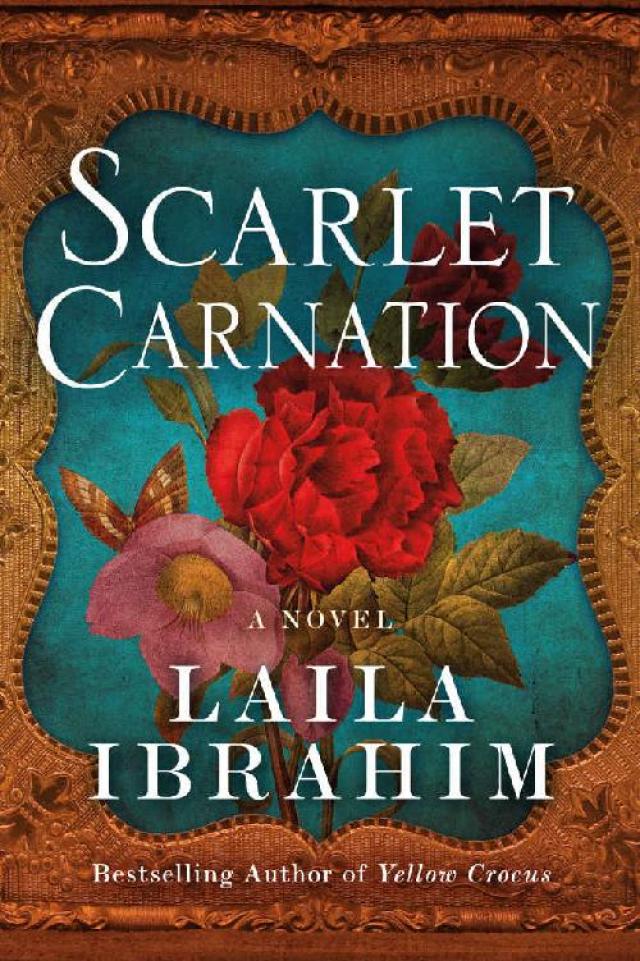
May nodded. “Nana Lisbeth planted white ones and scarlet ones a few years back, for us to wear for Mother’s Day. Scarlet to honor a living mother and white to honor a deceased mother. Somehow they mixed up, so many of the white carnations are tinged scarlet. With so many women wearing scarlet carnations to show pride for the sons in the war, she thinks it fitting in this wartime: scarlet for courage and white for mourning. It’s all blended together right now, isn’t it?”
He nodded. She studied his face.
“You know what I’m going to say?” she asked.
He nodded again. May took in a breath. She didn’t have to say it out loud. Would it simply be cruel? Was he hurt? She couldn’t tell.
“I will not be marrying you,” she declared, retrieving the ring from her pocket. She took his fist, uncurled his warm fingers, and set the jewelry in his palm. He left his hand open, the sign of their potential engagement glimmered in the sun. She looked at his face again.
With sudden clarity she asked, “You are relieved?”
He teared up and nodded for the third time.
Relief surged in her. She laughed quietly. They sat in silence.
Eventually, he looked at her and whispered, “My mother will be . . . very disappointed.”
May nodded. He really was a child still.
“She pressed you into proposing to me, didn’t she?”
“It wasn’t so much pressure as her certainty. I was confused, overwhelmed and . . .” John looked at her. “I just want to run from our mistake.”
Mistake. There was a time May had thought Kay Lynn was a mistake too. Now her daughter was her greatest delight and motivation.
May broke their silence. “I am happy for Kay Lynn to spend time with any of you. She will always know you are her father.”
He wiped an eye.
“I wanted to be . . .” He shrugged. “Ready?” He continued, “I nearly convinced myself that I was.”
May exhaled hard. His reaction was a deep affirmation that merging their lives with John’s would have been a grave mistake. Still, a sadness settled in her heart. Some part of her must have hoped he would protest by declaring his affection and devotion to them both.
She closed her eyes and took in a deep breath to settle her nerves. She felt the sun on her skin, warm and comforting. Opening her eyes she looked at the scarlet-tinged carnations mixed in with purple statice and orange poppies.
Courage and mourning.
John rose.
“Goodbye then,” he said.
May replied, “I wish you the best, John, always.” And she meant it, truly.
She watched him walk away down the sidewalk, getting smaller and smaller. Would he be a part of Kay Lynn’s life? It seemed unlikely. He didn’t ask after her when she was just steps away inside the house. May doubted he would make an effort to know his wonderful daughter—just like her own father. Fate was strange—repeating a pattern she was determined to end.
But now she had to accept she would be like her own mother, fending for her daughter as best as she could without a husband.
May took the pruners from the pot and cut one of the mottled carnations. Like her life, it was mixed up. She knew she’d made the right choice, though she wished it were otherwise. John was not the man she or Kay Lynn needed. In the kitchen she placed the carnation in a bud vase and carried it to their room to remind her of her own courage as well as the sadness of this day.