Poison for breakfast, p.10
Poison for Breakfast,
p.10


Nobody knows anything at all. We have no idea what is happening. We are all bewildered. Someone may say that they understand something, to ourselves or to others, but they are wrong, or guessing, or making it up. I don’t know why I used to sneak out at night and run down the street, and neither do you. I don’t know why an eccentric woman cursed the Emerson family whose daughter Sally married Stephen Jones, as her parents had hoped, and neither do any of your friends. Your father, if you have one, cannot unravel Zeno’s paradoxes, and your mother, if you can find her, does not know why some shops have daringly erratic hours. Not a single teacher of yours can explain if F. W. Bain really translated his books from old Sanskrit manuscripts or why he pretended to do so, or what Korla Pandit, née John Redd, was trying to say in the universal language of music, and if you ask them they will probably not even understand these very simple questions. None of your friends knows why I like swimming in open water or if there is a God, and if you ask them they will probably just shrug at these very complicated questions. Your cousins don’t know what the man did wrong, in the song sung by the woman with the adventurous and challenging life, and the person closest to you at this very moment, right over there, cannot explain why the loneliest people in the whole wide world are the ones you’re never going to see again. Not a single person understands kissing. No one knows why I am clumsy. I don’t know why cactuses are poisonous or why so many people have been forced into prison camps and other terrible situations. I can’t even figure out what’s wrong with people who don’t like poached eggs. I recently made one for a young man, so young some people call him a boy. He had never had a poached egg and had no interest in trying one. I tried to encourage him by saying it was fluffy and it wouldn’t kill him. He disagreed, and pointed out that even if it were fluffy, that it would still kill him, because eventually he would die, and I don’t know why his reply gave me an idea.
Nevertheless, he tried his best to eat the egg. We must try, all of us, a lot of the time, our best, and we must keep trying. We do not understand anything but we should try our best to understand each other. We should swim and walk in parks, thinking. We should watch movies and think about what might happen. We should buy food and think about where it comes from, and we should listen to music and wonder what it means. We should have conversations, real and imaginary, with translators handy so that everybody might understand everything we say. We may feel native to where we are, or feel displaced, or both, the way someone going on a journey is also a stranger in town, but nevertheless we should keep reading. We must read mysterious literature, and be as bewildered by it as we are by the world, and we should write down our ideas, turning our stories, as if by magic, into literature.
Many years ago, I was crying very hard on a bench outside. I was crying because there was someone I would never really see again. A man happened by whom I knew—not a friend, not even an associate. Truthfully, I had always thought he was something of an oaf. He was all dressed up in a fancy suit, and he was in a hurry. It is very embarrassing to cry when other people can see you, but it is something we all do eventually. The man saw me, and I saw him see me. I did not know where he was going, and he did not know why I was crying. He did not keep hurrying, which would have embarrassed me, and he did not give me a big hug and tell me everything was going to be all right, which would have made me cry harder. He stopped and sat next to me and did not speak a word. He did not say anything at all, and I could not tell you why it was the most perfect thing to do. It was a terrible time for me, but it was, perhaps, his finest hour.
I had not thought of that story in a while, and I was glad to do so. When I was done thinking about it, I closed my book, and nodded goodbye to the librarian. I put the scrap of paper in my pocket, and I never saw it again. It is an old story—somebody loses something. Perhaps it fell out of my pocket and into the hands of another reader, who was frightened and inspired to go on a journey, or perhaps it just withered away in my pocket. In any case, I no longer needed it. Its message had been received and understood, and it was time for me to get to work. I couldn’t wait. I left the library and tried to get my thoughts in order.
CHAPTER THIRTEEN
1.Here you are, Snicket.
2.You have an idea for a book you will write.
3.It is a mystery.
4.It is a book of philosophy.
5.It is about bewilderment.
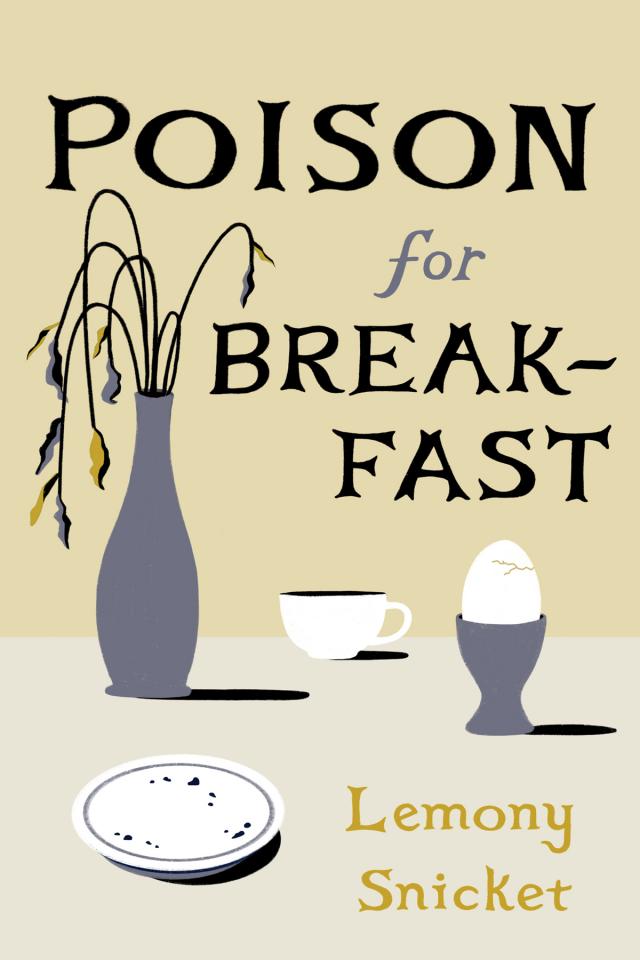
6.It will be called Poison for Breakfast.
7.Remember to include the element of surprise.
8.Remember to leave out certain things.
9.
10.Yes, nobody knows the other rule.
11.It’s bewildering.
12.Nevertheless, keep trying your best.
13.First, though, you’re hungry. What will you have for lunch?
NOTES
As I’ve said, everything in this book is true, although some people and places have been given different names so they will not be embarrassed and/or trespassed on. If you are interested in learning more about the things mentioned in this book, these notes might be helpful to you. Some of the things are considered inappropriate for children, so if you are a child, you might ask an adult before finding them, or at least not get caught finding them for yourself.
Chapter One
The poem calling the sea “a case of knives” is “Wading at Wellfleet,” by Elizabeth Bishop, who wrote many excellent poems.
The author I said I would not identify is Sophie Blackall.
“The Highwayman” is one of the few good poems by Alfred Noyes.
Chapter Two
The book concerning funerals in ancient Egypt is The Egyptian Book of the Dead. My copy is translated by Ramses Saleem. The authors are unknown.
The story about the Emerson family and the eccentric woman and Stephen Jones is called “Witch’s Revenge” and is from a book called Strangely Enough, by C. B. Colby.
The writer who taught me that “A Stranger Comes to Town” and “Someone Goes on a Journey” are the same thing is Ellen Miller, the author of a single book, Like Being Killed.
I should also acknowledge the writer Vladimir Nabokov, in whose novel Lolita is the parenthetical phrase “(picnic, lightning)” to explain someone’s death. I admire this phrase and use many similar phrases in this chapter. Lolita is a book some people think is particularly dangerous to young people, and so I will not recommend it, but merely mention it is one of the most fantastic novels in the world, and leave it at that.
Chapter Three
The wonderful book my neighbor was reading is The Headless Cupid, by Zilpha Keatley Snyder.
The paradox by Zeno is called Achilles and the Tortoise. Zeno thought up several other paradoxes, most of which are interesting. There are many books on Zeno and his paradoxes, both good and bad.
Chapter Four
The movie I saw when I was young is called Midnight. It is directed by Mitchell Leisen and written by Charles Brackett and Billy Wilder, from a story by Edwin Justus Mayer and Franz Schulz.
Chapter Five
A Syrup of the Bees by F. W. Bain is a real book.
Korla Pandit is a real musician.
Everything You Know about Indians Is Wrong is by Paul Chaat Smith.
Ceylon is currently called Sri Lanka.
Chapter Six
Little Red Riding Hood is the hero of a story which is usually named after her. There are many versions, some good and some bad.
Oedipus is the hero of Oedipus Rex, by Sophocles.
The Japanese story about the feudal lord is described in a book called The Izu Dancer and Other Stories. The book has two authors and two translators, but the section in question is written by Yaushi Inoue and translated by Leon Picon.
A rabbi named Julie Saxe-Taller helped me understand tzimtzum, as much as anyone can understand such a thing. I recommend learning from a rabbi to everyone, even rabbis.
The writer who said, “God made everything out of nothing, but the nothingness shows through” is Paul Valéry, from his book about bad thoughts.
The book I lost and then found again is The Story of Junk by Linda Yablonsky.
Chapter Seven
The song in the supermarket is “Sinnerman,” as performed by Nina Simone.
Persia is now often called Iran.
Chapter Eight
“300 Goats” is by Naomi Shahib Nye.
The song suggesting that the loneliest people in the whole wide world are the ones you’re never going to see again is “Harlem Roulette,” written by John Darnielle and first performed by his band the Mountain Goats.
Chapter Nine
The author and translator with whom I had the imaginary conversation are Pu Songling and John Minford, respectively. The book in question is Strange Tales from a Chinese Studio.
Chapter Ten
The composer who does not move the notes around is Morton Feldman. My favorite of his pieces is probably “Crippled Symmetry.”
The book with the girl and the cave and the tiger is The Long Secret by Louise Fitzhugh, often described, inaccurately, as a sequel to Harriet the Spy.
Chapter Eleven
Emily Dickinson is a real poet. None of her poems had titles, so they were numbered, although sometimes the numbers get mixed up. My favorite begins “I tie my Hat” and is usually numbered 443.
The composer in the prison camp is Olivier Messiaen, and the piece he composed there is Quartet for the End of Time. It is my librarian’s favorite Messiaen piece, but mine is Fête des belles eaux.
The philosopher who said that few people can be happy without hating some other person, etc., is Bertrand Russell.
Chapter Twelve
The poem about the oaf is by Antipatros of Thessalonika, and was written in ancient Greek. It was translated into English by Kenneth Rexroth, who is a poet himself.
It seems important to note that almost all of this book was written in a public library, and I would like to thank the staff and patrons of the library for being so quiet and helpful, except for one patron who was quite nasty to me.
Chapter Thirteen
There is no note for Chapter Thirteen.
Copyright © 2021 by Lemony Snicket
Illustrations copyright © 2021 by Margaux Kent
All rights reserved
First Edition
For information about permission to reproduce selections from this book, write to Permissions, Liveright Publishing Corporation, a division of W. W. Norton & Company, Inc., 500 Fifth Avenue, New York, NY 10110
For information about special discounts for bulk purchases, please contact W. W. Norton Special Sales at specialsales@wwnorton.com or 800-233-4830
Jacket design and illustration by Jared Oriel
Book design by Daniel Lagin
Production manager: Lauren Abbate
The Library of Congress has cataloged the printed edition as follows:
Names: Snicket, Lemony, author. | Kent, Margaux, illustrator.
Title: Poison for breakfast / Lemony Snicket ; illustrated by Margaux Kent.
Description: First edition. | New York, NY : Liveright Publishing Corporation, a division of W. W. Norton & Company, [2021]
Identifiers: LCCN 2021011131 | ISBN 9781324090625 (hardcover) | ISBN 9781324090632 (epub)
Subjects: GSAFD: Mystery fiction.
Classification: LCC PS3558.A4636 P65 2021 | DDC 813/.54—dc23
LC record available at https://lccn.loc.gov/2021011131
ISBN 978-1-324-09062-5
ISBN 978-1-324-09063-2 (ebk.)
Liveright Publishing Corporation
500 Fifth Avenue, New York, N.Y. 10110
www.wwnorton.com
W. W. Norton & Company Ltd.
15 Carlisle Street, London W1D 3BS
Lemony Snicket, Poison for Breakfast