Abominations, p.15
Abominations,
p.15



And now, to my horror, a “Summer of Cycling” campaign timed to coincide with the Olympic season aims to double—again!—the number of bikes on British roads. Oh, NO! NO, NO, NO! Whereas each cyclist is now encouraged to convert one friend, I actively discourage anyone who considers biking in town: “It’s much too dangerous,” I say. “Breathing all that exhaust, too—terrible for you.” Trashing cycling with a pannier slung over my shoulder, I get some funny looks.
Worst of all, blogs and call-in radio shows teem with irate British motorists clamoring to license cyclists. Our previous mayor, Ken Livingstone, advocated numbered plates for bikes that could be read by CCTV cameras. An Evening Standard columnist recently called for cyclists to carry third-party insurance. The chairman of London’s leading minicab firm demanded this spring that cyclists pay a “road tax.”
Thus popular momentum gathers to subject bikes to the whole grotesque legal apparatus that makes driving such a downer, thereby undermining the very uncomplicated independence that captivated me about my first banged-up hand-me-down mono-speed as a child. It’s already fiendishly difficult in London to slip through a red light with no traffic in sight, since with the explosion of cycling the cops are handing out tickets like girlie-show fliers. When we were merely an occasional annoyance, the authorities paid us no mind. Not long ago, my serene, sneaky, below-the-radar form of transport was an option on that ever-greater rarity of modern life: getting away with something. As my pastime has been colonized, its popularity threatens the last redoubt of freedom in this world.
“Your Gym Routine Is Worthless”
UnHerd.com Review-Essay on Alison Bechdel’s The Secret to Superhuman Strength, 2021
It seems I have a doppelgänger: a self-described “vigorous type” with a lifelong obsession with exercise, although this minor variation on Shriver happens to be gay. Born three years after me, in 1960, Alison Bechdel grew up in roughly the same America as I did—as she notes, “before the dawn of the exercise epoch.” Girls weren’t expected to bestir themselves beyond fifteen seconds of jogging in place in gym class, while bulging muscles on females were still considered gross. Nevertheless, Bechdel and I both resolved in our scrawny childhoods to become physically strong. We both invented ball games in the yard with rules of our own devising.
As I learned from her new graphic novel The Secret to Superhuman Strength, we both eschew team sports, preferring to compete primarily against ourselves. (Bechdel skis, and though I play tennis instead, I prefer rallying for hours on end to matches.) We were both regarded by schoolmates as mediocre athletes; that is, we were both chosen in the middle of the pack for kickball teams. We both took up running as a lark, beginning with short solo distances—in junior high, I did circuits of the football field while the rest of the class scarfed down miniature pizzas; Bechdel started spontaneously running to visit her grandmother. We both steadily increased this distance, and we both pushed our route to ten miles. Over the course of artistic careers, we’ve both been as dedicated to working up a sweat in a literal sense as we have been to our exertions on the page.
We’ve both gone through similar phases: weight training, long-distance cycling. Why, I positively seized on the fact that Bechdel spurns swimming—a difference!—and has got into yoga, which (so far) I’ve resisted. But over the last fifty years, we’ve both also been subjected to the larger Western world’s gathering fixation on fitness, which has overtaken our meager private labors and crashed over our heads like a thirty-foot breaker. Overwhelmingly, then, what Bechdel and I have most in common is that at nearly the same time we both took a step back from what she calls an accelerating “cardio-pulmonary frenzy” and wrote books about it.
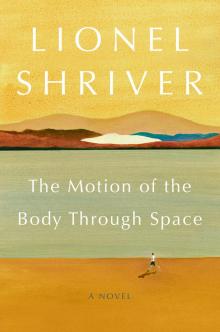
A word from our sponsor: my 2020 novel, The Motion of the Body Through Space, regards a woman of sixty who’s pursued a rigorous, albeit intensely private, fitness regime since childhood. At the very point that regime has almost entirely destroyed her knees—so much for those ten-mile runs—her sedentary husband announces he’s going to run a marathon. When he ramps up to the triathlon, for which he engages a sexy younger trainer, the marriage, to put it mildly, is imperiled. The purpose of my project was to examine what in God’s name is propelling this latter-day preoccupation with fitness and whether the trend is a force for ill or good. (Answer: both. Now you needn’t buy the book.)
Yet the graphic novel may be an even better form than the straight prose kind for exploring this topic. Illustration brings to life various forms of self-torture, and Bechdel’s rendering of her multiple exertions throughout the years is dryly self-parodic. The drawings are stylish as well as entertaining. The narrative moves nicely along. Simultaneously detailing her romantic and career travails, Bechdel’s accompanying text is lush enough to parse with some profundity our mysterious exaltation of roundly unproductive suffering. The whole package is presented with more than a soupçon of welcome self-derision. I loved it.
Nevertheless, I confess to some ambivalence about discovering that the powers that be created two of me, just in case something unfortunate happened to the spare. One reason people like Bechdel and me avoid competitive sports is that by nature we’re too competitive, and so might take conclusive defeat fatally to heart. Thus the rivalrous devil on my shoulder jeered over these pages, “Oh, yeah? You’ve biked a hundred miles in a day? Well, I’ve cycled so-called centuries cross-country for months!” I know. Pathetic. Indeed, an aim of both my novel and Bechdel’s is to question why we’ve come to invest so much status in fitness. How come many of us now compare ourselves with others in accordance with who does more repetitions of deltoid dips, even more so than with who earns more money or builds the more dazzling career?
When I started running around the football field at lunch and keeping a secret chart of my daily sit-ups, I imagined that these quirky absorptions were entirely my idea. Now I’m not so sure. Recognizing my double in Alison Bechdel (though she’s massively taller than I am, damn her) made me suspect uneasily that there might be other copies of me out there—hundreds, thousands, even millions.
Rare must be the parent who looks up “one thousand most popular names for girls” and exclaims, “Look! ‘Olivia’ is number one! Let’s call our baby the same name everyone else is choosing!” Something more enigmatic and subconscious propels “Olivia” to that top slot. “Olivia” is in the air. It burrows into the brains of parents-to-be from the side like an earwig. Meanwhile, all those parents who christened a daughter “Olivia” last year thought the name was fresh, unusual, and their idea.
So with fitness. I think both Bechdel and I were suggestible. The nascent cultural obsession with exercise was already in the air. We were early adopters. But we were still earwigged.
I acknowledge this apparent conformity with no pleasure. Like any proper American, I prefer to regard myself as self-created, not as a predictable product of outside forces, like pasta dough forced through the mold for fusilli. But the amount that Bechdel and I have in common cannot be a coincidence. We started out the same loner, high-achiever type and grew up in the same country at the same time.
In one respect the graphic artist and I may part ways. Strewn throughout Superhuman Strength are mini-bios of philosophers and poets: Wordsworth, Coleridge, Ralph Waldo Emerson, Jack Kerouac. These inserts are a little tedious. The bolstering of Bechdel’s personal story with historical heavy hitters suggests an insecurity about the worthiness of her theme. Writing my own novel about exercise, I shared that insecurity: Is this topic meaty enough to justify a book? For me, what came to seem important about the subject was making it seem less important.
Despite her playful, self-deprecating approach, Bechdel portrays her churn through multifarious routes to exhaustion as a form of spiritual seeking. By contrast, I’ve come to see this mystical elevation of exercise as a route to enlightenment as part of the problem—and there is a problem. Obviously, a greater focus on fitness comes with undeniable health benefits, but worship of the hard body is a form of idolatry. Taken to excess, fitness fanaticism naturally nurtures narcissism (the endurance-sport-convert husband in my novel becomes unbearable). What we need is not to go back to being slobs, but to restore a sense of proportion.
Keeping the body in working order is a mechanical matter, one best decoupled from status and virtue. I adore tennis. I happily impute to the sport an element of, yes, spiritual satisfaction—because for me tennis engenders joy in its purest form. By contrast, plain exercise—calisthenics, running when I’m not in the mood (almost always)—is drudgery. Exercise constitutes the dullest part of my day. The fact that I keep doggedly at it is one of the least interesting things about me, and I’d rather talk about almost anything but.
The elevation of fitness to the highest of attainments is a sure sign of a culture grown neurotically inward and stunted. It’s a sign of diminished aspirations. When “self-improvement” entails not learning German but doing jumping jacks, we’re aiming to clear the lowest of bars. We’re not producing superheroes, but gym bunnies. In the end, no matter how much agony we undergo to build our biceps, those perishable muscles will still atrophy in old age and then end up on the scrap heap—at which point, what have we got to show? We could stand to demote the push-up back to the floor where it belongs.
The whole purpose of maintaining a functional body is to be able to do something else: write books, invent new software, land a rover on Mars. Theoretically, Michelangelo could have spent all his time on chin-ups and never have got round to the Sistine Chapel. Alison Bechdel won’t be remembered for her running time, but for her exuberant drawings, droll captions, and candid self-reflection. The West’s obsession with physical strength, perversely, is a weakness.
Part V
Against the Grain
“I Am Not a Kook”
The New York Times, 2016
Multiple choice: In the primaries, which 2016 presidential candidate should this voter support?
She opposes hate-crime and hate-speech legislation. She dislikes fat taxes; she does like flat taxes. She regards prohibitions of smoking on beaches, or of using electronic cigarettes in public spaces, as evidentially unsupported and merely vengeful. She believes the federal government has bloated all out of proportion to its original purpose. She sees the federal, state, and local governments commanding 38 percent of the economy as a fundamental infringement on our liberty. She perceives American business as over-regulated, and the United States’ levying the third-highest corporation tax in the world as economically idiotic. She resists the welfare state and affirmative action.
Easy. This red-state rube can take her pick. But it gets trickier.
She is also pro-choice and endorses same-sex marriage. She opposes school prayer. She is outraged about abuse of police powers, particularly in black communities. She disapproves of farm subsidies and other congressional backhanders to big business. She abhors widespread state surveillance of Americans’ emails and phone calls. She would decriminalize assisted suicide, prostitution, and recreational drug use. She believes anyone should be free to publish visual depictions of Mohammed. While a feminist, she wouldn’t restrict pornography, however grossly misogynistic. She is skeptical of foreign military interventions, most of which, during her lifetime, don’t seem to have resulted in any real net gain for the United States.
If you guessed Rand Paul, that Kentucky senator may minimally approximate this voter’s positions, save for the fact that, as of last week, Rand Paul has left the building. No loss, if for our prototype, as for many American women, Mr. Paul’s antiabortion stance crosses a red line. Which it does. For no surprise: “she” is I.
The mainstream of neither the Democratic nor the Republican Party (insofar as it has a mainstream anymore) represents my views, which qualify as left-wing or right-wing only on the basis of “eeny meeny miny moe.” During the nine months a year I live in London, I’m regarded as an archconservative nut. When I fly home to the United States, I transform, mid-Atlantic, to a leftist radical—with the same opinions. That’s because most of my progressive social positions are taken as the norm in Britain by just about everybody.
The socially liberal economic conservative in America has long been disenfranchised. A true foreign-policy conservative is equally at a loss. Democrats and Republicans vary in their eagerness to undertake foreign military adventures by only a narrow degree. Yet whether it’s “leftist” or “rightist,” my catechism is consistent. The rubric to which those positions hew—we should be free to do whatever doesn’t impinge on the rights of others—forms the conceptual backbone of the United States. The Constitution is libertarian. To the extent that the unamended Constitution was flawed, it was more rigorous application of libertarian principles that abolished slavery and granted women’s suffrage. Libertarians were way ahead of the pack on decriminalizing homosexuality.
We can at least thank Rand Paul for nominally refurbishing libertarianism so that it is halfway respectable. But the real mystery is why American libertarianism was ever marginalized (and why they marginalized themselves). David Boaz encapsulates the essential idea in last year’s The Libertarian Mind: “You learn the essence of libertarianism in kindergarten: Don’t hit other people, don’t take their stuff, and keep your promises.”
Yet Chris Christie has declared that libertarianism is “dangerous.” Its advocates’ going on about property rights strikes communitarians as grabby, selfish, and sordid. Libertarians are caricatured as regarding every man as an island. When I announced to my mother in the 1980s that I considered myself libertarian, she recoiled. How did people like me come to seem like kooks?
This discussion always rounds on hard cases. Do parents have a right to not vaccinate their children against measles? (No, and Rand Paul got this issue wrong in his own terms. Vaccine refuseniks infringe on the rights of their neighbors’ children.) Individual rights can conflict with collective rights. Coercive legislation to secure clean waterways, breathable air, and sustainable fishing practices seems good and necessary, yet unlibertarian. Climate change is unlikely to be sorted out by the free market. Both governments on brief electoral cycles and companies with shareholders hungry for short-term gains struggle to meet long-term goals.
The hardest case is immigration. Libertarians ought to believe that anyone should be free to live anywhere. But in a crowded, mobile world of grossly disparate opportunities, open borders for wealthier countries are impractical. Little wonder that Rand Paul has championed American border security, not international freedom of movement.
In truth, few self-confessed libertarian candidates are purists. Mr. Paul’s support for reclassifying possession of “very small amounts” of controlled substances as a misdemeanor is a far cry from calling for the across-the-board decriminalization that a true libertarian would promote (at his or her political peril). Mr. Paul also backed Social Security—anathema! the state saving for retirement for you—because the program is so popular. His advocacy for the “rights of the unborn,” which run roughshod over the rights of us women who are already here, is glaringly unlibertarian.
I have my own inconsistencies. I have no problem with seat belt and helmet laws. I support a minimum wage—a higher minimum wage—and laws forbidding racial discrimination in employment. There are simply too many crazy people, and I’m keen on gun control out of sheer self-preservation. Having enjoyed a largely positive experience with Britain’s National Health Service, I prefer single-payer health care—though in the United States, I’m not holding my breath.
But then, without allowing for qualifications, any standpoint degenerates from pragmatic guideline to inflexible dogma. As with any other broad political perspective, libertarianism can be a useful starting point, but if you apply it in a strict, quasi-religious manner, you’ll indeed get consigned to the crackpot’s corner. All viable political positions make room for exceptions—leeriness of foreign interventions need not preclude entering World War II—and contend with What Is. So there’s little purpose to libertarians holding out for the elimination of the Federal Reserve or a return to the gold standard, especially since neither of those tired tropes flows inexorably from that core rubric that we should be free to do what doesn’t hurt others.
I cannot be the only American repeatedly forced to vote Democratic because the Republican social agenda is retrograde, if not lunatic—at the cost of unwillingly endorsing cumbersome high-tax solutions to this country’s problems. My comrades and I don’t all sit around reading Ayn Rand novels, either. In fact, the abundance of my natural political bedfellows don’t call themselves libertarian—though “socially liberal economic conservative” is a mouthful. We aren’t bigots, and we’re not evangelical. We are live-and-let-live about sexuality, accept human influence on climate change, and believe in evolution. But we’re also concerned about the national debt, oppressed by an arcane, punitive tax code, and unenthusiastic about widespread dependency on the state.
Dismayingly, the more acceptable libertarianism has grown, the less often its principles are applied. Defending the rights of people whose views we abhor has ceded to defending our right to take offense. Municipalities are ban-happy—forbidding anything from lighting up on your own balcony to putting a cookie in your kid’s bag lunch to placing a saltshaker on the tables of your local restaurant. The total Code of Federal Regulations is now over 175,000 pages in 238 volumes, with compliance costs of $1.75 trillion. Annually, businesses and individuals spend six billion worker hours on tax paperwork. No one has any idea how many federal crimes are on the statute books; there are anywhere from 4,500 to 300,000.