Abominations, p.21
Abominations,
p.21


(OK, the Xs are real. Otherwise, I lied. We got up at two p.m. We watched Knower’s video “The Government Knows When You Masturbate” three times. We devoured five episodes each of Ramsay’s Kitchen Nightmares and Come Dine with Me. We streamed Who Wants to Be a Millionaire? and then watched Quiz, which, being about Who Wants to Be a Millionaire?, gave us the cozy Russian-doll feeling of Gogglebox: watching people on TV who are watching TV. I can’t believe Jeff has already polished off that tequila.)
Thursday
Jeff and I divide up the parts of Ibsen’s An Enemy of the People and perform the script aloud. I decide it’s time I learned Greek. I learn Greek. Then I learn to play the violin. It takes a few minutes but within the hour I can get through the Prokofiev Violin Concerto No. 2 at a good pace. Jeff is doing an online course on Indonesian cooking. I take up watercolors. Then I knit bright woolen masks for the National Health Service.
At eight p.m. we lean out our front windows and bang pots with wooden spoons to express our gratitude for NHS staff. We feel a warm glow of conformity. The dented pots are ruined, but that’s all right because banging out the window makes so much difference to what happens.
I’ve been managing emotionally but today I’m anxious. Britain’s “three-week” lockdown is closing on four weeks. How will the government keep us safe? Worried, after destroying our cookware, we turn on the news. Dominic Raab announces that the lockdown will last three more weeks.
“Thank God!” I gasp.
“It was super important he didn’t even hint when we’re going to ‘exit,’” Jeff says appreciatively. “The British are a dim and impulsive people, and at even the word ‘exit’ they’d all rush into the street and start licking each other.”
“Back to carving Italian marble?” I propose.
(Not quite. We woke at dusk, which Jeff used as an excuse to crack open the cognac. I carped that he really shouldn’t start drinking before we’ve had our “morning” coffee. Jeff got belligerent and broke the snifter, then tried to blame me for it. We both refused to sweep up the glass. I grabbed the bottle for rewatching Kenneth Clark’s Civilisation—while we still had one.)
Lionel Shriver’s new novel, The Motion of the Body Through Space, is out in May. Please don’t despoil it by ordering a copy.
Part VI
End Papers
“In Defense of Death”
Population and Development Review, 2010
[Although I explored the financially ruinous consequences of the American health care system in my ninth novel, So Much for That, I returned to the interrelated topics of death and money in my most recent novel of 2021, Should We Stay or Should We Go. In the United States, the Affordable Care Act is failing to stem the relentless rise in the proportion of GDP swallowed by medical care—about 18 percent as of 2019. In the United Kingdom, 40 percent of the government’s budget goes to the National Health Service, while the proportion of GDP spent on the service since 1950 has doubled. All the issues I raised in this essay remain pressing. If anything, since this piece was published they’ve grown more so.]
For some years now, when watching exuberant television news packages on some dazzling medical innovation—say, bionic limbs for amputees that can be manipulated by thought alone—I’ve experienced a queasy double take. I think: “How much does this astonishing technology cost?”—a minor detail upbeat newscasters reliably omit. I think: “Doesn’t this technology’s per capita price tag limit its beneficiaries to a tiny handful of the well insured in the developed world?”
Most Americans would consider such nay-saying churlish. High-tech medical advances are an unquestioned virtue, a sacrosanct moral good. We may prevaricate about being short of cash, but we don’t slam the door on a volunteer collecting donations for cancer research because we don’t want more money poured into cancer cures—although next time, after reading Daniel Callahan’s brass-tacks analysis of what ails American health care, I might slam the door at that.
A distinguished biomedical ethicist and president emeritus of the Hastings Center, Callahan completed Taming the Beloved Beast just as health care reform was coming to a boil in Congress, but before a finalized bill narrowly passed this spring. Fortunately for the author, his book does indeed address itself to the nature of the pale, incremental measures in “Obamacare.” Unfortunately for the American people, his warnings about the real inflationary drivers of unsustainably escalating medical bills are as germane as ever.
One of the only elements of the Affordable Care Act designed to control costs relies on the knee-jerk American default, commercial competition—hence the creation of state “exchanges” designed to pit health insurance companies against each other in offering fair value for money. Callahan assembles conflicting data to conclude that for health care competition will not keep down costs, though he might have saved himself the trouble by visiting his local supermarket.
Commerce is not only competitive but collusive. Last year, the standard size of a can of tuna fish shrank to five from six ounces (not long ago, that was seven) for the same price. This shrinkage occurred across all national brands—StarKist, Chicken of the Sea, Bumble Bee, you name it—and all at once. Not a single mainstream manufacturer skipped the retooling costs and undercut its rivals by maintaining the larger size. (Cannily, so to speak, the smaller product is no longer quite large enough for one decent sandwich, which now requires opening two.) In kind, the universally inflated cost of American breakfast cereals has risen in suspiciously perfect unison, bearing no relation to the price of comparable products abroad; Weetabix in the United Kingdom costs half the price of American Shredded Wheat (aptly, the same goes for the cost of British health care). Helping to explain why plane tickets from multiple airlines to the same destination are often identical to the penny, informal, unactionable price fixing defies standard capitalist theory. Rather than competing to offer the best deal, whole industries act in mutually beneficial concert: you raise your price, we’ll raise ours, and everybody (aside from the consumer) wins. Having colluded for years in exactly this fashion, health insurance companies are currently raising premiums with all the fine-tuned coordination of an orchestral performance of Mahler’s Ninth. Little wonder that competition has historically failed to rein in medical bills.
Yet even the wicked health insurance industry is victimized by what Callahan identifies as the prime single driver of rising medical costs: those very dazzling medical inventions that we have enshrined in the United States as a sacrosanct moral good. Nearly half the cost escalation of medical care is due to spending on technology.
Overuse of expensive imaging equipment, for example, is economically irresistible. Excessive testing helps protect physicians from malpractice suits. More crucially, the fee-for-service model ensures that more tests make everyone more money: hospitals and doctors, sometimes keen to make a gizmo earn back its stiff sticker price, as well as the medical device manufacturers that often buy doctors’ lunches. Health insurance fee structures and Medicare reimbursement schedules guarantee that MRIs are vastly more remunerative than consultations.
High-tech specialists in surgery or oncology can earn many times more than hands-on general practitioners, who provide the unglamorous primary and preventive care in desperately short supply in the United States. Indeed, Callahan makes the case that by converting medicine from a calling into an industry, we have signed our economic death warrant. It is in the interest of doctors, hospitals, medical researchers, medical appliance manufacturers, and pharmaceutical companies for health care to be as expensive as possible, and more and more expensive it duly is. Worse, the industry as a whole has no interest in making Americans healthier, but rather an interest in convincing increasing numbers of well Americans that they are sick. Though the United States spent only 7 percent of its GDP on health care in 1970, it lavished 17 percent on same in 2009. With simply keeping the population alive and biologically functional on course to consuming a third of GDP by 2040, it’s surely not far-fetched to suggest that health care costs have the capacity to single-handedly bury the American economy. They are well on their way to becoming the American economy.
Yet all this expenditure is not even buying us a sense of physical well-being. Dr. Arthur Barsky’s study Worried Sick: Our Troubled Quest for Wellness documents that people now feel worse about their health than forty years ago, although by objective criteria their health is better. The lesson seems to run that you can’t be healthy enough, and that the quest for perfect medical reassurance boomerangs into anxiety.
Callahan’s finest observations aren’t economic and systemic, but cultural, even existential. Since our increasingly secular people are losing faith in pearly gates, we will pay any price to delay oblivion. The virtue of extending life expectancy goes as unquestioned as the virtue of the technologies that facilitate it.
The developed world’s oft-cited “aging population” is the result of two factors, one of which, high postwar fertility suddenly dropping below replacement rate, has lately been the sporadic target of (usually ineffective) pronatalist government policy. Hence the hefty payments to new parents in countries like South Korea and Australia. But the second contributing factor, ever-extending life expectancy, is blithely accepted as the inevitable, inexorable, and altogether marvelous march of progress. We don’t see legislation offering to pay people to die sooner. Politicians never campaign to rescind National Institutes of Health grants for research on lethal diseases of the elderly. To the contrary, we’re meant to greet the revelation that up to half of today’s American babies will make it to age one hundred as unalloyed good news.
As Callahan observes, death is no longer regarded as a natural constituent of the life cycle; it is an enemy, and enemies must be defeated. I would go further and submit that in contemporary America dying has become an outrage. Death is a technological failure whose solution isn’t mature spiritual resignation but know-how. (“Some 34 percent of Americans believe that medicine can cure any illness if they have access to the most advanced technology and treatment,” notes Callahan, a conviction he describes as “preposterous.”) What Beloved Beast dubs the “infinity model” of health care entices us with the notion that mortality can be indefinitely forestalled and that life expectancy can be indefinitely extended, a prospect that subscribers to Population and Development Review have every reason to view with horror.
Alas, for many patients we don’t extend life but drag out death, as wrenchingly illustrated in this June’s number one most emailed essay by Katy Butler in The New York Times Magazine, “What Broke My Father’s Heart”—about an accomplished father whose pacemaker, installed when he was eighty, kept the poor man technically alive through a long, burdensome, and humiliating dementia and bedridden incontinence. Be careful what you wish for. Indeed, many of the real-life results of “life-extending technologies” have all the ghastly, perverse consequences of the seemingly innocent wishes granted in W. W. Jacobs’s macabre short story “The Monkey’s Paw.”
Callahan offers a range of solutions. Given the author’s advanced years, some qualify admirably as admission against interest: Stop spending so much money on old people; weight the health care dollar toward primary and preventive medicine for the young and middle aged. (“A health care system should help young people to become old, but not to help the old to become even older.”) Focus research on emerging threats like childhood obesity, in preference to squandering vast resources on frail elderly patients with multiple diseases who have already enjoyed what the author terms “a full life.” Introduce cost considerations to Medicare, along with Medicaid currently on track to consume a stunning 21 percent of US GDP by 2050. Conceive a regulatory body along the lines of the United Kingdom’s much-maligned National Institute for Health and Clinical Excellence (incongruously abbreviated NICE), which could disallow entitlement funding for treatments not determined cost effective. Reject fee-for-service and put physicians on salary. Return to a medical model that treats injury and disease, not dissatisfaction—thus relegating redress of infertility, erectile dysfunction, and gender reassignment, for example, to elective procedures that the disgruntled are obliged to finance on their own dime. On a popular level: resign ourselves that some physical discomfort comes with the territory for us animals; recognize that medicine cannot ameliorate our every ache and pain. Accept that with aging comes deterioration, which mountain-biking baby boomers will have especial difficulty accommodating.
“Curing disease,” Callahan observes bluntly, “does not cure death.” But curing disease and delaying death is expensive, since when you cure one illness another will come along to take its place. A major driver of the 10 percent annual increase in medical spending for the last forty years is progress with cancer, whose survivors either fall prey to a costly recurrence or yet another ailment. (The best explanation I’ve ever heard for the rise of cancer in Western populations is that “you have to die of something.” We’ve cured enough of its competitors that cancer is one of the few fatal illnesses left.) Meanwhile, we reap diminishing returns, “achieving ever higher costs for ever smaller health gains.”
The political likelihood of these prescriptions being filled is minute. To bring about most of those structural reforms, the United States would require the very national health care system that Congress signally refused to consider from the get-go in 2009. Moreover, it’s one thing to make broad cultural recommendations like “We die; get used to it,” quite another to manifest them. Culture by its nature is deep and intractable, going to the very heart of what people most profoundly think and feel. Americans believe in technology with the ferocity of religious faith. Access to high-tech medicine is a right, and the more the better. Moreover, technology is expected constantly to improve; hence the resistance to any policy that would seem to hamper the hallowed medical “innovation.”
Yet I have made my own tiny contribution to incrementally shifting American culture in these respects. Fiction writing may be a feeble vehicle through which to influence my country; nevertheless, Taming the Beloved Beast, while full of wisdom, is also dry, repetitive, and woefully lacking in flesh-and-blood cases that might have brought medical dilemmas to life. My ninth novel is not as statistically trenchant, but it’s much more fun.
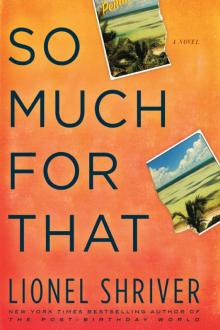
So Much for That is about people on the receiving end of “the beloved beast,” whose hot breath is pretty rank up close. My protagonist, Shep Knacker, has saved all his life for a retreat to a more tranquil, simpler existence in the developing world, where his dollars would stretch much further than in New York. Yet Shep is obliged to relinquish his idyllic so-called Afterlife when his wife announces she has just been diagnosed with mesothelioma. Going back to work as a peon in the company he founded, if only to keep his health insurance, my friend Shep watches his substantial savings steadily eroded by all the extras and “out of network” care that his insurance doesn’t cover. Alternate chapters begin with his latest investment account statement, whose diminution of funds is intentionally sickening. (Eventually dwindling to less than a month’s rent, that Merrill Lynch account is one of the book’s main characters.) Yet from the start we’re aware that Shep’s wife is expected to live little more than a year, a grim prognosis that exorbitant surgery and chemotherapy never manage to budge.
What a drag! This is entertainment? Yet as with many of my novels, I conceived the ending first, and wrote toward this one with gleeful enthusiasm. Out of exasperation and a newly discovered self-empowerment, Shep finally defies his culture’s edicts about What People Do and the medical establishment’s bullying takeover of the most intimate event in life, second only to birth: death. I’m loath to spoil my own story, of course, but the climax entails a multiple kidnapping from the clutches of modern medicine, and I’ve been pleased to gather from readers that the up-yours ending is convincingly triumphant. In a gesture of sweeping authorial benevolence, I give each character what he or she needs, which in more than one instance is a gentle, meaningful departure from this earth, without being hog-tied with tubes or drugged into a vacant stupor. Surely it’s a formal achievement for any novelist to kill off that many sympathetic characters and still pull off a happy ending.
My motivations for designing such a plot were cheerfully political. On the road to publicize the novel this spring, I made it my mission to hawk not merely literary fiction but an even less salable product: mortality. Covering one of my book festival events, the Sydney Morning Herald characterized me harshly in its headline as “Pro-Death Author Lionel Shriver” and I was not offended; I was pleased. Besides, I’ve not been promoting just any old death, but the good death, in an era when Western culture has ceased to believe there’s such a thing.
One version of a “good death,” of course, is a quick one, so folks who get run over by buses are fortunate in their way. Yet many other deaths would be mercifully rapid if we weren’t so insistent on our horribly imperfect, horribly expensive, and horribly temporary cures. Hooked to IVs and ventilators and chemotherapy bags, whose very presence seems to promise reprieve (why else would doctors deploy them?), moribund patients are cheated—emotionally and personally cheated, denied the full inhabitation of their last and potentially most profound experience. Unlike many novelists, I know, just a bit, what I’m talking about.
So Much for That grew out of losing one of my closest and dearest friends, Terri Gelenian-Wood, who was diagnosed with peritoneal mesothelioma in 2005 when she was only fifty. Doubtless caused by exposure to asbestos in materials with which she worked in her early years as a metalsmith, the cancer must have been gestating for up to thirty years; mesothelioma is hopelessly advanced by the time it’s detected. She lived a year and three months thereafter, most of that time in pain or at least, that beloved medical euphemism, in “discomfort.” Little of that suffering was due to the disease itself; rather, to recuperation from major surgery and the host of awful side effects from chemotherapy. She died anyway. Her treatments cost $2 million.