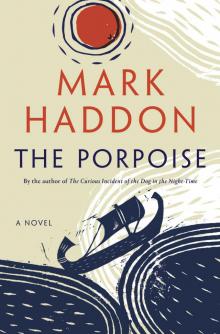
The porpoise, p.5
The Porpoise,
p.5


Philippe’s hackles rise as soon as she appears. If he had known a little more about Darius in advance he would have explicitly excluded her from the meeting. He says, without thinking, “You shouldn’t be here,” taking her subservience for granted. This, he will realise later, is the mistake that changes everything, goading her in front of Bobby’s son.
There is a moment of stillness. A woodpecker rat-a-tats somewhere in the garden. Darius says, to Angelica, calmly but brooking no contradiction, “Sit down with us. I’ve heard a great deal about you,” and Angelica thinks, for once, to hell with her father. She pours herself a cup of tea and takes a slice of cake and it is hard to tell whether her hands are shaking from excitement or fear, because she looks at Darius and knows that they are in league together against her father.
“Where do you go to school?” asks Darius, though he is pretty sure from what he has heard that she hasn’t been allowed near a school in a long time. “Or university?” There is something sexual and yet utterly unsexual about her that puzzles him. She doesn’t look sixteen. She looks twenty. Or twelve. And the rumours about her looks are true. Those extraordinary eyes.
“I don’t go to school.”
“So you’re stuck here with your old man.” He looks at Philippe and gives him a warm, knowing smile which both men know is a provocation.
“Darius’s father died a couple of months ago,” Philippe says to Angelica, trying to regain control of the situation. “Robert Koulouris? I’m sure you remember him. Darius has thoughtfully delivered some artwork which Robert was tracking down for me.”
Darius is not looking at her father. Darius is looking at Angelica. She is drunk with attention. There is something in his expression that she has never seen before at this close a range, something anarchic, something joyous. He likes her a lot, she can see it and feel it. She has no idea how these things work. What if they jumped into the car, span on the gravel, roared down the drive and never came back?
Darius says, “You should come for a drive.” Can he read her thoughts so clearly? “It is the most glorious day. We could be at the seaside in an hour.” He has no idea how long it would take to get to the seaside, nor what constitutes the seaside in these parts. Donkey rides and deckchairs? An oil refinery?
Angelica takes a little breath to control her voice before saying, calmly, “I would very much like that.” She can tell him on the way. Not the truth—she will never be able to tell him the truth—but some close cousin of the truth. Just enough to let him know how grateful she is and to guarantee that he does not bring her back.
But Darius’s sexual interest is already waning. He can see that she is needy and fragile. An hour in her company might be diverting, but three would be purgatory. Angelica’s feelings, however, are neither here nor there at this point. It is her father’s reaction that is driving this little drama. Darius might know nothing about Kokoschka or Balthus but in his own way he’s as good a salesman as his father and unwilling to walk away from any encounter without believing himself the winner.
Philippe says, “I’m afraid that won’t be possible.”
Angelica says, “Why not?” Her giddy imagination is running away with itself. She is picturing herself and Darius in front of a log fire in Norway or the Highlands of Scotland, one of those cold, damp locations her father hates. Outside the window a great blade of silver water lies between foggy mountains. Darius’s arm is around her shoulder.
Philippe is not used to being angry, let alone having to control that anger in front of people beyond the household. He wants to call Hervé, but to do so would be an admission of defeat all too visible to this strutting little cockerel. “Now you must leave us.”
Angelica feels close to weeping. The gift is being taken away before she can open it. “Papa…”
“Be quiet.” He stands up.
Darius performs a little pantomime of shifting his sitting position, leaning back in the chair to make himself even more comfortable. Philippe calms himself. The boy will take his time but he will go. There is nothing for him here.
“Papa, why are you doing this?” Angelica has so few weapons at her disposal.
“Your father is jealous.” Only when Darius says the word, the precise word—not protective but jealous—does he realise how accurate it is. Sexual jealousy. It is like reaching into a dark box and touching something cold and clammy and alive.
“Mr. Koulouris…” It sounds wrong. “Darius…” Philippe moves a little closer so that he is only a centimetre from the toes of Darius’s polished, conker-brown Chelsea boots. Has Philippe misjudged this? Might it end in a physical fight?
Darius looks at Angelica. She is on the edge of tears. This is not the kind of adventure he wanted. Something is very wrong in this house and if he stays any longer he will become entangled. He gets to his feet. “Philippe.” He turns from father to daughter. “Angelica…It has been a pleasure.” He holds her eye to make it clear that this sentence is addressed to her alone. “I am very sorry I cannot stay any longer.” He turns back to her father. “I will leave the prints with you. Let me know if you change your mind. I’ll send you an invoice later.” It is an excellent final gesture—cavalier, trusting, unruffled, unanswerable. But he needs to leave before Angelica spoils it by breaking down. “I can find my own way out.”
He drives to the seaside. No oil refinery, no donkeys, no deckchairs. Lepe Country Park—some cars, a row of Scots pines, a grey sky and a welcome cold wind to clear his head. There is a boxy, baby-blue café with big rectangular windows onto the beach. He buys himself a mug of what his English friends call builder’s tea plus an egg-mayonnaise sandwich. He needs a levelling dose of a normality he would usually despise. He will not let his worst imaginings come into focus. It is a thing that happens in boarding schools and broken homes. It does not happen in his social circle.
He books a room at the Viceroy in Winchester. Provincial tea-room rococo, though the clientele leave something to be desired. There is a difference between dressing casually and dressing badly and the world has become blind to the distinction. There are two men in the bar wearing Arsenal shirts in some ghastly synthetic material. His bedroom looks onto a lawn where three putti urinate into a circular marble trough, buffeting an empty Carlsberg can back and forth. He showers, changes and goes downstairs. The menu is trying a little too hard (he has wood pigeon with asparagus, peach and seaweed) but proficiently done. After supper he sits on a bench at the far end of the lawn smoking Sobranie Black Russians. He had imagined emailing friends, sticking a few photos of the fabled house—maybe even the fabled siren herself—on his private Instagram account, then, given the almost certain absence of local nightlife, getting a decent sleep before his early flight back to Athens. He wishes now that he had driven straight to Heathrow and was airborne so that the matter was definitively out of his hands. But a teenage girl is suffering and he finds that for once he can’t walk away. That desperate look she gave him as he turned and left. He had acted dishonourably and far from being a victory his departure had in fact been a shameful admission of defeat.
He throws back a double espresso to counteract the Malbec and only when he is in the car does he begin to wonder precisely what he is going to do when he arrives at the other end. He has not answered the question by the time he parks on the public road by the end of the drive. Everything is submarine, the colours going out one by one as the world sinks into the dark. He will ask to talk to Angelica alone. And if Philippe will not allow that…? The gravel on the drive is ridiculously loud under his boots, so he slips into the trees. A large cobweb wraps itself around his face. He flinches and brushes it away. When his heart has slowed he continues up the slope, a steady zigzag between the soft pine trunks, relying almost entirely on touch to navigate. There are long slashes of mauve sky up ahead. He steps onto the lawn. Four lemon rectangles burn like open stove doors in the silhouette of the house. Palm leaves are black swords overhead. He can smell gorse, creosote and septic tank. He keeps to the edge of the grass, ready to slip back into the trees if his movement triggers a bank of floodlights. He ascends the twelve concrete steps. The only noises are the hush of his breath and the faint scrape of grit under his feet.
He jumps again. Angelica is sitting on the patio with her back against the wall in the wedge of shadow between two big lit windows. Her head is in her hands. She is not taking the night air; she has been thrown out, or she is hiding from her father. “Hey!” he whispers. No reaction. He says it again, more loudly this time. She looks up, gasps and scrabbles crab-wise away from him. He steps into the light. “Angelica. It’s me.” He holds his open hands wide. “I really didn’t mean to scare you.” She settles. He takes a few steps towards her and crouches, as if she is a cat he doesn’t want to startle. “I came to say sorry for earlier.” He pauses. Saying sorry is not what he came to do. He must think clearly. He may have very little time. “I wanted to make sure that you were all right.” He sits himself against the same wall, a metre or so away from her, companionable he hopes, but not intrusive. He can see now that she is very much not all right because there is a sticky wound on the side of her head. She has tucked her hair behind her ear to keep it away from the drying blood. “He hit you.” There is only the faintest human glow from over the hills. They could be a hundred miles from anywhere.
“I fell over.”
“He hit you.” He says it more gently this time, meaning, You can tell me.
But it is the truth. Philippe never hits her. He is not stupid. He came to her room an hour or so after Darius had gone. He called her a whore, a bloody idiot. She said nothing. She never says anything. Her tactic is always to make herself small and quiet and wait for the storms to blow themselves out. Her father apologised. He said he was angry and shouldn’t be taking it out on her. He said that it was his own fault for letting that jumped-up coxcomb into the house. He said, “We’re safe now,” and put his hands around the back of her neck and tried to kiss her.
When her father had forced Darius to leave the house earlier in the day he had thrown away something precious. He had made it clear that he would do everything in his power to prevent her having the thing she wanted more than anything in the world. Emotions had churned inside her which she could neither name nor vent. It had been like having a high fever. She had scratched at her arms with her fingernails and there was some comfort in the pain and the puffy wheals she raised and the blood which began to flow when she had finally broken through the skin.
So, later, when her father tried to kiss her she squirmed away, something she had never done before. He gripped her upper arm and hissed, “You have no idea what is at stake here,” the anger he had graciously put aside now roaring back unchecked. She twisted free a second time, stumbled and banged her head on the wooden column at the corner of the bed-frame, blacking out briefly and coming round with her face pressed against a bloody carpet.
Now Darius has returned and far from being pleased she is frightened and confused. These shocks and reversals are the stuff of other people’s lives. What is he doing here? Her father is inside the house doubtless trying to clean her blood from the carpet right now, ineptly, with a bowl of soapy water and tea-towels in the hope that the staff won’t realise what it is.
“Angelica…?”
She touches the wound on the side of her head. “This doesn’t matter.” She must seize the moment. It has been sixteen years coming and if she loses her chance now it may never come again. “You’re going to help me.” It is part desperate plea, part simple demand. She does not recognise her own voice.
“Yes. I’m going to help you.” What in God’s name has he got himself into? He must think this through, and think it through fast. He will take her to a hospital. There must surely be one in Southampton. A friend-of-a-friend, Francine, is a criminal barrister in London. He can get her number easily enough. She will help, or she will know who can help. “Come on. We can do this.” He holds out his hand.
To her surprise, Angelica starts to cry. “I thought you’d abandoned me.”
Darius feels a sudden, stabbing doubt. Is she unwell in her mind? Is the wound something she did to herself, perhaps? Is it possible that she is hidden from the world because she cannot cope with the world?
But she gathers herself, takes hold of his hand and gets to her feet and says with complete clarity, “I know that this will be difficult and dangerous for you, but I really don’t think I can stay here any longer.” She cannot be passive. This is the moment upon which her entire life pivots. They will do this together, she and Darius. They can make it happen. “We have to move quickly because if my father isn’t looking for me now then he will be looking for me very soon.”
Darius cannot see her face. It is too darkly silhouetted against the light of the window, but he hears her sudden intake of breath and knows that something is wrong before he hears the soft click of a latch behind him followed by the snaky hiss of a sliding door. It must be her father. Who else could it be? He turns slowly, to demonstrate that he is unfazed. It is a mistake. Philippe has already swung something high above his head and Darius has time only to lift his right arm to protect himself. The object above Philippe’s head is the cast-iron poker that stands beside the wood fire in the living room. He brings it down as hard as he can and they all hear Darius’s upper arm snap under the impact, halfway between the elbow and the shoulder, the dog-leg of the broken bone clearly visible inside his shirt. There is no pain yet but he can no longer move the arm. Philippe hoists the poker for a second blow. Angelica cries out, “No!” and time slows, the way it slows during all terrible events—the car upside down in mid-air, the child falling from the balcony to the street. She sees Darius step backwards but cannot warn him in time and must watch as his foot misses the edge of the concrete patio; he loses his balance and, unable to put his arms out to save himself, he tumbles and rolls down the grassy slope to the flat of the dark lawn. Her father pauses briefly then runs down the slope after him, carrying the poker.
Darius is tougher than his foppish good looks suggest. Three teenage boys who tried to separate him from his wallet and phone in the Marais the previous year beat a bruised and bloody retreat, but right now he is on his back and one limb short and he has never encountered someone this determined to hurt another human being. He can hear Angelica screaming. She sounds as if she is a very long way away. Philippe stands over Darius, gathering himself for a decisive second blow because this preening little shit is trying to destroy two lives for no other reason than the fact that he cannot have Angelica for himself. He is the reason Philippe cannot let her go out into the world, the kind of man who thinks he can take anything he wants. Philippe’s anger is exhilarating.
Angelica yells, “Papa, stop! Please stop!”
Darius kicks hard at Philippe’s ankle and the older man topples sideways. Darius lifts himself with his good arm and scrabbles to his feet. The pain is starting to arrive and he must carry his broken arm as if it were a basket of eggs. He pauses. He is dizzy. If he runs now he will fall over. He must not look at his arm. Philippe is getting to his feet. Dizzy or not Darius has no choice. Zigzagging but upright, he runs towards the palms and pines. He reaches the edge of the lawn and realises that returning the way he came earlier in the evening is foolish. He does not know the garden as Philippe doubtless does. It is too late now. He enters the dark between the trees and after only a few paces, runs smack into a trunk and is hurled sideways onto the ground. And now the pain decisively arrives. It is hot metal poured into the broken bone. His eyes are full of fizzing light, like an old TV between stations. He is briefly absent from the world then returns to hear the soft crumple of feet on pine needles. He can see nothing. He knows only that Philippe is very near. Seconds pass. The poker does not descend. Has Angelica’s father seen sense or is he pausing to take careful aim? Darius has no easy way of standing up without rolling onto his front and making himself even more vulnerable. He tries to speak but when he fills his lungs he feels the broken bone-ends grate against one another inside his upper arm and the sensation consumes him utterly.
“You arrogant little shit,” says Philippe. “You are so proud of yourself. You understand nothing. About me. About my daughter.” He takes a big breath and Darius knows that he is raising the poker high over his head as if it were an axe and he were preparing to split a log.
* * *
. . .
She is briefly in hell. She is going to see her father murder Darius by smashing his head open in front of her and she cannot prevent this from happening. Darius’s arm is broken horribly. There is no way he can win any kind of fight. Then her father falls and Darius gets to his feet and it seems to Angelica that he stands a chance of getting away. But her father is on his feet, too, and Darius vanishes into the trees at the bottom of the garden and her father vanishes into the trees at the bottom of the garden. Then there is silence. The world is perfectly still. Were it not for her thumping heart she could have simply stepped outside to take in the night air. Darius? Her father? Did any of that happen? She feels embarrassed, as if she were recounting the events to a fourth person and they were smiling indulgently at her overheated imagination. Such things are not possible, not in a place like this, not to people like them.