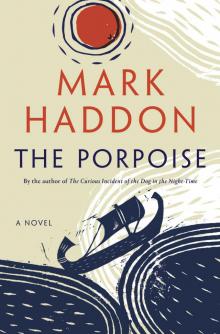
The porpoise, p.7
The Porpoise,
p.7


They cast off and motor out of the marina into the body of Poole Harbour. There is a steady wind astern so they hoist a single sail to help propel them towards the ocean proper. The deck tilts as the sail fills, only a couple of degrees but it reminds Darius of how ill-suited his physiology is to this form of transport. Right now, however, he would choose to be hoisted in the talons of a giant eagle as long as it was heading in the right direction and there were no more comfortable option.
To their left, above the beach, sits a row of preposterous mansions—a wedding cake, a baby-blue New England townhouse, a planetary outpost from Star Wars. “Football managers, DJs and TV presenters,” says Marlena.
Darius can see now that Marlena has a slight limp, though it seems not to hamper her gymnastic clambering. “An altercation in Sicily,” apparently, though she gives no more details. Anton’s neck is still bleeding but Helena insists that salt spray and a cool wind will prevent it becoming infected. Sun dances on the water and gulls are their outriders. A Condor catamaran thunders slowly towards the harbour mouth waiting to pick up speed in open water en route to Jersey. It is the size of a recumbent tower block. Tiny people wave from the rail.
The Porpoise yaws and twists as they climb into the wake of the ferry. Darius starts to relax and as he does so he is able to admit how frightened he has been over the last twelve hours. Someone was trying to kill him. Someone was trying to kill me. He says the phrase out loud and finds himself laughing then sobbing a little. He thinks about Angelica. He decides not to think about Angelica. He cannot help her if he is dead. Right now he is going to concentrate on not becoming dead. He sits against the cabin housing and takes the weight off his throbbing arm.
The tide is rising and as they reach the bottleneck where the chain-link ferry connects Sandbanks to Studland the squeezed and speeded water thickens and twists under the hull. Boats entering the harbour scoot past them on the flood—plump white yachts with downed sails and high, bevelled sterns, a fishing boat stacked with lobster pots, two whiny jet-skis, a yellow pleasure cruiser—Maid of the Islands—chugging straight out of 1974. Their own speed relative to the land slows to a stroll. A blue double-decker bus drives onto the waiting ferry at the Studland end of its tiny shuttle route. Darius is pretty sure there are naked men on the beach, though that seems unlikely for England.
Five minutes and they are out at sea. The engine is turned off and the injured Anton holds the wheel while Helena and Marlena raise the other three sails. The swell is higher and has a longer wavelength out here. This water is a different kind of substance. The sky is enormous.
He should have called his parents. He imagines his father’s voice at the end of the line. Μπα, ο άσωτος υιός μου τηλεφώνησε. He remembers that his father is dead. That he forgot this fact troubles him as much as the fact itself. He looks at the jigging, scalloped surface of the sea, seeking solace. He doesn’t yet know the details of his father’s will. The old man liked to keep his offspring on the back foot. Too late for buttering up now. There looms the very real possibility of Darius having to earn a living. There are kitesurfers far off. He wonders if they get tangled mid-air. He really should have tried a little harder in school.
His eye is caught by something in the water. He will look back and tell himself that he was in a disturbed state of mind, that it was a trick of the light, but he will never wholly convince himself. It is not a dolphin, nor is it flotsam. It is the body of a woman a metre or so under the surface of the water. Dark brown hair, light brown skin. She does not slip past like something merely floating in the water. For a good ten, fifteen seconds she is moving parallel to the boat. His first thought is that she has become tangled in one of their ropes, but there are no ropes trailing overboard. The way her image is jumbled and warped by the surface of the waves makes it hard to tell, but he cannot entirely suppress the idea that she is swimming.
* * *
. . .
The air becomes sweeter as they sail south. The towns on the coast seem smaller and more widely spaced—no pylons, no chimneys, only the occasional horse-tail of woodsmoke. The stars are powdered glass on velvet. There are more fish in the water—mackerel, tarpon, black-tipped sharks, swordfish, marlin, yellowfin tuna—though Darius knows the names only because Marlena points them out. One afternoon a churning shoal of herring revolves under the boat for half an hour so that it feels as if they are riding a great silver drum. Battalions of gulls dive repeatedly into the glittering mass and haul out with the silver winnings in their beaks. Just before the herring disperse there is a brief, panicked scattering and a humpback whale broaches the shoal, fish and water pouring from the monumental black bucket of its grooved lower jaw. One night they glide through a sheet of luminous plankton, the like of which the others have never seen. Darius takes it all for granted, part and parcel of ocean-sailing, some compensation for the nausea and the pain in his arm. Helena, Marlena and Anton, however, know that something is very wrong. There is no weird uptick in the weather, no alteration in sea currents which can feasibly explain this fecundity. Marlena counts thirty-six species of seabird—petrels, albatross, frigatebirds, boobies, shearwaters, razorbills…
The radio fails. Except that they can find nothing wrong with the radio. Then the GPS signal vanishes. The wavebands are as clear as the glassy water below the hull which no longer contains plastic flotsam or iridescent slicks of oil. They pass fishing vessels with oars and hand-stitched sails more like those out of the coastal villages of Guinea-Bissau or The Gambia.
Helena, Marlena and Anton are not easily perturbed, but this frightens them. They are navigating old-school, using charts and compass, and there are whole towns missing along the coast. They discuss going ashore but feel safer out here. When Anton says, “The zombie apocalypse is finally upon us,” it is neither funny nor less rational than any other explanation they can summon.
Darius’s arm begins to swell. His hand is white and he can no longer move his fingers without considerable pain. Anton cuts the plaster away with his Gerber Scout. It takes a long time and leaves several bloody gashes where the knife breaches the last millimetres of plaster with unexpected ease.
Helena, Marlena and Anton tell Darius nothing about the disturbing nature of the changes in the world around them. He has been through enough already and the situation is so peculiar that, even as a group, they are wary of admitting their concerns for fear of seeming crazy.
Two nights later, however, they fall asleep to the slap of waves on the hull and the shriek of shearwaters while riding at anchor in an isolated cove just above the Spanish border. In the small hours Darius is woken by noises which he does not recognise and cannot easily explain—creaks, thumps, scrapes. He climbs out of bed. The movement of the boat is different, a wider, slower roll. He can smell tar and wet wood. He thinks about waking the others but this seems like a good opportunity to restore a little of his badly undermined manhood. He mounts the steps, girds his loins, slides the hatch back and climbs onto the deck.
There is a man standing in front of him, wearing a soiled leather jerkin over a bare torso. He has a tattoo of a griffin with talons raised down one muscular arm, and a compass inked onto the centre of his chest. The man’s black hair is plaited down his back and he is so filthy that it is impossible to tell the colour of his skin. His eyes are narrow, Mongolian perhaps. His smell is the smell of someone who sleeps in the street and soils himself and does not change his clothes. Mixed with dog-breath and incense. There is an elderly, wooden-handled knife tucked into the rope that holds his trousers up. He looks like a man for whom killing other people is easy, if not habitual. He smiles at Darius. He has a small number of yellow teeth randomly arranged inside his mouth. Darius assumes it is an ironic smile, an indication that any resistance would be hilariously ineffective. “All is good. Back to sleep.” The accent is indecipherable, part Dublin, part Bangkok, part Lord alone knows where. Darius is having trouble breathing. The man is surely not alone. Two more like him and they will find themselves thrown overboard at best. People have been held for years on becalmed tankers off Mogadishu. It might be best to jump the rail now and swim, but he has one functioning arm and no memory of how far they are from the shore. He looks at the long rip of absolute black between the stars and the starlit chop of the waves, and this is when he sees what has happened while he was asleep.
“Shitting Christ.” The exclamation is so in tune with his own feelings that he thinks they are his own words, but Anton climbs up onto the deck beside him, looking not at the stranger but up into the air. “Holy shitting Christ.”
Darius looks up. The sails are different. The sails are huge, and square, and there are way too many of them. The deck shifts unexpectedly. Not moves as such but…expands. Darius stumbles. Anton falls. Helena’s head rises through the opened hatch. She looks different in a way that Darius can’t quite pinpoint. “And who the fuck are you?” She is addressing their tattooed potential murderer.
The man laughs as if this is an old joke the two of them have shared many times. “All is good. All is very good.” He reaches down and helps Anton to his feet.
The boat is bigger. There is no polish and nothing sings with light. There are barrels, there are actual cannons—black iron shafts, wooden bases, solid wooden wheels. There is a second man whom Darius has also never seen before. He has a dense ginger beard and a wooden leg which looks as if it was sawed from a chair. Two clinkered gigs are roped to the deck. Darius is taken aback by the ease with which the term clinkered gig comes to mind.
The most disturbing thing of all, however, happens inside his head. He has an overwhelming need to be on dry ground in a world where you can go to sleep and wake up to find everything exactly as it was when you closed your eyes. Since this is not possible he rides that long chute back through the years until he is sitting in the little circular cupola at the very top of the eastern tower. His pet monkey crouches over a bowl of pistachios, selecting nuts in turn, splitting the shells exactly as Darius has taught him, eating the kernels and throwing the shells over the balustrade, the tiny bell on his red collar tinkling as he does so. The monkey’s name is Kremnobates. It is winter and a light drizzle is falling on the ring of terracotta roofs by which he is surrounded. Beyond them a grey sea shades imperceptibly into a grey sky. There is a leather-bound book open on his lap, more parchment than paper. The words at the very top of the page read:
Talia iactanti stridens Aquilone procella
velum adversa ferit, fluctusque ad sidera tollit.
They flip effortlessly into English:
As he throws out these words, a screaming north wind
hits the sail full-on and lifts the waves to the stars.
Except that Darius has never learnt Latin, never owned a pet monkey, never lived in a building with a tower. And yet these images are utterly convincing—the pistachios, the little bell. Worse, they are part of a larger world he knows in equal detail. Below the hatch upon which he is kneeling a spiral staircase leads down to the long gallery with its terrifying tapestry of Phaethon failing to control the chariot of the sun. On the floor below that, his sister is being taught to play the cittern, her ill-tempered tutor chopping the air with his bony hands as if he were slicing a sausage. One and two and…His father swings between rage and sadness. Courtiers bow and flatter and cave. Slaves scurry from the royal presence like cockroaches from the light. Everywhere and nowhere, his mother’s ghost, more present than anyone.
Darius tries to put these images out of his mind and reach into the real past and summon the place he always felt safest and happiest, the villa in Kozani to which the Koulouris family retreated every summer, the cool of the stone-flagged hallway, the stuffed owl and the smell of cigarettes in his father’s study, the Rouault clown on the wall of the dining room. But the house is being swallowed by a fine, grey mist. He tries to remember his mother’s face and nothing will come…
He is back on the ship. It is night-time, he is lying on the deck and he is shaking uncontrollably. His mind has always been robust. He would have avoided a few scrapes if he’d been a little more anxious in advance of certain activities and a little more regretful afterwards. He has never quite believed in mental illness and has therefore caused grave offence on a number of occasions. Now he understands what it means to lose your mind. He is being carried away by a dark flood. There is nothing to which he can cling for safety and very little Darius left to do the clinging.
The tattooed man puts the metal spout of a water pouch to Darius’s lips, lifts it and squeezes. The liquid tastes of latrines and bay leaves and contains grit which he can feel between his teeth. The man with the ginger beard bats the pouch away and replaces it with a bottle. Darius takes a swig. He has never tasted petrol but it cannot be greatly different from this. He takes two large swigs and tightens his grip on the bottle lest it is taken away.
His mind has no centre any more. There is only a flurry of sensations and feelings. Nothing binds them together. He is a flock of birds, he is a field of grass, he is the aftermath of an explosion, the splinters flying away from one another. Arms lift him. He has no strength left. He is carried below decks, wrapped in a fleece, laid in a hammock and swayed into the relieving dark by the rot-gut and the roll of the hull.
* * *
. . .
He wakes in the Great Cabin. Images of the stuffed owl and the Rouault clown linger briefly, as resonant and troubling as the dispersing wisps of any nightmare. His head is heavy. He must have been drinking. He gets to his feet. Sunlight pours through the long window which runs the width of the stern. There is a wardrobe and a chest of drawers and a low-backed beechwood chair with wide legs. There are hourglasses of three different sizes. There is an astrolabe, a quadrant and a cross-staff. There are declination tables, astronomical maps and a shelf of charts held in fat rolls by ageing blue ribbons. Spread out on the table, its curly corners pinned down by four cast-iron balance-weights, is a vellum map of the Mediterranean.
His name is Pericles, Prince of Tyre, and this is where he is at home, in motion, incommunicado, hundreds of leagues from those chill and melancholy halls once warmed and lit by his mother’s generosity and goodwill. Two years since her untimely death. His father’s worst self unconstrained now, petty, angry, the runt of his own father’s litter, a small man with too much power. One third of the court desperate to carry out his every whim, one third hiding, a final third seizing the opportunity to use the chaos to their own advantage, much as men leash ill-tempered dogs and encourage them to hurt others, his sisters protected only by the fact that they are women and therefore have little value and demand little attention.
Another ten days and he will be back inside that godforsaken palace. One cannot remain at sea for ever and he owes a duty to the people over whom he will one day rule if not to the man from whose dead hands he will eventually take the crown. Is he a coward to hope that a violent confrontation between the two of them will justify a swift return to this peripatetic life of travel and trade? Assuming the city has not been eaten up by the canker of his father’s anger, or fallen to some neighbouring king who has taken advantage of eyes turned inwards. And if it has, so be it.
He clears his head by splashing his face with cold water from the fat-bottomed tin jug by the privy, then takes his pea coat from a hook and steps out of the door. The helmsman is checking the compass, gimballed in its teak box. He stands upright and executes a cursory but respectful nod. “My Lord.”
Pericles nods back then rises into the light and the fresh wind of the upper gun deck.
Above him sails ripple and sway—top-gallant, topsails, courses…Men spider through the rigging. He knows every inch of this ship from the stern lantern to the wooden mermaid with long tangerine hair, painted lips and full but slightly chipped wooden breasts. Three hundred and seventeen tonnes laden, nineteen carriage guns, a hold packed with bisket, Holland cheese, neats’ tongues, mutton, lemons, good wine…and secreted under these, the Barbary gold which they have earned trading Venetian glass.
Rubbing his arm, which hurts abominably for some unknown reason, he climbs to the quarterdeck and stands beside Helicanus who asks if he has any objection to them resuming their journey. He has none so they weigh anchor and tack into deeper water to gain the benefit of the propitious current then turn south towards Lisbon and the mouth of the Tagus.
His captain, Helicanus, has nut-brown skin and salt-stiffened blonde hair. Unnaturally young and still beardless, he nevertheless radiates a confidence which outstrips his youth. His two junior officers have done sterling service in some very tight spots on both this and previous voyages—Marlenus whose nimbleness belies the limp he sustained falling from a horse in Sicily, and the burly Antonio whose more recent wound has healed well in the salt air, though it will leave a scar on his neck which will either keep him out of respectable houses or make him the centre of attention depending on the sensibilities of the womenfolk in that particular city. The other hands have been taken on in Tyre or picked up en route. One man was lost overboard in a storm on the Dogger Bank, a second vanished among the fleshpots of Copenhagen and a third died of a fever. It’s a decent average for a trip of this length.
They round the cape at Sagres and turn towards Cádiz. Other ships pass them with increasing frequency as the ocean traffic of the eastern Atlantic thickens near the Strait of Gibraltar. When they enter the Mediterranean Pericles expects to feel more at home—small tides, fewer storms, more accurate maps, languages he understands—but something is wrong, a pebble in the mind’s shoe. There is a task which has to be done, of that he is certain, but the name and nature of the task eludes him. He lies awake at night, unable to sleep. They pass the Balearic Islands, they pass Sardinia, they pick up fresh water in Syracuse. There is a meteor shower at night, brief scratches of bright white light high in the north-west which send the more credulous sailors below decks for fear of contagion.