

Breaking point book 10 o.., p.13
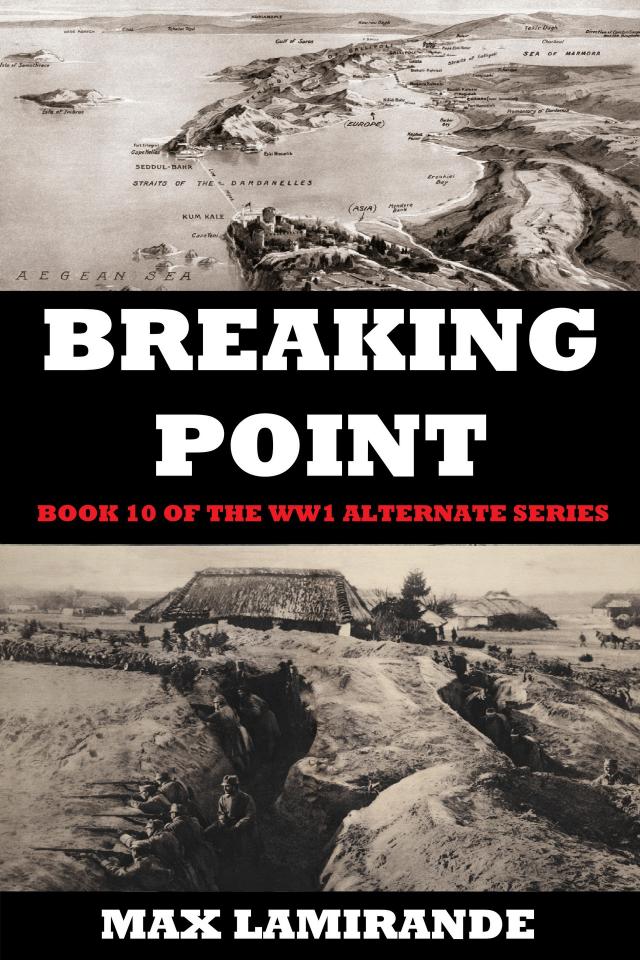
BREAKING POINT: Book 10 of the WW1 Alternate Series,
p.13


Helmut’s ears rang as the last Russian resistance collapsed. The surviving defenders dropped their rifles, hands raised, trembling beneath the sudden, overwhelming pressure of the assault.
Lieutenant Mullen stood atop the sandbag wall, chest heaving, face smeared with soot.
“Signal battalion!” he shouted. “Tell them the ridge is ours!” Sergeant Wolkrs clapped Helmut on the back, grinning. “Well done, boy. Viliya won’t hold much longer.” Below them, the village still burned and fought, but the key to its defense had fallen. And the 21st Landwehr Division surged forward, ready to break Viliya once and for all.
(…) 4th Hussars (reconstituted) Division (…)
Russian Private Soldier Dimitri Fedorov knew panic within the ranks when he saw it, as he was, by now, an experienced veteran having fought for over a year in Galicia and now in the Ukraine. The redoubt on the ridge in the center of the village had just fallen to a relentless assault by the enemy, and now the entire left flank of the 4th Hussars was disintegrating into chaos.
The battle had raged for a day and a half between the Russians and the Austro-Hungarians, and Dimitri had thought things would hold steady and that they would repulse the attacker again. The 4th Hussars had been called in haste a few days before when the enemy appeared out of nowhere by Lake Viliya and assaulted the village. Brusilov and his officers had not thought the Austro-Hungarians capable of such a feat (a trek across country without roads to outflank the main Ostrog defenses), and thus, the Russians had reacted a bit late to the enemy's sudden attack.
“Stay close, Fedorov,” said steady Sergeant Churin, flanked by his two tough soldiers, Alexander Mantvichuk and Victor Orban. The three men had been instrumental in Dimitri’s survival in Przemysl when they’d brought him along during their dramatic Drachenballon air escape over the enemy lines. Ever since then, the trio had included him in their unit and adventures. “This rout can kill you if you give in to it.” As if to confirm the NCO’s words, two raving mad soldiers, running from the front, got smacked by bullets in the back. “Stay low, we’ll retreat, but in an orderly fashion,” Churin continued, pointing toward an alley going up into the village. Viliya was built on the slopes of a ridge overlooking the lake, so they could reach higher ground that remained in Russian hands.
They had, however, to retreat fast, as that higher ground was shrinking fast. The Austro-Hungarian assault had come like a hammer. Their artillery shattered the lower houses, and their storming parties swept through the streets with frightening coordination. Machine-gun nests that had held for hours were now silent, buried under rubble or overrun by bayonets. Screams echoed across the village, drowned by the thunder of battle and the acrid hiss of burning timber.
Dimitri ducked behind a collapsed cart, panting. “Sergeant, they’re everywhere! They must have broken through the center, too.” “They did,” Churin said grimly, firing two shots down the street. “But they haven’t broken us. Move!”
Mantvichuk pushed Dimitri forward, practically dragging him through a narrow passageway between two half-destroyed houses. Smoke billowed from the rooftops, drifting upward in gray columns that blended with the low clouds. The sound of the lake’s waves crashed faintly somewhere below, mocking, peaceful, indifferent to the slaughter spreading across the village like a wildfire.
A group of Russians burst from behind a barn ahead, running uphill in blind panic. One stumbled and fell, clutching his leg, and another barely glanced at him before continuing the desperate climb. Churin clicked his tongue.
“That’s how units die,” he muttered. “But we will not be part of that. Stay tight.” A sudden rattle of machine-gun fire erupted from the house on their left. Orban cursed and slammed Dimitri against the wall as bullets tore through the wooden planking of a house. Mantvichuk leaned around the corner, fired a quick shot, then turned back. “Twenty or so Austrians,” he said. “They’re pushing up from the lake road.” Churin nodded. “Then we keep climbing. Viliya is lost.”
They continued upward, weaving through broken fences and smoking debris. The ridge above them seemed impossibly steep, but it was the only escape route still open. Behind them, the Austro-Hungarians shouted louder, issuing short, guttural commands in German that echoed through the alleys.
At a crossroad near the upper village well, they found half a platoon of Russians desperately forming a line behind overturned wagons. A young lieutenant, barely twenty, waved a pistol and shouted for the men to hold. But their faces were pale, their hands trembling.
“They won’t hold long,” Orban said quietly. “Then we won’t stay long,” Churin replied with a mischievous smile. Suddenly, a shell whistled overhead and exploded atop a nearby house. The roof blasted outward in a rain of flaming timbers. The shockwave flung Dimitri to the ground. When he looked up, the young lieutenant was gone, buried under a collapsed wall. Half the platoon fled without orders.
Churin grabbed Dimitri’s collar. “Up! Up, damn you! Keep moving!” They scrambled over a stone terrace and reached the last street before the northern slope. From here, the land slanted downward toward the fields and woodlands that led toward Ostrog. Far off, Dimitri heard something that sent a surge of hope through him: the disciplined rifle volleys of cavalry fighting dismounted.
“The 4th rearguard,” Mantvichuk breathed. “They’re holding the northern exit.” “Then we make for them,” Churin said. “If they break, Ostrog falls tomorrow.”
Behind them, Austro-Hungarian troops spilled into the upper village. Shouts of “Vorwärts!” and “Niederhalten!” echoed like a rising storm. Bullets nipped at their heels, striking stones and sending chips into their legs and boots. Orban turned twice to fire covering shots, shouting curses.
The northern slope was muddy and treacherous, churned by earlier troop movements. Dimitri slipped twice but kept going. The smell of burning tar and gunpowder filled the air. A wounded Russian crawled near a fence, pleading weakly for help. “We can’t stop,” Churin said, though his voice carried sorrow. “We die if we stop.”
At last, they reached the edge of the village, where the fields opened up into yellow grass and scattered birch trees. Ahead, a thin Russian line was forming, a hundred men at most, hussars and infantry mixed together, using horse troughs and low stone walls for cover. Officers shouted for more ammunition. Horses whinnied frantically behind them, tied hastily to poles or trees.
“Halt there!” a hussar captain barked as they approached. “What unit?” “4th Hussars, third auxiliary platoon,” Churin answered. “What’s left of us.” “You’re with us now,” the captain said. “Austro-Hungarians are pressing close. We hold here, or we’re cut off from Ostrog entirely.”
Mantvichuk knelt behind a stump and began firing immediately. Orban joined him. Dimitri dropped beside Churin, shouldering his rifle despite his shaking hands. The enemy appeared minutes later. They were dark shapes cresting the upper slope, moving like a black tide spilling out of Viliya. They fired as they advanced, muzzle flashes flickering like fireflies in the smoke. But now Dimitri was no longer running. He was fighting. He steadied his rifle, aimed, and fired into the oncoming shadows. For a moment, just a moment, he felt the line hold.
The rearguard’s rifles cracked in disciplined volleys. A machine gun rattled from behind a wagon. Austro-Hungarian soldiers fell, stumbled, regrouped. The battle for Viliya was lost, but the road to Ostrog would not be given up so easily. And Churin’s little band held their ground as the last defenders of the northern escape.
The Dardanelles, Part 2
(…) The plan (…)
The Entente plan at the Dardanelles was conceived as a bold stroke designed to reshape the entire course of the Great War. At its heart lay a grand strategic vision: open the route to Russia, force the Ottoman Empire out of the conflict, and strike a blow that would reverberate from the Balkans to Berlin. The Dardanelles were more than a narrow waterway. They were the hinge upon which the security of Istanbul, the Ottoman heartland, and access to the Black Sea all depended. With control of the straits, the Entente could transform a stagnant war into a global realignment and potentially save the Russians from disaster.
The plan unfolded in two intimately connected phases, each designed to complement the other. The first phase focused on the navy, whose role was nothing less than the destruction of the Ottoman Empire’s coastal defenses. The Dardanelles were guarded by a series of powerful fortresses, some ancient stone leviathans dating to the time of the sultans, others modernized with German-built steel gun houses and massive 240mm artillery pieces. These strongpoints, namely the twin bastions of Sedd-ül Bahr at Cape Helles and Kumkale on the Asiatic shore, had to be neutralized before any ground forces could safely land. Their guns commanded the entrance to the strait and could devastate transports or halt any approach by Entente warships.
To meet this challenge, a multinational fleet was assembled on a scale the Mediterranean had not seen in centuries. Battleships from Britain, France, Japan, and the United States gathered in the waters off Lemnos and Tenedos. Their task was clear: unleash a coordinated bombardment powerful enough to crack the Ottoman forts and open the gates of the strait. The plan relied on the superior firepower of modern dreadnoughts, whose heavy guns could pulverize the thick masonry of the coastal defenses from a distance beyond the range of Ottoman artillery. Once the guns of Sedd-ül Bahr and Kumkale were silenced, the fleet would use its dominance of the strait to support the second phase of the operation.
That second phase centered on the ground forces. The goal was to seize key portions of the Gallipoli Peninsula, particularly the ridges, heights, and headlands commanding the waterway, so that the naval forces could eventually advance unchallenged toward Istanbul. Control of the high ground was essential; whoever held the ridgeline held the strait itself.
The landings were therefore planned as a carefully orchestrated series of amphibious assaults, aimed at overwhelming the Ottoman defenses before they could mount an effective counterattack. The British, American, Serbian, and French forces were tasked with the main effort at Cape Helles, the southern tip of the peninsula. There, on the broad arc of beaches facing the open sea, multiple brigades would land simultaneously. Their objectives were the village of Sedd-ül Bahr, the slopes of Achi Baba, and eventually the heights dominating the northern half of the peninsula. This advance would serve as the hinge upon which the entire campaign would turn.
Further north, the ANZAC Corps, namely the Australian and New Zealand Army Corps, was to land near Ari Burnu, a narrow, rugged stretch of coast characterized by steep ridges and deep gullies. Their mission was to seize the spine of hills stretching inland and prevent Ottoman reinforcements from sweeping down the peninsula to crush the British beachheads. If successful, the ANZACs would secure a lodgement that could later be used for a northward push toward the heights of Chunuk Bair and the commanding ground around the Narrows.
Supporting these two major thrusts were additional Allied contingents tasked with covering their flanks, holding captured ground, and providing follow-on waves of reinforcements. The logistical demands were immense: thousands of troops, hundreds of landing boats, artillery pieces, horses, mules, ammunition, water, and supplies, all to be brought ashore under fire and sustained through the early days of the advance.
If all went well, the Entente would secure the peninsula, dominate the Dardanelles, advance upon Istanbul, and bring the Ottoman Empire to collapse. With the straits opened, Russian grain, troops, and resources could flow to the Western Allies, altering the entire balance of the war.
Unfortunately for the Entente, all did not go as well as they had imagined.
(…) Ari Burnu (…)
The first light of dawn crept slowly over the jagged ridges of the Sari Bair range as the boats of the 5th British Imperial Corps approached the narrow crescent of Ari Burnu Beach. The sea was deceptively calm, reflecting the soft pastel colors of the sky as if nothing violent could ever occur upon its surface. But the glow of the burning cliffside facing them was unmistakable: war had come to the Gallipoli shores.
The huddled men in the British landing boats had watched the bombardment from the sea only minutes before, as Carden’s Eastern Mediterranean Squadron smashed the coastal guns to splinters, their shells lighting up the heights like distant flashes of lightning. Now it was their turn.
The 34,000 soldiers of the so-called “ANZAC ” Corps (5th British Corps) were not purely British. This formation was a patchwork of the Empire, comprising Australians, New Zealanders, Irish battalions, Indian mule handlers, Canadian medical teams, and South African engineers. A dozen accents murmured across the boats, some whispering prayers, others muttering curses, and others saying nothing at all. The only constant sound was the rhythmic splash of oars and the distant crack of sporadic rifle fire from the ridges.
The boats scraped onto shingle, and the men leapt out, rifles raised, boots splashing through the chilly surf. The landing here, unlike the inferno taking place at Cape Helles to the south, was almost surreal in its silence. Only a few scattered Turkish riflemen fired from makeshift pits higher up the slopes. A handful of bullets snapped overhead, kicking up sand or sparking off the metal fittings of the cutters. But compared to the storm they had trained for, this was almost peaceful.
Within minutes, hundreds of men were moving inland, scrambling up the first low ridges. The terrain was rougher than any map had suggested, with gullies choked with thorn bushes, ridges that rose like walls, and goat trails that vanished into dead ends. Units became entangled. Some platoons climbed too far north, others drifted south into narrow ravines. Officers shouted orders, only to have them swallowed by the folds of the land. Yet the advance continued.
On the right flank, a mixed detachment of British and New Zealand infantry secured the so-called Plugge’s Plateau (it had a Turkish name but the British had named it so), raising a flag atop the rocky shelf that overlooked the entire cove. From there, they could see the vast blue sea glittering behind them and the endless waves of reinforcement boats coming in. A sense of triumph washed through the men. For the moment, Ari Burnu was theirs.
Farther inland, the Australians pushed toward the next ridge grandly named Russell’s Top, only to be slowed by the twisting gullies that cut the landscape. The enemy appeared in small pockets: a squad of Turkish riflemen firing from a fold in the slope, a handful of men running between boulders, and a lone machine gun dragged hurriedly up a track before vanishing behind the crest.
By mid-morning, the 5th Imperial Corps had landed almost 20,000 men. The cove was alive with motion: stretchers being carried to makeshift medical posts, mules dragging crates of ammunition up the slopes, engineers clearing paths, and officers frantically trying to bring order to the chaotic terrain.
The real fight was yet to come, but for now, the British were optimistic.
(…) Cape Helles (…)
The landings at Cape Helles bore no resemblance to the relative calm at Ari Burnu. Here, the Ottomans were ready, or as ready as men could be under the greatest naval bombardment the theater had ever witnessed. The rebuilt forts at Sedd-ül Bahr had been turned into smoking wreckage and slag by the combined fire of dreadnoughts and pre-dreadnoughts, but the Turkish riflemen and machine-gunners in the gullies, dunes, and broken village ruins remained very much alive.
At dawn, the amphibious invasion wave approached, with the 11th French Corps on the right, the hodgepodge Serbian Army in the center, and the 4th U.S. Infantry Division on the left flank. Their combined strength, including more than 78,000 soldiers, gave the Entente leaders every right to be confident.
As the boats neared the beach, the Ottomans opened fire. Machine-guns rattled from concealed stone walls, rifles snapped from every dune, and shrapnel shells burst overhead in white puffs. But the Entente had prepared for this. The ships behind them blasted every muzzle flash they could spot. France, Democratie, Texas, Michigan, and a phalanx of destroyers pounded the shoreline with shells and rapid-fire guns.
The French landed first. Their colonial regiments, including Senegalese Tirailleurs and Algerian Zouaves, charged forward, splashing through the surf with wild yells. They stormed the lower slopes of the Helles headland, overrunning several Turkish trenches in brutal close-quarters fighting. The French flag went up over the lower ruins of Sedd-ül Bahr by mid-morning.
Next came the Serbians. Driven by the memory of their homeland ravaged by the Central Powers, they fought with ferocious determination. They hit south of the French in dense waves, enduring heavy losses from Turkish machine guns firing from ravines. But the Serbians pushed inland with bayonets gleaming, capturing two key ridge points and linking with the French on their left. Their advance created the first true breakthrough of the day.
Then the Americans landed. The 4th U.S. Infantry Division, new to the theater but trained for amphibious assault, waded onto the beach north of the French. Ottoman defenders tried to repel them, but the Americans’ disciplined fire and support from nearby British destroyers allowed them to secure a foothold quickly. Within hours, they had established a defensible perimeter and pushed inland toward the village of Krithia. By noon, the beachhead at Cape Helles was stable but fragile.
The Turks launched counterattacks out of the gullies. Machine guns harassed every movement. Snipers fired from broken walls. Yet the Entente numbers were overwhelming. More waves poured ashore, with artillery crews dragging their guns, engineers clearing wire, medics setting up aid posts among the dunes.
By late afternoon, the French held the ruins of Sedd-ül Bahr, the Serbians controlled the central ridge, and the Americans were pushing up the inland track toward Krithia. The Ottomans were being forced back step by step.


