

Breaking point book 10 o.., p.22
BREAKING POINT: Book 10 of the WW1 Alternate Series,
p.22
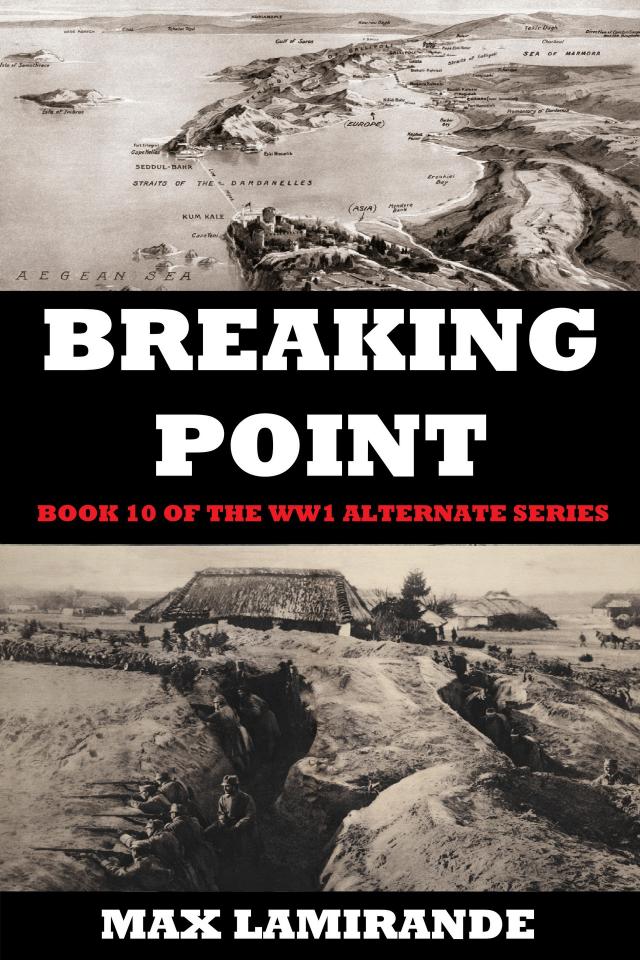


At a hundred meters, the Bavarian divisional bugles sounded the advance. With a great shout, the front lines surged forward into a jog, then into a full run, bayonets lowered. Russian morale was done for. Half the remaining defenders fled deeper into the town, heading for the main street or any alley that still offered a path of escape. The others, cornered or too exhausted to run, fought where they stood. The first Bavarians reached the trenches. What followed was not a battle but a slaughter.
Handfuls of Russians raised trembling hands, pleading in broken German or Polish for mercy; others fought with bayonets, shovels, even stones. The Bavarians pushed through them with ruthless efficiency, clearing trench after trench in moments. Blood splashed across wooden beams and spilled down the sides of the shallow earthworks. A machine gun nest that had continued firing until the last second was overrun, with four Russian bodies piled atop the Maxim, the crew cut down where they worked.
Within another ten minutes, the southern defenses of Bienica ceased to exist as an organized force. The remnants of the 56th Brigade streamed north between burning houses and shattered fences, abandoning rifles, packs, and machine-gun parts in the mud. Bavarian chasseurs pursued briefly before stopping at the general’s order; von Kneussl wanted the town secured, not a wild chase.
As smoke drifted low and the crackle of flames rose from the ruined cottages, von Kneussl lowered his binoculars. “Bienica is ours,” he said simply. The field before him was littered with the dead of both armies, gray and green mingling beneath the cold Belarus sky. The road to Minsk had opened another mile.
Bigalı Village (Bigali Köyü), May 1st, 1916
19th Turkish Division, second ridge line of the Gallipoli peninsula
The newly-named commander of the Turkish 19th Division, Lieutenant-Colonel Mustapha Kemal, looked at the dispatch giving him official command of the unit – his transfer papers from command of the 57th Ottoman Regiment. The regiment unit remained under his command as it was part of the 19th, and that made Kemal happy, for these men were like his children.
Bigalı (Bigali Köyü) was a small, secluded village tucked into the folds of the central Gallipoli ridgeline, about two miles east of ANZAC Cove as the crow flies. It sat behind the second line of hills, on the inward slope of the peninsula, hidden from direct naval observation and thus screened from battleship guns. The village lay north of the main Eceabat-Kilitbahir road, connected by narrow dirt tracks threading through gullies and scrub-covered hills. From its fields and low stone houses, the sounds of the ANZAC landing, with its rifle cracks, the rumble of naval artillery, and the shouts of men, could be heard drifting across the ridges, though the terrain shielded it from direct combat.
The village itself consisted of only a few dozen stone-and-timber houses, clustered around small courtyards with olive trees and low garden walls. Goats wandered freely along the paths, and wells sat beneath simple wooden shelters. In the spring of 1916, its residents were evacuated or pressed into service as porters for the army, transforming Bigalı into the nerve center of the Ottoman counteroffensive.
Kemal established his headquarters in a modest, two-room wooden house with a tiled roof, situated at the village’s western edge, which gave immediate access to the footpaths leading up toward Chunuk Bair and Scrubby Knoll, still under control of the Ottoman forces. The building contained a large front room where maps were spread across rough wooden tables, lanterns hung from rafters, and messengers crowded in to receive orders. A rear room served as Kemal’s sleeping quarters (though he rarely slept these days, being busy leading from the frontline), containing a simple iron-framed bed, a small chest for field documents, and a corner reserved for his field telephone and binocular case.
Outside, horses were tied along a stone wall, signalers strung wires toward the ridges, and runners came and went at all hours. Bigalı had become, in these critical days, the beating heart of the Ottoman defense against the ANZAC advance.
“As requested, Sir, here is the report from commanders Esat Pasha of the 2nd Corps and Colonel Halil Sami Bey from the 9th Division,” said his second-in-command, Major (Binbaşı) Izzettin Bey, the moment he entered the small building. Kemal took the paper from Izzettin Bey’s outstretched arm without any ceremony. “Thank you, Major.”
Mustapha was keen to know what was happening south of him, as the fighting in and around Cape Helles wasn’t rumored or reported to be going well. The Ottoman forces were well dug in and occupying the heights, but the Entente forces were so numerous that they were slowly but surely overwhelming the area’s defensive line.
Kemal unfolded the paper, read it, and returned it to İzzettin Bey. “Read it and let’s talk.” The Major did as he was told, and his face blanched. “This doesn’t look good, Sir.” “No, it doesn’t, and since we have our hands full here against the damned ANZACs, there isn’t a damn thing we can do about his situation.” “But, what about the reinforcements you asked for yesterday?”
“Indeed, Major. We cannot hold the heights with courage alone.” He tapped the table map, on the ridge line above Chunuk Bair. “The reinforcements coming to us will be decisive. The remaining battalions of the 72nd Regiment arrive tonight, and with them, we can seal the gaps along the second ridge. Tomorrow or the next day, elements of the 5th Division, including the Thirteenth and Fourteenth Regiments, will come under my operational control. They are fresh enough to be thrown into the line where the Australians press hardest. And after that, the 64th Regiment of the 3rd Division is marching from the interior. Artillery, too; we’ve got two batteries being dragged up along the gullies by mules. It will take time, but once they are positioned, we will be able to annihilate every enemy movement from the beach to the foothills. Remember this well: once these reinforcements are in place, our hold on the heights will no longer be fragile but permanent.”
The Turkish commander leaned over the map, signaling to his major to come closer. “Now look here, Izzettin. Esat Pasha’s situation at Helles is more precarious than ours. The enemy there is not a scattered landing force; he presses with full brigades, supported by ships that fire like mobile fortresses. Reinforcements are already moving to him, but it’s not certain that he will hold the overwhelming tide. The 2nd Division is on forced march, and parts of the 7th are being peeled from the Bulair line. Within days, the 12th and 16th Divisions will stiffen the entire southern defense. Extra artillery is rolling down from Kilitbahir. Those are heavy guns, the kind that can smash a beachhead to pieces if the enemy dares to push too far inland. Even depot troops and gendarmes are being thrown into the trenches to buy time.” Kemal exhaled slowly, folding his hands behind his back. “The enemy thinks he can crush us at two landings at once. Let him try. With these reinforcements, yours, mine, and Esat’s, we will show him why he will fail.”
“The real question, Sir, is whether Esat will hold or not.” “Well, my dear Major, if the southern defenses collapse completely, everything we have held here will come under pressure within hours. The enemy will not waste his time on the beaches. He will push straight for the high ridges.”
He moved to another map, this one large, representing the Gallipoli Peninsula in its entirety, and pinned it to the wall, placing his hand flat on the summits. “Our first duty,” he continued, “will be to secure Chunuk Bair and the second ridge line. This must be done immediately and without hesitation. If those heights stand, we control the peninsula. If they fall, the enemy will command all approaches to Maidos and the Narrows. The fleet will sail past our forts like a knife through soft bread. You understand, Izzettin? This ground is not terrain. It is destiny.”
He tapped the ridge with the back of his knuckle. “We will reinforce every trench along Chunuk Bair. I want the 27th Regiment holding the forward slopes, the remnants of the 57th reorganized into in-depth positions, and the fresh battalions from the 72nd placed behind them as immediate counterattack reserves. No gaps. No exposed gullies. Every approach must be sealed by rifle, by bayonet, or by stone if nothing else is left. I will also contact Liman von Sanders in Constantinople to ask him to redirect Esat Pasha’s reinforcements to me, since he probably can’t hold until they get there anyway.”
He straightened and looked toward the southern horizon where the sky flickered with distant flashes. “If the enemy marches north from Helles, he will come tired, confident, and over-extended. Good. Overconfidence blinds a man. Let him climb the ridges with his packs and his arrogance. We will be waiting on the heights.”
Kemal’s voice dropped, but his words sharpened. “Send word to every regimental commander: the heights are to be held to the last living soldier. There will be no withdrawal from Chunuk Bair. Not now, not ever. If Helles collapses, then this ridge becomes the shield of the Empire.”
He turned full-face to İzzettin. “Prepare the men. Tonight, we strengthen the heights. Tomorrow, we make them unbreakable.”
Infanterie-Regiment Graf Schwerin
New German defensive line, Chateaubriant, May 4th, 1916
“Déja vu” was the only feeling that could describe Private Oskar Dantz’s state of mind as he helped the machine gunner in the new trench position they were setting up. South of him, artillery thundered as the German and the Entente cannon dueled from long range. Sometimes, the heavy shells whizzed just above him, but mostly, the main artillery parks were located northwest of the Infanterie-Regiment Graf Schwerin’s position. To him and the others (especially the ones who had been fighting since Nantes), the writing was on the wall. The enemy forces were too numerous to stop, so they dug in on the Chateaubriant-Arzal Line, but it was only temporary. Oskar was no strategist, but from his lowly perspective, he suspected the Reich would eventually initiate a major strategic withdrawal east. Germany’s problem was the number of men it had (the Entente possessed at least a 3 to 1 superiority), considering the length of the front it had to cover. By abandoning most of northwestern France and redeploying its forces on a north-south axis just west of Paris, it could reduce the front it had to defend by at least 2. Oskar was but a lowly private, and what was obvious to him was also starting to dawn on the OHL. But any kind of retreat had to be done in stages, and the leadership also had to bring themselves to accept it. Thus, the Reich wasn’t there yet, and men like Dantz and the grunts on the ground would have to continue to fight stretched thin.
Oskar had a cigarette hanging from the corner of his mouth and was sweating heavily, as he and a couple of other soldiers had hauled the heavy weapon from the supply truck 400 yards behind the main trench line. “Don’t they think we can finish this war? It's obvious we are still going to retreat,” grumbled the man beside him, a new fellow (recruit) from Frankfurt, named Frederick Walken. “Why don’t you shut your fucking mouth, Walken?” barked crusty sergeant Wilhelm, hovering near them as they toiled to get the weapon in place.
They finally dropped the Maxim on the ground, while the machine gunner started to install the steel tripod on which the weapon would soon rest. Taking a long puff of his smoke, Oskar watched as the grayness of his exhaling billowed all around his head. By the outbreak of the First World War, the Maxim gun and its national derivatives, namely Germany’s MG-08, Britain’s .303 Maxim, and Russia’s M1910, were almost universally mounted on heavy tripods or equivalent sled mounts. These supports were not accessories but essential components of how the weapon was meant to function on the battlefield. A fully loaded Maxim could weigh well over 60 pounds and, combined with its water-cooled jacket, recoil system, and ammunition belts, required a stable firing platform to unleash the long, punishing bursts for which it became infamous. The nature of the ground itself forced its uses, as soft earth, even when hard-packed, tended to move and could throw a gunner’s aim off.
The tripod provided that stability. Each shot generated a substantial rearward recoil impulse, and without a rigid mount, the weapon’s fire would climb, wander, and eventually batter the gun to pieces. The tripod absorbed this force, keeping the barrel on target and allowing crews to maintain fire for minutes at a time without sacrificing accuracy. Even the sights were designed with this configuration in mind: range ladders, traverse arcs, and elevation adjustments all assumed a fixed, grounded position. The Maxim was therefore never a mobile assault weapon but a defensive anchor – an industrial-age machine built to dominate prepared positions, channel enemy attacks, and create the deadly, sustained fire zones that had come to define the trench warfare of the Great War so far.
“What do you think, Private?” said Sergeant Wilhelm, also watching the machine gunner toil to get his tripod installed. The NCO liked Oskar, as he was a good fighter, but also one of the last of the “old hands” since very few other than him and Wilhelm were still alive or unhurt. Everyone else in the section had been replaced several times over. The survival rates for recruits were not high. “We’ve got a great position, Sergeant. Clear field of fire, interlocking fields of fire, I am pretty sure the landscape will channel the enemy through here,” Oskar pointed to the left, “where this baby,” he then pointed to the Maxim, “should do its gruesome work.”
“Agreed, Private. Now,” his face changed from casual to mean in a moment, “we just need to whip those damned recruits into shape.” Wilhelm turned and started to yell at the loudmouthed recruits from Frankfurt.
Oskar put his left leg on the top of the sandbagged trench, watching the southern horizon flashing with explosions. He finished his cigarette and pinched it out before returning to help the machine gunner, who was then ready to mount the weapon on the tripod.
Wurttemberg Mountain Battalion
Nivillac, new German defensive line, May 5th, 1916
Several hours later, a similar scene was unfolding several miles to the west, in the town of Nivillac, where the Wurttemberg Mountain Battalion had also built up its defenses to await the inevitable Entente forces, advancing and on the offensive somewhere south of the new German defensive lines.
The area couldn’t yet be called a frontline, and the land right before the trench itself was not yet a no man’s land, since the Entente had not dug their own trenches south of the German one. “Sir, do you think they will arrive soon?” “Well, from the rumbling and the flashes I see there,” Rommel answered, pointing south toward the large flashes in the darkness, “I would say that they will be here tomorrow or the day after that.”
Captain Erwin Rommel was riding a horse, along with five of his best men. Among them was the always-at-his-side maverick Theo Stark, along with Private Hector Reinhardt and three more elite soldiers. These men had been with him during the fort assaults in the Italian Alps, and he trusted them with his life. For what he was about to do, they were also the perfect fit.
The skyline was a jagged ribbon of darkness, broken only by the violent, stuttering flashes of artillery far beyond the horizon. Each blast lit the night for an instant in white, then orange, swallowed again by endless black, revealing the haunted shapes of torn trees and distant ridges that vanished as quickly as they appeared. The ground trembled under the hooves of the German soldiers’ horses as they guided their mounts out of the forward trenches, riding slowly, cautiously, into the shadowed future no-man’s-land beyond their own wire. In the brief eruptions of light, their silhouettes emerged stark and ghostlike: helmets dull-dark with camouflage, tunics rippling in the cold wind, carbines slung low as steam rose from the horses’ nostrils like smoke from small chimneys. There had been no fighting yet in the area, so they rode amongst trees and small farm buildings, or stone walls.
Each flash carved their outlines against the night, resembling a second-long portrait of war, before darkness reclaimed them. The thunder of distant guns rolled over the fields in long, uneven waves, sometimes muttering, sometimes cracking like the sky itself was splitting apart. Overhead, drifting clouds reflected the fire below, their undersides turning a sickly red with every explosion. The men said little. The night spoke loudly enough: a horizon aflame, a battlefield breathing, and their path illuminated only by the relentless heartbeat of war.
Rommel had convinced the unit commander, Colonel Theodor von Ducker, that a raid could be attempted while the Entente moved its line northward. The idea was to try and catch a supply truck, an artillery column, or any other target of opportunity, ambush them, and then return to the trench at first light.
The plan was quite simple. Ride out in the middle of the night on horses for speed, find something to hit, and do their thing.
(…) An hour later, further south from the German Line (…)
Rommel steadied his horse with a quiet tug on the reins as another distant flash lit the skyline. Theo Stark rode just behind him, blanket-wrapped against the creeping chill, while Hector Reinhardt and the three other troopers, Klaus, Mertens, and young Willi, kept a tight formation in the darkness. They moved like shadows over the ground, having left behind the safety of their forward trench line. Ahead lay nothing but black fields, fences, small villages or dwellings, and patches of forest.
“South patrol reported movement,” Rommel whispered over his shoulder. “If they’re pushing guns forward tonight, we’ll make sure they don’t reach our lines tomorrow morning.” The men nodded. No one doubted him, as they’d done this many times over before. The night belonged to small groups with iron nerves and quick minds, and Rommel excelled in both.
They pressed on at a quick trot to cover the distance, hooves pounding the ground. Every artillery flash to the south momentarily carved them from the dark, then dropped them back into invisibility. The horses moved with disciplined quiet, trained for these night raids. After fifteen more minutes, Reinhardt hissed a warning.
“Lights at two o’clock!” yelled young Willi. Rommel froze, raising a clenched fist. Across the low rise, faint white beams flickered through the night: vehicle lamps, far too high above the ground to belong to infantry patrols. The convoy was moving north, toward them, slowly but unmistakably.


