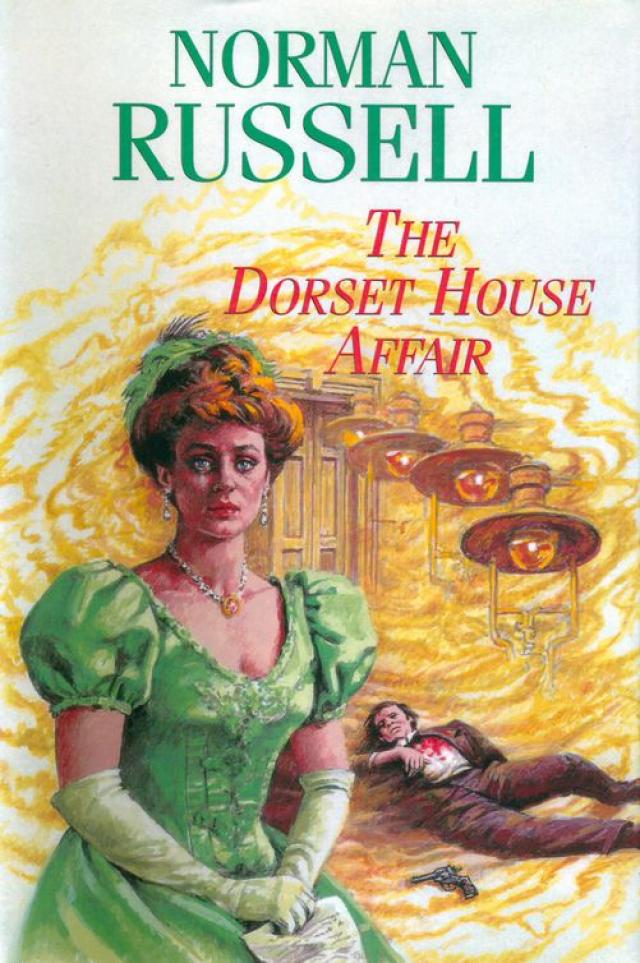
The dorset house affair, p.15
The Dorset House Affair,
p.15


Box recalled his visit to Louise Whittaker at Finchley on the previous Monday. He had told her then that Maurice Claygate’s fiancée had disbelieved the tale of Elizabeth de Bellefort’s heroic defence of her brother when she was a mere child. ‘I should like to meet Miss Julia Maltravers,’ Louise had said. ‘She sounds to me like a woman of discernment.’
Julia Maltravers and Louise Whittaker – why not bring the two women together? Louise had given him her own invaluable gloss on the Dorset House affair, and it was only right that she should hear what Julia Maltravers had to say.
Box left his office, and made his way upstairs. Tiptoeing past Superintendent Mackharness’s office, he walked along a narrow windowless passage, at the end of which an iron spiral staircase took him up to the telegraph cabin, a small room that had been built upwards through the roof of 2 King James’s Rents. There was no landing: you stood on the top step of the spiral staircase, and pushed open the narrow door.
The duty telegrapher, PC Mackenzie, sprang to his feet as Box, still standing on the staircase, half leaned into the bright little room.
‘Constable,’ said Box, ‘I want you to send a telegram via Charing Cross Post Office, for immediate delivery.’ He gave Mackenzie Louise Whittaker’s name and address, and then dictated the substance of the message.
‘Miss L. Whittaker. Want you to attend a meeting with self and Julia Maltravers as soon as possible. Saturday a.m. convenient. Suggested venue: King James’s Rents. Box.’
‘Very good, sir. Do you want a reply direct?’
‘What? Oh, yes. Thanks very much, Constable. You can bring it down to me when it arrives.’
Box returned to his office, and wrote a reply to Julia Maltravers’s letter. He put it into an envelope and affixed a penny stamp. Crossing the wet boards of the entrance hall, he looked into the reception room, where an elderly bearded sergeant was busy writing in a ledger.
‘Pat,’ said Box, ‘would you make sure that this letter gets the next post? I’d go out myself, but I’m expecting an answer to a telegram. Use the box at the end of Aberdeen Lane.’
Half an hour later, PC Mackenzie came down from the telegraph room with Louise Whittaker’s answer.
Box, King James’s Rents. Look forward to meeting you and Miss Maltravers Saturday a.m. at eleven. Suggested venue: the Acanthus Club. Whittaker.
The Acanthus Club, an institution for women who had managed to enter business and the professions, occupied a dignified old house in Scrivener’s Lane, a winding narrow road off Pall Mall, not far from the Burlington Arcade. A few stunted plane trees rose from the pavements and added a touch of faded green to the drab greys and browns of the Regency buildings.
Despite his best efforts, Box was half an hour late for the meeting with Louise and Julia Maltravers. The portress, a formidable lady in black, with jet appurtenances, conducted him up the wide staircase and along a passage, at the end of which was the strangers’ room.
Louise and Julia were sitting at a table in the window, evidently deep in conversation. When the portress announced him, they stopped speaking, and stared at him for a moment, as though wondering who he was. Evidently, the two women had established a rapport with each other at this, their first meeting.
‘Mr Box,’ said Louise Whittaker, ‘you’re a trifle late, you know, but Miss Maltravers and I have spent the time talking about the various members of the Claygate family. I’ve ordered coffee for the three of us, and the maid should be along soon. Meanwhile, let us not waste any more time. Come, Miss Maltravers, let us now hear an account of how you fared in your interview with Elizabeth de Bellefort.’
Julia Maltravers launched into her account of her visit to Normandy. Although Louise Whittaker had seized the initiative, Box was gratified to note that Julia addressed all her remarks to him.
‘At first, Mr Box,’ she said, ‘Elizabeth de Bellefort was wary of me, and treated me distantly. But very soon she began to confide in me. I found her in a distressed, haunted state, evidently very near a breakdown. She sensed my pity and concern, I expect, and that was why she made me her confidante.
‘There’s no doubt,’ Julia continued, ‘that Maurice treated Elizabeth de Bellefort shamefully. She told me in confidence what had happened to her, and I swore that I would keep that confidence secret. Indeed, it would be perfidy to do otherwise. Suffice it to say that she has been grossly wronged.’
‘You can tell us no more than that?’ asked Box.
‘No. But I can tell you that as a result of Maurice’s behaviour, that poor woman’s life has been permanently compromised. It was monstrous! What she told me will remain a secret. But when she talked about the plot that she and her brother had concocted to take revenge against Maurice Claygate by shooting him dead, I knew where my duty lay. Attempted murder is something to which I had no intention of giving silent assent, especially on this particular Saturday, which, had Maurice lived, would have been my wedding day.’
The others grew quiet for a moment, as they felt the pathos of the words that Julia had just spoken.
‘You did right, Miss Maltravers,’ said Box, breaking the silence, ‘though, in the event, that act of revenge was never carried out. As far as the law is concerned, Miss de Bellefort is innocent of any crime.’
Box was quick to see Louise Whittaker’s little movement of impatience. Although she said nothing, he knew that she was thinking of her own interpretation of the events in the garden passage. Elizabeth de Bellefort, according to Louise’s theory, had behaved in that frantic way because she had just come through that door herself, and so knew for a fact that something frightful remained in the passage.
At that moment, the maid arrived with a tray of coffee, and busied herself with laying out the cups and saucers. While she was doing this, and later, when she began to pour the steaming hot coffee into the cups, Arnold Box took swift stock of the theory that had taken shape in his mind ever since his visit to Louise at Finchley.
If Louise was right, and Elizabeth had really shot Maurice Claygate dead, what must have happened next? Perhaps Harry the Greek had come to Dorset House that night with one or two accomplices, who could have been concealed among those screens and cupboards halfway along the passage. After Elizabeth de Bellefort had shot Maurice dead, she had returned to the vestibule, where he, Box, had accosted her.
The accomplices rush out from their hiding place and drag the body as far as the door into the lane – what was it called? – Cowper’s Lane. Meanwhile, one of them, would have retrieved the note and the pistol….
They open the door into the lane and, dragging the body between them, make their way out of Dorset House. They hit upon the clever idea of pretending to be revellers, singing and shouting. That other groom – Joe? – was convinced that those three men had left the house through the garden door, and not by way of the path at the side of the house. Another of their number waited with the second-hand cab that eventually ended up in Callaghan’s cab yard. Yes, it could have happened like that.
The maid departed, and Box permitted himself to return to the matter in hand.
‘Would you please give me a careful account of what Miss de Beliefort told you about this murderous plot?’ asked Box. ‘I’ll take down what you say in shorthand. I may need to interrupt you from time to time.’
‘The brother and sister, who were staying at Dorset House,’ Julia continued, ‘concocted a note, designed to lure Maurice away from his guests and into the passage, where Elizabeth was supposed to be waiting with a gun – a pistol, you know. The note was duly written, and delivered to Maurice by one of the footmen—’
‘That would be a man called Harry the Greek,’ said Box. ‘There’s a general warrant out for him at this very moment. He was obviously in the pay of Alain de Bellefort. As for this note – did Miss de Bellefort reveal its contents?’
‘She did, and I made a conscious attempt to remember the exact words. “Please, dear Maurice, come to take my hand one final time. I am waiting in the garden passage”. I thought it sounded rather silly, but it seems to have done the trick.’
‘At last!’ cried Box. ‘A little glimmer of light in the darkness. The wording of that note would account for Maurice’s smug little smile when he read it. He couldn’t resist the fantasy of the lady still doting on him. He told his friends that he had a little assignation in the offing. But that was not the note that I found in the dead man’s pocket!’
Box flicked rapidly through the pages of his notebook.
‘Here: this is what that note said. “Come straight away to Lexington Place. If you fail me, I will tell your papa all. Sophie”. That note was put into Maurice’s pocket after he was dead. The real note—’
‘The real note, Mr Box,’ said Julia Maltravers, ‘fluttered out of Maurice’s hand after he’d been shot. But no, of course, that only happened in Elizabeth’s dream….’
Julia stopped in confusion. Her brow creased in a puzzled frown. Louise Whittaker leaned forward in her chair, and placed a hand on the young woman’s arm.
‘Julia,’ she said quietly, ‘you’d better tell Mr Box and me the substance of this dream. Perhaps, then, we’ll discover where all this is leading.’ Louise glanced at Box as she spoke, and saw his almost imperceptible nod of assent.
‘Elizabeth told me that in her recurring dream she imagines herself standing in the deserted garden passage at Dorset House. She is waiting for Maurice to appear. She said that she could smell the smoke from the fireworks, and could hear the conversation of some of the guests who were standing about in the garden. She felt the hard metal of the gun clasped in her hand. It was all extremely vivid, and I recall thinking that she must have had all the details of this plot drilled into her by that brother of hers. And then….’
Julia paused in her story, and glanced at Louise.
‘You think that this dream actually happened, don’t you, Miss Whittaker?’ she asked. ‘It’s too enduring in its detail to be entirely a dream. As I listened to Miss de Bellefort, I, too, began to think that she was recalling an actual event. But, of course, it couldn’t have been anything of the sort, because the passage, as Mr Box has told us, was empty.’
‘Was it?’ said Louise, flushing with vexation in spite of herself. ‘Was it indeed? It may have been empty when Mr Box pushed open the door, but it doesn’t follow that the passage was empty when Elizabeth de Bellefort came out of it – which is what I think she did – and all but fell into Mr Box’s arms. But come, Miss Maltravers, let us hear the conclusion of your tale.’
‘Elizabeth declared that the passage – the passage in her dream – was empty,’ Julia continued, ‘but she felt that there were witnesses standing behind her, hidden by some old cupboards and screens. And then she said that a demon was standing close behind her, and that if she had turned around, she would have seen it.’
‘A demon…. Well, well,’ said Box, half to himself. He jotted down a note in his book.
‘Elizabeth said that the door opened, and Maurice Claygate came into the passage. She saw him holding the note in his hand. He darted forward as though to take the gun away from her, and then she fired.’
‘Did she mention the noise of the fireworks at that moment?’
‘Yes, Mr Box, she did. She said that the noise nearly deafened her, and that a split second afterwards there came a shattering echo, reverberating along the passage.’
‘That’s right,’ said Box. ‘I heard that echo myself…. If this is all a dream, how is she able to hear what I heard? Did she say anything else?’
‘She said that poor Maurice didn’t seem surprised at what had happened to him. His eyes glazed over, and he sank to the ground. The note fluttered from his hand. She stepped over the body and flung open the door – to be confronted by you, Mr Box! And that is the substance of Elizabeth de Beliefort’s dream.’
Arnold Box sat in thought for a few moments. This dream…. Miss Whittaker had already suggested that Elizabeth de Bellefort had indeed just emerged from the garden passage when he had come upon her, desperately trying to prevent anyone from gaining entry. And now, the vivid details of the ‘dream’, and its existence as a single, unfragmented experience, suggested compellingly that the Frenchwoman was recalling a real experience, that her fragile mind was trying desperately to deny.
‘Louise,’ he said, ‘and you, Miss Maltravers, would you be willing to take part in a reconstruction of what could have happened in that passage? I would need a little time for preparation, but would suggest Monday afternoon, if that’s convenient.’
‘A reconstruction?’ asked Julia, intrigued.
‘An enactment, miss, would perhaps be a better word to use. We would take the events of Miss de Bellefort’s dream, and act them out as though they had taken place in reality. There would be nothing to fear, as you would be part of a police investigation. Perhaps you, Miss Maltravers, could secure the consent of Field Marshal Claygate?’
‘I think it’s an excellent idea, Mr Box,’ said Julia. ‘But I can’t quite see what it is that you hope to prove by acting out Elizabeth’s dream.’
‘The enactment might make us conclude that it wasn’t a dream,’ said Box, ‘which is what Miss Whittaker believes to be the case. It may show us that Elizabeth did indeed enter that empty passage with the fast intent of shooting Maurice Claygate dead. We shall observe a substitute perform the act of shooting, and then see her rush through the door into the vestibule. What happens after that, Miss Maltravers, is the part of the enactment that will particularly interest me.’
Box glanced at Louise Whittaker, inviting her to finish what he was going to say. It was she who had first suggested these ideas to him, and it was only right that she should give voice to them now.
‘Julia,’ said Louise, ‘on that fatal evening of Maurice’s birthday, Elizabeth de Bellefort, by the use of a cleverly worded note, lured your fiancé away from his guests and into the garden passage. It had all been cunningly plotted by the two of them, so why shouldn’t it have happened?
‘Let us say, for the sake of argument, that she did indeed conceal herself in that passage, and that, when Maurice entered it, she shot him dead. Immediately she rushes through the door into the vestibule. Let us leave her there. What is left behind? The dead body of Maurice Claygate, the fatal note, and the pistol which she had thrown to the ground. What would have happened then, between Elizabeth quitting the passage and Mr Box entering it?’
‘There was a footman on duty that night, Miss Maltravers,’ said Box, ‘who was, in fact, a petty criminal, well known to the police. He may have had accomplices in the house. These men could have removed the body of Maurice Claygate and conveyed it away into the lane behind Dorset House. Such a thing could be quite possible. If we can show that it was so in fact, it will put a whole new complexion on the crime.’
‘Elizabeth de Bellefort and her brother left for Normandy the next day,’ said Louise. ‘That in itself was suspicious, you know. It looks very like the brother protecting the sister. Once out of the country, no one could ask them any awkward questions. Let us by all means take part in this enactment. It’s a brilliant idea, and it could lead to brilliant results.’
‘Well,’ said Julia, ‘I embarked on this business in order to find out the truth, so let the truth prevail, however devastating the consequences may be. I will communicate with Field Marshal Claygate at once.’
‘Very well, then,’ said Box. ‘We will assemble in the vestibule behind the grand saloon in Dorset House next Monday, at three o’clock in the afternoon. A word of warning, though. The idea of an official re-enactment of a murder may seem exciting at the moment, but these affairs can prove to be quite upsetting for anyone who was intimately acquainted with the victim.’
‘Have no fears about my reaction, Mr Box,’ said Julia Maltravers. ‘A little emotional upset is a small price to pay for revealing the truth of my fiancé’s death. I am eagerly looking forward to next Monday afternoon.’
12
The Re–enactment
While Arnold Box was consulting with Louise and Julia at the Acanthus Club, Colonel Sir Adrian Kershaw was looking once again out of the window of his room on the second floor of the London Pavilion. He was watching the man who was coming to visit him climb down from the upper deck of an omnibus. This man was very different from the rough-and-ready Mr Ames, who had brought him the news of François Leclerc’s suicide.
No doubt Major Ronald Blythe had come directly from Victoria, using the public conveyance in an attempt to be anonymous. However, the major’s liking for green serge suits would always make him stand out in a crowd.
Some minutes later, Mr Cadbury showed Major Blythe into the room, and withdrew. The major was a lithe and lively man in his late thirties, his face adorned with a clipped moustache. There were lines of good humour at the corners of his deep-set blue eyes. To some people he was known as ‘Major Blythe of the Home Office’, to others, ‘Major Blythe, Secretary of the Hampstead Watch Committee’. To Kershaw, he was one of the most valuable of his secret servants, a man who controlled his own discreet network of operators. Major Blythe was Kershaw’s eye upon Europe.
Although in civilian clothes, Major Blythe drew himself briefly to attention before taking a seat opposite Kershaw.
‘So, Major,’ said the colonel, ‘you’ve thought fit to rush across Europe once again to cast down pearls of wisdom at my feet. Where have you been? It’s over a week since I sent you in pursuit of De Bellefort, and I’ve heard nothing. I thought you’d deserted me for the foe. You’re looking very dapper, if I may say so. That red carnation in your buttonhole goes well with your green suit.’
Major Blythe smiled. The colonel’s cheerful mien suggested that all was going well at his end of things. The civilities were over, and it was time for him to give his report.