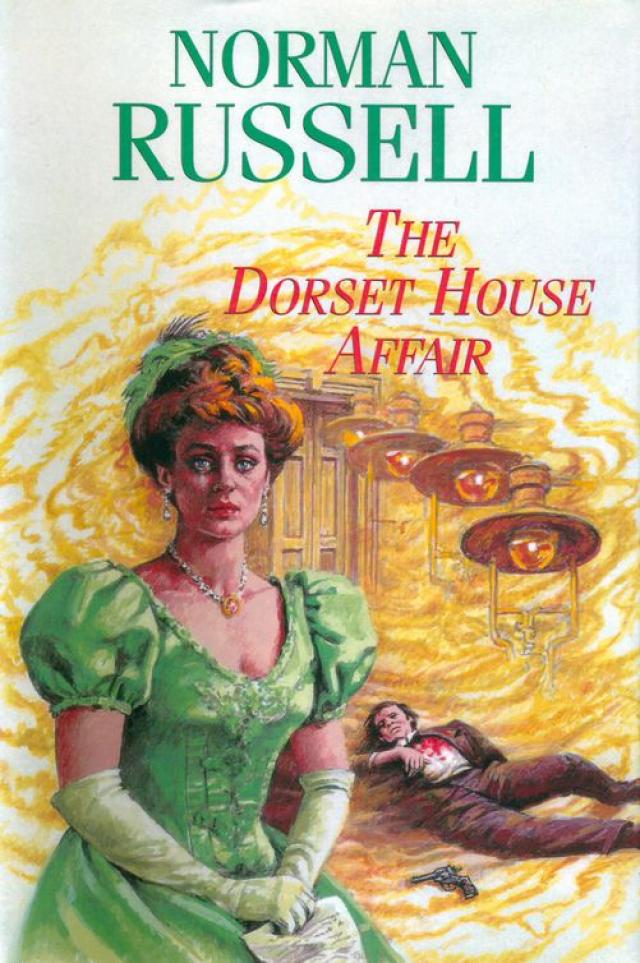
The dorset house affair, p.18
The Dorset House Affair,
p.18


It was nearing eleven o’clock when Arnold Box turned out of Fleet Street and into Cardinal’s Court. Mrs Peach had evidently not retired for the night, as a welcome glow of yellow light gleamed from the half-moon of glass above the door of Number 14. He had bade a sombre farewell to Sergeant Green outside St Thomas’s, and had taken a cab from the rank in Westminster Bridge Road.
After signing off duty, he had gone to Samson’s Café at the top of Aberdeen Lane, and dined off liver and fried potatoes, followed by ginger sponge pudding and a cup of rather greasy tea. There, he had met George Boyd, an old friend and ally, and the two men had talked about crime and criminals for over an hour. Samson’s Café was not one of Box’s favourite haunts, but he never liked to bother Mrs Peach with dinner when he was on a late day-shift.
Box used his latch key to open the front door, and climbed the stairs to his rooms. Mrs Peach had kept the fire going and, when he had divested himself of his hat and greatcoat, he lit the lamp, and put a small cast-iron pan of milk on the trivet over the fire. In a moment, he would make himself a cup of Epp’s Cocoa, to which he would add a dash of navy rum. He sat down in his leather armchair beside the fire.
So, it was the haughty Monsieur de Bellefort, not his frantic sister, who had actually shot Maurice Claygate. It was logical, when you thought about it. That poor young woman could not have been relied upon to shoot her former lover in cold blood. In her own mind, of course, she had done so, even though it had been a blank round that she had fired, but her brother had made quite sure that Maurice died, by firing the fatal shot himself.
And so the Frenchman’s warped sense of honour had been satisfied.
Honour? No, there was more to the business than dubious honour. De Bellefort had arranged for the young man’s dead body to be conveyed by cab to the house in Soho, thus linking Maurice Claygate’s death with that of Sophie Lénart. It had been a bold move, designed to furnish De Bellefort with an apparently unassailable alibi, and at the same time to suggest that Claygate was one of Sophie Lénart’s associates.
The milk boiled, and Box poured it on to the little pile of cocoa and sugar at the bottom of a large earthenware breakfast cup. He added a spoonful of rum, and sipped the steaming liquid thoughtfully.
Without doubt, Alain de Bellefort was a double murderer; but there was much to be done to bring the Frenchman to book, particularly with respect to the murder of Sophie Lénart. The folk in ‘C’ Division would have to be alerted first thing in the morning to the substance of Harry the Greek’s confession. He would ask Mr Mackharness to talk personally to Superintendent Hume at Little Vine Street.
It was also essential that Colonel Kershaw should hear of this latest development. Maurice Claygate had been one of his agents, and it was beginning to look very much as though De Bellefort had personally silenced him for that reason. He’d never really swallowed all that high-minded talk about ‘honour’. ‘What is honour? A word. Who hath it? Him that died o’ Wednesday.’ That was in the Bible, somewhere. Or maybe it was Shakespeare.
From the inside pocket of his coat Box removed the tightly rolled spill of paper that he had taken from Colonel Kershaw’s cigar case when he had met him in the upstairs room at the London Pavilion. He unrolled it, and read the few words that someone had printed on it in soft lead pencil.
H. Broadbent, Tobacconist, Ashentree Court, Bouverie Street, EC
Thank goodness! Ashentree Court was only a short walk from home. He’d call there first thing in the morning, on his way in to the Rents.
Box finished his cocoa, left the room, and climbed a further set of stairs to his bedroom on the second floor front. From the small window he could see the glow of the night sky above the buildings in Fleet Street. There were lamps glowing in the rear windows of the Daily Telegraph’s offices, where the presses were being made ready for the early morning edition of the paper.
Box blew out his candle, and within minutes he had sunk into a deep sleep. He awoke with a jolt some hours later, and sat up in bed. What was it? What had disturbed him? He began to recall a dream, a dream in which he had watched a foaming tide receding from the shore of a moonlit sea. It came to him then that Harry the Greek had just breathed his last.
At just after 7.30 the next morning, Arnold Box pushed open the door of Mr Broadbent’s tobacconist’s shop in Ashentree Court, just off Bouverie Street. A cheerful, rather elfish man in a black alpaca coat sat behind a small counter. As the bell behind the door set up its merry jangling, the man looked up from the newspaper that he was reading.
‘Inspector Box, I think?’ he said, smiling. ‘I thought you might be dropping in soon. He’s in Number 4 control box at Cardington Lane shunting yard, Euston Station. He’ll be there all morning, I expect. A box of vestas? Certainly, sir. A ha’penny. Yes, he’ll be there all morning. Good day.’
Although the morning promised to be fine, very little sunlight filtered through the dull canopy of engine smoke hanging above the complex network of tracks in the great shunting yard at Cardington Lane. A porter, evidently on the lookout for him, had conducted Box away from the busy platforms of Euston Station and through a maze of narrow walk-ways between the sets of lines. They had passed mysterious little brick sheds, in which you could see fires burning in miniature grates. Railwaymen bent on mysterious tasks to do with their vocation looked up as they passed. Countless wagons filled with coal stood in the sidings, and from time to time trainless locomotives would come bustling and clanking past them in a cloud of steam.
After a few minutes they emerged on to a sort of island, upon which rose a tall structure of wood and glass. A perilously steep iron staircase gave access to a kind of elevated office. A board affixed to the structure declared it to be Number 4 Control Box: East.
A very long passenger train had stopped at a signal on one of the main lines running through the sidings, its great locomotive was letting off steam. It reminded Box of an impatient thoroughbred horse waiting for the start of a race, and straining at the bit.
‘He’s up there,’ said the porter. He turned his back on Box, and began his walk back to the station. Box climbed the steep iron stair, and pushed open the door at the top.
Colonel Kershaw looked up as he entered, and immediately motioned him to be silent. At the same time, he beckoned Box over to the window where he was standing, evidently watching the impatient passenger train held up at the signal.
‘Let me just watch this, Box,’ said Kershaw, ‘and then you and I can talk.’
Following Kershaw’s gaze, Box saw a carriage door open, and a prosperous-looking man in frock coat and tall silk hat clamber down on to the track. He was immediately joined by four men clad in the livery of the London and North Western Railway Company, who hustled him across the sidings to a remote line where a small locomotive, coupled to a single grimy carriage, stood with steam up.
The man in the frock coat was helped up into the compartment, the door was slammed, and the small engine immediately began to move. In moments the little train had rattled its way out of sight under a bridge. On the main line, someone blew a whistle, and the long passenger train began its final haul into the station. Colonel Kershaw breathed a sigh of relief.
‘That man, Mr Box,’ he said, ‘was about to be met at Euston Station by a little delegation of enemies – my enemies and yours – who would have ensured that he was never seen alive again. Well, they’ll be disappointed, because he’s already changed trains, and embarked on the last leg of his journey. It’s a long story, Box – another story – that doesn’t concern you, so I’ll say no more. Now, what have you found out?’
Colonel Kershaw was wearing a dark overcoat and a flapped leather cap. He looked nothing like the elegant figure who had met Box in the upper room at the Pavilion. Evidently, he had no wish to stand out too obviously from the pervading gloom of the sidings.
Very carefully and slowly, Arnold Box told the colonel of his interview with Harry the Greek in St Thomas’s Hospital. Kershaw listened patiently without attempting to interrupt Box’s narrative, but his face turned very pale, and his lips set in a stern line. Box had seen him like that before. It was a sign of cold anger, fully mastered, but boding ill for whoever had caused it.
‘Harry’s story confirmed what I’d already suspected,’ Box concluded. ‘The so-called hallucination was, in fact, something that actually happened, and the killer was not Elizabeth de Bellefort but her brother, Alain—’
‘And the whole contrived drama at Dorset House, Box,’ said Kershaw, ‘was merely a cloak for De Bellefort’s assassination of Maurice Claygate. He may not have known that Claygate was one of my people – I should imagine that he is quite unaware of my existence – but he probably thought that the poor young man was working for Sir Charles Napier. It makes no difference, either way. Claygate was a danger to De Bellefort, and so he murdered him. It means – damn it all, Box! – it means that Sophie Lénart came into possession of that fatal list, and then decided to sell it on to De Bellefort—’
‘Why should she do that, sir?’
‘Because in her own warped way she was a French patriot, and knew that De Bellefort, for all his posturing, is a rootless scoundrel. If those misguided Alsatians were to be betrayed, it would be better for someone like De Bellefort to do it. She would offer it to him, and if he refused, she would have salved her conscience, such as it was. She would have suggested a high price, which that beggar could never have met….’
‘And so,’ said Box, ‘he made an assignation to see her – it would have been on the afternoon of Thursday, the sixth – and when he turned up at the house in Soho, he murdered her, and took the document.’
‘It must have been like that. And later the same day, Box,’ said Kershaw, ‘De Bellefort shot Maurice Claygate, and then furnished himself with an alibi by having him conveyed to that house in Soho while he remained at Dorset House. First he murdered Sophie Lénart, and then he brought poor Claygate’s body along to keep her company.’
‘I’m sure that we are right, sir,’ said Box. ‘But I don’t quite see why De Bellefort felt it necessary to murder that young man, and risk the gallows in order to do so. Do you think that family honour had something to do with it after all?’
‘Do you seriously connect the concept of honour with that skulking rat?’ said Kershaw. ‘Do you recall Tennyson’s lines?
His honour rooted in dishonour stood,
And faith unfaithful kept him falsely true.
Those lines fit De Bellefort like a well-tailored suit. He killed poor Claygate, Box, because that young man, as I told you the other day, had discovered Sophie Lénart’s part in the theft of the Alsace List from the French Foreign Ministry. You and I had imagined an unknown third party in the matter, but it’s now clear to me that De Bellefort was the killer of both Sophie and Maurice. He killed one to silence him, and killed the other so that he could steal from her.’
Colonel Kershaw was silent for a while, evidently absorbed in thought. Box glanced out of the grimy windows of the colonel’s hidden eyrie. It was a dismal prospect. Rain had begun to fall, and the coal heaped up in wagons on the sidings was gleaming wetly under a grey sky.
‘Box,’ said Kershaw so suddenly that the inspector started in surprise, ‘on this coming Saturday, the twenty-second, De Bellefort is going to visit the Queen’s Cottage in Kew Gardens, where he intends to hand over the Alsace List to an agent of the German secret services – a man called Pfeifer – in return for ten thousand pounds sterling. Rather more than thirty pieces of silver, but the principle’s the same.’
‘And what do you intend to do, sir?’
‘My original intention was to take the document from him, and send him and the German about their business, thus avoiding any diplomatic fuss. That’s all changed, now. I will be there with my people from early morning on Saturday, and this time I will take the document from De Bellefort, arrest him, and hand him over to you. Let the civil arm see the fellow safely to the scaffold. Pfeifer, of course, and what happens to him, is none of our business.’
‘I’ll receive Alain de Bellefort with the greatest of pleasure, sir,’ Box replied. ‘Saturday’s only five days off. Has he already returned to England?’
‘No, he hasn’t. He’s apparently in Amiens, according to my informant. He’s cutting it fine, I admit, but he’s not the man to turn up his nose at ten thousand pounds. He’ll be there.’
14
The Double Traitor
The Chevalier Alain de Bellefort looked out of the window of his sitting-room at the west front of Amiens Cathedral, which rose in all its Gothic majesty not far from the quiet hotel where he was staying. What grandeur! What an enduring monument to Gallic genius! One day, it would be again the capital of Royal Picardy, and the oriflamme of the Bourbons would fly above those stupendous towers.
That coming Saturday, he would hand over the Alsace List to Pfeifer, an accredited agent of the Prussian intelligence service, and in return would receive £10,000 in Bank of England notes. But at what cost! He had had to swallow the insults of that pig, who treated him as though he were a lackey. Well, perhaps one day, something could be done about Pfeifer.
He had enjoyed the brief visit that he had made to Maître Flambard, the family’s lawyer at Rouen, soon after his return from England. As soon as he had mentioned money, the yellow-face old sinner had been all smiles and affability. ‘What would ten thousand English pounds achieve?’ he’d asked, and Flambard had told him that such a sum would redeem all the mortgages held by the Paris bankers. It was then that he had conceived the bold and outrageous plan that he was even now putting into effect.
‘What if I were to come into possession of twenty thousand pounds?’ he had asked.
‘Why, then, monsieur,’ the old man had replied, ‘you would be able to restore the Manoir de Saint-Louis to its former splendour. Mind you,’ he’d added, with a curiously unpleasant smile, ‘to come by such an enormous sum of money, you would have had to rob a bank!’
‘You forget yourself,’ he had replied, with all the hauteur that he had been able to muster.
‘A thousand pardons, monseigneur,’ the old villain had said, baring his yellow teeth in a smile. Animal! Within the week, £20,000 would be his – £20,000 in Bank of England notes.
Events in England had arranged themselves more successfully than he had ever imagined possible. The English spy Maurice Claygate – the man who at one time could have become his brother-in-law – had been silenced. It was Claygate who had discovered De Bellefort’s connection with Sophie Lénart, and that knowledge would have prevented his daring attempt to seize the Alsace List from her. She wanted money that he did not possess, and therefore she had to be removed. And so he had killed two birds with one stone.
Very soon, he would be able to take his rightful place among the nobility and gentry of Normandy. People who mattered – mattered to him, that is – could come to dine and sleep at the manoir, issuing invitations to him in return. Perhaps he could contrive to become acquainted with the De Quetteville family, and others of that stamp.
Last month, on the promenade at Deauville, he had raised his hat to Count Gautier de Savignac, who had replied in kind, but it had been clear from the count’s expression that he had had no idea who De Bellefort was. All that would change.
The resurrected manor-house would need a chatelaine – a gracious hostess, witty and accomplished, who would shine in company. Elizabeth was well educated and a good conversationalist, and she was rightly admired for her beauty. But the recent events in England would soon make themselves the subject of gossip and speculation in French society. Nothing, of course, would be said, but much would be thought, and no doubt, acted upon. Elizabeth had become a liability.
Since their return from England, she had shut herself up in her apartments, seeing only the grumbling Anna. (Anna would be pensioned off, as soon as was decent). He would consult the physicians at the Bon Sauveur in Caen about the possibility of Elizabeth taking up residence there. It had a first-class reputation, and others in Elizabeth’s position had reconciled themselves to seeing out their lives there….
One of the grandest of the old Norman families was that of Pierre Charles Longaunay, the Seigneur de Franqueville. His crippled daughter, Clélie, had never married. Was there a possibility of an alliance there? Why not? She was an intelligent woman, quite presentable in her own eccentric way. Yes, there were possibilities….
The door of his sitting-room opened, and Henri, the hotel manager, appeared on the threshold. He bowed, and offered De Bellefort an ingratiating smile. Curse the fellow! He suspected that there was a kind of republican mockery behind his smiles.
‘Monseigneur, your visitor has arrived. He is in the small salon.’
‘Very well, Henri. Let him wait for a quarter of an hour, then send him up.’
‘It is as Monseigneur wishes,’ said the manager, bowing himself out of the room and closing the door.
De Bellefort took up a square buff envelope from a writing desk, and examined it critically. The handwriting on the front was a perfect copy of the original. He extracted a single sheet of paper, and looked at it in admiration. The little jobbing printer had reproduced the official heading of the French Foreign Ministry to a marvel. He himself had copied the twenty-four names and accompanying details of the plotters of a coming insurrection in Alsace. Later that day, he would carefully reseal both the original Alsace List, which he had taken from Sophie Lénart, and this, his clever forgery. If he played his cards right, the two documents would bring him in the unimaginably vast sum of £20,000. He put the forged document safely away in a drawer.
There came a knock on the door, and the manager reappeared with De Bellefort’s expected visitor. He ushered the man into the room, announced him, and withdrew.