Letters, p.48
Letters,
p.48


I had seen him before, in June ’56, when he gave his first lecture, his Inaugural, as Professor of Poetry at Oxford. […But] I had certainly never seen him at close quarters before. I was petrified, mute, with fear and awe, that first time. I was fascinated by his furrowed, Jurassic face—I had never seen a face which so resembled a geological landscape—at the same time trying not to stare. I was fascinated by his memory and wit—which reminded me, strongly, of Erik[*57] (indeed I never ceased to feel, here, an almost physiological resemblance between them). But, and here he differed sharply from Erik (and perhaps I felt there was something more akin to myself), the flow of wit, the gossip (he loved gossip!) might suddenly cease, if something deep chanced to be brought up. The memory, the wit, were prodigious, phenomenal; but what really moved me, what excited awe, was to see Wystan brooding, to see him suddenly silent, arrested by thought (I often saw this later, I loved to see him ponder; I saw it first, but forget the precise occasion, that evening at Orlan’s in ’67 or ’68). Erik doesn’t ponder—he’s quick as a flash. He’s as clever as Wystan—but he lacks (or disallows, or is disallowed) that strange depth. And Wystan himself had to struggle to find it—he often railed at “cleverness,” especially his own, how this would tempt one to clever instantaneous solutions, how it stood in the way of genuine thought; and how he himself, in his early work (so he thought) was often “clever,” but at the expense of genuine poetic depth. I do not remember—Orlan might—that I exchanged a single word with him that evening, other than saying “Pleased to meet you” and “Goodbye.” But Wystan noticed me—despite silence and shyness (he was himself often painfully shy, and knew very well how to be patient, to wait, for the shy).
It may have been a year or more before I ever met him alone—I’m inclined to put this sometime in ’69. He got me to speak of my Migraine, then in press, and was fascinated that I had given Groddeck[*58] so central a place. He then brought out something he had translated, but never published—a work of Groddeck on massage (Groddeck’s father ran a sort of gymnasium-sanatorium), with unexpected insights on the somatopsychic effects of this, and the somatopsychic and psychosomatic in general. It was in relation to this Body/Mind theme that I lost my own silence and shyness, and found myself talking, for the first time, quite freely with him and, in particular—he was endlessly, though tactfully, curious—being “pumped” on clinical and personal experiences. I spoke freely of the clinical, reluctantly of the personal: Wystan himself seemed to equate them—and I saw then what perhaps I had only sensed in certain poems, how profoundly, even essentially, “clinical” he himself was. But not in a glib sense (though he was sometimes glib); in a deep sense, which combined mind and heart.
So, I met him as a friend of Orlan’s; and then, so to speak, as myself. Curiously—this is often the case with me—there seemed to be (until close to the end) more letters between us than actual meetings. And a sort of decorum was there for—for years. He was always “Mr. Auden,” I was always “Dr. Sacks”—I am not sure that we used first names until ’70–’71. […]
Love,
Oliver
To Cyrus J. Stow
Dentist
September 7, 1984
[No Address Given]
Dear Dr. Stow,
I am sorry not to have thanked you before for your very generous letter—though I would scarcely care to present myself, or be regarded, as any sort of “model” for anyone! It seems to me the basic role of the physician is—to listen, to attend, whatever special skills and techniques and instruments he may then use. The danger is that all the technology may overwhelm him, overwhelm everybody, and that the still small voice, and the quietude of listening, get lost.
It is this loss of quiet listening and attention which seems so much the casualty in our huge, bustling, technologized, bureaucratized world—and it is tragically easy for the young and innocent to become victims. And then the crumbling of all heritages and traditions. But Man is a hardy creature, and a wise one—despite his follies!—and I think we will return to our senses, and the dignity and sanity of life, before it is too late.
Again, my thanks, and kind regards,
Oliver Sacks, M.D.
To Isabelle Rapin
September 11, 1984
119 Horton St., City Island, NY
Dear Isabelle,
How nice to hear from you tonight—I’m sorry I have been a bit boorishly out-of-touch since we last met, mostly feeling low-ish, but now perking up since a refreshing visit to the West Coast (it was very nice being welcomed at my old hospital in San Francisco, Mount Zion—I was surprised at being remembered. […] And seeing old friends, familiar, dear faces and places, so it was a good visit altogether; a nostalgic one; I half want to go back!).
I enclosed a somewhat reduced copy of Jerome Bruner’s[*59] lovely, generous, deep review of my book[*60]—along with a funny cartoon (which I like—the Times one made me squirm!). To have appreciation from a man of Bruner’s calibre and integrity makes me feel much better, has done something to boost my collapsed self-image and self-respect, which sunk to a low after that horrible thing in the LRB. I think now I am beginning to feel more philosophic. One must be, and not react to reactions, but quietly, firmly, confidently, modestly, go one’s own way. Easier said than done! I was also surprised and happy to be offered a Fellowship at the N.Y. Institute of the Humanities (the one which sponsored my “Neurology and the Soul” lecture, and has a weekly or fortnightly luncheon-discussion group, a real mix of artists, scientists, historians, philosophers, etc. presided over by Bruner). I think/hope it may offer the sort of intellectual community I have felt starved of, and need—because I am more isolated than I should be: but, of course, some of this is necessary solitude, and some defensive withdrawal, so I am not quite sure how I will respond. But it makes me feel less like an outcast, a pariah. […]
Love,
Oliver
To Galen Strawson
Philosopher and Critic
November 30, 1984
119 Horton St., City Island, NY
Dear Galen Strawson,
I just got sent a bunch of reviews, including yours, which I found of especial interest, and for which I thank you. I will, if I may—but this may be more a talking-to-myself—take up one point which you take up, and which, we both agree, is central.
I am often asked “Why don’t you write fiction?” and the answer is, I’m too interested in fact. Equally often I am asked “Why don’t you stick to the facts?” and this is a deeper and more difficult question, for it has to do with the status of “facts.” I am not sure whether there are any “brute facts,” “mere facts,” “raw facts,” etc. It seems to me that facts are always embedded in experience, and that this embedding—this enormous connectedness—is both theoretical and dramatic; and what is meant, what Wollheim[*61] means, by “leading a life.”
A pure case-history, a pure consecution, of pure facts, would be something like: “First there was fever. Then spots appeared. Then the urine became bloody…Finally the heart stopped.” Curiously, when I first drafted The Leg for the LRB, my editor said, “The phenomena are fascinating, but something is missing.” When I said “What?” she said “You, the experiencer.” It is ironic that when, after endless hesitation and inhibition, I introduce the experiencer—and this is all I meant when I spoke of “a neurological novel”—I get rounded on with extraordinary vehemence (not least by the LRB itself). […]
I do not regard a neurological “Tale” or “Novel” as a fiction—and yet, clearly, it is more than a case-history or consecution. It is a “Tale” because it has a centre—a Person, a “Who”—but a neurological tale because it deals with the impact of a “What,” a neurological “What.” Everything I write deals with relation of a Who to a What—in particular, the patient’s experience of a neurological disorder (which will include all its resonances and implications for him, the way it alters his life and feelings and thinking, etc.)—how he is altered by neurological disorder (and how, perhaps, he alters it). This constitutes—a “Story,” and a story is essentially dramatic. I hope I am not using “dramatic enhancement”—if I do, on occasion, it is an aberration to be pruned; but I must and do bring out the actual drama, and it is this which makes my “Tales” dramatic and yet wholly factual. I do not, consciously, introduce any “fiction(s),” nor do I feel I have “licence” to do so; nor, I think, do I “make up” or “fabulate”—though I think clinical stories, stories of people dealing with disease and disorder, may have a fabulous, or fablelike, quality. It is not a question of “fact” vs. “fiction,” but of how to convey a human reality, a reality at once clinical, phenomenal, historical. […]
Skip Notes
*1 Labe Scheinberg, a neurologist at AECOM.
*2 These careful observations are an early recognition of a rare and malign form of Parkinson’s with dementia that is now known as Lewy body disease, formally identified only decades later.
*3 Henry Walter Bates (1825–1892) wrote about his explorations of the Amazon rainforests with Alfred Russel Wallace.
*4 John Speke (1827–1864) made three expeditions to Africa to search for the source of the Nile and became the first European to see the great African lake now known as Lake Victoria.
*5 Bateson’s (1972) book was called Steps to an Ecology of Mind.
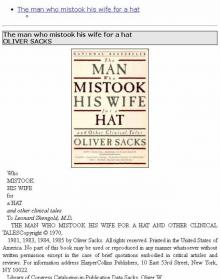
*6 He later described Hans H., using the pseudonym “Dr. P.,” in the title chapter of The Man Who Mistook His Wife for a Hat.
*7 OS writes in Uncle Tungsten of how, as a boy, he used to accompany his father, a general practitioner, on his house calls.
*8 OS’s cousin Carmel Ross, an actress and publicist, had arranged for him to be interviewed for the well-known talk show, and Cavett dedicated two shows to his conversations with OS. This considerably raised OS’s profile in the United States, and he received a number of letters from viewers.
*9 The 1974 documentary.
*10 At Beth Abraham Hospital.
*11 A quote from Auden’s work The Orators: An English Study.
*12 Parkes, along with his coproducer Larry Lasker, were interested in making a feature film based on Awakenings, and in 1981, OS took him to meet some of the postencephalitic patients at Beth Abraham.
*13 A working title for a film that Parkes and Lasker had written, released in 1983 as WarGames.
*14 Of the Writers Guild of America.
*15 A relatively young sister who was dying of a brain tumor.
*16 “Lullaby” was the final poem in Auden’s last book, Thank You, Fog—but it was not the last poem he wrote. And “let your last thinks all be thanks” is not its final line.
*17 Playwright (and later Nobel laureate) Harold Pinter. His one-act play inspired by Awakenings was published along with two others in Other Places: Three Plays (A Kind of Alaska, Victoria Station, and Family Voices).
*18 OS had continued to stay in touch with Gunn, and they occasionally visited each other in San Francisco or New York. In a letter from 1984 to his friend Douglas Chambers, Gunn described OS: “I did see Oliver, on one of his lightning visits here, and he was bubbling over with his peculiar kind of worried energy which I love so much in him but could so easily find irritating.” (From The Letters of Thom Gunn, edited by Michael Nott, August Kleinzahler, and Clive Wilmer, which contains a number of wonderful anecdotes about OS.)
*19 “Never less alone than when alone.”
*20 This seems like a rather grand, Kiplingesque word to describe the modest front porch of OS’s City Island house, though it did have room for a small dining table and a few chairs.
*21 This provisional title for the book later became the chapter title “Quickening” in A Leg to Stand On.
*22 A query from Medicaid, the government insurance program that covered most of OS’s nursing home patients. A few years later, OS would give up billing Medicaid altogether (though still seeing his patients), since that income barely met the expense of submitting bills.
*23 Weschler, a young staff writer at The New Yorker, had proposed to write a profile of OS for the magazine. They developed a close friendship, but once it became clear that Weschler felt he could not write the profile without discussing OS’s homosexuality, OS asked him not to proceed. Weschler recounts many of their conversations from this period in his 2019 book, And How Are You, Dr. Sacks?
*24 OS liked to use the rather archaic “aet” as an abbreviation for “at the ages of.”
*25 Dench originated the role of the patient, Deborah, in A Kind of Alaska.
*26 Eric Korn, who frequently traveled to the United States for bookfairs.
*27 His American editor, James H. Silberman at Summit Books, had to make his way through dozens of pages of OS’s often illegible handwriting.
*28 He is quoting Wittgenstein.
*29 Apraxic people have an inability to execute fine movements—for example, with posture or with speech.
*30 “The Man Who Mistook His Wife for a Hat” was published in the May 19, 1983, issue of the London Review of Books and would become the title story in the book of the same name.
*31 This, too, would eventually appear in The Man Who Mistook His Wife for a Hat, as “The Lost Mariner.”
*32 Silas Weir Mitchell, a Civil War–era physician and writer.
*33 Neurologist Henry Head (1861–1940).
*34 The subject of “The Man Who Mistook His Wife for a Hat.”
*35 A patient of Stern’s who had described living with Parkinson’s.
*36 A literary colony in the Adirondacks.
*37 A Leg to Stand On.
*38 OS had just turned fifty.
*39 I.e., the moment when he was first able to walk following his injury.
*40 From Auden’s poem “Thank You, Fog.”
*41 The first part of Arendt’s last book, The Life of the Mind, was subtitled Volume 1: Thinking.
*42 Charles and George Finn, the twin autistic savants OS wrote about in his essay “The Twins.”
*43 Zacharias Dase was a famous nineteenth-century calculator; though of limited intelligence and unable to understand mathematical principles, he was able to “calculate” tables of prime numbers into seven digits. Steven Smith wrote about Dase in his book, and F.W.H. Myers also wrote about him in his 1903 Human Personality and Its Survival of Bodily Death.
*44 Hermann von Helmholtz (1821–1894) was a pioneer in the study of human vision and hearing, among other fields.
*45 Joseph Fourier (1768–1830), a French mathematician.
*46 The essay.
*47 “Musical Ears.”
*48 At one of the New York Institute for the Humanities luncheons.
*49 The Journal of the American Medical Association had published a number of letters criticizing OS’s letter about the side effects of L-dopa—without giving him the opportunity to reply. See his unsent letter dated August 28, 1971.
*50 OS kept an album of press clippings relating to Migraine.
*51 The London Times.
*52 A Leg to Stand On.
*53 Rapin.
*54 Dallas.
*55 In the United Kingdom, “encephalitis” is pronounced with a hard “c”; thus this nickname for the encephalitic patients.
*56 I.e., his introduction to Auden.
*57 Eric Korn, whose name OS often misspelled as Erik.
*58 Georg Groddeck (1866–1934), a colleague of Freud’s, was a physician and pioneer of psychosomatic medicine.
*59 Jerome Bruner, a psychologist, was involved in research into cognitive and educational psychology. His many books were very influential, and he later became a good friend of OS’s.
*60 In The New York Review of Books.
*61 Richard Wollheim (1923–2003), a philosopher and Freud scholar.
11
Going Deeper
1985–1988
I (KE) first encountered OS in 1983, when I was asked to type a section of A Leg to Stand On. It was handwritten and covered with water stains, and thus hard to decipher. (He had, I later discovered, written parts of it during breaks from swimming in the Catskills, where he often spent weekends.)
I began traveling to his house on City Island once or twice a week, helping him sort papers and deal with his correspondence, and acting as a sounding board for the new set of case histories he was writing. In time they would become a collection named after the first story, The Man Who Mistook His Wife for a Hat.