Letters, p.54
Letters,
p.54


With all best wishes,
Oliver
Skip Notes
*1 Jim Silberman, editor in chief of Summit Books, who had also published the American edition of A Leg to Stand On.
*2 Tourette’s syndrome, which had come to OS’s attention as he worked with the Awakenings patients, remained an active interest for the rest of his life, though he never devoted an entire book to the subject.
*3 McClintock, who studied the ability of genes to change position on the chromosome, using corn as her experimental model, received a Nobel Prize for her work.
*4 A molecular biologist and Nobel laureate.
*5 James Watson’s account of the discovery of the structure of DNA.
*6 George Beadle, a geneticist and Nobel laureate.
*7 What OS calls here his epilogue is actually the final chapter of A Leg to Stand On; the epigraph by William James reads:
The truth of things is after all their living fulness, and some day, from a more commanding point of view than was possible to any one in [a previous] generation, our descendants, enriched with the spoils of all our analytic investigations, will get round to that higher and simpler way of looking at nature.
*8 In the late 1950s and the 1960s, Osmond investigated the use of hallucinogens, particularly LSD, in treating alcoholism and schizophrenia. He invented the word “psychedelic” and was the first to give hallucinogens to Aldous Huxley.
*9 This essay had just been published in The New York Review of Books.
*10 Samuel Johnson (1709–1784), lexicographer and writer, famously said, “He who makes a beast of himself gets rid of the pain of being a man.”
*11 OS had slipped on black ice, rupturing his right quadriceps (an injury oddly similar to that sustained in the Norwegian accident) and injuring his arm.
*12 Really a one-term series of lecture-seminars called “On Being Alive.”
*13 Other cousins.
*14 The amnesic patient described in “The Lost Mariner.”
*15 Ernest Rutherford, a Nobel laureate in physics.
*16 Wilhelm Reich (1897–1957), physician and psychoanalyst.
*17 A draft of Keeping Hope Alive: On Becoming a Psychotherapist.
*18 A neurological term for restlessness.
*19 Rodman had remarried.
*20 An English correspondent who wondered why, though he loved acting and was able to perform improvisations onstage, he was completely unable to memorize a script.
*21 This was certainly the case in 1986, before the internet and at a time when independent booksellers dominated the scene.
*22 A chamber opera adaptation with music by Michael Nyman and libretto by Christopher Rawlence.
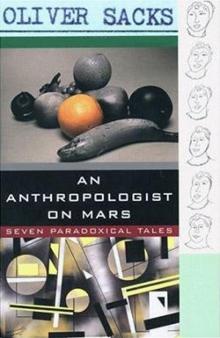
*23 OS referred to Isaacson by a pseudonym, “Jonathan I.” This essay, which appeared in The New York Review of Books (the journal’s first ever issue printed in color, to demonstrate what the painter could not see), was later revised and became the first chapter of An Anthropologist on Mars.
*24 Inability to recognize specific faces.
*25 Nuclear magnetic resonance, an imaging technology related to MRI.
*26 Though the filming did occur, it was never broadcast.
*27 OS developed a romantic attachment to a neurological colleague, and although it was not reciprocated as such, the two remained good friends.
*28 OS frequently spent weekends at Lake Jefferson, in the Catskills, to swim and write, and Larry sometimes accompanied him.
*29 Helen Jones, OS’s housekeeper.
*30 Josef Zihl and his colleagues described the uncanny experiences of a woman whose brain, following a stroke, had become unable to construct motion—instead, she would see a collection of “stills,” somewhat analogous to strobe photography.
*31 By the philosopher Patricia S. Churchland.
*32 Goldberg had emigrated from the Soviet Union, where he had worked closely with A. R. Luria.
*33 Goldberg was particularly interested in understanding how the brain’s left and right hemispheres seem to specialize in different realms but can adapt otherwise in response to injury.
*34 “Pilgrimage” was a memoir of Sontag’s bookish youth; she wrote of her rapture upon reading The Magic Mountain and then, to her surprise, having tea with Thomas Mann.
*35 Julian Huxley (1887–1975) grew up in a scientific family (his grandfather Thomas Huxley was famously known as “Darwin’s bulldog”). The younger Huxley became a zoologist and an influential popularizer of science. His brother Aldous was the author of The Doors of Perception.
*36 Lowell Handler.
*37 His travels with Handler to a Mennonite community in Alberta, Canada.
*38 Sontag was on the board of City Arts and Lectures and had encouraged her colleagues to invite OS.
*39 Böttiger was the head of medicine at the Karolinska Institute in Stockholm.
*40 Murphey wrote to OS with observations on the relationship between music and language, as well as the embodiment of learned movements.
*41 Joshua Meyrowitz’s No Sense of Place: The Impact of Electronic Media on Social Behavior (1985).
*42 OS was not a regular television watcher, but he acquired a television soon after this; he used it mostly to watch PBS or episodes of Star Trek.
*43 Gallaudet University, in Washington, D.C., was established in the nineteenth century for the education of deaf and hard-of-hearing people. Students there had objected to the naming of a hearing woman as president of the university. Their protest, Deaf Prez Now, became national news, and they succeeded in educating many hearing people about the importance of preserving their native language, ASL. A compromise was reached, and I. King Jordan—who had lost his hearing at the age of twenty-one and had some facility with ASL even though it was not his first language—was appointed president.
*44 OS got to know Stokoe’s revolutionary work on the linguistics of ASL (American Sign Language) during a visit to Gallaudet. Stokoe had confided in him that his wife of many decades had advanced Alzheimer’s.
*45 This reference is to a footnote in the 1983 American edition of Awakenings. The same footnote (number 42) can be found on page 55 of the 1990 edition.
*46 This reference is also from the 1983 American edition of Awakenings. A slightly revised version of the same footnote (number 28) can be found on page 26 of the 1990 edition.
*47 A compulsive need for inappropriate punning or joking, due to abnormalities in the frontal lobe.
*48 Arthur K. Shapiro.
*49 Ivy Mackenzie (1877–1959), a Scottish physician.
*50 “Toward a Romantic Science: The Work of Oliver Sacks” by Alan G. Wasserstein.
12
Adaptations
1989–1995
During the late 1980s, OS began reading the work of Gerald Edelman, who had won a Nobel Prize for his work in immunology and had then turned to the study of consciousness. Edelman’s theory of neuronal group selection, or neural Darwinism, proposed that the brain was endlessly adaptable, with experience strengthening certain groups of neurons while other groups of neurons, less called upon by experience, might be rededicated for other purposes (there was a certain analogy here to the immune system and its ability to learn by exposure). OS was very excited by this vision, feeling that it proposed a plausible mechanism for clinical syndromes he had long observed—for instance, the way that body image could rapidly remap, as it did when the immobilization of his injured leg caused its complete disappearance from neural representation. Edelman expounded his theory in three major works: Neural Darwinism (1987), Topobiology (1988), and The Remembered Present (1989).
To Robert B. Silvers
April 2, 1989 (9 p.m.)
119 Horton St., City Island, NY
Dear Bob,
I find you phoned about an hour ago when I was out to dinner—I just tried to call you back, but you had left for the night, and (I guess) your trip to Europe. It was very thoughtful of you to call.
I just got back myself from a marvellous trip to Italy—not quite my Italian Journey (though I saw the tree under which Goethe conceived his Metamorphosis, his Urpflanze, in Padua), but the sort which casts life in a different, fuller light than ever before (at least this is how I feel at the moment, tho’ the euphoria is rapidly evaporating). There was a lovely symposium in Florence (from the Art of Memory to Neuroscience), organized by Pietro Corsi (whom you know—what a fine and brilliant man he is). […] I went with Gerald Edelman and Israel[*1]—Gerald opened the conference with a stunning presentation, and Israel and I closed it with our own presentations. I had met Edelman before, but never been tête-a-tête with him for three days on end. It was an overwhelming experience. He is a bit of a tyrant (Israel calls him “Mussolini”!), but a real genius, with a grip and focus which never let up for a moment, and an almost quixotically-huge mental vision. I had read Neural Darwinism and Topobiology—neither of them easy to read—but feel I didn’t really understand him or his theories until I was exposed to them at point-blank range for 72 hours non-stop in Florence (and with Israel, who is a marvellous expositor, and who sees all sorts of implications and applications which the more theoretical Edelman himself may not at once see, with me as well). I am a “convert,” I think. I feel Edelman may have provided the first, the only non-reductive theory of mind we have, the only one rooted in known (or probable) brain-anatomy. I have babbled vaguely about “a neurology of self” for years, but I think Edelman has provided the theory for such a neurology—a theory of individuation, of the historical development of the individual, of the uniqueness of mental disposition and contents, of biology as biography. I suspected this when I was reading about the visual evolution of the congenitally deaf (which seemed so puzzling on any “pre-programmed” Chomskian basis), and phoned Israel up at the time, saying “Doesn’t this sound rather ‘Edelmanian?’ ”), and I am sure of it, in a very much more general sense, now. So my visit to Italy was doubly memorable—for giving me such a sense of the Renaissance—the past—and, with Edelman, such a sense of the future (or what I would like to see as a possible future of neurology).
The manuscript of his third book The Remembered Present: A Biological Theory of Consciousness has just been dropped at my house today—and I think it more radical, more wide-ranging, more pertinent to ourselves, our own mental life, than either of his previous books. […] But it is difficult—partly because of the sheer complexity and density of the thought, partly because he is not the most transparent of writers. I think that such a book cannot be merely reviewed—but has to be expounded and explained, and all its relevances and resonances explicitly brought out. I think its publication will be a major intellectual event, and that it deserves this. And I think there is no-one better qualified (indeed no-one else at all qualified) to do this than Israel, who is closer to Edelman’s thought than anyone else, but also himself imaginative, wide-ranging, critical, and in a position to bring out the clinical, literary, and varied other resonances and relevances. I think he may need another 10,000 word essay to do this, because there is so much that is new, and was not even hinted in the earlier work(s). And Edelman is not an assimilated or accepted part of the neuroscientific climate—he is widely misunderstood—or completely ignored (even Crick, who is a genius, and whom I greatly like and admire, seems completely to miss the essence and importance of his theory). […]
* * *
—
I spoke in Italy of my Italian artist, Franco Magnani,[*2] and his “autobiographical” memory, and his extraordinary paintings of a Pontito he has not seen in 30 years. It was fascinating visiting Pontito myself, going into the inside of another man’s memories and visions and art, so to speak; finding how incredibly exact his memory was—but also how transforming; the art of the transformer, the dreamer, was everywhere apparent. I had a feeling of Luria’s Mnemonist, and Freud, and Proust, all mixed up together, and illustrated by Franco—his quest to recapture (or, rather, reconstruct) the past. I also spoke of Stephen[*3]—and wanted, when I went on to England, to initiate contact with him and his mother and teacher. Unfortunately, by a piece of bungling, not irremediable, but annoying, his mother had been upset, and this was not possible. I will have to make a special visit later to see them.
I certainly want to make proper studies of both of them. I am sorry you didn’t get sent Stephen’s pictures—what I would like, when you come back, if you have time, is to visit you with both Stephen’s and Franco’s pictures, and discuss these with you; as well as talking about Italy, Edelman, or anything else.
I hope you have a good time in Europe—and look forward to seeing you on your return.
Best,
Oliver
PS Thank you too for your kind words about Seeing Voices.[*4] It seems, in some ways, more and more inadequate, as I learn and think more, and especially as I am now learning Sign—but I have to leave it at this point, with the thought that I might return to it, or the subject, in future works or editions. Perhaps everything one writes is “obsolete” (at least in relation to oneself) by the time it gets into print!
To Gerald Edelman
Neuroscientist
April 16, 1989
119 Horton St., City Island, NY
Dear Gerald,
[…] I found it an enormous pleasure and privilege being able to talk with you when we were in Italy—and if the Italian visit gave me a tremendous sense of the Renaissance, and the past, talking with you gave me an excited sense of a future (or a possible future), the sense—as you put it (Consciousness, p. 66) that one might come to enjoy “a deep view of how the brain functions.”
When I first came to this country, as a young man, in 1960, I made a pilgrimage to Marvin Minsky,[*5] and his then recently-opened Experimental Epistemology lab—I thought I might find the deep view there. And when Hubel and Wiesel[*6] (or, before that, Lettvin, and the MIT people) published, I got a shiver, and wondered if “the deep view” lay there. And then, I think, I fell into a sort of depression—an epistemological depression, if I may so put it—in which I ceased even to use the word “consciousness”; or, at least, to think of it as something for scientific enquiry (thus I declined to go to another conference in Italy a couple of years ago, on “Consciousness”: foolish of me—but that was my state of mind). You speak of something akin to this as being, perhaps, widespread—with neuroscience not daring to tackle anything so “global,” and philosophy (for the most part) as being unproductive or absurd. And, most specifically, of the inadequacy of “functionalist” approaches, the “computer” view, which has so dominated (even tyrannized) people for the last 30 years. Given all this, and a certain sense of impasse and despair (epistemologically), I found it exciting, in the extreme, to listen to you, and to get a glimpse of a quite other way of thinking.
In the preface to Awakenings, I quoted from Keynes’ preface to his General Theory: “The ideas which are here expressed so laboriously are extremely simple and should be obvious. The difficulty lies, not in the new ideas, but in escaping from the old ones, which ramify, for those brought up as most of us have been, into every corner of our minds.” And he speaks of the composition of his book as having been “a long struggle for escape” for him—a struggle which it must also be for any reader who hopes to understand it. I feel somewhat similarly about the ideas you express in Neural Darwinism, Topobiology, and now—with such rich resonances and implications—in your new Consciousness book.
You yourself, perhaps, have completed your escape—but you must not underestimate the struggle which some of your readers may have to go through; not because they are stupid, nor because your ideas are obscure (on the contrary, they shine); but because understanding entails a “conversion” of mind—or, at the least, an ability to detach oneself (if only for a while) from habitual modes of thought, in order to savour a quite new mode of thought. There will be sudden “Yes! I see it!” and “Yes, he’s right!” and “Yes, that would explain x, y, and z, which I could never understand!”—and sudden backslidings, when the thought seems to elude one, and one cannot “see” it any more. This, at least, I have found in myself—and in some of my friends who are studying your works. […]
This letter is an interim, an acknowledgement, something to say how much I am appreciating the contact with you and your work, how exciting I find it, and the (epistemological) hope that it gives me. And because I have been rudely silent since we met.
May I also, in the meantime, take the liberty of sending you these proofs of my new book[*7]—you will find brief reference to brain “plasticity” (p. 102), and to Neural Darwinism (pp. 115–6). (Most of the book was written earlier, in a rather “Chomskian” frame of mind, and it was only at the proof-stage, in the galley-proofs, that the little Edelmanian section was put in. It is very inadequate, but it showed a direction. I wonder what you think about the issues—particularly, the rather novel sorts of perceptual categorization and learning, which the deaf may go through.)