Letters, p.79
Letters,
p.79


But now I have some sad news. When I told you, at the start of ’06, that I had developed a cancer (melanoma) in the eye you said “Shit!”—which was exactly how I felt. These things rarely metastasize, and I had nine good and productive years—seeing my friends, travelling, writing—but now (“Shit!!!” redoubled) the thing has metastasized, to my liver. They are not too treatable, and I am forced to think of life—and death—in a new way.
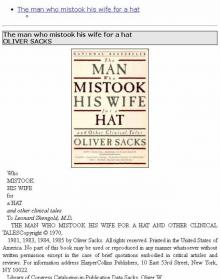
I am especially sensible of all the good and generous things in my life—not least your wonderful review of A Leg to Stand On when it came out here in ’84. I had been a bit depressed by a (nasty) review of it in England, and your review completely transformed my mood, my image of myself, and stimulated me to write nearly a dozen new pieces, in short order—pieces which became the basis of The Man Who Mistook His Wife for a Hat. You lifted me out of the abyss; and you have been such a good friend (and, implicitly, a mentor) ever since. […]
I can only hope that I can preserve the same good energy in the time that remains to me—enjoying life, seeing my friends, and (of course) writing to the last.
All my love—and thanks dear Jerry,
Oliver
* * *
—
On February 19, The New York Times published OS’s essay “My Own Life,” which announced to the world that he was dying. By February 21, the Times had received such an outpouring of comments from readers that the editors decided to publish a selection of those as a feature article. And OS himself was deluged with thousands of letters and emails, many from fans, others from colleagues and friends. He read virtually all and replied to a huge number of them—especially, of course, those from friends and colleagues.
To V. S. Ramachandran
February 24, 2015
2 Horatio St., New York
Dear Rama,
I was very touched by your letter, especially your references to Crick and Richard Gregory, your feeling that such men should be immortal, and that you still hear their voices in your head. I felt that also about both of them—Edelman too—and have written something about them in my autobiography. I am amazed and moved—greatly honored too—that you include me in this pantheon of influences.
I am sorry to hear of the rough time you have been having with exaggeration of benign familial tremor. One relative of mine with this finds that a stiff drink b.i.d.[*3] makes all the difference; another, a non-drinker, takes Xyrem. (I’m sure you have sampled both.)
* * *
—
I was in hospital for a week after my (right hepatic) embolizations last Monday, and still rather weak and in some pain. When these symptoms die down, I will have the left lobe done. I can’t look beyond that point. I’ve never been one for metaphysics or mysticism, but will get Schrodinger’s book (I know only his What is Life?).
You wd be welcome here any time.
Love,
Oliver
To Faine Wright
Piano Teacher
March 8, 2015
2 Horatio St., New York
Dear Faine,
It was such a pleasure seeing you again last Wednesday—I am glad you are getting your energy back, sad you still have the pains.
What a pleasure it is to walk! Yesterday, with Billy, I went to a Fern meeting[*4] in the NY Bot. Gdn—an anniversary: I first went to one in March 1993, though this one may be my last visit (I hope not!) there was a sense of farewell, and some tears all round (it is very rare for me to tear up, tho’ I think I may need to, sometimes) and after the meeting—quite a long walk (for me), a mile perhaps, in the NYBG, especially beautiful with new fallen snow.
I have been practicing the Sarabande (from the 4th English Suite)—minor keys call to me, now, more than major ones—and trying to keep my fingers nimble with the C-minor Prelude. But I have to go into hospital on Wednesday for a second embolization—the first one, happily, worked brilliantly, and there was no hint of any metastases outside the liver. So I must defer a lesson to the following week. […]
Love,
Oliver
To Michael Jellinek
Child Psychiatrist and Former Student
March 20, 2015
2 Horatio St., New York
Dear Michael,
I was warmed—and delighted—by your letter: no letters move me more than those from former students, and I have received many in the last few weeks, all reminding me of those few years (1967–1973) when I met/taught medical students from Einstein. […]
And very moved—I had forgotten (till your letter reminded me) that strange, front living-room in my Bronx Park East house, which had a single, enormous bright green carpet, tubs of ferns against the window—and, as you say, no furniture. And you, vital young people (tho’ I was only, I suppose, 10–12 years older than you), sitting on the floor, munching, and talking about everything under the sun. I hope I gave you—and your fellow-students—a chance to talk too (I have a tendency to monologue, reminiscence, storytelling, maybe fabulation, myself).
I am happy to know that that brief contact 40 years ago had some influence on you, and that you have had a gratifying career as a child psychiatrist.
My warmest good wishes—and thanks,
Oliver
To Richard Aldrich
Historian[*5]
April 10, 2015
2 Horatio St., New York
Dear Richard,
I was very moved and, yes, comforted by your warm, generous letter—the “Warwick experience,” so multifarious, meant a lot to me, though so brief. Being “historically-minded” (rather than “cutting edge”) I especially enjoyed my time with you and the Institute of Advanced Study—and being able to speak about (and exemplify) the role of narrative, and having (Hawthorne’s phrase haunts me) “an intercourse with the world.”
I am currently (now that I have had two procedures to reduce the “melanoma load” in my liver, albeit temporarily) feeling better, and had quite a long swim today.
What you say about a (sort of) posthumous life in the memory of friends and others (and the friends who are around me now) is a real source of comfort, along with the feeling that (in some difficult to categorize way) I may have done something worthwhile with my life, and loved and been loved.
* * *
—
I was intrigued, taken aback, by your thought that we have been “spectacularly lucky” in living at this time, while everyone seems to put such a negative spin on everything (global warming, the Middle East, cybercrime, etc.). But certainly, for better or worse, we have seen more, deep changes in our lifetime than any previous generation. I hope my (not-too-egocentric) autobiography will give (as thru a peephole: an odd, idiosyncratic one) a (sort of) picture of our time, as well as of me. Dear Richard, thank you again for a very special letter.
Say “Hi” for me to people who remember me at Warwick.
Oliver
* * *
—
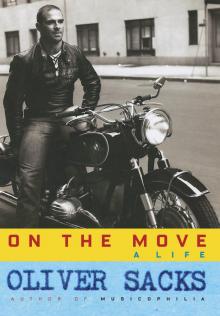
At the end of April, we celebrated the publication of On the Move with publishers and friends before a final trip to the United Kingdom in May to say farewell to family and friends and old familiar places. We—OS, Billy, and KE—detoured to see Chesil Beach and the fossils of Lyme Regis, and visited a primate rescue center in Dorset, where OS communed with baby orangutans.
To Nick Lane
Biochemist, Author of Life Ascending
May 13, 2015
2 Horatio St., New York
Dear Nick,
Some years ago you sent me Life Ascending, and it has been a bedside book ever since, one I pick up, and learn from, get inspired by, again and again.
And now your (astounding!) new book—The Vital Question. I have read many books and articles on “The Origin of Life,” but yours has a depth, a detail, a logic—an experimental support (insofar as laboratory reactors can simulate alkaline vents etc)—and an intellectual exuberance—which is enthralling.
I picked it up when I was in London last week (after reading a review in New Scientist)—and have been reading it slowly (slowly because it is challenging in the best sense; and because I am half-blind now), and am only up to Chapter 4—slowly, but with great excitement.
When Crick was approaching his end, with complete equanimity, and working, literally, to his last hours, his only lament was that he would not see what scientific advance would be achieved by 2030—and now I am dying I have just this feeling. But your book is giving me a special joy—because it is not only a superb synthesis of the last half century, but a sort of peephole into the next half-century, and shows what a golden age of science we are in. This (curiously) is a great comfort to me—at this stage—as well as a joy.
Congratulations on your work—I have read (some of) your papers over the years, and often meant to write to you—and now The Vital Question lets me write, and express my admiration both for your (and others’) work and your presentation of it.
With best wishes,
Oliver
To Richard Wagner
Former Neighbor of Thom Gunn’s
June 30, 2015
2 Horatio St., New York
Dear Dr. Wagner (can I say Richard?),
I was greatly interested, greatly moved, by your letter—your courage in being honest and forthright, at a time and on a subject[*6] bound, sooner or later, to cause your ejection from the priesthood. In another few years, perhaps, with Pope Francis at the helm, these last bastions of Catholic bigotry may have fallen.
I like to think of you as living across the street when I visited Thom, and glad to know that he appreciated you and your work. I still miss him deeply—there were not too many people with whom I could be entirely open—and I like to think that his ghost is pleased that my title comes from his poems. (I find it a huge relief being open now to all and sundry—I am so glad I completed my book before I became ill.)
And what a liberation, an affirmation, for us all that the Supreme Court voted as it did.[*7] I suspect that Ruth Bader Ginsburg, quite ill now, stayed on to ensure the 5/4 decision.
Thanks for your letter, and my very best wishes,
Oliver
To Robert John Aumann
July 29, 2015
2 Horatio St., New York
Dear Robert John,
Many thanks for your letter—I fear I was too dismissive-seeming or gnomic in my piece.[*8] I fully agree that understanding consciousness (and its necessary connection with brain processes) is THE last frontier in Science, and, as you say, unlike any other problem. I am not sure whether the word “mechanistic” helps—I am not wedded to it, and get impatient when, say, colleagues (like Zeki or Ramachandran) give me neurological/mechanistic theories of beauty.
But I am equally, or more, impatient with any Cartesian dichotomies (“Mind”/Matter; Res cogitans/res extensa etc).
I think one may need to expand the word “consciousness” to include sentience, feeling, etc. which are surely well-developed not only in mammals, but many (?all) invertebrates—octopus etc. Certainly “Nature” has no problem giving animals an “inner” side, sentience, consciousness, etc.—even if “higher” forms of consciousness—autobiographic, self-consciousness etc. are (more or less) confined to humans (with perhaps a little in apes, dolphins etc).
* * *
—
The subject of (embodied) consciousness was largely avoided by neuroscientists—taboo—until, in 1979, Crick made a clarion-call (in Scientific American) for the necessity and legitimacy of its scientific investigation—and was devoted, to his death in ’04, to finding (what he called) “neural correlates” of consciousness (especially visual consciousness). He wrote many papers and some books on the subject, and Christof Koch carries on the work.
To my mind Edelman was a deeper thinker here than Crick, and proposed various models and theories of it from 1978 to his death in 2014.
Both were a bit irked by the philosopher Colin McGinn (The Problem of Consciousness, etc) who said there would always be a gap between neuroscience, however advanced, and (an understanding of) Consciousness. He felt that we suffered from a “cognitive closure,” a limitation which would prevent us ever thinking in the appropriate terms. He was sometimes called a “mysterian.” If I say “I do not see it as a problem at all,” it is because I see C (or its precursors—sentience etc) as a property of living entities (living—I am not a pan-psychist). (But I agree we don’t have the least inkling of how/what happens—that we are nowhere.)
I do not know how long my own Consciousness will last. My Hebrew names are Eliahu Z’ave, do not know my mother’s (she was Muriel Elsie Landau). My father was Schmuel Eliezer.
Love +++
Oliver
Billy says “hello,” Kate too.
To Atul Gawande
July 30, 2015
2 Horatio St., New York
Dear Atul,
I get a great many letters, most thoughtful and heartwarming, but yours was very special, and meant a great deal to me.
(I am sorry I did not cite your book in On the Move, perhaps in the “Little Sisters” Section (pp 223–5), where I cited Victoria Sweet’s book—do you know her/it?) I am so glad I was able to complete OTM before I became ill, and with no thought that I would get ill.
I like your comment about the continuing importance of, or maybe the current return to, elements etc.[*9] I am currently writing a piece on Eyes—all sorts from those of jellyfish and scallops and jumping spiders and octopus to our (vertebrate) eyes, and was delighted to find a transcript of a talk on this which I gave to our “Field Club” at school in 1950, very nice to discover some constancies in one’s life. I am also trying to write something about the (deadly) effects of Social Media, when they absorb people, to the exclusion of everything else, throughout their waking hours—there is a terrifying long-short story by E. M. Forster called “The Machine Stops,” written c 1900—do you know it? It is incredible that he foresaw such possibilities then.[*10]
But I do not know if I can complete the pieces—I fear I am losing ground fast (I had to have 2 liters of ascites[*11] tapped a couple of days ago—and I fear it is reaccumulating fast).
When I think or write in pessimistic (even apocalyptic) terms I am pulled back by the image of people like you—good, powerful articulate people, who can do something to reverse the evil trends in Medicine, or Society generally, and guide us to a saner course. It is people like you—good scientists, good physicians etc—who give me hope for the future—a hope one needs very much when one’s own life is close to the end, and the negativities of life (so well put by the Pope in his Encyclical or Martin Rees in Our Final Hour) seem to darken the horizon.
Thank you again for your very good, deep letter—I too hope we can connect again.
Oliver
To Robert John Aumann
August 9, 2015
2 Horatio St., New York
Dearest Robert John,
You have been much in my mind lately—I have been thinking of how our 20 years’ friendship has been so deeply important and moving for me.
Visiting you, and the “cousinhood,” in Israel last year was, in a way, a critical experience for me, enjoying the embrace of family in a way which I had not known since childhood. In particular, the Erev Shabbat meal and prayers and songs with you and your family were a high point of my experience (Billy’s, too). Also crucial, and moving me at the deepest levels, was your 2004 interview, in which, among many other things, you spoke of the beauty of the Sabbath for you, its stoppage of time, its remoteness from all daily concerns.
These thoughts have incited me to write a little essay (“Sabbath”), which I enclose. After some minor revisions, especially towards the end, I hope I can persuade the New York Times to publish it. It will constitute, so to speak, “my last words.”
I am losing ground fast, I am very weak, but fortunately fairly comfortable. Unless the second immunotherapy infusion tomorrow can retard the rapid spread of metastases, I doubt if I shall outlast this month. Please give my love and warmest greetings to your family, and to all the cousins in Israel. Thank you for everything.
Love,
Oliver
PS I met a Rabbi today. […] We talked freely of everything, and said the Shema together. (I will keep a copy by my bedside so I can become more fluent.) He suggested coming again and going over some Talmud with me. He seems learned and sensitive—I think I will do this.
He wondered too if I might not say, with him, the Mourner’s Kaddish for my parents (I never did).
To Gay Sacks
August 9, 2015
2 Horatio St., New York
Dearest Gay,
My cancer has been rushing ahead like a tidal wave, and nothing seems able to slow it down. I am very weak now, though not too uncomfortable, but I am moving towards terminal care and doubt if I will outlast this month.
Although I know you and Carla and Jonny[*12] wondered about advancing your visit here, I am in general averse now to visits and phone calls, although I am happy to receive emails or letters.