Usurper, p.21
Usurper,
p.21


‘Phraates sits on his arse at Ctesiphon and does nothing,’ he complained as he sat in the governor’s beautifully decorated large office.
We lounged on plush couches, drank wine and were surrounded by walls decorated with sun and lion motifs, the lion representing divinity, royalty and the lineage of kings, and the sun symbolising the ruler of heaven. On the governor’s huge mahogany desk was a bronze statue of Pahlavi Senmurv , the great falcon that sits on top of the mythical mother of all trees, the Saena . Rogerio himself sat at his desk. Khosrou wanted him to be excluded because he was not a king but I suggested that for diplomatic reasons he be allowed to attend the meeting of rulers.
‘I begged him to send me soldiers but all he sent me was a condescending note saying he had every faith in Phanes.’
‘The only one who has,’ smirked Gafarn.
Silaces looked at me. ‘Your threatening note worked too well.’
‘I did not send a threatening note,’ I insisted.
‘Yes you did. A veiled threat, I grant you, but a threat nevertheless. The boy king won’t shift his arse when there are, what did you say, one hundred and thirty thousand men poised ready to strike.’
‘We don’t need Phraates,’ said Spartacus, ‘we have a plan to defeat the Kushans without him.’
As it was Khosrou’s plan, the King of Margiana explained his idea for lunging across the Indus while Gafarn and Silaces would march to the relief of Sigal. In addition, a combined army drawn from Anauon and Yueh-Chih would be marching from the north to trap the Kushans in a giant vice, though Khosrou was vague about its numbers and when it would march.
‘It’s up to us, then,’ stated Silaces bluntly.
Khosrou nodded. ‘Yes. We alone can save the eastern half of the empire from being lost.’
Rogerio sat with his head down twiddling his thumbs, overwhelmed by the enormity of the events that had taken place in Sakastan. He desperately wanted to say something but was intimidated and so remained silent.
‘If you have something to say, spit it out,’ commanded Silaces.
‘Forgive me, majesty,’ said Rogerio, ‘but there are only thirty thousand soldiers camped here. Is that enough to…’
A knock at the door interrupted his words.
‘Come!’ he ordered.
A slave entered, bowed his head and walked briskly over to Rogerio, handing him a note. The governor read it and tossed it on the table.
‘An officer of Phanes’ bodyguard is outside.’
I felt a tingle of dread dance down my spine.
‘What does he want?’ said Rogerio out loud.
‘Nothing good, I’ll warrant,’ said Gafarn morosely.
‘Let’s hear what he has to say,’ Khosrou told the governor.
My heart sank when the dirty, sweating officer with a torn tunic and battered breastplate presented himself, dented helmet in the crook of his arm. He looked as though he would pass out at any moment.
‘Fetch water,’ ordered Gafarn.
‘Sit down, man,’ I said, ‘before you fall down.’
Spartacus used his feet to push a chair towards the wavering officer, who gladly accepted the offer. A slave arrived with a jug of water, filling and refilling a cup as he drank greedily. It took him a few minutes to catch his breath but finally he was ready to relay his sorry tale. He stood but was ordered to sit back down by Khosrou.
‘Bad news sounds no better if it is told by someone standing, boy.’
‘The army of his highness King Phanes engaged the Kushans twenty miles south of Sigal, near the Erymanthus River. At first our horsemen drove the enemy riders back, exposing their foot soldiers. The king ordered his own foot soldiers to attack the enemy spearmen who were drawn up in a great square.’
I looked at Gafarn who shook his head.
The officer was close to being distraught. ‘But the enemy horsemen counterattacked and drove our own horsemen back, which meant the king’s foot soldiers were suddenly surrounded. Then the enemy square broke apart and attacked. Many of our spearmen drowned in the river but more were surrounded and cut to pieces. Faced with the imminent destruction of his army, King Phanes took a strategic decision to withdraw to save the rest of his army.’
‘And where is that army now?’ I asked.
‘Pulling back to Puta, majesty, where it will be reinforced prior to once again marching against Parthia’s enemies.’
Khosrou chuckled. ‘And pray where does Phanes intend to draw his reinforcements from.’
The officer stood and removed a crumpled piece of papyrus from his tunic.
‘King Phanes penned this letter on the march, majesty.’
‘You mean retreat?’ said Silaces.
The officer nodded. He turned to me and bowed. ‘It is addressed to you, highness.’
He extended his arm and I took the letter. I decided to read it aloud as I was but one among equals.
‘To my dear friend, King Pacorus.’
‘He’s changed his tune,’ smiled Gafarn.
‘He is about to beg,’ said Malik.
I continued reading the letter. ‘As a former lord high general, you will understand the utmost importance of acting speedily to avert disaster. After inflicting high casualties on the Kushans…’
Khosrou guffawed and Spartacus’ face twisted into a grimace as he desperately tried to stop himself laughing. I frowned at them both.
‘After inflicting high casualties on the Kushans,’ I said loudly, ‘I was forced to retreat in the face of the overwhelming numerical superiority of the enemy. I intend to withdraw to Puta, there to await the forces you and the other kings have assembled at Bam. I am certain that our combined forces can not only defeat the Kushans but also relieve the city of Sigal, where your beloved wife and daughters are trapped. I remain your friend and ally…’
I tossed the letter on Rogerio’s desk.
‘The Kushans pursued you?’ I asked the officer.
‘Yes, highness.’
‘In what numbers?’ enquired Gafarn.
‘Several thousand, all horsemen, majesty.’
‘That is good news for Sigal,’ mused Spartacus, ‘having to fight Phanes means they probably lack the numbers to attempt a storm.’
Malik nodded. ‘Agreed, and if the Kushans are now invading Carmania their forces will be spread thin.’
‘This Kujula,’ said Khosrou, ‘I hear you have met him, Pacorus.’
‘Met him and fought him,’ I replied.
‘What do you make of him?’
I thought for a moment. ‘Brave, intelligent and very ambitious.’
‘The last quality might just be his undoing,’ said Khosrou.
‘The plan stands, then?’ asked Silaces.
Khosrou looked at each of us in turn. We all nodded our assent.
‘It does,’ said the King of Margiana. He pointed at the officer. ‘Get some rest, get yourself a fresh horse and ride back to your king. He will need you.’
‘What message should I convey to my king, majesty?’
‘Tell him we go to defeat the Kushans and eject them from Parthia,’ I told him.
‘But we will not be riding to Puta,’ added Gafarn.
‘King Phanes is lord high general,’ said the officer.
‘Not for much longer,’ Khosrou told him, ‘you may leave us.’
He left the room with slouched shoulders and head down but Phanes’ loss, which was not unexpected, was our gain. With Kushan troops now venturing south into Carmania, Kujula’s strength was further diluted. I felt confident we could both relieve Sigal and cause our enemy to withdraw back across the Indus by a punitive campaign in the Kushan Empire itself. As did everyone else.
The Sigal relief force jointly commanded by Silaces and Gafarn numbered sixteen thousand men, the bulk of which were the ten thousand horse archers of Elymais. But the army also included fifteen hundred cataphracts, three thousand squires, Sakastan’s lancers and Spartacus’ medium horsemen. There was also a substantial camel train carrying supplies, tents, spare weapons and hundreds of thousands of arrows. The army kicked up a great dust cloud as it made its way east. I extended my arm to Gafarn and Silaces.
‘The gods be with you, Pacorus,’ said Silaces.
I clasped his forearm. ‘And with you, too, my friend.’
He wheeled his horse away and trotted towards the great column of camels and horsemen, his escort and banner man carrying his four-pointed star standard following.
‘Keep my son safe,’ said Gafarn, clutching my forearm.
‘Spartacus?’ I grinned. ‘He should be the one taking care of me.’
I turned to Prince Pacorus. ‘Make sure you do not repeat the mistakes of King Phanes, nephew. Do not underestimate the Kushans.’
The prince, resplendent in his gleaming steel scale armour suit, nodded solemnly.
‘Hatra will not fail you, uncle.’
I raised my hand to them both, turned Tegha and rode away to catch up with the second column that was leaving Bam, my griffin standard being held by a Duran horse archer fluttering behind me. Khosrou’s column was smaller – fourteen thousand men – and accompanied by far fewer camels. To say we were campaigning light was an understatement. There was no camel train carrying spare arrows, no replacement weapons and the bare minimum of food and fodder. I joined Spartacus, Malik and Khosrou and their banners: the red griffin joining the black flag of the Agraci, the lion of Gordyene and the Caspian Tiger of Margiana.
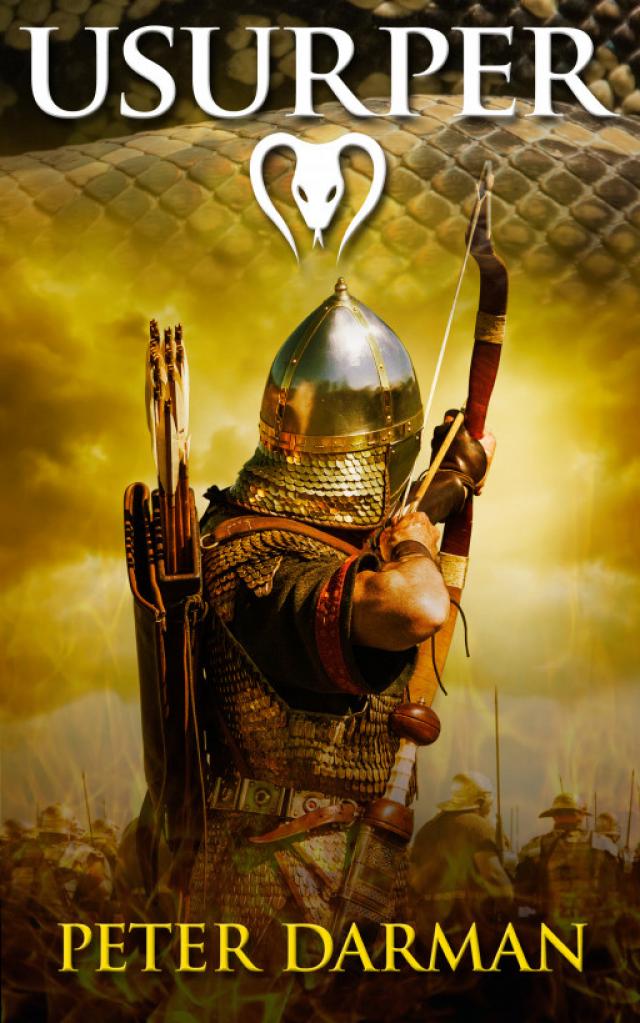
General Kuban’s soldiers, compared to the finest from Dura, Gordyene and even the black-clad Agraci, looked like bandits on their ponies. But each man was protected by a cuirass comprising bands of hardened leather laced together and a padded leather helmet with neck and ear flaps. Like all of us they carried a recurve bow, slightly smaller than our own with a body constructed using wood and horn laminated together using animal resin. When the resin dried the resulting bond between the horn and wood gave the body of the bow enough strength to withstand the immense pressures placed on it when the bowstring was drawn. To increase the power of the weapon further, sinews from animal tendons were laminated to the outside face of the bow.
Like us they carried bows in cases on their right side, with up to five quivers on the opposite side, each one carrying thirty arrows. Parthian arrows were bronze, three-winged and socketed so that shafts could be inserted into the head. Unlike our own arrows, those of Khosrou’s warriors were fletched with feathers attached to the shaft in a slight spiral pattern so they spun when shot, thus increasing their accuracy. For close-quarter work the Margianans carried a two-edge straight sword, a dagger and a spear with a long metal point.
Led by Khosrou’s scouts, Talib and his men accompanying Gafarn, we headed northeast to take us into the hills that delineated the border between Sakastan and Drangiana. We moved fast, covering up to fifty miles a day with a rest day when we reached the banks of the Indus, the boundary between the Parthian Empire and India. We had left the windswept hills and mountains behind to enter a land of fertile plains interspersed with bare knolls. The few villages we had encountered had been deserted and showed signs of being plundered, no doubt by Kujula’s troops when they invaded Parthia.
‘Looks quiet,’ observed Khosrou, squinting in the sunlight as he scanned the river from north to south.
‘It must be a mile wide,’ said Spartacus.
‘And fast flowing,’ added Malik.
‘We should send scouts over the Indus and wait until they return,’ I advised, ‘it’s too quiet.’
Khosrou roared with laughter. ‘You are getting too cautious in your old age, Pacorus. We go now.’
He shouted at his horse, which bolted forward down the gently sloping riverbank and into the clear water. Spartacus grinned and followed, behind him Khosrou’s guard cantering forward to splash into the water. I too rode down the now churned-up bank and Tegha entered the water. It was refreshingly cool and though the current was fast, the river itself was not deep, water lapping around my legs as my trusty mount headed for the eastern bank. Either side of me, stretching up and down the western bank for half a mile, thousands of horsemen forded the Indus and began the first Parthian invasion of India.
The crossing was straightforward but not without hazards. Some horses stumbled on the muddy river bottom and collapsed into the water, their riders clinging on as the beasts swam rapidly to the opposite bank, soaking them both. Within an hour all our men and supplies were across the river, plundering the villages near the riverbank of food and livestock, before using the reed roofs for firewood. The inhabitants had fled to the east before we crossed the river and as night came no patrols were despatched to hunt them down. Instead, we butchered the pigs and roasted their flesh. The smell of cooked pork filled the warm night air as I walked with Khosrou to the riverbank, the Indus black and calm under a moonlit sky.
‘I never thought I would see this river,’ I said, ‘let alone cross it.’
‘Neither did I, but here we are. As soon as we start burning towns and villages word will get back to Kujula that his lands are under attack. Then he will come running.’
‘You are certain of that, lord?’
He gave me a mischievous grin. ‘He is seeking to expand his empire and will not take kindly to thieves sneaking into his domain. Believe me.’
I did not hear the beast spring from the water but saw the blur of movement as the crocodile launched itself at us. I shoved Khosrou aside, which saved his life because the huge monster, turned silver by the moonlight, snapped down its huge jaws on the king’s boots. Lured by the aroma of roasting flesh, it mattered little to the creature that it had seized a living being.
‘Rally to the king I shouted,’ drawing my sword and plunging it into the crocodile’s scaly back.
The point of the spatha pierced the scales and bit deep into its flesh. It roared in rage, released Khosrou and spun to attack me. I withdrew my blade and slashed at its jaws, which snapped shut around the metal to wrench it from my grip. It tossed the sword angrily aside and ran at me, its short stumpy legs moving rapidly as its huge body lumbered forward. I tried to retreat but lost my footing and fell backwards on to the sandy bank. I froze in terror as the crocodile closed on me, its huge jaws opening to reveal rows of razor-sharp teeth that would snap my body in two. I could not move or make a sound as time stood still and I could contemplate my demise.
The spear blade being driven into the crocodile made no sound but made the beast arch its back and momentarily forget me, giving one of Khosrou’s bodyguard a chance to grab me by the scruff of the neck and haul me away. Two more spear blades were driven into the crocodile’s body, the three soldiers gripping their shafts with both hands as they pinned the beast to the ground. Now the reptile was thrashing around wildly, hissing and growling as it desperately tried to free itself. To no avail. More of Khosrou’s bodyguard arrived to plunge their spears into the beast, which stopped floundering around as it was stabbed repeatedly.
‘Finish the bastard off,’ shouted Khosrou, the grizzled old king being held back by the commander of his bodyguard for fear he might venture too close to the crocodile’s jaws.
The beast was killed by a single spear thrust into its brain, suddenly becoming silent and still as the soldiers withdrew their spear blades and stepped back. Khosrou came over to me.
‘Are you all right, Pacorus?’
‘Thanks to your men, lord. It took my sword.’
‘Find King Pacorus’ sword,’ Khosrou commanded.
My spatha was retrieved and we issued orders that archers were to be posted all along the riverbank, a safe distance from the water’s edge. All horses and camels were withdrawn from near the river in case more crocodiles were loitering with intent to seize a meal. The carcass of the huge reptile was hauled back to the camp of Khosrou’s bodyguard where it was butchered and roasted. I was invited to partake of the feast but I had lost my appetite.
The next day we raided into the Kushan lands proper, our forces divided into hundred-man groups that roamed for miles over the huge plain criss-crossed with rivers, lakes and swamps. The monsoon was coming to an end but the daily deluges had created vast flooded areas filled with birds and other wildlife. This was a lush, fertile land where every village cultivated wheat, rice, mangoes, guavas, plums, oranges, pomegranates and lemons. Though it was hot and humid, the heavy rainfall that fell in short, intense bursts brought welcome relief and refreshed both men and horses. The only problem was unfastening our bowstrings and storing them in saddlebags to prevent them getting wet. Our own bowstrings were made from sinew but the Margianans also carried horsehair bowstrings that did not absorb moisture and thus did not stretch.
On the first day, we encountered mostly deserted villages, which we fired, but on the second our columns began to overtake fleeing people weighed down with livestock and children. The morning sky was already filled with the smoke of torched villages when we came across a settlement crammed full of refugees, women and children screaming when my horse archers surrounded the village and nocked arrows in their bowstrings. With me were two companies of Durans and by my side their commander, the lithe Katana who had been born and bred in the city of Dura. The villagers were wailing and babbling in their native tongue. The men among them armed with a variety of spears, knives and farming implements formed a cordon around their wives and children. In the oppressive humidity, my banner hung limply from its shaft and sweat was running down my neck. All the male villagers were dressed in white cotton dhotis , many were bare chested, while the women were clad in white or yellow saris. They held the hands of their children tightly, knowing that the men on horseback before them were armed with recurve bows that could easily pierce their flesh.