Usurper, p.5
Usurper,
p.5


I had worked hard to restore the agricultural lands of my kingdom, which spread south from the city of Dura for a hundred miles. Peace with the Agraci meant farmers could grow their crops free from the threat of being attacked by desert raiders. The garrisons of the mud-brick forts spaced at five-mile intervals along the length of the Euphrates throughout the kingdom assisted the farmers in constructing irrigation channels bringing water from the river to their fields. The western bank of the Euphrates was now blossoming and I did not want thousands of camels and horses to trample crops and scatter livestock. Nor did I want the more unruly elements of our force – Kalet and his lords – grazing their animals on farmers’ crops.
In appearance there was little difference between the lords and their warriors and Malik’s men. Both sides wore loose-fitting black robes with shemaghs as head and face protection. Like all of us they applied antimony powder around their eyes to alleviate the damage caused by squinting in the sun. All of us had adopted the Agraci goats’ hair tents, which in the inferno of summer were very hot to touch on the outside but which remained pleasant inside in extremes of heat. Of course, those who lived on the other side of the Euphrates denounced those who inhabited Dura as semi-barbarians and half-breeds who intermarried with the Agraci and other races. It was true, but the Parthian Empire also contained many different races and peoples that had intermarried over the centuries, making a mockery of Phraates’ policy of Parthian purity.
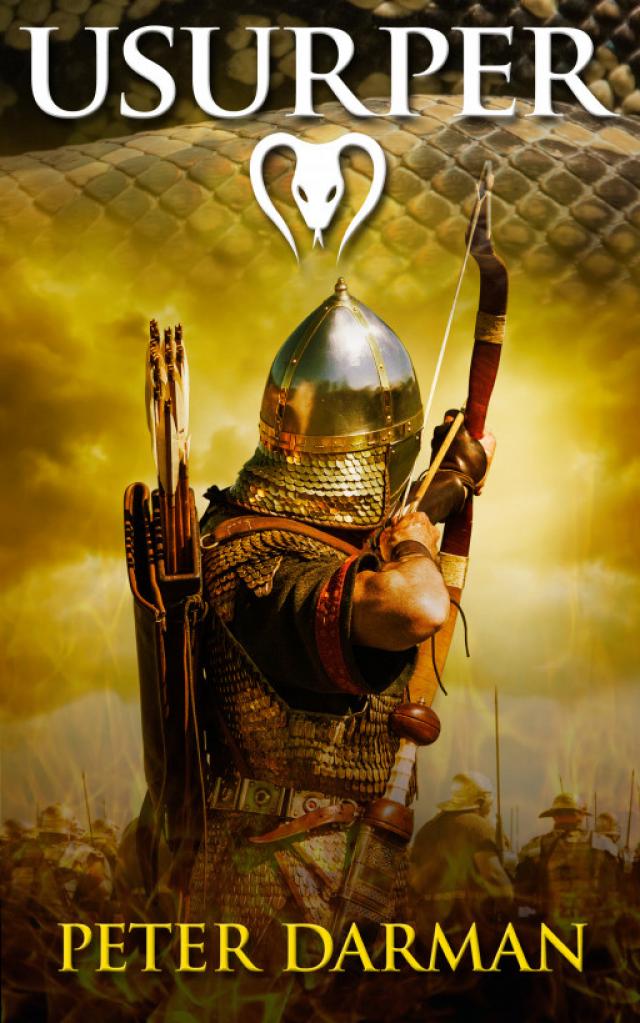
Our column kicked up a huge amount of dust as it wound its way south across the barren, scorched landscape, a small army comprising over eleven thousand warriors and soldiers, seven thousand camels and three thousand squires. Gafarn had brought Hatra’s Royal Bodyguard, its members drawn from the cream of the city’s nobility. On the battlefield their steel armour and helmets glinted in the sun and their white horses were encased in scale armour, but today the armour for men and horses was stored on camels led by squires, their masters riding in leggings, tunics and floppy hats. Two squires served each cataphract, each one leading a camel that carried armour, food, tents, spare weapons, clothing and fodder for their horses. The horse archers, considered the poor relations of the mounted arm, were supplied by the camel train, which also carried an adequate quantity of replacement arrows. As we were not marching to war, however, we were not equipped with a dedicated ammunition supply train.
We maintained a steady rate of travel, riding for two hours and dismounting to give our horses a rest before recommencing our riding for another two hours, and so on. In this way, we covered forty miles a day, halting in the early evening to pitch camp and prepare an evening meal, though the horses were unsaddled, rubbed down, watered and fed before we partook of our own food. Our sustenance, if it can be called that, consisted of hard biscuit, dates, cured meat and water. We ate well at Dura and would do so again when we reached Uruk, but I saw no point in bringing along a small army of servants, barrels of wine and animals to be slaughtered for an evening meal.
Prince Pacorus made a face as he chewed on a piece of cured goat.
‘This is not Hatra’s palace, alas,’ I said.
We had all gathered to eat our evening meal in my tent, where we sat at a table on the carpet-covered floor.
‘You should have asked to borrow Phraates’ pavilion,’ Gafarn told me, ‘that is how a king should travel. Purple and crimson rugs underfoot and rich curtains decorated with animal patterns in gold and silver. It even has guy ropes made of silk.’
‘Completely useless,’ said Silaces, biting off a chunk of dry meat, ‘like its owner.’
‘Let’s not spend an evening listing Phraates’ shortcomings,’ I pleaded.
‘Why not?’ asked Silaces, ‘he has so many, as you yourself recognise, Pacorus. After all, you would not be gifting me command of your army if you did not feel he needs restraining.’
He looked at Spartacus, Gafarn and Nergal. ‘You all feel the same, do you not?’
They nodded but Diana wanted to change the subject.
‘Let us not speak of Phraates, he is so hateful. Let us hope maturity will come with age.’
‘Tell us of Sakastan,’ requested Rasha of Isabella.
My daughter had a wistful look as she described her adopted homeland.
‘It is a land of great beauty, one dominated by towering mountains and forbidding desert but one where you will find lush forests of larch, aspen and juniper. The rivers feed irrigation ditches that water flat plains filled with wheat and vines, while swampy terraces are abundant in delicious rice.’
‘Sounds idyllic,’ opined Nergal.
Isabella sighed. ‘It is.’
I smiled as she waxed lyrical about Sakastan, its topography and people, painting a picture of a land of milk and honey. When you are in love everything seems rosy and free from blemishes, but I remember Peroz painting a more realistic picture of his kingdom during one of his visits to Dura. He told me of hot, dry summers and cold winters, of a land that could be lashed by severe dust storms and spring floods when melt water came from the mountains. It suffered plagues and pestilence like all other kingdoms and its people worshipped the gods and prayed for a better life. But I was more interested in Sakastan’s current relations with Carmania.
Agbar and his men were never far from Isabella during the journey, guarding her tent at night and surrounding her during the daylight hours. The commander of her bodyguard was mortified that Indira had spirited herself into my daughter’s tent on the journey to Dura but Claudia had criticised him for reproaching himself.
‘The knifewoman had the help of the gods, commander, no security measure would have made the slightest difference.’
‘Why would the gods assist an assassin, princess?’ asked Agbar, his yellow attire in sharp contrast to the black robes worn by Claudia.
She shrugged. ‘Perhaps Spada was beloved of the gods and they were angry that my mother had robbed them of his life. Or perhaps they thought Indira and my mother would make a good match and wanted to discover which one would triumph.’
Agbar was relieved that what might be viewed as a dereliction of duty was absolved by divine intervention. I liked the honest and forthright Saka who was very forthcoming when it came to the king of the Carmanians.
‘King Phanes has continually tried to provoke his brother, my master, into starting a war, majesty.’
I had heard the same from Khosrou of Margiana but wanted to hear the story from a new source.
‘He sends raiding parties across the border to rape and pillage.’
‘And yet Peroz does not retaliate?’ I queried.
‘He is too noble to sink to his brother’s level,’ stated Isabella. ‘If it wasn’t for the queen mother the two brothers would have reconciled long ago.’
I was curious. ‘The queen mother?’
‘Queen Hamide, majesty,’ Agbar informed me, ‘the woman who casts a long shadow over the kingdoms of Sakastan and Carmania.’
Chapter 3
We travelled through the passes of the Zagros Mountains to reach the city of Elymais, the capital of the kingdom of the same name that was positioned in the foothills of the mountains. It was a pleasant, clean city freshened by cool mountain breezes and fed by clear water from the highlands. The mountains themselves although bleak and imposing contained large, fertile plains providing fodder for herds of wild horses, the most famous being the Nisean that mounted Parthian horse archers and cataphracts. Elymais supplied horses to the other kingdoms in the empire and even to the Chinese emperor. This made its kings and merchants rich, the more so because the Silk Road passed through their territory. The caravans used to be prey to the semi-nomadic tribes that infested the Zagros range – the Uxians, Baktiari, Quashqui and Kamsa – but the rulers of the kingdom had used bribery and repression to keep the roads free of bandits, as well as recruiting the young men of the tribes to fight in their armies. I myself had recruited Zagros tribesmen to fight the Romans in Judea many years before.
The soldiers and their horses and camels pitched camp outside the city walls, the kings and queens being lodged in Silaces’ palace, an impressive structure constructed on a stone terrace and containing a throne hall, stables, temples, stone columns and walls decorated with friezes of mythical creatures. It was also filled with slaves who attended to the wishes and whims of their guests.
At Dura councils of war were held in a room in the Headquarters Building but at Elymais they were conducted in the War Hall, a square structure surrounded by stone columns. It had a marble floor, cedar doors and a huge hide map of the Parthian Empire on the wall facing the couches on which we sat, white-robed slaves serving us fresh fruit juice and pastries. Silaces pointed at the map, slapping the backside of a striking female slave with raven-black hair down her back and sultry brown eyes.
‘Persis is under the rule of a new satrap, one of Phraates’ lackeys by the name of Osrow. He’s a little toad by all accounts but you should know that he and Phanes are allies, or kindred spirits might be a better name.’
I was alarmed. ‘Peroz’s list of enemies grows.’
‘What about Drangiana and Aria?’ asked Spartacus.
Those two kingdoms lay north of Sakastan and I had to confess I knew next to nothing about either. Silaces winked at the slave who beamed back at him. Clearly the King of Elymais did not sleep alone when back in his homeland.
‘Aria is ruled by Tiridates the Younger, the son of the now deceased Tiridates the Elder, and Drangiana is ruled by King Antiochus. Both monarchs are more interested in what is happening to the east rather than the squabbling between Phanes and Peroz.’
‘And what is happening to the east?’ asked Gafarn.
Silaces walked over to the map and pointed at the lands beyond the empire’s eastern frontier.
‘They are concerned about the Kushans, a warlike people who a generation ago were unknown but who now lie across the Indus.’
‘Where did they come from?’ asked Nergal.
Silaces walked back to his silver rhyton. ‘From somewhere in the east. The point is they are looking for new lands to conquer and the Indus is broad but shallow.’
‘Then what keeps them on the other side of it?’ said Spartacus.
‘We do,’ smiled Silaces, ‘or at least us and the other kings of the empire. The Kushans know that the Parthian high king can raise a mighty army to come to the aid of the eastern kingdoms, so Kujula is wary of starting a war with the empire, for the moment.’
I was intrigued. ‘Kujula?’
‘The leader of the Kushans,’ he told me.
‘What else do you know of him?’ asked Gafarn.
‘He’s got a big army,’ stated Silaces.
I emptied my rhyton. ‘It is as I have always believed. If the empire stays united and strong it can repulse its external enemies. That is why it is important for all of us to be seen to support Phraates.’
‘Word will have been carried to the four corners of the world of our recent victory over Mark Antony,’ said Spartacus.
‘And our visit to Sakastan will deter any aggression from these Kushans,’ I added.
Gafarn studied the map. ‘Perhaps if Phraates became aware of the dangers facing his eastern border he might be deterred from listening to the grievances of Queen Aliyeh.’
Silaces was unconvinced. ‘Soon you will need a hammer and chisel to prise Phraates away from Ctesiphon. He likes intrigue and court life, and unlike his father views the idea of touring the kingdoms of his empire with distaste.’
‘He is still young,’ I said. ‘He needs to grow into the role. I accept that he may not have the qualities of his father.’
‘That’s putting it mildly,’ sniggered Silaces.
‘Nevertheless,’ I continued, ‘he has defeated the Romans, which strengthens his position, which in turn is good for the stability of the empire.’
Spartacus was confused. ‘Forgive me, uncle, but if you are such a staunch supporter of Phraates, why have you arranged a potential alliance against him?’
‘He has a point,’ grinned Gafarn.
‘I have not formed an alliance against Phraates,’ I insisted, ‘I have merely taken measures to curb his youthful exuberance.’
Silaces held out his rhyton to be refilled. ‘What if Phraates, realising he has potentially one hundred and thirty thousand soldiers to call upon, summons me to Ctesiphon to inform me he has decided to invade Syria or Armenia?’
Gafarn was laughing. ‘Didn’t think of that, Pacorus, did you?’
I had not.
‘You will inform him that it will take at least six months to assemble such a force, perhaps longer,’ I told Silaces, ‘by which time we will have returned to our respective homelands, and then we will petition the high king, pleading for more time because we are experiencing logistical difficulties.’
‘What difficulties?’ Spartacus demanded to know.
I sighed deeply. ‘Tell him your soldiers are deficient in weapons.’
Spartacus jumped up. ‘No Gordyene soldier is deficient in weapons and equipment.’
I held my head in my hands. ‘In the name of the gods, I know that, Spartacus.’
‘Then why say it?’ he scowled.
‘It is just a ruse, a delaying tactic.’
He retook his seat. ‘Ah, I see. I suppose I could tell him that, although if he thinks Gordyene’s army is weak that might encourage Media to attack us.’
‘We are just speaking in generalities, my son,’ smiled Gafarn, ‘I’m sure your uncle never intended to slight you or your army.’
Nergal leaned back and looked up at the intricately carved cedar wood ceiling. ‘Of course, if Pacorus had accepted the high crown then all these plans and schemes would not be necessary.’
I shook my head at one of my oldest friends. ‘Please don’t, I feel a headache coming on.’
But the short time spent at Elymais refreshed our bodies and minds and ended all too quickly. We said our farewells to Silaces and continued our journey east, the cool mountain air giving way to the heat and dust as our great column skirted the Dasht-e Lut to the north. This desert was unlike anything in Syria or Mesopotamia where animals and people could eke out an existence and even prosper. Dasht-e Lut means ‘emptiness desert’ in Persian, a place of searing heat, strong winds and shifting dunes. Agbar and Talib scouted ahead as we wanted to avoid the main road used by the caravans carrying silk west to Egypt and Rome. Not that we intended any harm to those using the Silk Road from China; rather, we wished to avoid drawing attention to our column, which was venturing dangerously near to Carmania’s northern border. So we entered the southern area of the Dasht-e Lut where travellers, if they had any sense, rarely ventured.
For two days we were blasted by howling sandstorms, forcing us to stop as clouds of sharp, golden sand particles engulfed us. Then the wind ceased and we re-commenced our journey, traversing a landscape seemingly devoid of life but possessing a wild beauty with its sand dunes the size of temples, white salt pans and pink sandstone hills sculptured by the winds. We carried on east through a horizonless expanse, the unrelenting heat sapping people and animals alike. We reduced the time we sat in the saddle to save the horses, their heads cast low during the hottest parts of the day and only reviving in the evening when they were relieved of their saddles and given water. We slept under the stars rather than pitch tents to save energy, which the squires were grateful for.
The days appeared endless but that was a deception. Shadows lengthened and the temperature dropped rapidly, the ever-blue sky overhead darkening quickly as we halted to make camp for the night. Stars filled the night sky to present a wonderful spectacle, which no one had the energy to appreciate after hours under a merciless sun traversing an energy sapping desert. So we slept like the dead and woke as dawn was breaking, the desert turning orange and purple as the sun rose above the eastern horizon. As the heat rose conversation invariably dried up as everyone focused on his or her individual journey. Patrols were posted to the flanks, vanguard and rear, but even they spent most of the time on foot rather than in the saddle. No one wanted to bear the shame of losing a horse to dehydration or exhaustion. Only the camels seemed immune from the harsh conditions.
On the sixth day of our ordeal in the Dasht-e Lut, the heat more intense than previously, if that was possible, my legs became like lead as I led a lethargic Tegha by the side of a huge star-shaped dune. My lips were blistered and I was regretting the decision to venture into this wasteland to mask our presence and cut a few days off our journey. Gallia, head covered by a floppy hat, her pale skin blotchy, walked ahead beside Zenobia with the Amazons. I turned to see Eszter alongside Isabella and, further back, Claudia walking beside another figure in black. Rasha probably. They seemed deep in conversation, Claudia’s arms gesticulating, and the wife of Spartacus nodding. Hardy breed, the Agraci.
That night, as I lay exhausted staring up at the stars after a meal of hard biscuit and even harder cured meat, I questioned Claudia about her conversation with Rasha.
‘I have not spoken to Rasha in days,’ she told me.
‘I saw you talking to her today,’ I said, ‘unless my eyes were deceiving me.’
‘I was talking to a friend,’ she replied.
I sat up and looked at her. ‘What friend? We have been in this godless place for days.’
She gave me a withering look. ‘No place is bereft of the gods, father.’
‘Perhaps you could introduce her to me tomorrow,’ I said.
‘She is no longer with us,’ she shot back.
I chuckled. ‘She has taken herself off to her village, perhaps? Oh, wait, there aren’t any settlements in this desert.’
‘I will say no more on the matter,’ replied Claudia.
On the seventh day of our journey we reached the city of Bam.
Located in a wide barren plain and surrounded by the Kaboudi and Baarez Mountains, the city of Bam was the gateway to Sakastan, a green oasis surrounded by dirt and sand. For over three thousand years people had come to Bam to trade, pray and refresh themselves in its cool waters.