Usurper, p.27
Usurper,
p.27
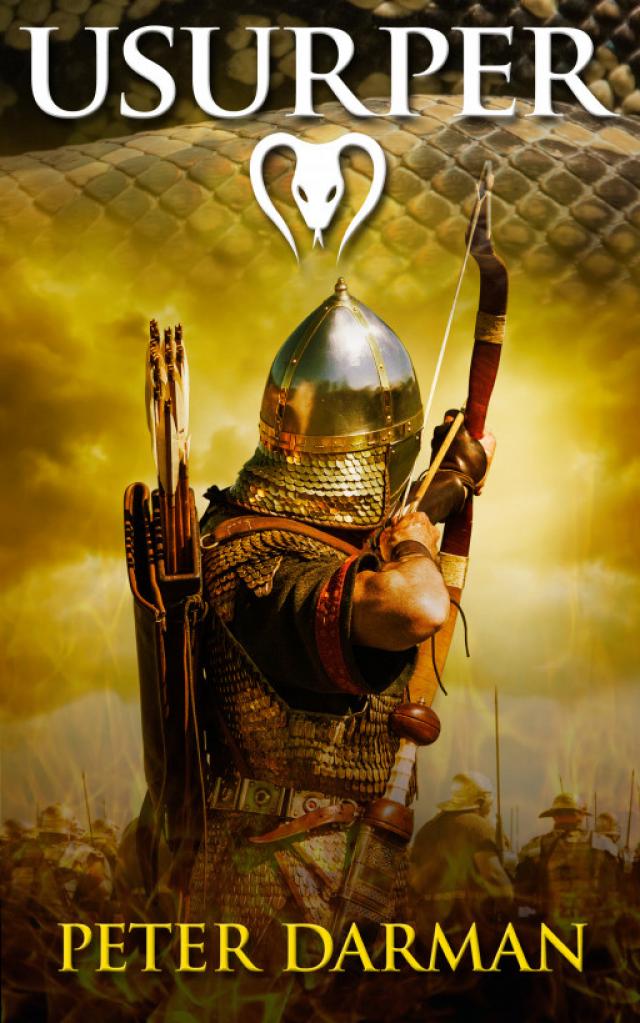


‘Wheel left, wheel left,’ shouted Katana, the signaller next to him blowing his trumpet frantically to convey his commander’s wishes to those out of earshot. I pulled back my bowstring and released it to shoot a Kushan readying his javelin to launch. I forgot about the Kushan shield wall and the Agraci to focus my efforts on the hundreds of light horsemen that were enveloping our flank, throwing javelins and drawing their swords as they closed on Duran horse archers. For a few minutes, the air was thick with javelins and arrows in a frantic exchange of missiles but then the Kushans were among us, hacking and thrusting with their swords. I slid my bow back into its case and drew my own sword when a rider closed on me, his shield tucked tight to his body. He slashed at me with a diagonal cut but I shouted at Tegha to retreat and he backed away, the blade missing my torso. The Kushan came forward on his horse and thrust his sword forward towards my chest. I ducked to the right but the sword point bit into the top of my cuirass. I hacked down with my spatha to knock his sword away from my body and whipped it back to draw the side of the blade across his face, slicing deep into his nose.
It was not a mortal wound but serious enough for him to drop his sword and shield to clutch his face and withdraw, only for another Kushan on my right to attack me with an overhead downward sword strike. I managed to parry it with my spatha but out of the corner of my eye I saw a leering Kushan on my left raise his sword to deliver a strike that I could neither avoid or parry. Sounds disappeared and time slowed in my helplessness, to be rescued by a sword being driven into the Kushan’s armpit. He collapsed from his saddle and I was free to concentrate on the enemy on my right, our swords locked above our heads. I drew my dagger from its sheath with my left hand and stabbed it repeatedly into the Kushan’s unprotected belly, turning his tunic red. He winced in pain, dropped his sword and flopped forward in the saddle. I chopped my spatha down on the back of his neck to sever his spinal cord and saw his lifeless body move away on the back of his horse.
Titus Rutilus had saved my life with his timely intervention and I raised my spatha to him in salute. But nothing could save my men or the Agraci who were being slowly forced back by the Kushan light horsemen, whose attack had emptied many saddles. We were losing the battle and I heard a new sound that seemed to herald our defeat, a mad trumpeting, but not one made by any human.
They came crashing through the Kushan light horsemen, maddened by the arrows stuck in them. It was fortunate that we did not see them up close because a rampaging elephant is a formidable creature. I counted twenty in all though there may have been more, but they had a devastating effect on the Kushan light horsemen they trampled through, scattering them like dust to the wind and saving our hides. Those Kushans in our midst heard the elephants too and saw their comrades swept aside, horses rearing up to throw their riders onto the riverbank where they were crushed underfoot by elephants.
The spectacle was awe inspiring and grisly, but more importantly gave the Agraci and my horse archers a blessed respite, as well as denting the morale of the Kushan horsemen. I sheathed my sword, pulled my bow from its case, strung an arrow and shot the nearest Kushan rider in the belly. My Durans needed no instructions as their training took over and they began shooting in all directions, each arrow finding a target to cause the Kushans to withdraw. The Agraci, having abandoned their attempts to hack through the Kushan shield wall, withdrew from the fray. The last of the rampaging elephants splashed into the river, the wooden boxes on their backs filled with dead men. But who had killed them?
‘I see a white horse’s head,’ shouted Katana in excitement.
I looked around at the companies of horse archers reforming now the Kushan horsemen had melted away, searching for a horse with a white head.
‘It is Hatra’s banner,’ Katana exclaimed.
I turned my gaze to where he was pointing, beyond the end of the still immobile Kushan spearmen, to see a wondrous sight – horse archers riding from the south, among them the banner of Hatra and behind them the four-pointed star of Elymais – Silaces! They must have been the ones who had scattered the Kushan elephants and in the process shattered the enemy’s right flank. We had been shown our escape route. I turned to Katana.
‘Get word to Malik that he and his men should ride around the Kushan centre and link up with the Hatrans and Silaces’ men. Send riders to Khosrou informing him to disengage and follow the Agraci.
I looked up into the sky, expecting to see arrows shot by Kushan longbowmen falling among us, but mercifully all I could see were puffy white clouds and blue. It could mean only one thing: the horse archers of Gafarn and Silaces must be assaulting the rear of the enemy’s centre.
It took an age for Khosrou’s men to desist their attacks on the enemy shield wall and withdraw back into the river where they could then wade south before riding to where our friends and allies were forming a battle line. The riverbanks and water were choked with dead and injured horses, dead bodies and wounded men trying to reach dry land. I thanked Shamash the enemy foot archers were occupied because otherwise we would have had to conduct our manoeuvre under volleys of arrows. As it was the horsemen of Dura, Margiana and Gordyene had a blessed respite from the bloodshed as they directed their tired mounts to safety.
Khosrou still lived but hundreds of his men had been killed and hundreds more wounded.
Spartacus had fared better, partly because he only had twelve hundred men to command, which made controlling them easier. As soon as the Kushan light horsemen attacked he turned his companies ninety degrees to face north, from where in the water they could shoot at the enemy riders. I wish I had thought of that, but had I done so I would have condemned the Agraci to even higher losses.
My nephew, unharmed but devoid of arrows, was beaming as he came to my side and spotted the banner of his father.
‘My brother will give this Kujula some Parthian steel,’ he grinned, urging his horse ahead. ‘The gods are with us, uncle.’
I looked at the dead in the water and the corpses of horses, saw the waterway streaked with blood and knew the gods were indeed here, though only to enjoy the spectacle. Where before there had been thousands of men battling each other, there were now only the dead and wounded as the Kushan spearmen about-faced to move away from the Indus to form a square to protect their longbowmen. I nudged Tegha forward to follow the companies of Durans that were heading for the stand of banners to the south of Kujula’s army.
It was a happy reunion, Khosrou roaring with triumph as he greeted Salar, Silaces and Gafarn, his tired men on their blown horses forming into their companies to the rear of the kings. I slid off Tegha and threw my arms around Gallia, the Amazons raising their bows in salute as man and wife were reunited.
‘Our daughters are safe?’ I asked.
‘Safe and well.’
‘And Sigal, Nergal, what about Marcus and Alcaeus?’
She put two fingers to my lips. ‘All are well, Pacorus, I thank the gods you are unharmed.’
I cupped her face and kissed her lovingly on the lips.
‘There’s still a battle to fight,’ said Silaces gruffly, rolling his eyes at the sight of Rasha and Spartacus locking lips.
I released Gallia who took her helmet from Zenobia and mounted her horse. I gained Tegha ’s saddle and the irritable King of Elymais provided an update on the overall situation. I shook the hands of Gafarn and Salar as the kings and queens gathered around Silaces.
‘As soon as the Kushans quit the siege of Sigal we made sure the city was safe and then followed our friend Kujula as he retraced his steps. Your man Talib and his scouts kept in contact with them, which meant we could maintain a safe distance just in case the bastard retraced his steps and ambushed us.’
‘And did he?’ asked Malik.
‘No, he was in a hurry so we had a pleasant march through the mountains. Kujula did pick up reinforcements as he neared the Indus, though,’ Silaces informed me.
‘The forces that invaded Aria and Drangiana,’ I said.
‘It would appear so,’ nodded Gafarn.
‘We have drawn the poison from the empire,’ I said in triumph.
‘Not quite,’ reported Silaces.
A cursory examination of the ground lying to the immediate west of the Indus revealed the Kushans to be a large force of horsemen and foot soldiers, the latter now manoeuvring to form a giant square as a defence against the thousands of Hatran and Elymais horse archers that had attacked the rear of Kujula’s army, to devastating effect.
‘Seems like you have them penned in nicely,’ said Khosrou, taking a swig from a water skin. He handed it to me. I had a raging thirst and grabbed it eagerly.
‘Except for the thousands of enemy horsemen mustering on the other side of that square,’ reported Silaces.
I took a great gulp and realised it was wine. I choked on the bitter liquid.
‘A belly full of wine greases the limbs for battle,’ grinned Khosrou.
‘Wine?’ I blurted. ‘It tastes like vinegar.’
Prince Pacorus rode up, all gleaming armour and white plumes in his helmet. He saw me and saluted.
‘It is good to see you, uncle, I’m sure Lord Azad will be pleased to know you have returned safely to Parthia.’
‘Where is Azad?’
‘With the rest of our cataphracts,’ Gallia told me, ‘about to destroy the enemy horsemen so we can annihilate the Kushan square.’
Salar yanked his reins to turn his horse to the right.
‘I will lead the charge to rid the empire of these foreign invaders.’
‘Get me a fresh horse,’ shouted Spartacus to anyone listening.
‘Where are you going?’ I said.
‘To lead my lancers,’ he told me, ‘I assume they are here.’
‘They are,’ confirmed Rasha proudly, ‘along with my Vipers.’
‘Time is of the essence, my lord,’ said Prince Pacorus to Salar.
I was tempted to join them but the old wound in my leg had flared up alarmingly and Tegha was blown, along with those of Katana and his horse archers, those who were still alive. Khosrou must have read my thoughts.
‘Let the young bucks seal the victory, Pacorus, we have done our bit. Unless they foul it up, of course, then we’ll have to clean up the mess. Have some more wine.’
He passed me his waterskin and I took a measured swig. To our front the horse archers were withdrawing, revealing an unbroken square and in the distance a long line of horsemen. Behind us the horse archers of Hatra and Elymais were refreshing their ammunition from the camel train carrying spare arrows. A lull had descended over the battlefield as both sides drew breath following our failed attempt to break the Kushan line and the arrival of Silaces’ army. He had been elected commander of the different contingents on account of him having the largest number of troops. But now all eyes were focused on the coming clash between the rival horsemen. It was ideal terrain for mounted warfare – flat and treeless.
‘Your man Kewab is organising our heavy horsemen,’ Gafarn told me, ‘let’s hope he is as good as everyone believes him to be.’
I smiled then winced as a pain shot through my leg. ‘He is the best.’
Gafarn was surprised. ‘Even better than you, three times lord high general of the empire?’
‘That was not a reward or recognition for anything, more a punishment.’
‘I’m sure High King Phraates would be hurt to hear you say such things,’ Gafarn looked around. ‘Where is our young protégé anyway?’
Gallia grinned but Silaces did not see the humour in our words.
‘The little brat should be here, defending his empire, not enjoying the company of whores at Ctesiphon.’
Gafarn was going to goad him further but I shook my head.
‘Where is Kalet?’ I asked, fearing the worst.
‘Salar asked him if he and his men would like to raid Carmania,’ Gafarn told me, ‘he was more than happy to oblige.’
‘Salar was worried that in our absence,’ said Gallia, ‘Phanes might be tempted to attack his kingdom once more. So, he sent Kalet to keep him amused.’
‘That is hardly going to encourage peace,’ I lamented.
‘You know what peace is, Pacorus?’ said Khosrou. ‘The interval between wars.’
A mass blast of trumpets brought our conversation to an end and all eyes turned to the two lines of horsemen advancing towards each other. From our position, we could see the Kushan square next to the riverbank and on the left the hind quarters of Parthian horses walking forward, lances and kontus shafts held vertically by their riders.
Fifteen hundred cataphracts trotted forward, comprising Hatra’s Royal Bodyguard and a thousand Durans commanded by Kewab and Azad. They were arrayed in two ranks, as were the fifteen hundred of Salar’s lancers on their right commanded by their king, and the same number of Saka lancers led by Shapur, who I was delighted to learn had been a thorn in the Kushans’ side during their abortive siege of Sigal. I was also pleased he had left his elephants in Sakastan. I later learned that Kewab had placed Spartacus’ five hundred medium horsemen on the left of the line, which meant the Parthian line had a frontage of nearly a mile.
The earth began to shake as five thousand riders broke into a canter and then a gallop to charge the Kushans.
‘Break the bastards,’ shouted Khosrou, as a horrible scraping sound reached our ears, signalling that the two sides had collided. Kontus points skewered Kushan riders to inflict hundreds of casualties on Kujula’s horsemen, but the emperor had many more riders and soon a furious mêlée was raging in which Kushan numerical superiority at first began to tell. But the element that tipped the scales back in our favour was a thousand ukku blades. Every Duran cataphract carried a sword forged from the mysterious metal from southern India that I had purchased for a king’s ransom many years before. Now those blades with swirling patterns along their blackened length repaid their enormous price as they cut through Kushan swords, armour and helmets.
All we could see was a maelstrom of horsemen and all we could hear was a mad clattering noise that resembled an army of rabid woodpeckers at work. We sat in silence, praying to the gods to grant our soldiers victory.
‘Get the men ready,’ barked Silaces to a subordinate, ‘we may have to cover their retreat.’
‘Bring the companies forward,’ Gafarn ordered his commander of horse archers.
The spectre of defeat was etched on their faces and the longer the mêlée in front of us went on the more I became fearful.
‘We will lend our support,’ I told Katana, who saluted and rode back to where my horse archers were restocking their quivers.
As the mêlée continued we grew ever anxious. Hundreds of horse archers began to form in their companies, all in column formation, ready to ride forward to shoot volleys at the enemy horsemen should they prove victorious and put our own riders to flight. But we had foolishly underestimated the fighting abilities of our cataphracts, who slowly but surely and despite being outnumbered, began to cut down the enemy horsemen with their swords, maces and axes. The mad chopping sound suddenly stopped and we looked at each other. Gallia grinned at me and I grinned back. We did not know what precisely was happening but we could see that our horsemen were getting smaller, meaning they were advancing.
‘Get your men forward and rake that square with arrows,’ Silaces commanded his subordinate.
‘I will be joining them, Silaces,’ said Gafarn, turning his horse and raising an arm to my wife and me.
‘Amazons,’ called Gallia, ‘follow me.’
I wanted to stop her but knew it was futile. Rasha was already organising her Vipers to join the force that would number nearly twelve thousand horse archers. My own, Spartacus’ and Khosrou’s horse archers were riding animals that had had a hard morning already and would therefore be retained as a reserve. I doubted it would be needed – the enemy’s horsemen had been put to flight and were being pursued, the Kushan foot soldiers were immobile in their square, and the enemy had lost a large number of their foot archers. All that remained was for the square to be showered by thousands of arrows to seal our victory.
And then it all changed.
‘What in the name of the gods?’
I heard Silaces’ voice and saw three columns of horsemen riding towards us at speed. They appeared from the other side of the Kushan square, presumably held in reserve by Kujula. They galloped towards us until they were perhaps five hundred paces away before halting and deploying into a long line, placing themselves between the square and us. From the latter came the sounds of drums and horns.
‘They’re retreating back across the river,’ I said.
Silaces clenched his fist. ‘We will see about that.’
He and Gafarn launched their horse archers, who ran into an arrow storm that decapitated the heads of the company columns that rode forward to battle their Kushan counterparts. So they changed tactics to send companies around the flanks of the Kushans, who extended their line to compensate. The Kushans were well trained but they were greatly outnumbered and soon their line was ragged as they tried in vain to maintain a screen to mask the retreat of the Kushan square, which was now entering the Indus. Parties of horse archers galloped towards the Kushan line, wheeling right and right again to withdraw from the enemy as the Kushans shot arrows at our riders. The arrows fell short and other companies approached the Kushan line to draw their arrows. The enemy line began to assume the shape of a vast curve as Kujula’s men did their utmost to protect the thousands of foot soldiers who were now wading across the Indus. Kujula was sacrificing his horse archers to save the bulk of his army.
I turned to Khosrou, who was emptying his waterskin.
‘Time to get our feet wet again, lord.’
While Gallia, Rasha, Silaces and Gafarn were whittling down the enemy’s horse archers, a task that demanded patience, courage and a great quantity of arrows, Khosrou and I led our tired horsemen back into the corpse-choked river to shoot at the thousands of Kushan foot soldiers who were making for the eastern bank. It was a surreal experience, the water gently lapping around our horses as we rode them against the mild current until we were around three hundred paces from the enemy mass. Then we proceeded to halt our horses and shoot arrows at the foe, aiming high into the sky so our arrows would fall among the Kushans. Those of the enemy who had shields hoisted them above their heads but our arrows fell like rain during a thunderstorm, my Durans and Khosrou’s warriors shooting up to twelve arrows a minute at the Kushans. The latter’s cohesion and discipline collapsed as they began a mad rush towards the riverbank, falling head first into the water in a desperate effort to avoid the arrow storm. Those who fell were trampled underfoot by those following and drowned instead of being struck by arrows. Others, hit by more than one arrow, floated downstream towards us, their lifeless bodies bumping into horses that reared up in alarm or thrashed around in the water in a state of panic, throwing their riders.