The corsican caper, p.11
The Corsican Caper,
p.11
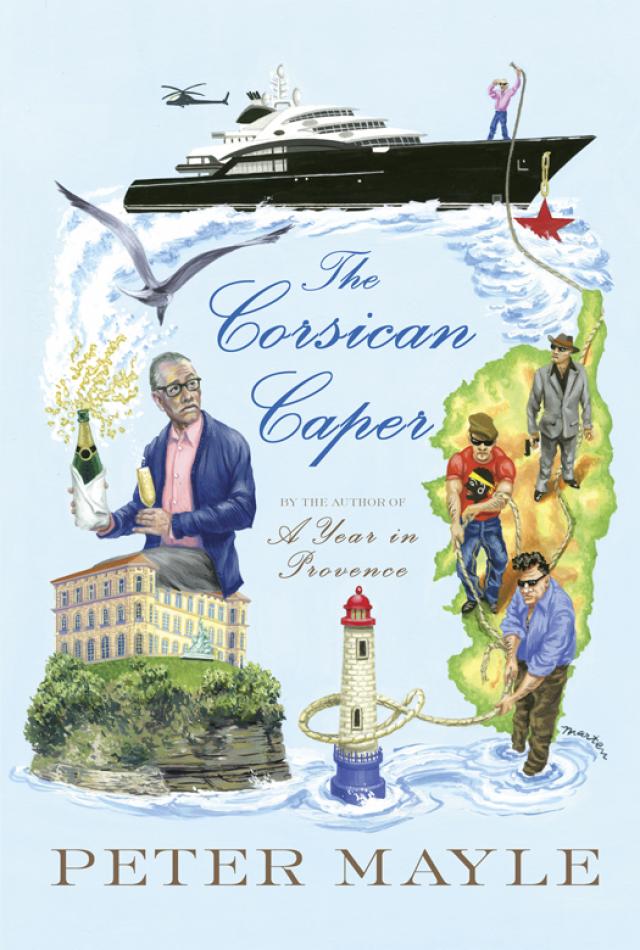


Flo Figatelli, from a vantage point in the bushes by the side of the road, saw Sam’s car coming toward the reservoir. He called his brother as he hurried back to join him and the Oblomovs.
“He’s just about at the top of the path,” said Jo. “Another five minutes and he’ll be down here.” The Oblomovs nodded and took out their guns. This was turning out to be easier than they had expected. They squatted behind their bush, making sure their field of fire wouldn’t be blocked by any thick foliage.
Halfway down the path, Sam let Alfred off the leash. The dog rummaged in the bushes, delighted to find unfamiliar smells, coming back every few minutes to make sure that Sam and his precious supply of biscuits weren’t too far away. They reached the reservoir, found the cigarette pack, and started off down the track, Alfred leading the way.
Sam’s mind was clear, his senses on full alert, his eyes fixed on Alfred’s shaggy rump. The dog would be the first, Sam reckoned, to sense any sign of the presence of human life in the undergrowth. Something crunched under his foot, and he looked down to see a small heap of hunters’ droppings—empty shotgun cartridge cases that had been partly stamped into the earth. After another few yards, there was an empty pastis flask. Thirsty work, hunting. On they went, following the twists of the track until they could see, fifty yards ahead, the opening of the clearing.
Alfred stopped. His head lowered, he resumed walking toward the clearing with deliberate, stiff-legged steps, as though he had already seen something, and was stalking it. Sam braced himself as they came to the end of the path. Alfred stopped again, his attention focused on a clump of bushes a few feet ahead.
The Oblomovs, hidden in that very clump, were of two minds. Should they shoot the dog first, or the man? Sign language from the elder Oblomov indicated the man. They were being paid to shoot the man; the dog they would dispose of later. They raised their guns and took aim.
The two shots came within a split second of each other. Sam’s body jackknifed as he fell to the ground, facedown, with Alfred whining beside him. The bushes parted, and out came the Oblomovs, guns at the ready, unaware of the Figatellis closing up behind them, each carrying a “Corsican persuader”—a short, blunt wooden club with a solid-lead head. The Oblomovs, intent on Sam’s motionless body, never saw the blows coming. They dropped instantly.
“Nice work, guys.” Sam sat up, rubbing his chest and trying to ward off Alfred, who was licking his face. “Ouf! I never thought those blanks would carry such a wallop. Lucky I was wearing the vest. OK, let’s get them ready for their big moment.”
The Oblomovs showed no signs of consciousness as they were rolled over and their hands were cuffed behind their backs. Their cell phones were taken, and their guns were transferred to plastic bags, using handkerchiefs to avoid leaving prints. Flo took out his phone. “You can come down now,” he said. “They’ll wake up in a couple of minutes.”
They were bleary-eyed but conscious by the time the big Peugeot with the darkened windows arrived and pulled to a stop. The driver, a large man with a boxer’s broken nose, got out and opened the rear door, and Uncle Doumé emerged. Sam hardly recognized him. Gone were the old work clothes, the sweet smile, and three days’ worth of stubble. This, judging by his dark suit and even darker sunglasses, was a man of some importance. He walked slowly over to the Oblomovs and stood looking down at them, his hands on his hips. “So,” he said, “these are the killers.” He turned his head. “Claude—my chair.”
The driver came over from the car carrying a director’s chair, unfolded it and placed it in front of the Oblomovs. Uncle Doumé sat down and took a small cheroot from his pocket, lit it carefully, and blew on the end until it glowed.
“You have placed yourselves in a difficult and dangerous situation,” he said to the Oblomovs. “You have attempted to murder my good friend here”—he waved his cheroot in Sam’s direction—“an attempt which he and his colleagues have prevented. They are now witnesses who will be happy to testify against you. As further proof, your fingerprints are all over the weapons. And you are in Corsica, where this kind of behavior is not tolerated, particularly not from foreigners.”
He paused, and blew a smoke ring. “As I said, a dangerous situation. It seems to me that there are a number of options, some less pleasant than others. First, we could shoot you, and claim self-defense.” The Oblomovs were beginning to show signs of apprehension. “Second, we could have you tried for attempted murder in front of a friend of mine, a judge, and I can promise that he would hand down a harsh sentence—thirty or forty years in a Corsican jail. And third, the most sensible option: you cooperate with us, and your reward would be a very much lighter sentence, to be served, if you prefer, in France. Do you have any questions?”
There was no response from the Oblomovs.
“Good. I will leave you with my colleagues, but I warn you. They are not patient men.” And with that, Uncle Doumé returned to his car. Claude folded up the chair and followed.
Not surprisingly, after a very brief discussion the Oblomovs chose the third option. Jo Figatelli called one of his many close contacts at police headquarters in Calvi and arranged for a van to be sent to pick up the Russians and take them to be locked up pending interrogation.
“We’ll wait for them here,” said Jo to Sam. “You’ve done your work for the day. Go back to the house and have a drink.”
Sam sat in the car, gave Alfred a celebratory biscuit, and called Elena. “It’s done, and everything went according to plan. The Russians are on their way to jail.”
Elena’s sigh was a huge gust of relief. “Are you OK?”
“I have a mild case of bulletproof-vest rash, but otherwise I’m fine. I’m on my way back to Laura’s house. I’ll tell you all about it over dinner.”
There was another long sigh. “Sam, I’ve been so worried.”
“I’ll be fine. The rash usually clears up after a couple of days.”
The first thing that Sam saw when he got back was the big Peugeot parked in front of the house. A close second was the welcoming committee of Uncle Doumé, Laura, Elena, and Reboul waiting by the open front door. Alfred bounded from the car, with Sam following. He hugged Elena, and felt warm tears on her cheeks. Reboul embraced him, patted his back, squeezed his shoulder, ruffled his hair, and looked as though he might burst into tears himself. A perfumed kiss from Laura, a smile and a grunt from Uncle Doumé, and they went into the house.
Reboul was almost dancing with relief and excitement, and Elena was gripping Sam’s hand so tightly he thought he should ask her to stop before it came off. Laura and Uncle Doumé, nodding and smiling, added to the general air of merriment as they went into the living room and gathered around a magnum of Champagne in its oversized ice bucket. While Reboul was dealing with the cork, Sam felt it was time for a quick dose of reality.
“I hate to say this,” he said, “but let’s not overdo the celebration just yet. It’s not over. We still have to deal with Vronsky.”
Chapter Twenty
Before Sam could get any further into the problem of Vronsky, his phone rang.
“Jo? What happened?” Sam wedged the phone more firmly against his ear. “They did? Both of them? That’s great. Don’t let them anywhere near a phone. I think we can get going now. I’ll talk to you later.”
He was smiling as he put down the phone. “Good news. In return for reduced sentences, the Oblomovs have both signed confessions that they were carrying out an assassination contract for Vronsky. That makes him an accomplice in an attempted murder, and that just about does it. I think I could manage a drink.”
Reboul poured, Sam drank. Champagne had never tasted so good.
“I have a little news of my own,” said Reboul. “You know my friend Hervé? He’s explained everything to his counterpart in Paris, and the Paris flics are ready to move on Vronsky as soon as you give the word.”
“The sooner the better,” said Sam. “There’s nothing to be gained by waiting, and Vronsky will start getting nervous when he doesn’t hear from the Oblomovs. Does Hervé work late? Could we call him now?”
Five minutes later, it was all arranged. The police would pick Vronsky up as he left the Bristol to go out to dinner. He would spend the night in a Parisian cell. The following day, he would be delivered to Marseille, where he would face interrogation and trial. Hervé said that with a word in the right ear, it could be arranged for Vronsky to be sent to French Guiana, on the coast of South America, to serve his sentence. A most unhealthy place, according to Hervé, where the odds against survival were high.
“Now, my friends,” Reboul said, “do you think it’s safe to celebrate? Because I have a suggestion: lunch at Le Pharo, perhaps the day after tomorrow, so that my chef has time to prepare. I will arrange transport for everyone from Calvi to Marseille. How does that sound? Only if you’re free, of course.” He looked around at the smiling faces of Laura, Doumé, Elena, and Sam. “And we mustn’t forget the Figatelli boys.”
The following morning, the three of them boarded Reboul’s plane for the short hop back to Marseille. Reboul was still effervescent with relief, even more so when Hervé called to say that Vronsky had been picked up as planned and would be delivered to Marseille later in the day. He had apparently been threatening massive lawsuits for wrongful arrest to anyone who cared to listen.
“He can squawk all he wants to,” said Reboul, “but he doesn’t know yet about those signed confessions. Sam, I didn’t want to ask you before—but were you absolutely sure those guns had been loaded with blanks?”
“Of course,” said Sam. “The Figatellis knew that if they screwed up I’d come back to haunt them. Seriously, they were terrific. They loaded the magazines themselves, and found some way of keeping the guns out of the Oblomovs’ hands until the last minute. I never had any worries.”
Half an hour later, they were in the car, heading back to Le Pharo. Reboul immediately went into the kitchen for a conference with Alphonse, planning the menu for the celebration lunch. Elena and Sam went down to the pool and stretched out in the sun.
“I still can’t believe it’s all over,” said Elena. She leaned over and kissed Sam on the tip of his nose. “Can we go back to having a vacation now?”
“What do you have in mind?”
“Just the usual stuff. You know, making love in the afternoon, dinner under the stars, that kind of thing. Maybe we could look at a few apartments, explore the calanques, spend some time with Mimi and Philippe.”
“Anything you want, my sweet, as long as I don’t have to wear a bulletproof vest. What happened to that, by the way?”
“Laura took it and put it in Alfred’s basket. She said the scent of it would remind him of you.”
Sam was considering this unusual compliment when Reboul arrived at the pool, smiling broadly and clutching a sheet of paper. “Voilà,” he said, waving the paper, “Alphonse and I have agreed on the menu for tomorrow, and it is a tour de force. I won’t spoil his moment by telling you the details—he wants to do that himself—but I can guarantee a most memorable meal, a banquet. And now, I must go to the cellar and choose the wines.” He paused, and gave a long, theatrical sigh. “My work is never done.”
The group making its way up the steps of Reboul’s plane the following morning provided an interesting contrast in dress styles. Laura, elegant in gray silk; Uncle Doumé in a flowered shirt and baggy white trousers; the Figatellis in jeans and their favorite T-shirts, black with gold lettering spelling out the reassuring promise that whatever happens in Vegas stays in Vegas.
The short trip over to Marseille gave Laura, who had never met the Figatellis, the chance to get to know them. She clearly liked what she saw, and flirted outrageously. They flirted back, and she became quite girlish, with much fluttering of the eyelashes. Uncle Doumé was busy in the cockpit taking beginner’s lessons from the pilot, and by the time the plane landed everyone was in the best of spirits.
Le Pharo was ready for them. Reboul, with decorating advice offered by Elena, had turned one corner of the terrace into a haven of shade, with giant umbrellas shielding a seating area and the long dining table from the sun. White was everywhere—the umbrellas, the armchairs and couches, the tablecloth and napkins, and the ‘Iceberg’ roses that overflowed from huge terra-cotta pots. Elena and Reboul had dressed to match, all in white.
“Bravo, Francis, bravo.” Laura patted Reboul on the cheek. “This is quite wonderful, just like something out of that magazine—what’s it called?—Côté Sud. Now then, if someone were to offer me a little of that excellent Champagne I see on the table, I don’t think I could resist.”
Reboul had arranged for Claudine, his housekeeper, and Nanou, his housemaid from Martinique, to take care of his guests, and when he saw that everyone had a glass he stood up to offer a few words of welcome.
“First, let me say how grateful I am to you all for your help. Nobody could ask for better friends, and I shall never forget what you’ve done. This lunch, this happy occasion, is to say thank you, but I also want to say that if ever there is anything I can do to help any of you, all you have to do is ask.” He paused, a little emotional, and swallowed hard before continuing. “It is a day to eat, drink, and be merry. Never has a fine meal been so richly deserved. And now, to prepare you for what is to come, it’s time to welcome Alphonse, king of Le Pharo’s kitchen and creator of today’s menu.”
The chef, who had been waiting outside the kitchen door for his cue, came forward, smiling and nodding at the guests.
Alphonse, as Elena later remarked, restored one’s faith in the classic French chef—classically rotund, classically jolly, and wearing a long, heavy apron instead of the dainty white monogrammed jackets so popular with show business chefs. He made his way onto the terrace accompanied by a round of applause, took his place next to Reboul, and cleared his throat.
“I have prepared for you a simple lunch with, as you will see, one or two Corsican touches in honor of our Corsican friends.” He nodded and beamed at the Figatellis and Uncle Doumé. “To start, coquilles Saint-Jacques to awaken the palate—just three per person, pan-fried, and accompanied by chives and a ragoût of new peas and broad beans, drizzled with olive oil and the merest dusting of Camargue salt.”
He took a sip of the Champagne that Reboul had passed to him before moving on to the next course. “We remain with the saints, and with the appetite now on the qui vive, we have a filet de Saint-Pierre, with asparagus tips and a lemon emulsion, made, naturellement, with the finest Corsican lemons.” Another nod and a beam to the Figatellis.
“To follow, braised rump of Corsican veal, with a fricassée of new potatoes and carrots and an infused jus of savory. This will put us in the mood for a selection of goat cheeses, and here, I must confess, I cannot promise that all the goats who contributed were Corsican. Even so, I think you will enjoy the cheeses. There are three: one soft and creamy; one hard and strong; and one cendré, with a fine dusting of ashes. The combination is subtle and delicious.”
He looked toward Laura, and bowed his head. “To finish, I am indebted to Madame Lombard, who gave me the recipe for her sublime chocolate cake, rich and dark. I have added some early-season cherries, stoned and lightly heated in Corsican myrte until the juices run, and a large flourish of whipped cream.” He looked around, smiling at his audience, and delivered the traditional chef’s blessing, “Alors, bon appétit!” The applause followed him back to the kitchen.
Elena was shaking her head at Sam. “If that’s a simple lunch, I’m Paul Bocuse. You’re going to have to carry me away from the table.”
Reboul, who had been standing next to them, pretended to be shocked. “No, no, no,” he said. “I know the list of dishes is long, but the portions are modest, a series of exquisite mouthfuls. After you’ve eaten, you will spring from the table, ready for a run around the Vieux Port.” He cocked his head and winked. “Or possibly a siesta.”
“Now you’re talking,” said Elena.
A good lunch anywhere is a pleasure, but a good lunch with friends out of doors on a fine summer’s day is a total joy. Everything seems to have been given an extra touch of magic. The wine tastes better, the jokes are funnier, the compliments more elegant, the food more delicious. And so it was that day at Le Pharo. The gastronomic voyage from coquilles Saint-Jacques to Laura’s chocolate triumph took three hours, with interludes between courses for impromptu speeches, most of which were in fact extended invitations. Sam and Elena invited everyone to Los Angeles. The Figatellis invited everyone to Calvi. Laura offered a choice between Paris and Gstaad, and Uncle Doumé proposed a visit to his family’s vineyard in Patrimonio, where, he said, even the bathroom taps ran with wine.
Reboul had just gotten to his feet when his phone rang. He stood at the head of the table, listening intently, smiling at first and then laughing out loud. He was shaking his head as the call finished. “I can promise you a rare sight, my friends,” he said. “Follow me.” He led the group to the edge of the terrace, scooping up a pair of binoculars from a low table, and stood looking out to sea. “The call was from Hervé,” he said. “Any moment now, we should see them coming round the headland.”
A minute passed, then two, and finally they saw, rounding the headland a few hundred yards away, a dark-blue police launch. It was dwarfed by what was following it—The Caspian Queen, her Russian ensign at half-mast. The binoculars were passed around, and it was possible to make out several figures dressed in the uniform of the Police Nationale moving around the main deck.
“They’re on their way to the port,” said Reboul, “where Hervé tells me the boat will be kept while—how did he put it?—the owner is helping the police with their inquiries. So I don’t think we’ll be seeing any more of The Caspian Queen.”
“I’ll drink to that,” said Sam. “Champagne, anyone?”