The corsican caper, p.2
The Corsican Caper,
p.2


Sam ran his fingers over the fine silk of something so insubstantial he thought for a moment that it was a small handkerchief. He shook his head. “I don’t know,” he said. “I think I need to see them on, to make sure that they fit.”
“Sure,” said Elena, as she scooped them up from the bed and headed back to the dressing room. She looked over her shoulder, and winked. “Don’t go away.”
Chapter Three
The letter had been hand-delivered earlier that morning, so Claudine said, by a very well dressed gentleman who had arrived in a Mercedes. He hadn’t left his name.
Reboul opened the envelope, its inside lined with chocolate-brown tissue, and took out the single sheet of heavy, buff-colored paper. Instead of an address at the top, a discreetly embossed heading announced that the sender was the Vicomte de Pertuis. His message was brief and to the point:
I would be most grateful for a few minutes with you to discuss a matter of mutual interest and profit. I am entirely at your disposition as to a time and place to meet. Please telephone me at the number below to arrange a rendezvous.
This was followed by a one-word signature: Pertuis.
Over the years, Reboul, like most wealthy men, had received countless solicitations from people offering to increase his fortune by one shady means or another. Some had been amusing, others quite astonishing in their imaginative use of his money. This time, he found himself more than usually intrigued. Perhaps the title helped, although the aristocracy these days, God knows, had become thoroughly venal and commercialized. But one never knew. This might be worth a few minutes. He picked up his phone and called the number.
“Pertuis.”
“Reboul.”
The voice changed instantly, becoming unctuous. “Monsieur Reboul, how very kind of you to call. I’m delighted to hear from you.”
“Obviously, I received your note. I’m free this afternoon around three, if that would suit you. I think you know where I live.”
“Of course, of course. Three o’clock it is. I look forward to it immensely.”
Elena and Sam had spent the morning being tourists. Many changes had taken place in Marseille leading up to 2013, when it had taken its turn as the European Capital of Culture. And Elena, an avid collector of travel tips, had read about them all, from the transformation of the once shabby docks (Le Grand Lifting) to Pagnol’s “Château de ma mère” becoming a Mediterranean film center. There were also new museums and exhibition sites, newly created gardens both wet and dry, even a glamorous glass ombrière to give visitors to the fish market some shelter from the elements, if not from the ripe language. All in all, there were enough novelties to occupy even the most fast-moving of sightseers for at least a month.
Sam did his best to keep up with Elena, but it was exhausting work. He looked with increasing longing at the cafés they rushed past until he could stay silent no longer. “Lunch,” he said, his voice steely with determination. “We must have lunch.”
He hailed a taxi, bundled Elena in, and told the driver to take them to the Vallon des Auffes, just off the Corniche. Elena put her travel notes in her bag and let out a long, theatrical sigh. “Culture is defeated, and gluttony wins again,” she said, “and just when I was enjoying myself. Where are we going?”
“It’s a little port with two terrific restaurants, Chez Fonfon and Chez Jeannot. Philippe told me about them: Jeannot for moules farcies, Fonfon for bouillabaisse.”
Elena looked down at her pale-blue T-shirt and cream linen skirt. “I’m not dressed for bouillabaisse. How about the moules?”
The Vallon des Auffes is a pocket port, too small to accommodate any but the most modest boats. Without doubt, the best place to appreciate the miniature but highly picturesque view is the terrace at Chez Jeannot, and Elena settled into her seat with a little sigh of satisfaction. “This is cute,” she said. “Maybe you were right after all.”
“Sorry about that. I won’t let it happen again.” Before Elena had a chance to roll her eyes—her standard response to Sam’s attempts at sarcasm—he had buried himself in the wine list. “Let’s see: a vivacious little rosé? Or perhaps a crisp and beautifully balanced white, with just a hint of impertinence, from the vineyards of Cassis?”
Over the years, Elena had become used to Sam having bon viveur moments as soon as he set foot in France. It was part of the travel experience. “Do you think they have French fries to go with the mussels?”
“Pommes frites, sweetheart, pommes frites.”
“Sam, you’re behaving like a dictionary. Don’t be a pain.”
“A pain? I’m thirsty, I’m hungry, and my feet hurt, but otherwise I’m the soul of charm and good humor. Now, what’s it to be? Pink or white?”
When the rosé arrived, Sam raised his glass to Elena. “To our vacation. How does it feel to be back here again?”
Elena took a sip of wine and held it in her mouth for a moment before swallowing. “Good. No—better than good. It’s lovely. I’ve missed Provence. I know how much you like it, too.” She took off her sunglasses and leaned forward, her expression suddenly thoughtful. “How about getting a little place here? You know, just for the summer. Somewhere to keep your espadrilles.”
Sam raised his eyebrows. “You wouldn’t miss summer in L.A., when the smog is at its most beautiful?”
“I guess I’d survive. Sam, I’m serious.”
“OK, that’s settled.” He smiled at Elena’s startled reaction, and raised his glass again. “That was easy. As a matter of fact, I was going to suggest the same thing. I could learn to play boules. And you could learn to cook.”
Before Elena could think of a suitably crushing reply, the moules farcies arrived, the mussels cooked with herbs, garlic, and, according to the waiter, beaucoup d’amour; the frites fried twice to make them crisp on the outside, soft on the inside. To accompany the food there was an excited but inconclusive discussion about property in Provence: the merits and drawbacks of the coast versus the country, a village house in the Luberon or an apartment in Marseille. Over coffee, it was agreed that they would contact a couple of real estate agents to help them look around. When the bill came, Elena insisted on paying. She planned to frame the check as a souvenir of the day they had made their decision.
When they returned to Le Pharo at the beginning of the evening, it was to find Reboul still fuming. He had received a visit, he told them, from someone he described as a used-car salesman masquerading as a Vicomte, who had said that he had found an extremely rich buyer for Le Pharo: a man, he had said, with the deepest of deep pockets. It’s not for sale, said Reboul. Not for fifty million euros? Don’t you understand, said Reboul, it’s not for sale. Aha, said the Vicomte, but it is well known that there is a price for everything. It is possible that I could persuade my client to dig even deeper into his pockets.
“And that’s when I showed him out,” said Reboul. “There’s a price for everything, is there? Quel culot! What a nerve!”
“Well,” said Sam, “I guess that’s one real estate agent we can knock off the list.”
Reboul paused, corkscrew in hand. “What do you mean?”
“We decided at lunch. We’d like to try and buy a little place over here.”
Reboul’s face lit up. “Really? How wonderful. Now that really does deserve a drink.” He put the corkscrew to work on a bottle of Chassagne-Montrachet. “This is the best news I’ve had in weeks. Where do you want to be? What can I do to help?”
The Vicomte, to his credit, was a very resilient man. Besides, he had come up against similar protestations many times before, most of which had vanished when their speaker was faced with a big enough check. And so, when he was reporting back to Vronsky on The Caspian Queen, he managed to present an appearance of guarded optimism.
“Of course he said he wasn’t interested in selling. That’s what they all say at first—it’s an old trick to get the price up. I must have heard it dozens of times.” The Vicomte smiled, nodding his thanks for the glass of Champagne that had been put in front of him by Vronsky’s chief steward. “I’ve found that it’s usually best to leave them to think about it for a week or two before getting back to them. You’re not planning to sail off somewhere, I hope?”
Vronsky shook his head. “I don’t like unfinished business. That property is perfect for me, and I won’t be leaving Marseille until it’s mine.”
Chapter Four
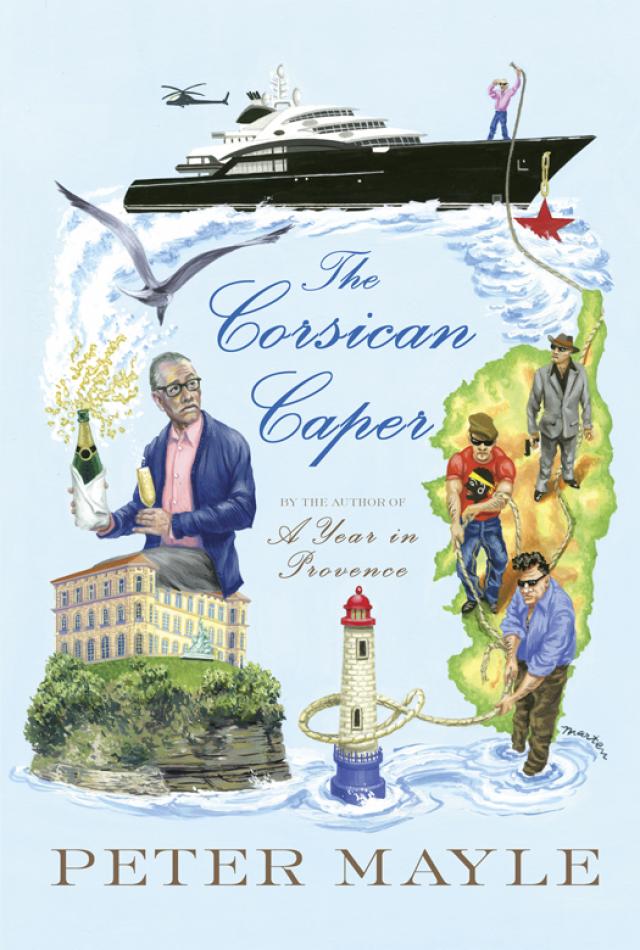
Reboul had persuaded Elena to persuade Sam to put aside his horror of all things that float and come on a cruise around Corsica. His boat, as he had been at pains to explain to Sam, was built for comfort rather than speed; as another inducement he promised that they would never be out of sight of land. In fact, it was generally accepted, according to Reboul, that the very best way to see Corsica was to sail around it. Many of the prettiest little beaches were inaccessible by car and, at this time of the year, deserted. And, as Elena said, it does a girl good to have a beach all to herself. She was in her element—barefoot, clear-eyed, her skin the color of dark honey, her disposition angelic, her pleasure contagious. How could Sam resist? Confirmed landlubber though he was, he had to admit that sailing had its moments.
They had moored overnight in the port of Calvi, with a view of the massive Citadelle that had kept watch over the town for six hundred years. Dinner had been taken in a restaurant two steps from the quay: a fine daurade royale, the fish celebrated by its admirers as “the playboy of the Mediterranean.” It had been cooked in a salt crust and served with a pungent aioli. To follow there was brocciu, the creamy local cheese best enjoyed with a generous helping of fig jam. Now they were back on the boat, drowsy and replete, their skin still tingling from the day’s sun.
Reboul had left Elena and Sam on deck, leaning back in their chairs counting the stars. When he reappeared, it was with a bottle and three glasses. “We must finish as the Corsicans do,” he said, “with a little nightcap that will make us sleep like babies.” He placed the bottle on the table. In its appearance, it was as far as a bottle can get from the gilded extravagances that are so often used in the presentation of after-dinner drinks. It was devoid of printed label or ornate stopper. There was a label of sorts, stuck on sideways, with a single handwritten word: Myrte. And there was a stopper—a cork, darkened with age, that looked as though it had seen service in several other bottles. The overall effect would never have won any prizes for elegance.
Reboul set the glasses in a row and started to pour. “This is made by the farmer who lives near my aunt in Speloncato. Myrtle berries, macerated in a mixture of eau-de-vie and sugar, with a touch of lemon and a couple of cloves.” He slid two glasses across the table.
Elena sipped once, then again. “Ah, yes,” she said in her best winetaster’s voice. “I think I detect a hint of cloves.” She smiled at Reboul. “I could get to like this a lot. It’s lovely—sweet, but kind of peppery. Do you think your aunt’s farmer would make some for me?”
The next morning, they sailed south. Reboul wanted them to see the village of Girolata, accessible only by sea or mule track, where Sébastien, an old friend, had decided to spend the summers of his retirement. To keep himself amused, he had opened a bar on the beach, hired a pretty local girl as bartender, and assumed the modest responsibilities of chef. Since there was only one dish on the menu—the local langouste—his kitchen duties gave him plenty of time for his favorite hobby, which was sitting in the sun.
He was standing at the water’s edge to welcome them as they came ashore—wiry, tanned to a crisp, his face a network of wrinkles relieved by a wide white smile. He embraced Reboul, kissed Elena’s hand, shook Sam’s, and led them up the beach toward a low, open-fronted shack with tables and chairs arranged under faded canvas umbrellas. A sign hanging above the bar read Le Cac Quarante and, in smaller letters, Les chèques sont pas acceptés.
“Cac Quarante—that’s a pretty weird name for a bar,” said Elena. “Is it some kind of Corsican specialty?”
Reboul grinned. “Not quite. It’s the French equivalent of the Dow Jones index—the movement of the most important forty stocks on the Bourse. That’s where Sébastien used to work.”
They were settling themselves around the table and studying the handwritten, postcard-sized wine list when Reboul’s phone rang. He left the table and strolled down the beach while he took the call. When he came back, it was with a scowl on his face. He was shaking his head as he sat down. “You won’t believe this,” he said. “That was Claudine. That real estate agent has just turned up with Vronsky, that Russian maniac with the helicopter. They told Claudine that I’d said they could look around the house. While she was talking to me, they’d slipped away and gone into the living room. So I told her to call the police and have them kicked out.” He shook his head again. “Unbelievable.”
Sam took a bottle from the ice bucket and poured a glass. “This might help. It’s Canarelli, Sébastien’s favorite rosé.” Sure enough, the first long, considered swig seemed to have a calming effect on Reboul. “Tell me, Sam,” he said, “what would happen if someone did that in America?”
“Well now,” said Sam, “you have to remember that in the States, a house is not a home without a gun. So I guess we’d shoot him. That usually works.”
Reboul smiled, his good humor restored. “I must remember that.”
The langoustes were fresh, firm, and sweet, served with a mayonnaise almost thick enough to need a knife, made with egg yolks and extra-virgin Corsican olive oil. A second bottle of wine was ordered, and the conversation turned to Elena and Sam’s plan to buy a small place in Provence—nothing grand, but as Elena said, with beaucoup de charme.
“I think I should warn you,” said Reboul, “that those three words are memorized at birth by all Provençal real estate agents. Charm is the great excuse for dark rooms, tiny windows, low ceilings, suspect plumbing, rats in the cellar, bats in the bedroom, and anything else that might be seen as a disadvantage. If the property is really on its last legs and falling to pieces, it has un charme fou—a crazy charm. And, as if that’s not enough, it will also have ‘enormous potential.’ So don’t be surprised if the agent offers to lend you rose-colored spectacles.” He paused for another sip of wine. “Anyway, when we get back I’ll find a couple of names of people for you to contact.”
Three sunny, lazy days later, they were back. It had been, for all of them, a brief but magical vacation from real life, and it left them with a feeling of benevolence toward the rest of the world. This, of course, couldn’t last.
Real life was lying in wait.
Elena, who had left her electronic links to the office at Le Pharo, opened her BlackBerry to find a dozen messages from clients she had blissfully forgotten. Sam, a man who was far too busy enjoying life to contemplate death, found an extremely stern e-mail from his lawyer, who professed himself to be deeply concerned about Sam’s repeated failures to make out a will. And Reboul, despite himself, had become increasingly taken up by thoughts of Vronsky; not only thoughts, but questions. When a man takes such an aggressive interest in your home, it’s only natural to want to know more about him.
Fortunately for Reboul, there was Hervé, Marseille’s chief of police, whom he had contacted recently about Vronsky’s helicopter. As Reboul had found several times in the past, Hervé’s tentacles seemed to reach everywhere—the underworld, the government, Interpol, even deep within the local chamber of commerce. The two men met for lunch three or four times a year to exchange gossip and favors, an arrangement that suited them both.
“Well, mon vieux,” said Hervé, “what have you done now? Too many parking tickets? Assaulted a politician? Been caught pinching girls’ bottoms again?” As his laughter came down the phone, Reboul could picture Hervé’s face—round, smiling, and cheerful, a misleading face that concealed the tough and determined officer Reboul knew him to be.
“I need a little information,” said Reboul. “Remember the business with the helicopter? Well, I think the guy who organized that has been snooping around again. While I was away, he got into the house for a guided tour. I’d like to know a little more about him. His name is Vronsky. He’s Russian, and he’s rich. Very rich.”
“Let me see what I can find out. Rich Russians in Europe aren’t too difficult to track. I’ll try to have something for you in a couple of days. Meanwhile, don’t do anything I wouldn’t do, d’accord?”
Chapter Five
The early evening calm at Le Pharo—the hour of l’apéritif—was disturbed by the sound of a motorcycle’s engine. The rider, a burly policeman in highly polished boots, parked his machine carefully, removed his helmet and placed it on the saddle, rang the front door bell, and stood to attention. He had been told that this was a very important delivery, ordered by the chief himself, and that all the niceties should be observed.
Claudine opened the door. The policeman saluted. “For Monsieur Reboul,” he said, handing over a manila envelope.
“Merci, monsieur.”
“De rien, madame. Bonne soirée.” Mission accomplished, he saluted again before roaring off down the drive.
Claudine immediately took the envelope to Reboul, who slit it open and took out three sheets of paper. The first was a handwritten note from Hervé:
Cher ami,
I am taking the small precaution of using the old-fashioned way of communicating, with pieces of paper. As you know, nothing electronic is completely private these days, and I would prefer that this doesn’t end up on the Internet.
As you will see, Monsieur Vronsky has had an interesting career. What strikes me is the high mortality rate of his business partners. Although nothing has been proven, I don’t believe in coincidence, and I regard these deaths as a serious warning. I strongly recommend that you have nothing to do with this man. He seems extremely dangerous.