The corsican caper, p.8
The Corsican Caper,
p.8
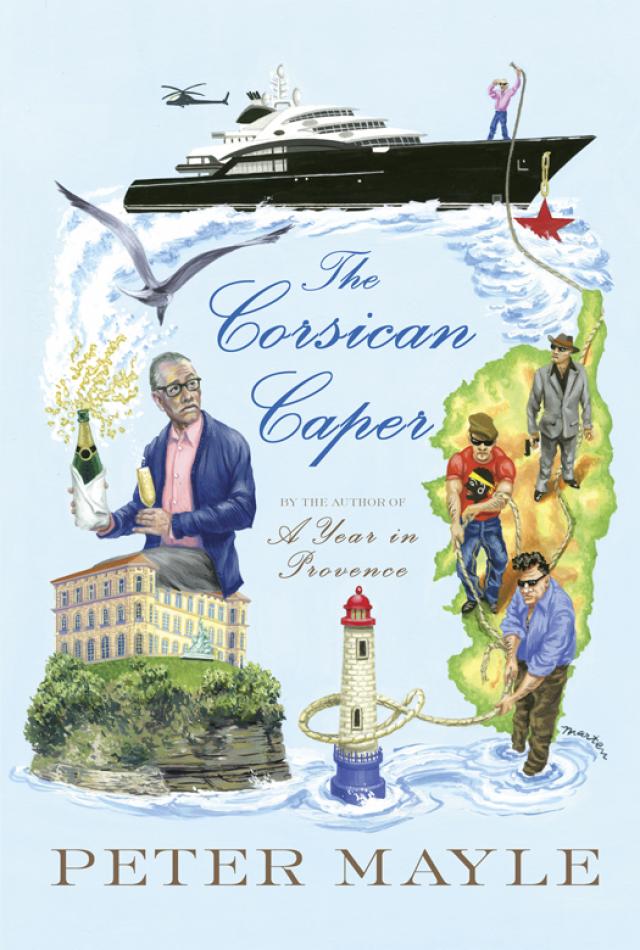


The Figatellis, sitting over coffee in the back room of their bar, compared their impressions of the meeting.
“Well,” said Flo, “am I getting suspicious in my old age or does he know a lot more than he let on?”
“He must know all about it. If Maurice was able to pick up the rumor during a sober moment, Zonza, with that network of his, would certainly have heard. How many people does he have out on the street with their ears flapping? A dozen? Fifty? He must know.”
The brothers sat in silence for a few moments, trying to think of some way to induce Zonza to tell them what he had learned. But, as they had to admit, he was not a man who would respond kindly to pressure. Threats were out of the question. Money might work, but how much would it take?
“If we could find out who these Russians are, we’d at least have some options,” said Jo. He took out his phone. “Let’s get Maurice over here. Maybe he can remember where he got his information.”
Maurice made his entrance in his usual furtive fashion, as though he were half-expecting to be mugged. Small and dark, with a scruffy little beard, he prided himself on his unremarkable appearance. “It’s easy to get lost in a crowd,” he was fond of saying, “but I can almost vanish in an empty room.” And it was true. Like a chameleon, he was able to blend in with his surroundings. It was an eavesdropper’s greatest asset.
He accepted a glass of Corsican whisky and looked at the Figatellis expectantly, the possibility of another job never far from his thoughts.
“Remember that rumor you heard?” asked Flo. “About a couple of Russians?”
Maurice held up both hands. “Don’t rush me. I’ve got the word out, but these things aren’t on the evening news. Finding the name of the target? That’s going to take time.”
“Maybe it would be easier if we knew the names of the Russians.”
“Ah.” Maurice scratched his beard. “You’re right. One thing leads to another. Do you want me to …”
Flo grinned. “That little bonus of yours is getting bigger all the time.”
Maurice finished his whisky and stood up. “Always a pleasure, gentlemen. I’ll get back to you.”
Chapter Fifteen
The first Vronsky interview, with Philippe employing the slavish flattery he would normally reserve for insecure politicians, had gone well. By the time it had finished, Vronsky seemed relaxed, comfortable, and, so Philippe hoped, more likely to let slip an indiscretion or two. For this next session, Vronsky had even agreed to leave the floating womb of The Caspian Queen and meet Philippe for lunch at Peron, only insisting that a separate table for one be reserved for Nikki, the ever-present bodyguard.
Lunch started with a reaction from Vronsky that boded well for the interview. This was his first visit to Peron, and he was delighted with the expansive sea view, which happened to feature The Caspian Queen at anchor five hundred yards away.
“You see?” he said, nodding at the yacht. “She follows me like a faithful dog.”
Philippe smiled and poured the wine. “I’ve been thinking,” he said. “You’ve had a fascinating life, been all over the world, made millions—excuse me, billions—and it would be a great shame if we tried to compress all that you’ve achieved into this one article. It cries out for more important treatment.”
Vronsky’s eyebrows went up. “You have something in mind?”
“I do. I’d like to suggest that I write your biography.”
Philippe was expecting a reaction—an attack of false modesty, perhaps, or a little preening, but Vronsky said nothing while he turned the idea over in his mind. Like so many rich and successful men, he was often the target of a nagging feeling that whatever he had wasn’t quite enough. Something was lacking. Recognition, fame, celebrity—however it was described, it would be the ultimate public confirmation that he, Oleg Vronsky, was exceptional. And a flattering biography was one way of achieving that. Not surprisingly, Vronsky found the idea appealing.
“I’ve done a little research,” said Philippe, “and it’s a great rags-to-riches story: modest beginnings, risk and adventure in Africa and Brazil, enormous success—people will love it.” He shook his head. “I’m sorry. I know we’re here to work on the interview. But I’m really excited about the biography. Would you think about it?”
With the seed planted, Philippe went back to his notes, and the questions began. They started harmlessly enough: How did Vronsky like France? What would be his next stop after Marseille? Did he play golf? Where did he stay when he was in London or Paris? Did he spend any time on the Riviera?
This led naturally into Philippe’s next question. “I’ve heard,” he said, “that dozens of Russians have settled in the South of France. Do you know many of them?”
“A few,” said Vronsky, “but not here. It’s too quiet for them here—not enough parties. They prefer the Riviera. Cap d’Antibes, for instance. I was there not long ago, and it’s getting to be like a suburb of Moscow.”
As lunch continued and the wine flowed, Vronsky revealed that he had little time for his countrymen: “Peasants, for the most part, peasants who have struck it lucky—loud, vulgar, and uncultured.” Philippe, feeling that the protestations were a little too glib, wasn’t altogether convinced. He made a mental note to look into the Russian colony on the coast.
As lunch drew to its liquid end, Philippe told Vronsky that he had enough material to start writing, and promised to arrange for a photographer to come and take pictures of the great man on his yacht, and perhaps at the wheel of his Bentley. They parted company on the best of terms, each feeling that the meeting had been more than satisfactory.
Nino Zonza was experiencing an unusual moment of indecision. Normally a man who made up his mind quickly, he found himself torn between the lucrative deal he had made with the Oblomovs and his natural instinct to side with the Figatellis, who were, like him, good Corsicans.
To add to his difficulties, there was the problem of what to do with the losers. If he should decide in favor of the Figatellis, the Oblomovs would be sure to look for revenge. And if he should choose the Oblomovs? Well, Calvi is a small town, and there are precious few secrets. The Figatellis would undoubtedly find out that he had taken a decision against them. They would be displeased, and a displeased Corsican on your doorstep is a very dangerous man.
Eventually, it was this consideration that helped him reach a solution that he found satisfactory: give the winners the problem, and let them take care of the losers. Yes. That would do very well. He summoned his chauffeur and gave him a scribbled note to be delivered to the Figatellis’ bar in the Rue de la Place.
The meeting was set for the following evening. As before, the Figatellis were picked up near the Citadelle and deposited at Zonza’s house by the mute chauffeur. But this time, the old man showed signs of hospitality, with a tray, three glasses, and a bottle of myrte on the low table in front of his armchair when his guests arrived. He waved the brothers to sit down opposite him.
“As I put in my note,” he said, “certain information has come my way that may be of interest to you. I shall be more specific, but first”—he smiled his gold-tooth smile—“perhaps you would care for some refreshment.” He filled the three glasses, holding the bottle with both hands to compensate for the tremors of old age.
He raised his glass. “To you, my fellow Corsicans.” They sipped the peppery, sweet liquid. Zonza dabbed his lips with a silk handkerchief, settled back in his chair, and began to speak.
The call came through later that evening, as Reboul was stepping out of the shower. By the time it had finished, he had dripped dry. He dressed quickly, and went downstairs to find Sam having a glass of wine with Elena before dinner. Ignoring them, he went straight to the bar and poured himself a large brandy.
“Francis, you look as if you’ve seen a ghost.” Sam went over and patted his friend on the shoulder. “What’s the matter?”
Reboul took a long swig of brandy before answering, and Sam noticed that the hand holding the glass was trembling. “I’ve just had a call from Jo Figatelli in Calvi.” Another swig of brandy. “There’s a contract out to have me killed.”
“What?”
“Jo says it’s being set up by two voyous—Russians, both of them—and that can’t be a coincidence; it’s got to be that bastard Vronsky. He’s behind it, I’m sure.”
Elena and Sam watched as Reboul drained his glass and went back for more. “Is this real?” asked Sam. “Not just a rumor from a bar?”
Reboul shook his head. “Jo’s smarter than that. And besides, he got this from an old crook called Zonza, who runs most of the crime in Calvi. He’s been approached by these two Russians, the Oblomovs, who are looking for some local help to carry out the contract with them. They’ve promised Zonza a lot of money if he can find a couple of reliable men—Corsicans, obviously—to work with them setting things up. That’s not a problem, but there’s a complication: part of the deal is that the job must be done in Corsica, and not mainland France.”
“Why?” asked Elena, and then the penny dropped. “Oh, I get it. If it is Vronsky, he won’t be anywhere near Corsica when the job’s done. That’s his usual alibi, isn’t it? He’ll be a long way away, and he’ll have witnesses to prove it. Clean hands, no worries.”
Reboul had started to look a little better. Shock had been replaced by anger, and he was seething with outrage. “What can we do to get rid of this lunatic?”
“Well,” said Sam, “without some hard evidence, it’s no good going to the police, and so far he’s covered his tracks pretty well. Short of blowing up his boat or bribing his bodyguard to dump him overboard, it’s not easy to see how to get at him. But we’ll find a way. There’s always a way.” And, as the evening wore on, Sam came up with a suggestion that they all agreed had possibilities.
“This is a long shot,” he said. “But if we could catch the Oblomovs red-handed, that would give us some serious pressure to put on them. If their choices were a bullet in the head, a lifetime in jail, or cooperation, they might be persuaded to turn state’s evidence, spill the beans on Vronsky, and leave him facing a charge of conspiracy to commit murder. That should be enough to put him away for a very long time, safe and sound in a Marseille prison. The big problem, of course, is catching them red-handed, and that particular trap needs to be baited.”
Sam paused, and turned to Reboul. “In other words, the Oblomovs need to know you’re in Corsica before they’ll make their move.”
It was getting late, and it wasn’t a decision to be taken lightly. They agreed to sleep on it, but before going to bed Sam made a quick call to Philippe.
The next morning was gray and drizzly, rare for Marseille, and the weather matched the somber expressions of the group having breakfast while waiting for Philippe. Reboul looked haggard after a night with little sleep, and it took large doses of coffee and sympathy from Elena and Sam to lift his spirits.
Philippe arrived, wet and concerned. Sam’s call had given him the bare bones of the bad news, but no details. “Tell me everything,” he said, and Reboul repeated the conversation of the previous night, with Philippe shaking his head in disbelief. “This is crazy,” he said. “Are you sure it’s true?”
“Jo’s a good man. He doesn’t scare easily and he doesn’t make things up. I believe him.”
“And you think Vronsky would do this just because you won’t sell him your house?”
Reboul leaned forward, tapping the table for emphasis. “He has a history, remember? His partner in Africa? His partner in Russia? A business contact in New York? All dead. That’s his solution for dealing with people who get in his way. Vronsky has no rules. He thinks he can do anything he wants, and so far he’s been right. Why should it be any different this time? So yes, I do believe Jo.”
There was silence around the table until Reboul left his seat and started pacing up and down. “I’ve had enough,” he said. “I’ve never in my life run away from problems, and I’m not going to start now.” He stopped in front of Sam. “Call Jo, and work out a plan with him. I’m going to Corsica.”
Chapter Sixteen
The Figatelli brothers stood at the entrance to their bar, consulting their watches as the early evening parade of tourists strolled up and down the Rue de la Place. In the small room behind the bar that served as an office, a bottle of Clos Capitoro, a fine red wine from Porticcio, had been opened and left to breathe. Sam had just called from Sainte-Catherine, the local airport; he’d landed, he was on his way, and the Figatellis were impatient to see him. If past experience was anything to go by, there was never a dull moment when Sam had one of his ideas.
A taxi pulled up outside the bar and the Figatellis took up their positions on either side of the entrance. The elaborate salutes they performed as Sam left the taxi turned into enthusiastic hugs before they went through the bar and into their office.
“Well, my friends,” said Sam, “this is just like old times. Do you want to start, or shall I?” He accepted the glass of wine that Flo gave him and took a thoughtful sip. “Mmm. I could get to like this.”
“Made it myself,” said Flo. “We have some news, but why don’t you start? How’s Francis?”
“He’s OK, but he’s pretty mad at Vronsky. And he’s hell-bent on coming to Corsica. He’s even worked out a reason to come. Did you know he has an aunt who lives here? She has a house in a village called Speloncato, and he’s putting out a story that she’s getting over an operation, and he wants to check that she’s getting proper care. I’m not happy about him being here, but we’ll talk about that later. If he really does come, we need to work out a way to keep him safe.”
“Here’s something that might help,” said Jo. “When we were with Zonza, we asked him for the names of the two guys he lined up to help the Oblomovs. They’re local boys, and we have friends who know them. So, there are a couple of interesting possibilities.” He paused to refill their glasses. “First, we might be able to persuade these two guys to change sides, and tell us what the Oblomovs plan to do about Francis—how they’re going to do the job and when. And second, if we have that information, we could use it to ambush the Oblomovs before they have a chance to do anything dangerous.”
“That’s great, and it’s certainly a help,” said Sam, “but don’t forget this is all about nailing Vronsky. We need to have proof that he set it up. We need confessions from the Oblomovs.”
The plotting continued well into the bottle of wine, and then over dinner. By the time Sam left the following morning, a plan had been agreed, with only one final detail left to be resolved: a way of letting the Oblomovs know, without causing suspicion, when and where Reboul’s visit would take place. But the Figatellis had no doubt that Zonza could be used to pass the information on.
Sam, reviewing the plan during the fifty-five-minute flight back to Marseille, felt that it had been a very worthwhile trip.
Patience had never been one of Oleg Vronsky’s virtues, and, now that the decision had been made to dispose of Reboul, he was becoming increasingly anxious to make progress. The regular calls from one of the Oblomovs, always in the evening, had so far ended in disappointment. The same problem—how they were to get Reboul over to Corsica—was the subject of daily discussion. Plans had been made, examined, discarded. It was all very frustrating.
And so when Sasha Oblomov broke the pattern and called in the morning, Vronsky had a feeling that his luck might have changed.
“You have news?” he asked.
“The best,” said Oblomov. “My contact in Calvi just called. He told me that Reboul is coming over to Corsica for a couple of days next week. There is some old aunt he wants to see. And this is where it gets really interesting. She lives in a village called Speloncato—not too far from Calvi, but remote, surrounded by wild country. It sounds perfect. We can get him going in or coming out.”
“Good. Very good. Call me when you’ve worked out a plan.”
In high good humor, Vronsky called Philippe to explain that the photographic session arranged for the following week would have to be postponed. An urgent business problem required Vronsky’s presence in Paris. Philippe was the soul of understanding, and wished him a successful trip. All that remained for Vronsky to do was to ask his secretary to reserve his usual suite in the Bristol, et voilà. His alibi would be established.
Philippe’s journalistic experience had made him suspicious of evasive action taken by his interview subjects at the next-to-last moment, and, smelling a Russian rat, he called Sam.
“It’s happened to me a few times before,” Philippe said. “Usually politicians who have just been caught with their pants down and don’t need any more publicity. This time, I don’t know.”
“I do,” said Sam. “It means they’re getting ready to make a move. Can you get away from work early so we can talk to Francis?”
When Philippe arrived at the end of the afternoon, he found Reboul surprisingly relaxed for a man whose life was under threat, opening a bottle of Champagne before the three of them settled down to business.
“I’ll be fine,” he said. “I have you two, I have the Figatelli boys and all their contacts, and, most important, we have advance information. We know what they’re going to try before they try it. The fact that Vronsky is running off to Paris is proof that he’s arranged it all. It’s what he’s always done—he’s never there when accidents happen.” He raised his glass. “Bon voyage!”