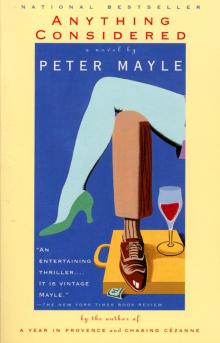
Anything considered, p.13
Anything Considered,
p.13


Penato, the Californian, turned to Bennett, shaking his head. “Now I’ve seen everything. Are all Brits like this with their dogs?”
Bennett had been watching Anna, who was graciously allowing Tuzzi to arrange a napkin on her lap. “What? Sorry—yes, dogs. They’re usually much better treated than our wives.”
With Anna’s napkin arranged to his satisfaction, Tuzzi tapped the side of his wineglass with a fork and looked around the table. “My dear friends, no business tonight. Tonight is gala, in honor of our most beautiful guest. After dinner, we have a movie in my little screening room, and the Ragazza is now on anchor for the night, so we can eat and sleep comfortably. Buon appetito!”
Bennett attempted to engage his neighbors, Polluce and Kasuga, in conversation, but had very limited success. The two men were drinking more water than wine, and seemed content to maintain a watchful silence. After the first course, Bennett gave up to concentrate on the loup de mer that had been placed in front of him, and to glance from time to time at Anna with increasing misgivings. She was flirting—flirting, in Bennett’s opinion, quite outrageously—with both Tuzzi and Lord Glebe, who were trying to outdo each other in their elaborate attentions.
“And now, my dear, a special treat.” Glebe bent over his fish while he performed some delicate surgery on its head with his knife and fork. “Ah, there we are.” He presented his fork to Anna. “Have a cheek. An excellent beast, the sea bass, and his cheeks are delicious.”
The men around the table fell silent and watched as Anna leaned over, pushing her shoulders up and forward to emphasize the already generous valley between her breasts. She opened her mouth, passed the tip of her tongue over her lips, and, with her wide eyes fixed on Lord Glebe, very slowly and deliberately sucked the tiny piece of white flesh from the fork. A performance, Bennett thought, that left absolutely nothing to the imagination. “Mmm,” Anna said, “that’s so good.”
The table let out a collective breath. Glebe beamed, and regained control of his trembling fork as Anna dabbed her lips with her napkin. Tuzzi, not to be outdone in the matter of fish cheeks, insisted on helping her excavate the head of her own fish. Bennett glared at her. She smiled back. From the other side of the table, Penato called across to Tuzzi.
“Hey, Enzo. Enough with the fish. What’s the movie tonight?”
“Momento.” Tuzzi completed the operation and patted Anna’s arm. “Tonight is coming Fellini.”
“Dear God,” said Lord Glebe. “Again?”
“My friend,” said Tuzzi, “Fellini was the maestro. You have sour gripes because he wasn’t English.”
Anna put down her knife and fork, and batted her eyelashes at Tuzzi. “I adore Fellini. I think he’s my favorite.”
Bennett was finding it difficult to watch Anna, but impossible not to. Tuzzi was mentally turning down the sheets every time he looked at her. The evening was going to end in tears, he was convinced of it, unless he could talk some sense into her during the movie.
But when dinner ended, and they moved with their brandy and cigars into the screening room, Tuzzi again insisted on supervising the seating arrangements, reserving two armchairs at the back for himself and Anna. The lights dimmed, the opening titles of Amarcord appeared on the screen, and Bennett sank into a deep sulk, which lasted throughout the film. Next to him, Lord Glebe fell asleep with Genghis at his feet, their snores providing a profundo accompaniment to the sound track.
As the lights came up, Bennett nudged his neighbor awake. “What? What? Oh, it’s finished. Thank the Lord for that. I can’t take him after dinner. Best on an empty stomach, Fellini.”
Bennett stood, stretched, and turned. It was as he had unwillingly forced himself to expect. The two chairs at the back were unoccupied.
11
“DEAR ME,” said Lord Glebe when he noticed the two empty seats. “We seem to have lost our host.” He looked around the screening room with an air of mild irritation. “Ah well. I suppose I’d better do the honors. If you gentlemen feel like a nightcap, help yourselves at the bar on the afterdeck. Or I’m sure young Piero will make you a cup of cocoa if you ask him nicely.” He stooped to pick up Genghis’s plate. “I’m off to the land of Nod. Busy day tomorrow.”
Bennett went below. Without any real hope of an answer, he stopped to knock at Anna’s door, listened to silence for a moment or two. He let himself in and sat scowling on her bed, feeling a sour, confused mixture of disappointment and jealousy. It wasn’t a night for sleep. Restless and angry, he returned to the deserted main deck.
The boat was completely silent now, at anchor, steady under his feet except for the gentle rise and fall of a lazy swell. The floodlit surface of the swimming pool barely moved, a slight tilt one way, a slight tilt the other. The air was soft and salty, warm and still; the stars were sharp. Bennett swore under his breath and stared at the shore. He could see a small port in the distance, the shallow curve of the harbor defined by lights, a mass of hills, blacker than the blackness of the sky, rising behind the huddle of houses. A beautiful, miserable night.
A whisper of sound, no louder than a scuff against the deck, made him turn his head. Something was there, in one of the deep pools of shadow between the bulkhead lights. Probably Glebe’s dog, making his evening rounds. Curious, Bennett walked toward it, then froze in shock as a figure stepped into the light.
Anna was naked except for a brief triangle of white at her hips, the aluminum attaché case clutched to her chest. Her eyes bright with relief, she jerked her head toward the stern and led the startled Bennett in silence along the length of the boat until they reached the gangway that led down into the sea. Anna put her mouth to Bennett’s ear. “You go first. You’ll have to swim on your back and pull me. I’ll hold the case out of the water.”
“What happened? Are you OK?”
“Jesus, Bennett. Get going.”
He eased himself into the sea, blazer billowing and Old Etonian tie floating bravely in front of him, and took hold of Anna under her upraised arms. With the case held clear of the surface, they kicked away from the boat and began to swim backward to the shore.
After ten laborious minutes they rested, treading water. There was no sign of life on the Ragazza, no alarm bells, no hurrying figures on deck.
“What happened? Where’s Tuzzi?”
“He’s out of it, but I don’t know for how long. Come on. Let’s go.”
They continued trying to kick in unison, slow and awkward, Bennett’s sodden clothes weighing more and more heavily, Anna’s arms aching with the effort of holding up the case, their eyes constantly on the Ragazza. A long and exhausting hour passed.
At last, Bennett’s shoulder bumped against the sharp prow of a moored sailing boat. He turned his head and saw the welcome closeness of the harbor lights. Five minutes later, they were standing chest-deep in viscous, oily water. Another fifty yards, and they were crouched on the stone steps leading from the beach up to the quay, the light spilling down across Anna’s shoulders and a bosom that was still heaving from the effort of the swim.
“Bennett, cut it out.”
“What?”
“You’re leering. Let me have your shirt.”
Bennett stripped off his blazer and gave Anna his shirt, doing his best to ignore the way the sodden fabric clung to her body. He was starting to feel light-headed with fatigue. But they’d done it. They’d escaped. Poe’s men were bound to be somewhere in the port, keeping an eye on the boat. Find them, give them the case, and then home for a hot bath. He touched Anna’s cheek. “Well done, Sergeant. The medal’s in the post. Let’s go and find Poe’s men, and get rid of that damned case.”
Anna shook her head. “We need to talk about it, but not here. Not now. This is the first place Tuzzi will come looking. We’ve got to get out.” She looked over his shoulder toward the boat, her face intent. “Bennett. Please.”
Bennett struggled back into his waterlogged blazer. “Well, it’s a bloody long walk to anywhere from here.”
“We’ll steal a car.”
“Fine. Yes, of course. We’ll steal a car. Any particular color?”
“It’s only a couple of wires, and you can start the engine. I know how to do it.” The strain left her face as she grinned. “Trust me.”
Hearing the two most ominous words in the English language, Bennett sighed and looked cautiously over the top of the wall. At one end of the port was a small hotel and a row of shuttered shops. Next to them, three restaurants, side by side. More shops, some houses, and the road leading out of the village. But cars? Why weren’t there any cars? Bennett had a moment of panic, and then he recognized something familiar about the trio of restaurants. He’d been to one of them, years ago. He realized that this was Cassis, and in Cassis cars were forbidden on the quay. He remembered having to park above the village.
“I can’t see anyone,” Bennett said, “but we’d better not risk the street. Stay close to the wall.”
They made their way along the shingle to the far, unlit end of the harbor. Nothing moved. Nothing broke the silence except the occasional scratch and creak of rigging from the moored sailboats, and the sound of pebbles under their feet. Bennett hoisted himself over the wall and pulled Anna after him, and they followed the road out of the village.
——
In the cramped, hot room in the hotel at the end of the port, Gérard rubbed his eyes and looked at his watch. Thank God for that. His shift was over. He got up from the chair by the window and shook his partner awake. “It’s all yours until dawn. Have fun.” Gérard stretched out on the bed, sticky and uncomfortable in his ill-fitting police uniform. His partner lit a cigarette to discourage the mosquitoes and looked dutifully at the distant lights of the Ragazza, bracing himself to stay awake through four hours of boredom. Still, it was good money. The patron paid well.
——
Anna and Bennett walked slowly through the parking area, searching for a car without an alarm system, trying door handles, looking for an unlocked trunk, hoping not to have to smash a window. Bennett stopped by a dusty Peugeot 205 convertible and saw that it had no alarm stickers, no red light winking on the dashboard. He called softly across to Anna. “Could you start this?”
Anna came over to the car. “Sure. You get it open, I’ll get it going.”
Bennett went back to the entrance of the parking area, where two large garbage containers had been placed for the use of civic-minded motorists, and fished among the remnants of beach picnics until he found a beer bottle. It broke easily against the wall, and Bennett returned to the car with a jagged glass knife, which he used to hack a slit in the canvas top. He reached through it and unlocked the door. “You’re in.”
“You’re learning,” said Anna. She knelt, and began fumbling under the dashboard. The shirt had ridden up to her waist, and Bennett found himself mesmerized by the sight of wet, transparent cotton stretched over a bottom that dreams were made of. This isn’t the moment, he told himself. Concentrate on the job.
The little car coughed, the engine turned over. Bennett switched on the lights and checked the fuel gauge; half full. “We’re OK,” he said. “That’s plenty to get us to Monaco.”
“Bennett, think. Monaco’s bad news. They may be watching the apartment. They may be in the apartment. We need to talk.”
“We can talk on the way. They won’t be watching the apartment. They think we’re still on the boat.”
“No. Somewhere else. Not Monaco.”
“Anna, look at us. We’re filthy, we’re soaking wet, you’re dressed in a shirt and a pair of knickers, we’re in a stolen car, and it must be two in the morning. What do you want to do? Check into the Hôtel du Cap? Do we look like respectable tourists?”
“There must be somewhere we can go.”
“Oh God. All right.” Bennett slammed the car in gear and headed for the autoroute. “We’ll go to Saint-Martin.”
“Bennett?”
“Now what?”
“You’re mad at me, aren’t you?”
“Bloody furious. It’s done. We’ve got the case. You’ll get your money. Why complicate everything? What more do you want?”
“I’ll tell you when we get there.” Anna settled back in the passenger seat, the attaché case between her knees. “Shall I tell you what happened?”
“No.” He kept his eyes on the empty road, his foot hard on the accelerator. “Yes. Spare me the sordid details.”
“There weren’t any. We watched the movie for a few minutes, and then he said he had something he wanted to show me.”
“Let me guess.”
“It was the moon.…”
“What moon? There wasn’t a moon.…”
“OK, so it was the stars. Anyway, we left the screening room, checked out the stars, and then he asked if I’d like a glass of champagne somewhere comfortable.”
“I can’t imagine where that might have been. God, I’ve heard some pretty feeble lines in my time …”
“You think I haven’t? So, big surprise, he takes me to his cabin—champagne on ice, lights down low, music, the full routine—but I couldn’t see the case anywhere. I asked him about it, told him I wanted to see what all these high-powered business guys were so excited about. Ah, he said, it’s in my private safe. We can look at it later. Then he said: How about a little coke?”
“The perfect host. I hope you sneezed.”
“I never touch it. But he had a snootful, and made a grab at me, and we chased around the bed for a couple of minutes. Then he stopped, and he had a kind of sneaky look on his face, and he said, OK, I make a deal: I open the safe, you take off the skirt. I open the case, you take off the top.”
Bennett sighed. “And they say romance is dead. Then what? Don’t tell me. He wanted to take you home to meet his mother.”
“He opened the safe. He opened the case—I wanted to make sure the stuff was still in there—and then I gave him the West Bank handshake.” She was silent for a moment. “I kicked him in the balls and knocked him cold with one of the bedside lamps. Then I gagged him and tied him to the bed with lamp wire. And then I kind of lost it and came looking for you.”
Bennett slowed down at the entrance to the autoroute, felt in his pocket for some damp change. He said nothing, imagining the scene in Tuzzi’s cabin, more pleased than he cared to admit that it hadn’t ended in bed. But it hadn’t ended. Efforts at retribution would surely follow as soon as the Italian and his vital organs had recovered. “Well,” he said as the car pulled away, “that’s one place we won’t be invited back. How hard did you hit him?”
“Oh, you know. Hard.”
“Good.” They headed north to pick up the A7. Two hours, and they’d be in Saint-Martin.
Anna looked at the set of his face in the glow of the dashboard light. He’d forgotten to joke. He’d been jealous. That was nice, she thought, as she closed her eyes.
——
Tuzzi ached. His head, his testicles, and, most of all, his pride had been severely bruised. Once he’d regained consciousness, it had taken him a supremely painful half hour to tug one hand free of its binding, raise the alarm, and order a search of the Ragazza. Now, with his head bandaged and an ice pack melting between his legs, he was sitting with a pajama-clad Lord Glebe, the case found in Bennett’s cabin open on the table in front of them.
Glebe frowned and shook his head. “Should have known he was a wrong’un. Chap doesn’t put ‘Honorable’ on his business cards unless he’s a jumped-up tradesman.”
Tuzzi looked puzzled. “Is a title, no?”
“Of a sort. Basically, it means that you’re waiting for daddy to fall off the perch.”
“Eh?”
“Die, old boy. Then the title passes on.” Glebe shook his head again and studied the case. “Well,” he said, “it’s a ringer, but it’s a damned good one.”
“It has to be Poe.” Tuzzi began to cross his legs, winced, and changed his mind. “That stronzo. Only he could know. I will take out his heart. I will make him wish he never left the tomb of his mother.”
“Womb, old boy.” Glebe scratched his head. “Of course, the others wouldn’t know it’s not the real case. Eh?”
Tuzzi stared at him, the bandage around his head giving him the air of a damaged pirate. “Maybe not. Except the papers are different.”
“But you only know that because you’ve seen the real papers.”
“Sì.”
“Well, then,” said Glebe, “my view is that the auction should proceed as planned. Of course, it won’t take the buyer long to realize he’s been sold a pup. He’ll come back to us. We’ll be suitably shocked and horrified, put the blame on Poe, and join forces to go after him. Meanwhile, we’ll send the lads out to look for Bennett and the girl, and the cash from the sale will be on the money market, earning interest until we give it back. Every little helps. What?”
Tuzzi pursed his lips and rocked slowly back and forth. Then he smiled and nodded and, very gently, tapped his cheek just below his eye with an index finger. “Bene. You’re thinking like a Sicilian, my friend.”
“Really?” said Glebe. “Oh dear. I must have been away from England too long.”
——
Bennett ran his hand along the top of the stone lintel until his fingers found Georgette’s key. As he opened the front door and turned on the lights, he was aware of the familiar scent of lavender, furniture polish, and linseed oil. The small living room was, as usual, spotless.
Anna looked around and gave a low whistle. “Are you sure you’re not married?”
“Oh, I’m just a housewife at heart.” Bennett went to the kitchen, in search of coffee. “Actually, it’s Georgette. She’s what they call a treasure.” He poked his head around the kitchen door. “You’ll find the shower upstairs. I’ll see if I can dig out something for you to wear.”
While the coffee was brewing, Bennett turned out his pockets. He spread his sodden banknotes carefully across the bottom of a frying pan and put them on the hob to dry. His passport, he realized, was still on the boat. So was Anna’s. If they had any thoughts of leaving Europe, they’d better think again.