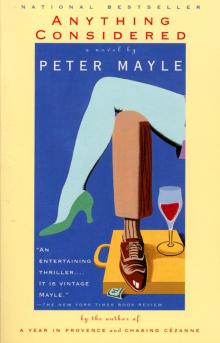
Anything considered, p.22
Anything Considered,
p.22


22
ANNA and Bennett followed Bonfils along a corridor lined with cells, unable to resist glancing through the bars at their neighbors of the previous night. Huddled bodies in varying degrees of dirt and disrepair snored and twitched on bunks, or sat disconsolately, heads in hands, contemplating the floor and the prospect of punishment. Sunday morning in the slammer—malodorous, squalid, despairing. The sweet sea air out on the street came like a rush of clean water to the head. It was six o’clock.
Three large unmarked Citroëns of that smoky-blue color preferred by the French police when traveling incognito were parked outside headquarters. Moreau, Anna, and Bennett joined the driver of the lead car. Bonfils checked the passengers in the other two vehicles—seven gendarmes, in their weekend plain clothes of jeans, blousons, and sunglasses, which, with their regulation short haircuts, gave them the appearance of a group of young soldiers on leave. They were in high spirits, delighted at the thought of a day off from the drudgery of the beat, doing undercover work on double pay. Bonfils, surly and nervous, got in the second car, and the convoy turned onto the Croisette and made for the autoroute.
Moreau, adrenaline high and pipe agurgle, sat in the front seat, making lavish and rather superfluous use of the car phone as he went over details that had been discussed at length the night before. He reminded the commanding officer of the air force base at Salon to have a helicopter on standby. He reminded the captain of the gendarmerie at Les Beaumettes to keep his men on their toes—“but discreetly, mon vieux, discreetly. We mustn’t frighten off the pigeons, eh?”—in case local reinforcements might be needed. He woke Léon at the Café Crillon in Saint-Martin, to remind him that a command center would be set up in the storage room behind the bar. And when he’d run out of legitimate targets, he called Bonfils in the second car, to nag him once again.
Yes, chief, the men are armed. Yes, chief, they know the drill. No, chief, there are no problems. Bonfils cradled his phone and stared gloomily at the car ahead. What a pig’s breakfast this was turning into. Suppose Polluce turned up? Surely he was too smart for that. But what if he wasn’t? What if his determination to get the case made him take the chance? He’d be arrested on suspicion and in a cell so fast his feet wouldn’t touch the ground. And that would be the end of a promising career for Captain Bonfils. He turned around and told the men in the back to shut up. Babbling away like a bunch of schoolgirls. Anyone would think this was a putain picnic.
The three cars, unhindered by the civilian restraints of speed limits, were keeping to a steady one hundred eighty kilometers an hour, racing the sun as it rose slowly behind them. Anna and Bennett were finding it difficult not to let their elation show. In a whispered conference before dawn, they had agreed to act as though normally apprehensive at being involved in a police operation. But it was hard. Every time they looked at each other, glances of delicious complicity, they had to fight the urge to smile. They locked hands, and forced themselves to turn away from each other and study the landscape.
The convoy passed the exit to Marignane airport and flashed through countryside that was becoming increasingly jagged and untamed, a severe contrast to the soft lushness of the palm trees and barbered grass they had left behind in Cannes. Moreau looked at his watch for the twentieth time, and then, nodding to himself in satisfaction, called the other two cars and ordered a brief stop at Cavaillon. Newspapers were to be bought and issued to the men. Camouflage, to give them a touch of Sunday-morning authenticity as they waited in Léon’s café to spring the trap. But not the same newspaper, comprenez? A selection. It wouldn’t do for everyone to be hiding behind France-Dimanche. How true it was, thought Moreau, that God was in the details. God and police work.
They made Cavaillon by eight. The men got out to stretch their legs, while Bonfils supervised the choice and purchase of newspapers. Requests for coffee were refused; Moreau was impatient to reach Saint-Martin and establish himself in his café headquarters. There would be coffee then, he told the men, coffee and fresh croissants. With a growing sense of excitement, Moreau directed the driver—who had no need of directions, having memorized the route already, according to his chief’s instructions—to take the D2 out of Cavaillon. They would be in Saint-Martin in fifteen minutes.
——
Enzo Tuzzi had gone to bed in his cabin with a problem and woken up with a solution. The $100,000 discount demanded by Polluce rankled. It was unreasonable and excessive. Just the thought of it at dinner had given Tuzzi indigestion and heartburn, most unusual for a man who took pride in the robust efficiency of his bodily functions. But by morning, the heartburn had disappeared and a simple scheme had presented itself. He would charge Polluce a delivery fee of $100,000, and if the miserable Corsican stronzo didn’t like it, Tuzzi would sell the formula elsewhere. Bravo, Enzo, bravo, he said to himself as he applied pomade to his hair before securing it carefully in a glistening tuft at the nape of his neck.
And now for the wardrobe, but nothing too conspicuous. He selected a loose-fitting checked shirt, which he wore outside a pair of dark-blue cotton trousers. From his bedside table—an unnecessary precaution, he was sure—he took the nickel-plated .38 in its chamois holster and clipped it to his waistband, under the shirt. A generous dab of cologne, a final flick to the mustache, one last admiring preen in front of the mirror, and he was ready. Glebe was right. This was a simple errand. Perhaps he would take young Benito to lunch afterward to celebrate. The boy tried hard, and had a useful uncle in the construction business in Naples.
He arrived on deck to find Lord Glebe, in his traveling outfit of dove-gray linen suit and slippers of embroidered velveteen, giving the steward detailed instructions about the care and feeding of Genghis during his master’s absence. Tuzzi took him aside to explain his $100,000 idea.
“It’s worth a try,” said Glebe. “But I think we should expect a little resistance from Polluce. He won’t be a happy man.”
“So?” Tuzzi dismissed the unhappiness of Polluce across the deck and into the Mediterranean with a flick of his hand. “We will have the case. He wants it, he pays for it. Or we go somewhere else.” Tuzzi grinned, and massaged Glebe’s shoulder in his enthusiasm.
Surveying the wrinkled damage to the linen of his suit, Glebe moved out of arm’s reach. “Well, as I said, it’s worth a try. Every little bit helps. But if I were you, old boy, I’d wait until you’re back on board before you make the call. Hotheaded lot, those Corsicans.”
“What is this hothead?”
Glebe sighed. It would be a relief to spend a few days in a country where people spoke English, or what passed for English nowadays. “It means excitable, old boy. Quick-tempered, fiery, that sort of thing.”
“Ah,” said Tuzzi. “Vulcanico.”
“The very word. Well, I must fly. Good luck—or maybe I should say buona fortuna.” Glebe walked aft, to the launch that waited to take him ashore.
Tuzzi called after him. “I count the days for your return, my friend.”
Dear God in heaven, Glebe thought to himself as he waved his cheroot in a languid farewell, he manages to make everything sound like a second-rate aria.
Tuzzi called for coffee, and Benito.
“Don Tuzz’, I am ready.” The burly young man stood in front of Tuzzi, his chest swelling with enthusiasm. Tuzzi flinched as he read the message that stretched across Benito’s T-shirt: Per favore, non mi rompere i coglioni. It brought back painful memories. Besides, the sentiment was inappropriate for Sunday morning, a churchgoing day. Please don’t break my balls. Tuzzi shook his head. Young people needed guidance. He sent Benito off to change, and sipped his coffee. Tomorrow he would make for Ibiza, and some well-earned rest and diversion with those young Spanish girls, plump as ripe figs.
——
Julian Poe stood on his terrace, admiring the morning light as it spilled over the peaks of the Grand Lubéron. He had been tempted to get to Saint-Martin early, but had finally decided against doing anything that might spook the messenger with the case. Amateurs scared easily. Bennett and the girl would certainly scare easily, he thought, once Shimo got his hands on them in that cold, bare room next to the cellar. Gérard—poor Gérard, stuck in a car for days on end—had been told to move in and pick them up at ten, and not to be too gentle about it.
All in all, it promised to be a most pleasant day—the formula recovered, the money returned, and the bonus of vengeance. Poe looked at his watch and saw that there was ample time for a civilized breakfast, an English breakfast. This morning, he was having the last of the Cumberland sausages from Harrods, and then he would call Chou-Chou in Paris to make arrangements for her return. Or maybe she’d like to meet him in London, for a few days at the Connaught. Yes, it was going to be a fine day. He turned back to the house and saw Shimo waiting like a statue inside the doorway.
“Morning, Shimo. In your Sunday best, I see.” For once, the Japanese had put aside his suit, and was dressed in baggy black cotton trousers and top, black shoes with thin crepe soles. His fighting clothes—the trousers loose enough for kicks, the crepe soles for grip. Poe didn’t anticipate trouble; Shimo always did. It was one of the reasons he’d lasted so long.
He inclined his head. “Good morning, Mr. Julian. Breakfast is ready.”
“Splendid.” Poe patted Shimo on the shoulder, feeling the hardness of highly trained muscle under the cotton. “I couldn’t tempt you into a sausage, could I? They’re very good.”
Shimo shook his head. “I ate at six. Rice and miso soup. Healthy food.”
Poe sensed faint disapproval, as he always did where his diet was concerned. Shimo would be happier if he made do on bean sprouts, but the smell coming from the kitchen dispelled any guilt. “You’re right,” Poe said. “I know you’re right. But I do love a good sausage.” He sat at the table, reveling in the feel of the linen napkin, the delicacy of the almost translucent Limoges china, the heft and balance of the antique silver cutlery, the wonderful, luxurious, orderly texture of his privileged existence. And they say crime doesn’t pay, he thought. Idiots.
——
Georgette had left her bed shortly after dawn, woken by anticipation and curiosity and unable to get back to sleep. She had dressed quickly and gone round to Bennett’s house, to make sure that no dead flies or errant motes of dust had fallen during the night to blemish the buffed perfection of tiles and glass and wood. She was determined that whoever was coming this morning—be it the president of the Republic himself—would find the Bennett residence immaculate, a credit to her and to the village. And so it was.
She returned home and took the case from its bed under the gravel. After one final fruitless attempt to unravel the mysteries of the combination lock, she scoured and polished the ribbed aluminum until it gave off the subdued gleam of old pewter. The case joined her for breakfast, sitting there on the table as she dipped a toasted slice of yesterday’s baguette into her café crème, watched the slow crawl of time around the face of the clock, and thought with pleasure of how she would impart the morning’s news to Papin and the others. She would drip it to them, detail by fascinating detail, saving the best—whatever that might be—for last. Finishing breakfast, she washed the dishes, and waited.
——
One by one, the early regulars were drifting into the Café Crillon. Anny and Léon, alert and expectant behind the bar, were trying to give the impression of business as usual, just another Sunday. But they failed to convince the oldest of the old men, the grandfather in chief, the old despot whom Léon called the chef des pépés. He was, after all, the self-appointed chairman of the table in the back.
And he sensed that something was up. He stopped just inside the threshold and looked around him with deep suspicion, an old hound picking up the scent of a hidden cat.
Ever since his doctor had told him to give up the after-dinner tots of marc, he had been an early riser, and deprivation of rough alcohol and the consequent insomnia had made him crusty. He stood, leaning on his stick, head thrust forward, the wattles on his neck tensed with the expectation of unpalatable news. “Eh, alors,” he said. “Eh, alors. What’s going on?”
Anny feigned innocence. “What do you mean, pépé?”
The old man shook his stick at the vase of flowers on the bar, the unusual neatness of the tables and chairs, each table decorated with a single bright nasturtium in a miniature brandy snifter.
“All this,” he said. “Flowers. Folderol.” He moved slowly to his table at the back, the ferrule of his stick a tapping counterpoint to the shuffle of his carpet slippers. “And the prices,” he said. “No doubt they have been augmented to pay for this friperie.” He put one hand to the approximate area of his liver, grunted, and eased himself into his chair.
“Not at all,” said Anny. “Flowers brighten the place up. Besides, it’s Sunday.”
“Bof,” said the old man. “Expecting the Almighty to drop in after Mass, are you?” He snorted. “Flowers. Soon it will be chandeliers, no doubt. Bring me a little rosé. Where are the dominoes?”
The hunt for the dominoes was cut short by the sound of cars pulling up outside the café. “It’s them!” Léon ducked around the bar and through the door.
“It’s who?” The old man banged his stick on the floor as he watched Anny follow Léon out of the café. “Dieu et Jésus, must one die of thirst?”
Léon directed the three cars to the yard behind the café, where the beer trucks from Mutzig and Kronenbourg made their deliveries. He embraced Bennett, shook hands deferentially with Moreau, and led the way through the back door into the storage room. “Voilà,” he said. “It’s not comfortable, but it’s private. And from here”—he pushed open the shutter of a tiny window—“you can see everyone who comes to the village.” He invited Moreau to inspect the view of the main street and the parking area. “You see, monsieur? It is as I told you on the phone. I hope you find it satisfactory?”
Moreau peered through the window, his lips making faint popping sounds around the stem of his pipe. He nodded. It was satisfactory. “Bonfils, get the men out of the cars. We’ll put four of them at the tables outside—not together, mind—and the rest inside, at the front.” He turned to Anna and Bennett. “You stay with me, in here.” He paused, his head cocked. “What’s that?”
The steady thump of the old man’s stick on the floor had become louder and more insistent. Léon opened the door that led to the bar. “J’arrive, j’arrive. Anny, see what our friends would like—pastaga, maybe a little Calva.” The thumping continued. Léon shook his head. “Merde! J’arrive!”
The pépé, all thoughts of dominoes forgotten, glared at the sudden influx of young men with newspapers, who were seating themselves in the front of the café. Strangers, every one of them. He grunted as Léon placed a tumbler of rosé in front of him. “Crowds,” he said. “One cannot even have a quiet drink on a Sunday. Who are they?”
“Tourists,” said Léon. “Just tourists.”
“Foreigners.”
Saint-Martin’s watch committee of elderly ladies, now settled on chairs in front of their houses around the place to keep an eye on the comings and goings of the morning, were finding the clientele of the café unusually absorbing. All these clean young men, and so early. And why was it that each time a car pulled into the village, their newspapers dropped in unison? It was not normal. It was not at all normal.
Anna and Bennett stood at their post by the window in the storage room, drinking coffee and trying to ignore the agitated splutter of Moreau’s pipe and the glowering presence of Bonfils. Moreau was seated on a beer keg, two wine cartons serving as a makeshift desk, his notes and his tobacco pouch arranged in front of him, his eye returning constantly to his watch, his hand hovering over his cellular phone until he could restrain himself no longer. He put through a call to Chevalier.
After a brief but evidently successful conversation—excitement mounting with every “Ah bon?” until his voice approached falsetto—he came over to the window to share his good humor with Anna and Bennett. “Paris is pleased with the progress of this affair,” he said. “Extremely pleased. The highest level is taking a close personal interest. He will be at his desk to hear our news. An amusing connection, don’t you think? The back room of a country café, and the Elysée Palace.” He looked at his watch and hummed softly to himself. Any minute now.
——
Georgette’s head emerged from her front door with infinite caution, her eyes checking the windows of her neighbors’ houses. All was still, the lace curtains hanging motionless. In fact, most of her neighbors, drawn by the magnet of speculation coming from the ladies around the place, had discovered a pressing need to visit the café, where Anny and Léon were having their busiest Sunday morning in years.
Satisfied that her journey would pass unnoticed, Georgette pulled her cap down over her eyes, picked up the plastic shopping bag containing the case, and scuttled around the corner to the Allée des Lices. She let herself in and put the case on the table as Bennett had told her, taking care not to scratch the waxy mirror shine of the wood. She made sure the front door was unlocked. She ran her hands over the couch, smoothing away nonexistent wrinkles, and went into the kitchen. There she waited.
——
The dark-green Range Rover swung into the village and parked by the side of the monument to the dead of the First World War. Outside the café, the newspapers were lowered to half-mast. Around the place, the elderly ladies paused in their muttered conversations to inspect the passengers. The church clock began to wheeze and whir and count the strokes to ten.
Bennett watched the car doors open, saw Shimo get out, then Poe, and nodded to Moreau, standing just behind him. “That’s Poe.” Anna looked at her former lover, elegant in beige and black, and reached for Bennett’s hand. He smiled at her. “Punctual bastard, isn’t he?”
Moreau kept his eyes on Poe. “Bonfils? We give him five minutes, and then we pick him up. I want him with the case in his hands, d’accord?”