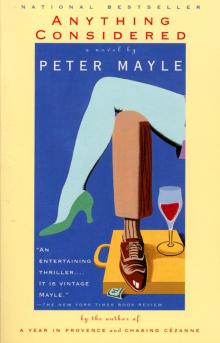
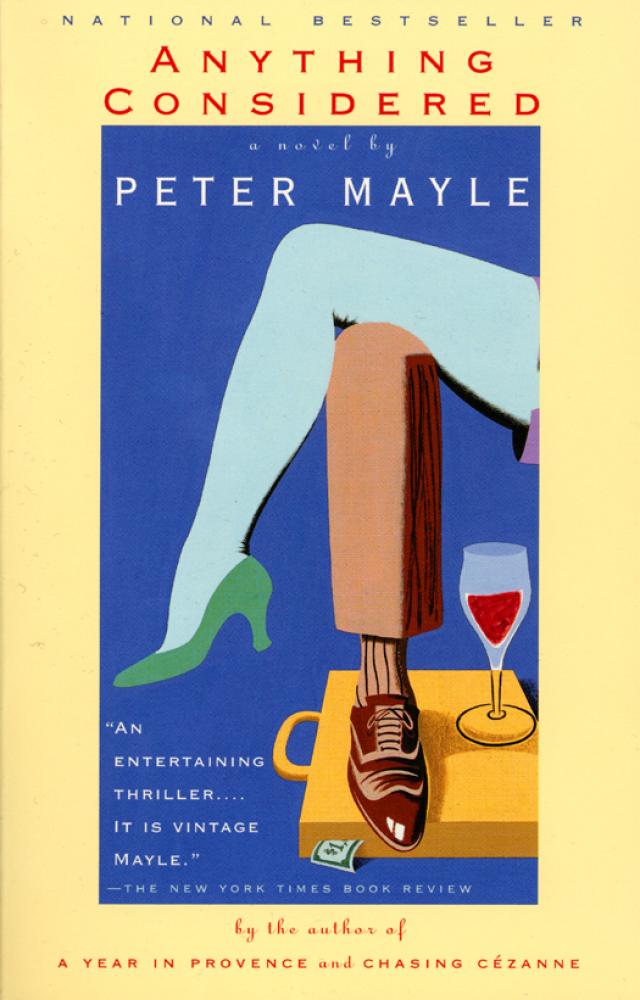
Anything considered, p.2
Anything Considered,
p.2


He walked down the main street to the bakery, with its gleaming iron-and-brass bread racks, which antique dealers were always trying to buy. He knew they wouldn’t succeed as long as Barbier was the baker—a proper baker, possessed of a baker’s stoop, a permanent flour pallor, and a stubborn attachment to the old ways of doing things. The thought pleased Bennett, and he stopped to take in the smell of fresh loaves and almond cakes.
“Jeune homme!”
Madame Joux beckoned to him from the open door of the épicerie next door. He obeyed the insistent finger, preparing himself for the worst. His account, a dispensation that he had been able to establish only after Georgette had bullied Madame Joux into accepting such a modern notion, was overdue. Credit facilities, always regarded with distrust in any self-respecting French village, were about to be withdrawn. He could sense it coming.
He took the sturdy hand of Madame Joux and bent over it politely, inhaling the aromatic traces of Roquefort and smoked sausage that clung to her fingers. “Madame,” he said. “As always, you add to the beauty of the morning.” He was encouraged to see the beginnings of a simper cross her face, and decided it was safe to broach the subject of his account. “I am desolated. I’ve run out of checks. You have no idea how inefficient these banks are nowadays. I myself …”
Madame Joux stopped him with a playful backhand to the chest. “A detail,” she said. “I trust you like a son. Écoute—my little Solange is coming this weekend from Avignon. You must join us for dinner en famille.”
Bennett’s smile slipped fractionally. Madame Joux had been trying to engineer a romance between him and little Solange for several months. He had nothing against the girl—she was quite sweet, in fact, and there had been a moment at the village fete last summer when he had almost been carried away during a paso doble under the trees—but the thought of being an appendage to the Joux dynasty had saved him.
“Madame,” he said, “nothing would give me more pleasure. If it wasn’t for my old aunt …”
“What aunt is this?”
“The one in Menton, with the varicose veins. I must be at her side this weekend. There is talk of an operation.”
Madame Joux was a connoisseur of other people’s operations, ever hopeful that some fascinating complications might develop. She pursed her lips and nodded. Patting her on the shoulder, Bennett took his leave before Madame Joux could suggest that the fictitious aunt should be brought to Saint-Martin to convalesce. He’d have to lie low during the weekend, and be prepared for many questions of a surgical nature during the following week. As he continued down the street, he reflected on the complexities of village life, realizing how much he enjoyed them.
He ducked through the narrow door of the post office. Saint-Martin—or rather the mayor—had declined a delivery service as being elitist and unnecessary, so villagers were obliged to collect their mail from the mayor’s brother-in-law, Monsieur Papin, who took a close interest in all incoming communications; he was widely believed to steam open letters that looked in any way personal. He greeted Bennett with small clucking sounds and shook his head.
“No love letters today, monsieur. No billets-doux. Just two bills.” He slid the drab envelopes across the stained plastic counter. “Oh, and your newspaper.”
Bennett slipped the bills into his pocket, nodded to Papin, and took his International Herald Tribune next door to the Café Crillon, center of Saint-Martin’s social life, headquarters of the village boules club, and the setting, every day at noon, for a fifty-franc lunch. The room was long and dark, with a pockmarked zinc bar to one side, tables and chairs scattered at random across the bare tiled floor, and a video-game machine, which had lost an argument with an overenthusiastic player two years earlier and had been out of order ever since.
What ambiance there was came from Anne-Marie and Léon, the young couple who had exchanged office life in Lyon for, as Anne-Marie put it, a career in hospitality. They were regarded in the village with some suspicion, being considered foreign and unnaturally cheerful, and it would be twenty years or so before they were accepted. Bennett, another foreigner who hadn’t learned enough about life to lose his optimism, found them a delightful change from the monosyllabic peasants who played cards each day in the back while they waited for the crack of doom to sound.
Léon looked up from the copy of Le Provençal that was spread over the bar. “Bonjour, chef. Du champagne?” He shook Bennett’s hand and raised his eyebrows. “Bière? Pastaga?” Léon’s idea of a good client was one who started drinking shortly after breakfast, and it was with an air of disappointment that he took Bennett’s order for a coffee. “With a little something, perhaps? I have some homemade Calva.”
Bennett shook his head. “Maybe after lunch. What’s Anny cooking today?”
Léon’s rosy moon face beamed, and he kissed the tips of his stubby fingers. “A triumph—lentils, bacon, and Lyonnais sausage. Too good for fifty francs.” He shrugged. “But what can you do? Here, they expect a banquet for nothing.”
“It’s a hard life, Léon.”
“Bien sûr. And then you die.” He grinned and poured himself a beer, as Bennett took his coffee to a table by the window, where he unfolded his paper.
The Herald Tribune was Bennett’s small daily indulgence. He liked its manageable size, the balance of its editorial content, and its restrained treatment of the recurring political indiscretions that turned newspapers on the other side of the Channel into shrill scandal sheets. He had given up reading the British press once he realized that he no longer recognized the names of the people being pilloried in its pages.
Sipping his coffee, he reviewed the state of the world as shown on the front page. Unrest in Russia. Bickering in the European Community. Squabbling in the U.S. Senate. The death of a venerable Hollywood actor. Not one of the Tribune’s jollier days, he thought, and stared through the window at the little village square, where miniature French flags snapped in the breeze above the war memorial. The sun was higher now, the sky a deeper blue, the mountains gray-green and hazy in the distance. He would hate to leave this place for the grind of an office in a morose northern city.
But the question nagged away at him: How could he afford to stay? He started to make notes on the back of an envelope. Current assets: excellent health, colloquial French picked up during his years in Paris, no family ties, a small wardrobe of old but good clothes, a Carrier watch that had so far avoided the pawnshop, a secondhand Peugeot, and approximately twenty thousand francs in cash, the residue of a split commission from a house sale. Current liabilities: domestic bills, Georgette’s wages, and a dispiriting absence of brilliant moneymaking ideas. He had enough to get by on for another two or three months, providing he was frugal. But economy had never been one of his vices, and ten years of expense account life in the production business hadn’t helped.
Sod it. He’d think of something. He always had before. He pushed the envelope away and went over to the bar.
“Léon? I’d like a glass of champagne. But a good one. Not that vinegar you were selling on New Year’s Eve.” He slid a hundred-franc note across the zinc.
Léon’s amiable expression didn’t change. “It was cheap.”
“My friend, it was terrible.”
“Of course for ten francs a glass it was terrible.” Léon held up a finger. “I will find you a treasure.” He went through a door behind the bar, and reappeared cradling a bottle with exaggerated care, which he held out for Bennett’s approval. “Voilà. The 1988 of Perrier-Jouet.” He set the bottle down and undressed the neck. “Are you celebrating?”
Bennett watched him twist the cork until it came out with a muffled sigh, and he savored the familiar flicker of hopeful well-being that champagne always gave him. “I’m about to have a good idea.”
Léon, nodding, filled the tall, narrow glass. Bennett listened to the delicate hiss of the wine, bent his head to inhale its toasty bouquet. The old peasants in the back turned to look at this new example of foreign extravagance, shook their heads in disapproval, and returned to their cards and the tumblers of rosé they would nurse throughout the morning.
Bennett felt the cool rush of bubbles on his tongue, then turned to the section of his newspaper marked “International Classified,” where tax havens and business opportunities were advertised next to services of a more personal nature. On the left side of the page, a worldwide exclusive marriage agency offered—“for responsible people”—introductions to elite industrialists with alpha personalities. Over on the right of the page, just in case things didn’t work out, was a number to call if you wanted a fast divorce for $495. As he looked through the selection of tax-free cars, apartments of grand luxe in Paris, and escort agencies everywhere from Mayfair to Wiesbaden, Bennett did indeed have an idea.
Why wait for something to happen, hoping that fate would be kind to him? He would take the initiative and make his own luck. He would advertise himself.
After a little rewriting and editing, and a second inspirational glass of champagne, he sat back and reviewed his efforts:
UNATTACHED ENGLISHMAN
Mid thirties, personable, fluent French, seeks interesting and unusual work, preferably in the Aix/Avignon area. Anything considered except marriage.
In the afternoon, he would call the Herald Tribune and place the ad. The season was about to start. There were bound to be dozens of replies. His blood quickened with a sense of impending adventure, and his appetite bloomed. Bennett turned his attention to Anne-Marie’s cooking.
2
“THESE won’t do for another summer,” said Georgette, holding up Bennett’s last remaining pair of white cotton trousers. “They are exhausted. Fini.”
“They look fine to me, Georgette. Worn in. I like old clothes.”
“Non. They have suffered. These I have scrubbed too many times. Wine, soup, sauce—every time you eat, you make a catastrophe. Don’t the English ever use napkins?” She shook her head, tossing the retired trousers onto a pile of shirts and shorts that had failed to meet her sartorial standards. Later, they would be taken to the mission of the Pénitents Blancs for distribution to the poor.
“Georgette, it is impossible to eat écrevisses with your clothes on without some trivial accident. Unfortunately, even in France, one is not permitted to dine naked.”
Georgette shuddered. “Quelle horreur. Imagine Papin. Or Madame Joux.”
“There’s no need to bring personalities into it, Georgette.”
“D’accord. The trousers go.”
Bennett sighed. It was true that he was prone to the occasional mishap at the table. It was also true that the white trousers seldom survived a meal unsoiled; indeed, in the enthusiasm of the moment, they very often didn’t make it through the first course. But in his current circumstances, more clothes were out of the question. He made a last plea for the trousers. They had a sentimental value, having been bought for him in Saint-Tropez by one of the girlfriends he still remembered fondly. Surely they could survive for one final summer.
Georgette leaned toward him and poked his chest repeatedly with an iron finger. “Non, non, et non. Would you walk around in rags and disgrace me in front of the village? Eh?”
Bennett had endured one of Georgette’s sulks before, over the matter of the ancient tweed jacket that he had insisted on keeping against her wishes. She had punished him with a week of silence and had deliberately overstarched his underwear. He wasn’t prepared to repeat the experience.
“Very well, Georgette. I shall have my chauffeur drive me up to Paris next week and buy a complete summer wardrobe. From Charvet.”
“No doubt,” she said. “And I shall win the Tour de France.” Scooping up the pile from the floor, she disappeared, cackling in triumph, to the kitchen.
Bennett looked at his watch and saw that it was eleven o’clock. The post should have arrived by now, and replies were due. His advertisement had run more than two weeks ago, and he had spent the period since then mostly with a client from Zurich, who had finally decided that his idea of rural bliss was not Provence but an apartment in Geneva. As Georgette cranked the radio up to working level in the kitchen, Bennett let himself out and made his way down the street toward what he hoped would be a sackful of replies and a glittering future.
Monsieur Papin peered at him through the window of the guichet, nodded good morning, and retrieved a newspaper and a large brown envelope from a cubbyhole behind him. He surrendered the newspaper, weighed the envelope in his hand. “An important packet,” he said, “from Paris.”
“Ah bon,” said Bennett.
“Seven francs fifty to pay, for insufficient postage. Or if you wish, I can send it back.”
This was known in the village as Papin’s pourboire, the little extra he added on when he thought the market would bear it. Three francs here, five francs there—it came to enough to buy himself a few good bottles at Christmas. Bennett handed over the seven francs fifty and asked for a receipt. Papin, scowling, said he would eventually prepare one. The two men parted in an atmosphere of chilly politeness. Bennett rarely disliked anyone, but for Papin he could make an exception.
The café was quiet, the only sounds coming from the wheeze of the refrigerator and the slap of cards from the table in the back. The old men turned their heads in unison as Bennett came in. He nodded. The heads turned back. Bennett took his glass of rosé and settled at a window table. The envelope felt bulky and promising, and before opening it and tipping out the contents, he offered up a silent toast to the patron saint of impoverished Englishmen.
An invitation to invest a quarter of a million francs in Pizza Sympa, the fastest-growing chain on the Côte d’Azur, was the first to be put to one side as a nonstarter. It was followed by a letter, written in lavender ink, from a man in Neuilly in search of a younger companion to share nature pursuits. An escort agency in Cannes promised substantial remuneration for gentlemen of taste and breeding, and requested a nude photograph for their files. Bennett thought of giving this to Papin.
Here was a job he could at least do with his clothes on. A Saudi prince needed a chauffeur-interpreter for the summer—based on Cap Ferrat, choice of three Mercedes, free lodging, uniform allowance, references essential. That might do, Bennett thought, if only he could manage the references. Georgette? Léon? His septic tank clients? He still had a small supply of crested House of Lords writing paper, left behind by an earl who had rented one of the houses last summer. He could use that and write his own reference. The princely letter went to start a pile of possibles.
But the pile failed to grow, as Bennett sifted through the next batch of replies. He decided against becoming a Jehovah’s Witness, a tour guide, a part-time instructor at a language school, or a tout for a pleasure boat operator in Antibes, memories of the boat business still being too fresh and painful. Finally, a single envelope—the envelope Bennett had saved until last—remained.
Of that rich, self-confident true blue favored by the English establishment, it made Bennett think of Smythson’s in Bond Street, where pinstriped men gather to brood over such arcane but vital details as blind embossing and deckled edges. He opened the envelope carefully and saw that it was lined with darker-blue tissue, a shade that matched precisely the brief printed heading at the top of the letter.
DOMAINE DES ROCHERS
I write in response to your advertisement. It is possible that we might find an area of mutual interest. If you would like to discuss it, please telephone me at 90.90.00.77.
Julian Poe
Bennett studied the bold, angular handwriting in deep-black ink. He held the paper up to the light and saw the edge of a watermark. Everything about the letter suggested taste and affluence, and Bennett was out of his chair and halfway to the bar to use the café phone when he realized that it was almost noon. Did people like Julian Poe sit down for lunch at twelve on the dot? Disturbing him at the table would be a bad start. Bennett dithered for a moment, then decided to take a chance.
The voice at the other end of the phone was French, reserved and impersonal, a servant’s voice. Bennett asked for Monsieur Poe.
“De la part de qui?”
“Bennett. No, wait a minute. Say it’s Box Eighty-four, from the Herald Tribune.”
The line clicked to hold, and Bennett signaled Léon for another glass of wine. He felt unreasonably hopeful, sure that this would lead to something. Such is the effect that opulent writing paper can have on a man who has just lost his last pair of white trousers.
The line clicked again.
“This is all very clandestine. Shall I call you Box Eighty-four, or do you have a name?” The voice matched the writing paper—smooth and rich and assured. A toff’s voice. With the instinctive English habit of classifying people by their accents, Bennett placed Poe at the top end of the social order. Probably an Old Etonian, like that little turd Brynford-Smith.
“Yes. Sorry. It’s Bennett.”
“Well, Mr. Bennett, we should meet. I take it you’re not too far from Bonnieux?”
“Saint-Martin-le-Vieux, actually. About half an hour away.”
“Splendid. Why don’t you come over this evening, about six. If we don’t instantly loathe each other, we can dine together.”
Bennett took down the directions to Poe’s house, treated himself to lunch, and went back over the brief conversation. Poe had sounded pleasant and relaxed, and from what he had described of his property, it seemed as though he owned the major part of a mountain above Bonnieux. Bennett wondered what the job was, and what would be appropriate dress for the interview.
He stood in front of the mirror in his bedroom, trying to gauge the effect he would have on a prospective employer. He was an inch under six feet, and lean, as bachelors with irregular eating habits often are. His face was long and tight-skinned, with sun wrinkles around the blue eyes and well-defined lines on either side of his mouth. His hair, straight and dark brown, was a little long, but it shone, Georgette having long ago convinced him of the benefits of Savon de Marseille on the scalp.