The good the bad and the.., p.1
The Good, the Bad, & the Cute,
p.1


The Good, the Bad, & the Cute
The Secret Ways of Dolls
Editors Ronald Linson and Deidre J Owen
Smashwords Edition
Copyright 2021
Published by Mannison Press, LLC at Smashwords
This ebook is licensed for your personal enjoyment only. This ebook may not be re-sold or given away to other people. If you would like to share this book with another person, please purchase an additional copy for each recipient. If you're reading this book and did not purchase it, or it was not purchased for your use only, then please return to your favorite ebook retailer and purchase your own copy. Thank you for respecting the hard work of the author.
CONTENT WARNING:
Some stories contain depictions of violence and disturbing allusions to the deaths of young persons. Discretion is advised.
When I was ten, I read fairy tales in secret and would have been ashamed if I had been found doing so. Now that I am fifty, I read them openly. When I became a man I put away childish things, including the fear of childishness and the desire to be very grown up.
~C. S. Lewis, Of Other Worlds
Contents
Introduction
1. Rattenfänger
About Rhiannon Lotze
2. Foundlings
About Gary G. Power
3. Ollie
About Tim Mendees
4. Octo
About Piers Anthony
5. A Weary Mother's Nightmare
About Deidre J Owen
6. Baby
About Benjamin Michael Greene
7. The Deal
About Connor Kuntz
8. The Untethered
About K. B. Bailey
9. The Daily Isabelle
About Ronald Linson
10. A Rattle Tale
About Gary Clifton
11. Inside an Empty Room
About Rachel Nussbaum
12. Childish Things
About Matthew Brady
Introduction
Deidre J Owen
About nine years ago (in 2012) I had a disturbing experience when my toddler left a small plush dolly outside on the porch. It was late in the evening when I discovered this innocuous little thing sprawled out in the gathering darkness, and she sent me spinning down a rabbit hole of horror.
Recently, I shared this story in detail with my business partner, and I found it fascinating that the experience—however silly it may have seemed—had left me scarred, as a mother. I hadn't thought of it in years, but the memory had been triggered by a business discussion about potential project ideas...one of which was an anthology about dolls.
Our first story! Well, maybe. Or maybe not. My story was a simple one and could only be fleshed out so far; it wouldn't have the legs to stand as a short story for such an anthology.
But! What if...
What if we made it a flash fiction anthology? Yes, in our Minibook format!
With that, the ideas began to flow freely and a new breed of anthology was born in our little publishing house. You see, financing another large-scale project like our Youth Disrupted anthologies is still a bit out of our depth, but a Mannison Minibook anthology was well within reach.
After much discussion, we decided to make this inaugural Minibook anthology an invitational. We reviewed our ever-growing list of authors and created a shortlist of some folks who we thought might fit the bill. And the list was long! Yikes! Whittling the list was a difficult task, but due to the constraints of the Minibooks format we found ourselves limited to only a handful of writers. We were pleased when our invitations were met with enthusiasm, and soon a wonderful variety of stories filled our in-box.
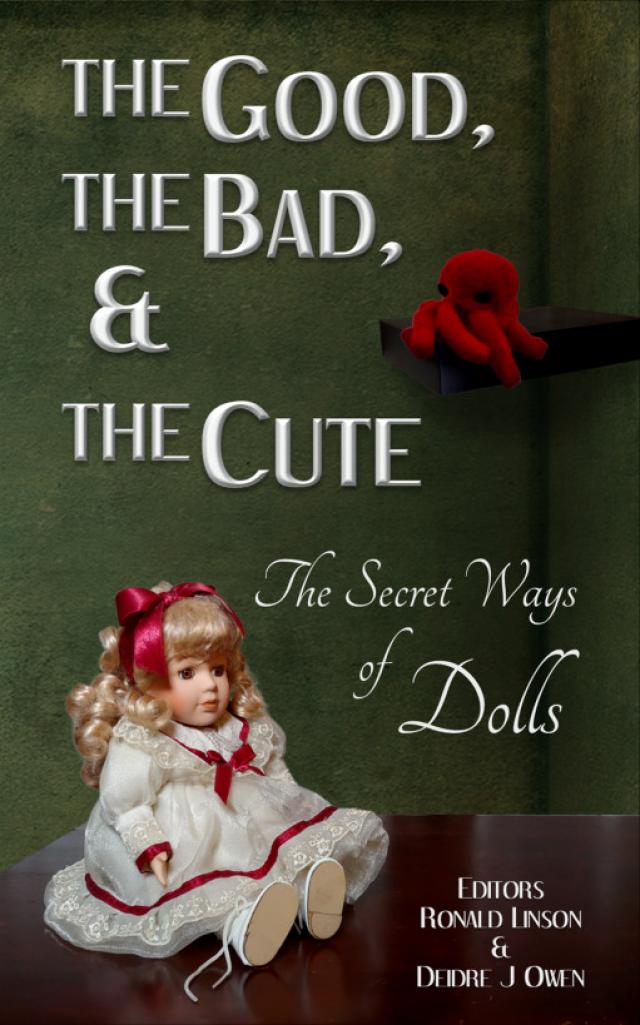
As for the cover, if you're curious, that is the real Jacqueline doll straight from my daughter's shelf. As lovely as this antique is, I've always found her to be rather unsettling. She has a wind-up music box inside her soft body, and occasionally—every now and then—the tension will slip just enough that a single tone will escape. Chills rip through my body just thinking about it.
And the malevolent cephalopod? Courtesy of one Tim Mendees, from an ocean away. Gratitude, friend!
Now, without further preamble (or pre-ramble, in my case) we are pleased to present to you: The Good, the Bad, and the Cute: The Secret Ways of Dolls.
Deidre J Owen
Lithia, Florida
June 2021
1. Rattenfänger
Rhiannon Lotze
1284 ad
Proud stalks of golden wheat undulated in the field. Children flooded the grain sea, laughter trailing behind them as they weaved in and out of the neatly planted rows.
Dragons swooped through the sky, conjured from imagination, and dive-bombed the army of tiny warriors who wielded sticks with all the panache of brave knights wielding swords. The dragons looked eerily similar to crows but, if asked, every child without fail would tell a tale of scaly behemoths spewing fire from their snouts.
Monsters plagued not just the skies, though.
On the ground, packs of vicious werewolves attacked on all fronts, leaping from the wheat to seize the bold warriors between razor-sharp teeth. The army valiantly fought them off with bows and arrows which looked suspiciously like slingshots fed with pebbles. Even the werewolves bore an uncanny resemblance to rats but, if asked, every child without fail would tell a tale of snarling beasts armed with ten-inch claws.
As the sun dipped towards the horizon, a new danger encroached.
Although the children protected their fortress of wheat ferociously, some enemies could not be overcome. A conquering army of stern-faced parents approached, warning that supper was almost ready and tardiness would be punished with an empty belly.
Knowing they were beat, the gallant warriors laid down their arms and surrendered, but with the promise to take up the fight another day.
A short time later, the crows and rats had only each other for company.
1304 ad
Bruise-like clouds gathered during the night while the town slumbered. Just before dawn, the sky split open and great sheets of water poured down, turning the streets to muck. The garlands festooning every house drooped soggily.
Bleary-eyed and bundled thickly in woolen layers, the townspeople emerged tentatively from their homes, eying the fat droplets with distaste. A celebration had been planned, but the rain made the comforting call of cozy fireplaces all the more alluring.
Nonetheless, a few daring souls stepped over their thresholds and into the wet streets. The rain slowed to a gentle mist and others joined in, until the streets were crowded.
Despite the throng, the only sounds to be heard were those of the squelching mud and the whistling wind.
The eyes of the townspeople couldn't help but notice three homes with black Xs freshly marked on their doors, indicating houses in mourning.
Not a single family was untouched by the grief that now hung heavily over those three houses, a fact belied by what every townsperson carried. Small, stuffed toys in the shape of rats were clutched in hands, tucked in pockets, and nestled in rucksacks, a reminder of what they had lost.
The gathering space was on the edge of town, in the open air. Tables and chairs placed the night before were sodden. Water greyed the cotton cloths on the tables, the plates and mugs set out overflowed, and the festive centerpieces were wind-disheveled.
Nevertheless, the townspeople dutifully took their places, sitting on wooden chairs that immediately soaked them through.
All eyes stared out at a field beyond the gathering space, without actually seeing it.
Once, that field was bountiful with golden wheat. Children ran among the stalks, playing make-believe.
Now, the field was bald, without even stubble to remind the villagers that it once contained so much life.
A fence grown from thorny brambles hemmed the land in, and tall guard towers loomed over it, keeping constant watch over the field.
The townspeople erected the fence and the towers to protect, but their efforts were in vain.
There was nothing left to protect.
The children were gone.
A throat clearing at the head of the gathering called attention to a village elder. The celebration was beginning.
1284 ad
Whoops of delight pealed through the air, floating high above the stalks of wheat.
The werewolves were vanquished!
Upon making the daily pilgrimage to their haunting grounds, the children swiftly realized that not a werewolf—nor a rat—was to be found.
This delightful discovery soon transformed into disappointment.
The werewolves vastly outnumbered the dragons, and there weren't enough dragons for everyone to fight.
A conference was hastily gathered and a solution proposed. A great chest was spotted in town, simply sitting in the square. Wouldn't an adventure hunting for buried treasure be the next best thing to conquering werewolves?
The biggest and strongest of the adventurers stole sneakily into town and absconded with the chest, which weighed exceptionally more than expected. Upon returning to their wheat fortress, blindfolds darkened eyes and pilfered shovels made quick work of a hole on the edge of the field, near a narrow river. The treasure having been buried, the blindfolds came off and the hunt began!
Alas, by day's end, the treasure had not yet been revealed, but excitement for the next day's adventure thickened the air when calls for dinner began issuing through the stalks.
&nb
sp; However, before the adventurers could dust off their knees and stow their gear—telescopes of hollow reeds, tree bark maps, and woven grass hats—a lovely, lilting tune drifted through the field.
The ear of every child pricked up at the start of this wonderful music, so simple, yet so joyous that many of them wept. Compelled to find the source of the song, each adventurer dropped their belongings where they stood and marched as one to the edge of the field beyond town. The wheat closed tight behind them.
Not a single child returned home for dinner that night.
But, in each of their beds appeared a simple memento: a stuffed toy in the shape of a rat.
1304 ad
Although the village elders called the gathering a celebration, it felt like a funeral, a mourning. Even the vibrant garlands and colourful baubles decorating the town couldn't bring cheer to the bleakness in the villagers' eyes.
Today was the day they thanked their town, their homes, for the life they provided, then abandoned them forever.
Twenty years ago, rats infested the village like a curse. They ate the crops, the food stores. People were going hungry.
To get rid of the rats, they hired an exterminator. He demanded an exorbitant fee, but promised remarkable results. Every family surrendered all the valuables they had to the communal chest—generations worth of savings. What were precious trinkets compared to the food that sustained them?
But when it came time to pay the exterminator, the chest was gone, vanished.
He promised to exact revenge until he was given what was owed.
That very night, every single child in the village vanished. The only sign they had ever existed was the toy rats left in their beds.
The disappearances never stopped, because the townspeople had nothing left with which to pay. For the last twenty years, every new child of the village vanished as well. Sometimes it happened only a matter of months after the birth. Sometimes it took years. One child made it to the age of twelve before his parents' unrelenting vigil over him slipped. Just one slip, and he was gone.
Even when the villagers razed the wheat field to the ground and erected the guard towers to keep a lookout, their efforts came to naught.
The last three children disappeared that morning, the Xs on their parents' doorways a final pronouncement.
It was as if the curse left by the exterminator somehow knew the villagers were giving up, abandoning their homes in the hopes of starting over somewhere new, and struck one last time.
The day expired gloomily under a sky of heavy clouds. The villagers ate the food prepared for the celebration, listened to the fond remembrances of the elders, and paid their thanks to the land they had called home for generations.
None wanted to go. But none wanted to stay, either. The memories were too heavy, the dread heavier still. No fewer than ten women were pregnant, and the townspeople would not let their babies be born to a fate of disappearance.
When midday came, a group of men took up shovels and dug up the thorny brambles fencing in the field where they last saw their children.
A pathway cleared, the villagers formed two lines and advanced into the field, spacing themselves evenly apart. Nearly every pair of hands clutched one of the dolls left behind in place of their children.
Led by an elder, they all raised their faces to the drab sky and prayed together, asking forgiveness, compassion, and an end to their curse now that they were driven from their homes.
When the prayers ended, each person crouched in the muddy field, kissed the dolls in their hands, and laid them to rest on the earth, a final goodbye and a memorial to what they lost.
Then they pulled their sweaters tight, swung their rucksacks onto their shoulders, and grimly trudged out of town.
A crooked signpost marked the border. As they passed, each villager touched two fingers to the faded name painted onto the wood, a final goodbye to their town of Hamelin.
The rain kept up all day and all night, churning the razed field to muck and swelling the nearby river.
As the river rose, it ate away at the banks containing it, chewing up great swathes of dirt and sweeping them away.
A particularly grand swell eroded much of the shoreline, obliterating an enormous chunk of the land. As it did, the corner of a wooden chest peeked through the thick mud. Each ripple of the river revealed more and more of the chest until it was openly visible to anyone chancing by.
As luck would have it, a man dressed in a tattered collection of colourfully-patched clothes happened to spot the chest.
Although he hadn't been seen in twenty years, each of the villagers in Hamelin would have known him on the spot as the exterminator who took away their rats and their children.
Curling his fingers around his reed pipe, he approached the chest, recognizing it as the vessel for his long-overdue payment.
Looking around for the person who had finally deemed it time to pay him and seeing nothing but a field of stuffed rat toys, the exterminator shrugged. He placed one hand on the chest, snapped the fingers of the other, and vanished.
A bright flash ensconced the field and the toy rats vanished, too. In their place stood all the lost children of Hamelin, exactly as they were the day they were transformed into dolls.
Brilliant smiles bloomed on their faces when they realized they were finally home, restored to their real selves.
As one, they turned and ran for town, eager to embrace parents they were sure still waited for them.
About the Author
Rhiannon Lotze is a Canadian author from Windsor, Ontario, which means she's 97% maple syrup and 3% Timbit. She's been a writer (and huge nerd) since she was nine years old and writing her first Star Wars fanfiction, although she didn't know it was called "fanfiction" at the time. Rhiannon is also an avid reader and camper, and her favourite place to do both is on the shores of Lake Huron. Other Mannison Press publications by Rhiannon include the Minibooks Of Gods and Myth (2020) and Non-Prophet (2020), as well as "Barrens and Brine" from the anthology Little Girl Lost: Thirteen Tales of Youth Disrupted (2019). You can find out more about her work at www.rhiannonlotze.com.
Smashwords profile here: https://www.smashwords.com/profile/view/RhiannonLotze.
2. Foundlings
Gary G. Power
Thomas Ratliff, nineteenth century squire of Saytton Manor, employed vagrants to become valets, housemaids, and footmen. The heretical landowner kept a secret, though; he was an occultist and practitioner of spiritual dispossession. He took in thieves, beggars, and prostitutes and gave them shelter and employment. His nefarious plan was to create new life from old and preserve his own existence for eternity. Instead, he created psychotic replicates with a lust for flesh and blood.
And so twelve mannequins, grotesque caricatures of their ill-fated human counterparts, slumber in the tepid darkness of a secret oak-paneled room deep below the foundations of Saytton Manor. They are Foundlings. Like homeless children, they are abandoned and unwanted. It is their instinct to feast upon the vices and corruption of men. Their porcelain complexions are unblemished and their gazes fixed in vacant stares, but they see through earthly eyes, they taste with fleshy tongues, and they bite with human teeth. For 150 years they have remained dormant with their chimerical thoughts, festering in a pool of unnatural torpidity.
Until now.