Tarot, p.1
Tarot,
p.1
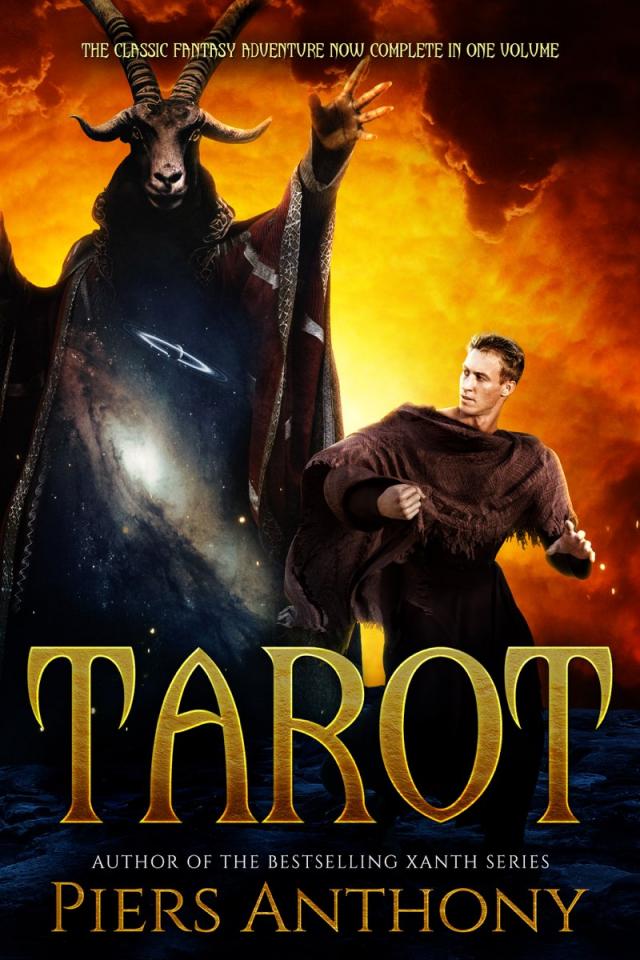


Tarot
PIERS ANTHONY
Xenophile Press
PO Box 255
Hannacroix, NY 12087
www.apocryphilepress.com
Jove/HBJ edition, 1979
Berkley edition, 1981
Xenophile Omnibus edition, 2023
Copyright © 1979, 1980 by Piers Anthony
All rights reserved.
ISBN 978-1-958061-58-9 | paper
ISBN 978-1-958061-59-6 | ePub
A HISTORY OF THE BIBLE, copyright © 1959 by Fred Gladstone Bratton. Published by Beacon Press. Used by permission of the publisher.
THE HISTORY OF THE DEVIL AND THE IDEA OF EVIL, copyright © 1974 by Paul Cams. Published by Crown Publishers. Used by permission of the publisher.
NO LAUGHING MATTER: RATIONALE OF THE DIRTY JOKE (Second Series), copyright © 1975 by G. Legman. Distributed by Breaking Point, Inc. Used by permission of the author.
The author wishes to thank J. W. Drought for the passage reproduced here from his novel, THE SECRET, published by Skylight Press, Norwalk, Connecticut, 1963.
This is a work of fiction. Names and characters are the products of the author’s imagination. No part of this book may be reproduced, stored in a retrieval system, or transmitted in any form or by any means electronic, mechanical, photocopy, recording, or otherwise without written permission of the author and publisher, except for brief quotations in printed reviews.
Contents
Introduction
Author’s Note
0 • Folly (Fool)
1 • Skill (Magician)
2 • Memory (High Priestess)
∞ • Unknown (Ghost)
3 • Action (Empress)
4 • Power (Emperor)
5 • Intuition (Hierophant)
6 • Choice (Lovers)
7 • Precession (Chariot)
8 • Emotion (Desire)
9 • Discipline (Strength)
10 • Nature (Family)
11 • Chance (Wheel of Fortune)
12 • Time (Sphinx)
13 • Reflection (Past)
14 • Will (Future)
15 • Honor (Justice)
16 • Sacrifice (Hanged Man)
17 • Change (Death)
18 • Vision (Imagination)
19 • Transfer (Temperance)
20 • Violence (Devil)
21 • Revelation (Lightning-Struck Tower)
22 • Hope/Fear (Star)
23 • Deception (Moon)
24 • Triumph (Sun)
25 • Reason (Thought)
26 • Decision (Judgment)
27 • Wisdom (Savant)
28 • Completion (Universe)
Appendix
About the Author
Dedicated to the Holy Order of Vision
Introduction
This volume has a horrendous history. This Introduction is akin to the Author’s Notes I run in some of my fantasy novels, and is not integral to the novel, so may be skipped by those who object to cranky authorial comment on re- and irre-levancies.
Back in April 1975 (I trust my fantasy fans will forgive my use of mundane months; this was in the prehistoric era before I got into Xanth, Adept and such), I was hard at work on the short novel But What of Earth? for Laser Books. I had been promised three months to write it, but was granted only two, so I was in a hurry. Today with the computer I can do a novel in two months, but then I wrote my first drafts in pencil and typed them twice on the manual typewriter, and that is not as fast. On April 23 I completed the first draft; on the 24th I settled down to listen to a taped lecture by John White that my father had sent, while looking over the voluminous literature a religious group had sent. I had met one of the Brothers of this Order at a judo tournament, and talked with him. I am agnostic, neither condemning nor espousing any religion; I keep an open mind, and learn what I can when the opportunity presents. No, we were not competing; we were working together to lay out the heavy mats so the younger folk could compete. Chores of this nature are generally done by those who are driven as much by responsibility as notoriety. Then we sat in the bleachers and introduced ourselves, and I learned a bit about the nature of his Order, and he learned that I was a writer. “Piers Anthony?!” he exclaimed. “Really?” To my surprise, he had heard of me, and read my books. I had assumed that a figure in monkly vestments would not be interested in science fiction. No; as it turned out this was a liberal Order, and their members could read what they chose and attend judo tournaments if they chose; their ministry was not confined to the cloister. Indeed, this Brother had been into wrestling in the past, which was why he had an interest in judo.
The tournament passed, but our acquaintance remained. I visited his local unit with one of my daughters, who was then four years old, and talked with several Brothers and Sisters. I was not a candidate for conversion, and they understood that; my interest was as a writer who wanted to know the nature of their operation. I was favorably impressed with them; they were trying to do good in their fashion, without proselytizing. It was possible that I might bring some of their philosophy into one of my novels. Indeed, I did so, and thus was created Brother Paul of the Holy Order of Vision, one of the major characters in But What of Earth? That was not the name of either the Order or the Brother I had encountered; they did not seek that sort of publicity. (Brother Paul’s last name, Cenji, was actually the name of our dog, Cenji Basenji; our animals, like our children, all had P or C names, unless named elsewhere before we got them.) I showed a draft of the novel to the Brother so that he could see how I handled the notion of such an Order and such a Brother who knew martial arts but practiced peace (and this is not the paradox you might suppose; serious martial artists may be serious advocates of peace and spiritual improvement), and he approved the treatment.
That novel proceeded to its own horrendous history, which included the firing of the editor and the shutting down of that line of books after their egregious violation of my contract (these events may have been coincidental rather than connected), and the eventual resale of it to another publisher for republication, my original text restored. I think that volume set something of a record for bad editing. But it was the source of Brother Paul, who was to become the major figure in the present novel. Tarot. It happened that on this day, April 24, 1975, when I was just about to commence the second draft typing of Earth?, and my older daughter was sick, I took time to listen to the tape and look at the literature—and abruptly things came together. The literature included lessons in the Order’s basic beliefs, and associated books had pictures of tarot cards that were new to me. I found them fascinating, especially the thirteenth, depicting the skeletal Death figure. The tape was about certain paranormal phenomena, which John White explained in intriguing fashion, and this merged with what I was reading about the Order, and from this mergence my new novel was conceived: Brother Paul, from the world of Earth?, and the view of religion he honored, and a paranormal challenge. I knew from the start that this would be one of the major novels of my career.
I wrote 1400 words on the project that day, answered some letters, picked 27 slugs out of our garden (we had to get them out; every night they were coming in by the dozens and mowing down our plants, having no mercy), and then returned to my current work. Every few days I would make a few more notes, and sometimes these would take off, as when I wrote 2600 words on May 27. But Tarot was generally in the background as I moved through my paying projects that year and the next—Earth?, a martial arts collaborative novel, Cluster, and Chaining the Lady. Tarot became part of the Cluster-series framework, and Brother Paul had a scene in one of those novels. Thus he spread across three projects, and eventually seven volumes.
As part of my research I bought a tarot deck. There were instructions on how to do a reading, so I followed them, posing a personal question. Understand: I did this experimentally, because I have no belief in the supernatural. I just wanted to see what would happen. Well, I might as well have touched a lighted match to a powder keg, with similar innocence. That reading not only answered my question, it related so well that I felt like a butterfly pinned to a board in a museum.
This really got my attention. How could a supernatural device work so well for an unbeliever? For indeed, I was no convert; I knew there could be no magic here. I went into an intense bout of thinking, and worked it out: the tarot deck presents a concentration of symbols, some of which are almost certain to relate to any person. The pictures have multiple levels, many interpretations, and these are what the person tunes in on. If Death comes up, and there has been a recent death in the family, there is confirmation. If there has not been a death, then there is the fear of one coming up. If there is no such fear, the symbol may relate to the termination of something important, such as one’s job. Death is not just literal death; it is Transformation, or Change, and that can manifest in many ways. Similarly the other symbols have projections like pincushions; you can’t touch them without getting stuck. The Lovers is also Choice, so that card relates to romance or to a difficult decision—and when is there a time when you are not faced with some decision, and which one is ever simple? So these versatile symbols, coupled with the human mind’s capacity to interpret, to make something relate, do almost inevitably relate to your life. I had solved the mystery—but my respect for the tarot deck remained, and it was integral to my project.
I worked up a summary on Tarot and shipped it off to the publishing house John White had formed. His partner lost the manuscript, and the partnership dissolved. That was the first but far from
the last such negative signal I was to receive. In February 1976 I typed up a fifty-page sample-and-summary and sent it off to my agent for more conventional marketing.
Avon bought it, paying me an advance of $5,000. The project was airborne! At about this time I also received a contract from Del Rey for the first Xanth novel, and in addition we were preparing to build a house in backwoods Florida and move to the forest to live. The Xanth novel had an earlier deadline, so I got it done first, and that was to have a profound effect on my career and launch me from a four-figure income to a six-figure income in due course. But Xanth was fun, with its parody of the map of Florida and the things I noted in the backwoods; Tarot was serious, and therefore doomed to relative obscurity.
In mid-November 1976 I got down to serious work on it, both research and writing. I worked ten and a half months, the novel slowed by our building and moving, a considerable distraction. The contractor proved to be incompetent and dishonest; we finally sued and put him out of business, but we were stuck with an incomplete house and a financial squeeze. Hints of our experience were incorporated in my novel Shade of the Tree, yet another project that took many years to place. A writer’s life is not necessarily an easy one! I was in the submission draft typing of Tarot as we formally moved to P’s’n’C’s Trees (Piers & Penny, Carol & Cheryl) on August 28; we could delay no longer, because our children had to start school in Citrus County the next day. We had to camp in the storage building that was to become my study, for two weeks, because the house wasn’t finished. We had no electricity; we cooked over an open outdoor fire and carried jugs of water up from the pump, and slept four abreast in sleeping bags in the loft, sweltering in the 90°F heat that remained there long after dark. But the work went on, limited to daylight hours, and indeed, I set my personal record for submission manuscript typing in September, completing the last 349 pages in the last ten days of the month. I accomplished this only by single-minded orientation to the project; the following month, after it was done, I got to work on the furniture moving and such that was necessary to make the main house livable. What did my wife say about this? Nothing; she had been married to a writer for a long time.
I showed copies of the manuscript to my father, who has an interest in this sort of thing, and to a professor who was doing a booklet on me. Both responded with unmitigated praise for the novel. (It is easy to tell the difference between such folk and the average reviewer: it is one of intelligence and literary taste. Ask any author.) (No, the booklet was never completed or published; instead one was published by another professor, who found Tarot inferior to Xanth.) Then I sent it to the Brother whose Order had started this project of mine. He had ben transferred to another city, but we had maintained correspondence, and he was eager to see it. He never replied, and communication with the Order was cut off. Years later I learned from an ex-member that they had banned my novel for reading by their membership. From this I infer that they were not pleased with it. I regret this, for the novel stemmed in significant part from my admiration of their operation. Evidently I had misinterpreted it—or perhaps they misinterpreted Tarot. Certainly book-banning was no part of what I had understood their attitude to be. Was the inspiration for the Holy Order of Vision based on illusion? That appears to be the case. I have no joy in this revelation.
Regardless, I was satisfied that I had completed the major novel of my career, and my agent agreed, and I still feel that way today, a decade later, as we get ready to (you guessed it) build and move again. This time we expect to get a competent and honest contractor, and yes (you guessed it again!) I am at work on the next major novel of my career, Tatham Mound. Writers never learn; every decade or so I drop the paying projects and do something significant. Macroscope was the first, Tarot the second. Something always happens. Mound already has a remarkable two-year history, and I’m barely into it; that will be discussed in its place, in due course. You might suppose the hassle was over with Tarot. Not so—because the publisher was unable to accept it, without formidable revision and cutting, though agreeing that it was what I had described in the summary. There had been a change of editors, so that the one who had authorized the project was gone; that is almost invariably bad news for a writer. I have never changed publishers for money, only for editing, and that continues today.
What to do? Rather than suffer cuts that I felt would emasculate the novel, I preferred to take it back and remarket it. But this was chancy; sometimes publishers seem to have an unwritten law that what one doesn’t publish, no others will. So I had my wife read it, to judge whether it was as strong as I thought, and whether the proposed revisions were as bad as I thought. My wife does not routinely read my fiction, and neither does my agent; they accept my word on the quality of my novels. I’m not sure whether my editors read them either, but I'm pretty sure my readers do, and that’s what counts. My wife said it was a good novel, and my agent agreed. That was it; I would remarket. I took Tarot back, and I agreed to write a new novel in the Cluster series in lieu of this one for Avon; thus Thousandstar came into being. No, it was no hack effort; I had a terrific struggle humanizing an eyeless and earless alien protagonist, but got through, and it remains one of my favorite novels. I always write as well as I can, on any project. Meanwhile my agent tried Tarot on my other publishers. Del Rey promptly bounced it, and so did Berkley. None of my publishers wanted my major novel!
Well, I had had similar problems marketing Macroscope, so knew how to proceed. We went to a new publisher, and got an offer from Jove: $15,000, provided they could break it up into three volumes. My agent and I discussed it, and decided that the novel was a single entity and would suffer if broken up. Therefore we accepted a lower advance, $11,500, provided it would be published in one volume. End of hassle? Ha! The Perils of Piers never end so simply; there is always another cliffhanger.
Jove concluded later that it could not afford to market the quarter-million word novel as a single volume after all; their cover price was limited, and they would lose money because of the cost of the paper. The editor worked her wiles on me over the phone (young women can get very persuasive when they try) and I agreed to let it be broken into parts. But I insisted that it never be referred to as a trilogy, because I have firm standards for series: every novel must be able to stand on its own, so that a reader new to the series is not confused. This, I believe, is one of the reasons my series have been successful; people can read them forward, backward, or scrambled, and still enjoy them. But if someone read only the middle segment of Tarot, confusion could reign, and my reputation as an intelligible writer would suffer. The full impact of the novel could be gained only if all three volumes were read, and in the proper order. The editor agreed, and a formal amendment to the contract was signed to that effect. Naturally, ever since then, it has been referred to as a trilogy.
Jove published the first volume in 1979—and went out of the science fiction business. Its SF line was taken over by Berkley, who had rejected this novel before, and the two remaining volumes were published in 1980. Split apart, mislabeled, and published in different years, the major novel of my career was effectively destroyed. It made no sales records and contested for no awards. My present success is based on my light fantasy, which picked up both, ironically.
But now at last Tarot is being republished as it was supposed to be. Except for this Introduction, and the quotations introducing the chapters, which are really the cards of the Animation Tarot deck I crafted in the course of writing the novel, and the five introductions to the five major segments of the novel. Those l am leaving in the appendix as separate little essays, because they do relate as much to the Animation Tarot Deck as to the novel—just so you understand that the original novel was a thing of shape as well as of text, the five suits governing its presentation. In lieu of the quotations I have substituted little discussions describing their general natures. I did this not because of any disenchantment with the quotations, but because of the difficulty I faced getting permission to use them. I had to write to each publisher and ask for the right to quote. Their responses were varied. Some responded graciously, granting permission free of charge. Some charged: a typical fee was $50. One charged $100 for each translation of my novel; I was appalled, and they relented, charging me only once. Some did not answer; one refused to allow a quote to appear in a science fiction novel. That happened late, and I had to make a last-moment substitution. Fortunately I found one: there was a passage I liked very much in Stephen King’s Salem’s Lot. As it happened, I knew Mr. King’s literary agent, Kirby McCauley, for he was also my agent. I asked him, and he granted permission immediately without charge. Stephen King could have objected, of course; he did not, and from that moment I was favorably disposed toward him, and our association has been amicable ever since. (His daughter is a fan of mine; I sent her my Adept trilogy, and King sent me a copy of Pet Sematary with an autograph a page long. I hope our acquaintance remains as polite as we impinge on each other’s domains; he has now done a fantasy novel, and I shall be doing horror.) I had two from G. Legman’s volumes on The Rationale of the Dirty Joke, and in the course of getting permission from him I told him of my favorite dirty joke, which, of all the tens of thousands he covers, was the one he had missed.