Tarot, p.43
Tarot,
p.43
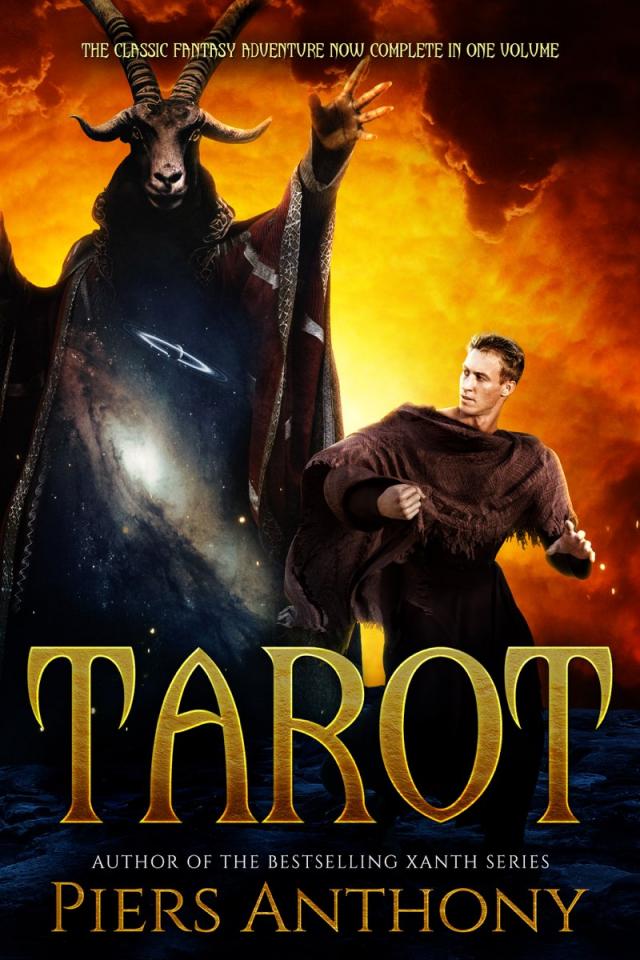


How had this happened? Jesus had entered the pool an ordinary man. He had swum into the glowing column; it was like a baptism of light—
“Could it be?” Brother Paul murmured wonderingly. “Antares did say something about—”
“I have met my Father,” Jesus said, amazed. His face glowed ethereally, and now he resembled the many portraits of him in Christian churches, haloed by radiation. Divine light!
“—the Ancients, leaving sites across the galaxy, capable of strange things,” Brother Paul continued. “Associated with aura. Could I have somehow triggered it, activated such a site, my own aura keying it—a column of aura—imbuing you—enhancing your aura—”
“I must be about my Father’s business,” Jesus said with quiet determination.
Brother Paul stared at him, the realization coming slowly but with terrible force. Was there really any difference between the Aura of the Ancients—and what Christianity called the Holy Ghost?
16 • Sacrifice (Hanged Man)
Insights on the nature of Jesus Christ can come from unusual sources. The Devil and All His Works by Dennis Wheatley remarks that almost all our information comes from the four Gospels, which were complied from oral tradition long after Jesus’ death. Certainly he was a historical character, but there is less certainty about his divinity. Wonders such as his virgin birth are trimmings customarily added to the lives of holy men to add glamor. Jesus differed from other teachers in that he claimed to be divine, but he gave no proof, and indeed lacked the power to ascend to heaven of his own volition. It is possible that his words were misinterpreted, and that he was actually alluding to that spark of divine spirit that is in each of us, himself included. Much of his life is unaccounted for, and we do not know what kind of training he may have had. On the other hand, he might have been a human being who suffered from the delusion that he was divine.
Brother Paul emerged from the scene troubled. Therion sat atop the Bible again, smirking. “Got your answer?”
“I got an answer,” Brother Paul said. “But I’m not satisfied I can accept it.”
“You were there; if you can’t believe what happened—”
“I was in an Animation subscene, not the historical reality. I suspect these scenes are the product of the imaginations of all of us who are participants in this quest. The effect of precession leads us into strange bypaths.”
“I was watching. I never heard of an ancient copper plaque that radiates a column of Holy-Ghostly light. You can’t blame me for that one!”
“No, that was from my own mind,” Brother Paul agreed. “I encountered a—a person who informed me about the powers of the so-called Kirlian Aura and of a long-expired civilization he termed the Ancients. He suggested there might be potent Ancient sites or ruins on Planet Earth. Thus perhaps it was natural for me to conjecture this as the explanation of Jesus’ power.”
Therion nodded. “Imbued by a machine many hundreds or thousands of years old.”
”Millions of years old.”
“Millions! Beautiful! To primitives, that power would seem God-like.” Therion squinted at him. “I think you mentioned the four-faced visitors of Ezekiel in your Bible. That was a good notion. Those were surely men in self-propelled space suits—”
“I don’t believe the Ancients were human,” Brother Paul said. “In any event, they were no longer around when man achieved prominence on Earth.”
“Still, there could be other aliens, looking for those powerful old sites, trying to tap their scientific riches before the local yokels did. Ezekiel’s visitors could have been looking for the Ancient site that Jesus actually found. But—do I have it clear?—Only a creature with a very strong aura like yours can key open such a site, so those aliens failed. When you touched it, you activated it, and then Jesus got the brunt of its force.”
“So it appeared in the Animation. But of course we were not really on Earth, so even if there were such a site, I could not have—”
“Don’t be so quick to explain it away! That’s a theory of Christianity I can accept! A local boy shazamed into Superman by the sleeping robot—and what a swath that boy cut with that power! But he should have bathed in that alien beam longer until he was invulnerable except for maybe his heel—though of course it wasn’t really Achilles’ heel that was vulnerable—so they couldn’t crucify him.”
Brother Paul shook his head. “The very fact you can accept this notion—means that I must question it. If the Holy Ghost becomes no more than alien technology, God has no part in it.”
“Ah, but God works in devious ways! Maybe He operates through Ancient sites!”
“Maybe,” Brother Paul agreed, again refusing to be baited. “But I would prefer to think of Jesus as a mere mortal man with an immortal message.”
“Oh come on, Brother! The Son of God—a natural man?”
“Enhanced by the Spirit of God. Without the Holy Ghost, Jesus was quite mortal.”
“Oho! So it is the Ghost that counts, not the man.”
Brother Paul did not care to engage this alert, devious, diabolic skeptic in theological argument. “Approximately.”
“Then you have been looking in the wrong place. You were following Jesus when you should have followed that super aura.”
Brother Paul looked at him, startled. “Yes! It was the Spirit that made Christ and Christianity what it was. What it is. If the Spirit is false, if it is nothing but alien technology, then Christianity is false, and—”
“And you must seek elsewhere for the God of Tarot,” Therion finished. “Exactly my case.”
“If that phenomenon was only an Ancient aura,” Brother Paul continued, working it out, “it might have imbued an ordinary man for a time, perhaps during his life—but it would not have survived the loss of its host. It would have dissipated on his death or reverted to its machine. Yet the Holy Ghost would have survived the demise of the man and gone on to imbue his Disciples, as prophesied by Joel and described in the Acts of the Apostles. ‘And it shall come to pass that I will pour out my spirit upon all flesh; and your sons and daughters shall prophesy, your old men shall dream dreams, and your young men shall see visions.’ This did happen at the first harvest festival, the Pentecost, after Jesus was crucified. The Apostles went on to preach the Word and heal the sick and form the nucleus of Christianity—”
“Are you sure it happened?” Therion inquired sardonically. “Or did they merely pay their visits to that same Ancient site, bathe in the ‘Holy Light,’ and pick up more grace from the machine?”
“That’s ridiculous! There wasn’t any machine! That was just a product of my imagination—”
Therion merely smiled.
“All right, damn you!” Brother Paul snapped, conscious of the verbal irony. How could a disciple of the Devil be further damned? “I’ll go back and follow that aura! Then will you be satisfied?”
”You are the one who needs to be satisfied,” Therion pointed out. “You are the judge of the God of Tarot.”
The man was infuriatingly correct. “I will follow that aura until the end.” He stepped toward the Bible.
Therion hastily jumped off as the pages flipped over. Then Brother Paul found himself in the forming scene of—the Crucifixion.
“Oh, no!” he muttered. But of course he had to attend because this was where Jesus’ aura would survive—or dissipate.
A crowd of people was walking along a road leading up a hill. In the center a man struggled under the weight of a huge wooden cross. Brother Paul moved forward, biting his lower lip. He hated this, but he had to get close to Jesus in order to verify the man’s aura.
Ironic, that this mob of perhaps a hundred was all that the city of Jerusalem, with a population of 25,000, could spare either to ridicule or to mourn the greatest man of the age! The plain fact was that ninety-nine per cent of the population was simply too busy with its routine pursuits to pay any attention to—
He banged into a bystander. “Sorry,” Brother Paul said. “I was trying to see—” But the man took no notice of him.
Brother Paul made his way to the front, finally getting a look at the cross-carrier’s face. And stopped, surprised. It was not Jesus!
Then he laughed with sheer relief of confusion, though his underlying distress had not been abated. Jesus had not carried his own cross; he had been too weak after the beating they had given him so that another man had been impressed to carry it for him.
Brother Paul’s laughter had attracted momentary attention. People shied away from him, and a Roman soldier scowled.
Now he saw Jesus walking a few paces behind, wearing the crown of thorns, eyes downcast. He was pale, and there was a trickle of blood on his forehead where a thorn had punctured the skin, but he walked unassisted.
“Oh, Jesus!” Brother Paul breathed. “Couldn’t there have been some other way!” Yet then there would have been no Christianity…
The group moved slowly on up the hill, limited by the pace of the man staggering under the burden of the cross. Brother Paul, wary of interfering with history even in Animation, walked with them, trying to get close enough to feel Jesus’ aura without attracting further attention to himself. But the Roman soldier spied him and warned him away with a dark glance. Brother Paul fell back.
They come to the gate in the great city wall. Beyond this was the dread place called Golgotha. The meaning of the name, Brother Paul remembered, was “The Skull.”
Now the crowd milled about as the soldiers prepared the ground for the crucifixion. It was necessary to dig a hole to stand the cross in and place a support to act as a fulcrum so that the cross could be erected. The immediate vicinity was crowded because two more victims had arrived with their crosses; the religious nut did not rate an entire ceremony to himself. Yet Jesus was the center of attention.
Women closed in, and the harried soldiers permitted this encroachment because the ladies were obviously harmless and were, after all, female. Brother Paul tried to move in with them, but again the soldier spied him and warned him back with a significant gesture. The Romans were businesslike and relatively dispassionate; they evidently did not like this business, but they had done it before, followed orders now, and did not intend to let the situation get out of hand. Brother Paul retreated again still unable to verify Jesus’ aura by contact.
The ladies clustered about Jesus tearfully, some mourning most eloquently. In Brother Paul’s day the term “wailing” had derogatory connotations, but here the wailing was genuine: a passionate voicing of utter bereavement that chilled the flesh and whose sincerity could not be doubted. Occidentals were unable to show emotion this candidly, and perhaps this was their loss.
Jesus stood up straight and spoke for the first time since Brother Paul had joined the party. “O daughters of Jerusalem, do not weep over me. Weep over yourselves and over your own children.”
They became silent, surprised. Jesus continued talking to them, but Brother Paul, straining to hear, was roughly interrupted by a hand on his shoulder. Startled, he turned about. There was a Roman legionary, impressive in his ornate helmet, armored skirt, and slung short sword.
“Governor Pilate will speak with you,” the soldier said gruffly.
Oh, no! The last thing Brother Paul wanted was to become involved in history. Of course he could not affect actual history, but if his presence distorted the Animation, he would not be able to ascertain the truth he sought. Was the validity of the Holy Ghost something that was inherently unknowable?
No! Better to believe that there had been a man like him at the Crucifixion, who had spoken to Pontius Pilate. Brother Paul was merely occupying the body, the host, as it were in Transfer, as the alien visitor Antares would have put it. All he had to do was go along with it, acting natural. So long as he did not deliberately step out of character for this situation, it should be all right.
Pilate was resplendent in his official Roman tunic and embroidered cape, astride a magnificent stallion. Behind him the flag of Rome fluttered restlessly in the rising wind, its huge eagle seeming almost to fly. Oh, the trappings of power were impressive!
The Governor stared down at Brother Paul from his elevation. “You appear to be unusually interested in the proceedings, and you are not from Jerusalem. Are you one of this man’s disciples?”
Brother Paul stood frozen. Was he, like Simon, to deny his faith? Yet he was not a disciple in the fashion Pilate meant; not one of the Twelve. “I am not a disciple,” Brother Paul said carefully. “But I do believe in the divinity of Jesus Christ.” Yet was that itself a lie? He was here to verify the aura Jesus hosted, to ascertain whether it was some artificial, machine-enhanced thing, or the living Holy Spirit of God. How could he claim to believe when his objectivity required that he hold his judgment in abeyance. “At least, I think he may be the—”
“The King of the Jews?” Pilate asked. Suddenly Brother Paul recognized him: Therion! The Roman soldiers had been Therion too, but this was better casting.
“Perhaps,” Brother Paul agreed tightly. The legionary beside him shifted his balance. (Could a single role-player play two roles simultaneously in Animation? Apparently so.)
“Are you literate?” Pilate asked.
Since the verbal portion of this Animation was in Brother Paul’s own language, it seemed safe to assume the writing was also. “Yes.”
“Yes, sir!” the legionary snapped. “Show respect to the Governor!”
Brother Paul reminded himself of his need to play along with the Animation. “Yes, sir,” he repeated.
Pilate nodded benignly. “Excellent. I have a task for you. I am not altogether satisfied of this man Jesus’ guilt; in fact I find little to condemn him other than intemperate words, most of which have been uttered by his accusers.” He glanced aside, making an eloquent gesture of spitting. “The high priests of the Temple, who feel their authority threatened by one who preaches some modicum of decency and salvation, even for the poor. Pharisees!” And now he did spit. “I understand this man Jesus once rousted them right out of the Temple, kicking over their tables and scattering their money. Good riddance!” Then his gaze returned to Brother Paul. “But these Jews would have him die, and I do not wish to incite further unrest while passions are already roused during this local celebration, the Passaway. Passover, I mean. Relates to some sort of mythology concerning Egypt, I hear, though I’d like to hear the Egyptians’ side of it! At any rate, the politics of the situation require me to accede to an act I do not necessarily approve, washing my hands of responsibility for the decision. But that others may at least know the claim for which this man is being crucified, rightly or wrongly, I propose to inscribe a plaque and set it on his cross. You will print the words on this plaque. Are you amenable to that?” Brother Paul had not expected a statement of this nature from either Pilate or Therion, yet it rang true. Besides which, the legionary was nudging him with a dagger-like knuckle. “I—am amenable,” he murmured. Then, as the legionary reacted, he added “Sir.”
Pilate looked away, dismissing him. Brother Paul got to work on the plaque. He seemed to remember it, historically, as having been made of stone, but what they provided was a rough wooden board. Well, that would have to do. “What shall I inscribe?” he asked the legionary.
The man shrugged. He seemed amiable enough when out from under the eye of the Governor. “What is he accused of?”
“Of being the King of the Jews,” Brother Paul said, half facetiously.
“Then write that.” Case closed.
Brother Paul took the heavy chalk and printed out the seven words as boldly and clearly as he could: THIS IS THE KING OF THE JEWS.
One of the Temple priests came by as he was completing it. “That isn’t right!” the man protested. “He isn’t really the King of the Jews. You should write that he says he is—”
“Go soak your head,” Brother Paul muttered.
Angrily, the priest went a few paces to complain to the Governor. In a moment Pilate’s half-ironic response sounded above the clatter and hubbub of the proceedings: “What I have written, I have written.”
Brother Paul smiled privately. By assuming authorship of the plaque, Pontius Pilate had squelched all further complaints.
The legionary also smiled, briefly. “Serves the hypocrite right,” he said, glancing at the disgruntled priest. “I’d like to see the whole lot of them crucified.” He studied the plaque. “Does it really say—?”
He was illiterate, of course. That was why Pilate had needed a literate volunteer. Otherwise Pilate would have had to write the words himself, and that would have been beneath his station as well as to a certain extent again involving him in the matter he had supposedly washed his hands of. “It really does,” Brother Paul assured him.
“King Herod should see that!” the legionary remarked appreciatively. Obviously he resented the whole troublesome tribe of Jews and enjoyed a good insult to any of them. “Now go take it to the cross. Hurry, before they erect it.”
Suddenly Brother Paul had a legitimate way to get close to Jesus. Yet now that the opportunity was upon him, he found himself hanging back. How could he participate so immediately in this abomination?
“Move!” the legionary snapped, fingering his sword hilt. “They’re about to mount him.”
Brother Paul moved. He brought the plaque to the cross where it lay on the ground. “The Governor says to put this—”
“Yeah?” another soldier said. “How’d you like to put it up your—”
“It’s all right,” the first legionary said from behind Brother Paul. “Governor Pilate did order it.”
The soldier shrugged. “If you say so, Longinus. Here, you take over this spear; I’m going to need my hands.”
Longinus took the spear. “Hammer it in above his head,” he told Brother Paul. “They’re stretching him out now.”
And while Brother Paul held the plaque, they made Jesus lie down upon the cross, placing his feet on the partial platform near the base and stretching his arms out along the crosspiece. Jesus was nearly naked now; they had stripped all his clothing except a loincloth: part of the humiliation of this form of execution. It was not enough that a man die; he had to die with his pride effaced. Brother Paul’s heart seemed to freeze for several beats, seeing him there. Was there no way to abate this horror? Yet of course there was not.