Tarot, p.2
Tarot,
p.2


One very nice quote was from Arthur Koestler’s The Ghost in the Machine, about the nature of consciousness. I had paid for its use, but later discovered that the proper credit had been omitted from my volume. I wrote in January, 1983, to his agency to apologize, though it had not been my error. His agent replied in February, and was nice about it. “I’m pretty sure Mr. Koestler will take it in his stride,” she said. And in March Arthur Koestler and his wife committed suicide.
All things considered, I am unwilling to go through all that again, to obtain permissions for the quotes for this new edition. I still admire the quotations and the books and authors from which they stem, but there is just too much sheer experience involved in making those contacts.
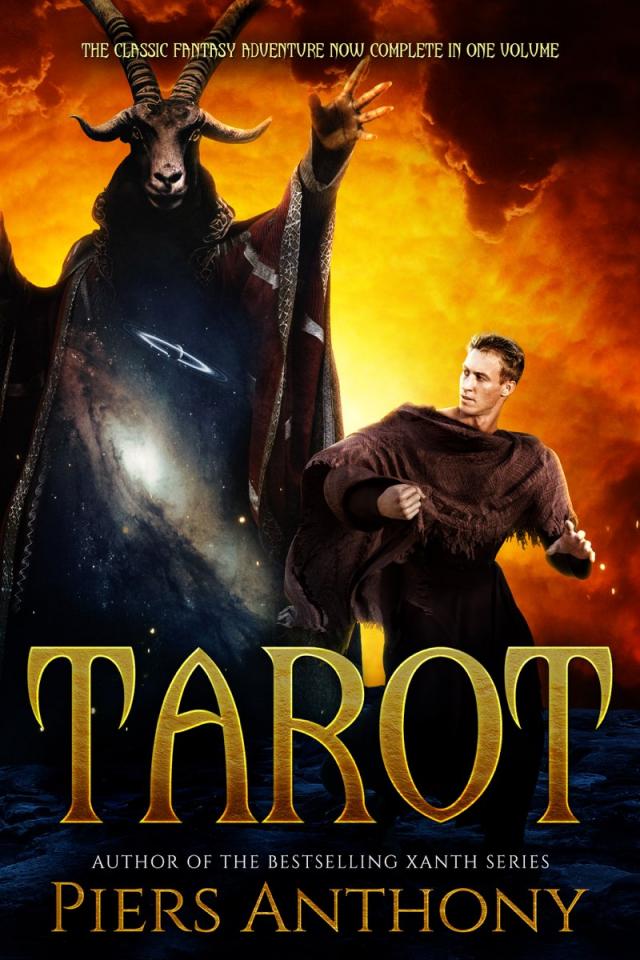
Over the years I have had a number of letters about the novel. I dread these, because they tend to be from those who are deeply into the subject of tarot, as readers or philosophers, posing questions that require a good deal of knowledge and thought. I am not an expert in the tarot deck, and not a believer in the occult; I am a dedicated writer who researches as necessary for the things that come into my fiction. I answer as well as I can, perhaps disappointing them. Nonetheless, I did do my share of research into the nature of tarot, and will describe some of my discoveries here.
There is not one tarot deck; there are many. They come in all types and colors and sizes. Whole books have been written on the subject of particular interpretations of particular decks, such as the Rider-Waite, and each interpreter seems to feel that his is the only proper one. Hundreds of different decks have been published, and many books have been written describing the variety of tarot decks available. One such book, for those interested but casual, is The Book of Tarot by Fred Gettings. For those who prefer a thoroughgoing survey, try the two-volume, almost-thousand-page Encyclopedia of Tarot by Stuart R. Kaplan, who seems to be the expert here. Yes, I did know of a tarot deck he had not encountered; at his request I lent it to him … and did not hear from him again. Nevertheless, if you want to fathom the breadth and variety of tarot, this is the place to start; you can learn more than you dreamed existed about tarot. You can also order exotic decks through his “Best of Cards” catalogue. Another interesting volume is Tarots by Italo Calvino; I paid $104 for Copy #462 in 1976 because I needed it for my research. The volume contains about thirty thousand words, and uses as illustrations facsimiles of one of the earliest (therefore most authentic) tarot decks known, the Visconti/Sforza, circa mid-fifteenth century. It was from this deck that I realized that the card now called the Hermit originated as Time; by a process called iconographical transformation (that is, someone sees the illustration and confuses its meaning) the significance was lost—a fact that seems to have eluded most modern scholars. At any rate, Tarots is a story crafted from the laying out of the tarot deck, the plot suggested by the cards. It is interesting enough, but perhaps not worth a hundred dollars a copy.
The thing about the tarot deck—any variant—is that it is multi-purpose. You can use it for entertainment, as in games or gambling or simple house-of-cards constructions. Or for divination, character analysis, even as a kind of Rorschach test. Or for study, as in a survey of all available decks and their cultural indications, and the history of the deck itself, which has some intriguing implications. Or for business, which is what the merchandisers and collectors do, and perhaps the diviners too: making money from it. Or for meditation, considering the meaning of the cards, their symbolism: this can get you into deep psychological territory. Five uses, equating to the five suits of Wands, Cups, Swords, Coins and Aura.
Ah, I see I need to explain. Neither the number of cards nor the number of suits is fixed. The “standard” tarot deck has 78 cards, consisting of 22 Trumps (a corruption of Triumphs) and 56 suit cards divided into four suits of 14 cards each: ten pips and four court cards. I realized that something was missing, because the suits equate to the classical “elements” and, contrary to popular belief, there were not four but five elements taught: Fire, Water, Air, Earth and Spirit. Thus there should be a fifth suit—yet it is missing from contemporary decks. In addition, the interpretations of the cards are a hopeless hodgepodge; experts disagree, sometimes violently, and there is no consistent pattern. I discovered that I was building a novel on a deck that was fashioned of sand. That would not do. So I set about restoring it to its proper state, which was obviously a hundred cards and five suits. This is the Animation Tarot deck, and it is described in the Appendix. The novel explains why and how the deck was truncated, so that for centuries only imperfect versions were known.
No, there is no commercially available Animation Tarot deck. Actually there are two versions: the Classic that relates to the time of its origin in the fourteenth century (forget claims about ancient Egypt and such; I deem them to be without merit, as the novel will show) and the Cluster, that relates to that future century when it is published. But both have the same symbolic values, with the exception of the blank Ghost card; only the illustrations differ. The Ghost has fifteen alternate faces that relate to different species of the galaxy, bringing the effective number of Triumphs to 44; we of mundane Earth may never properly comprehend their ramifications, so can treat it simply as the Unknown. I explored prospects for publishing the deck, but this led to a series of complications, some of which are of such nature that even I, who know precious few inhibitions in print, will not discuss them. I concluded that the effort and cost would be too great in relation to the benefit, so have never put the deck into print. Perhaps someday that will change; I have not forgotten the matter. Some informal decks do exist, notably a hand drawn one in a lovely knit slipcase by a religious order that espouses the principles of the Holy Order of Vision; they sent me a complimentary copy. More than one reader has done nice illustrations for the deck. But there is a world of difference between such individual efforts and a commercial venture. In the interim, you can make up your own deck from index cards, as recommended in the Appendix, or adapt a playing-card deck by adding marked cards. You don't have to have the symbols correctly painted on each card; the meaning is inherent in the card regardless of its markings, just as personality is inherent in a person regardless of the appearance of his body. I haven’t even worked out all the illustrations for the Triumphs, though I do have some notions for pictures and color coding. In general, the Cluster variant would be one way up, and the Classical variant the other way up, so that the cards can be taken either way, future or past. Folly, or the Fool, or 0 Triumph, might be the world in the shape of a zero, with blood pouring out. Skill, or the Magician, or 1 Triumph, might be Brother Paul before the windmill, one hand lifted, the other pointing down, as he indicates the key elements. Memory, or the High Priestess (Lady Pope), or 2 Triumph, might be the Rev. Mother Mary in her office. Action, or the Empress, or 3 Triumph, might be the lovely girl in the amaranth field. That sort of thing. I have not kept all the numbers of the mundane tarot, deeming the order and meanings to be more significant than the actual numbers, so my Change-Death card is #17 instead of #13; the picture for that might be a child playing in the cavity of a wall. The novel will clarify the horror of that seemingly innocent image, which derives from what I understand is a true event. But the images are not settled, and anyone who wishes to make up his own Animation deck may use what suits him.
I have, however, worked out certain protocols which are used in my novels, notably Kirlian Quest. For those who wish to do a reading the Animation Tarot way, here is the Cluster Satellite Spread. A spread is the layout of the cards, as you put them down in turn from the deck. It is the means to obtain messages from the cards, and anybody can do it; you don’t need to pay a professional reader or psychic. You are the Querent; you may ask any Question, and you can do it alone. You may prefer to; bear in mind my first experience with a Reading. But be warned: this gets detailed, and will be confusing unless you are actually dealing out the cards as you read. Skim over it otherwise, until you encounter something interesting. I am, as I said, a skeptic about the supernatural; you are more open-minded on this subject than I, so for this purpose I shall assume that it is valid, and that the Animation Tarot really wants to speak to you. You don’t even have to use the Animation Deck; any garden-variety tarot deck will work (though not as well), or even regular playing cards, if you know how to read them. The cards are the means, not the end, and so is this Spread.
First, select your Significator. That is the card that stands for you, personally. This is normally one of the Court cards, but it doesn’t have to be. For example, if you are an active lady who likes nature hikes, you might identify with the Queen of Wands, the Suit of Nature. If you are a teenager who likes money and plans to be a millionaire before age thirty, you might be the Knight of Coins, The Suit of Trade. I, as a frustrated artist who turned to words for expression, regard my Significator as the King of Aura, the Suit of Art. There are several associations for each suit, so you should be able to find one that aligns with your nature, that you feel comfortable with, that is you. That card is your Significator, the most important one in the deck—for you. You need to identify it before you even start your Reading.
Next, shuffle the complete deck, including your Significator. The order your cards start with should never be restored; you may shuffle or not between uses, and the deck gains experience with each use, and this must not be revoked by any mechanical ordering. (Other tarot decks are not sensitive about this, but you are not dealing with any ordinary tarot deck now. This one lives.) Deal them face down into five piles, in any order you prefer, so long as you finish with 20 cards in each.
Now start with any pile and turn the cards face up until you come to your Significator. If it isn’t in the first pile, do the second, and the third; just keep methodically going until you find it. Stop right there, with the Significator in your hand, and study the situation. Which pile was it in? The five piles have these meanings: 1. DO 2. THINK 3. FEEL 4. HAVE 5. BE. You can see how these align with Nature (Wands), Science (Swords), Faith (Cups), Trade (Coins) and Art (Aura) respectively; indeed, these are the meanings of the #1s for the five Suits. Everything fits together, and the meanings constantly interact in patterns of five; in fact the number five is fundamental to this art: the fingers of your hand. Two hands to your body make ten fingers, the number of pip cards per Suit; square that and you have the total for the Deck. The ancients were conscious of the patterns of numbers in a way the moderns are not; they could do magic with intricate squares of numbers. That is why the disruption of the original tarot pattern was such a crime against magic, rendering it largely inoperative. A computer would suffer similarly if 2% of its innards were randomly removed, and folk would doubt that it ever had worked, just as they do now with spoiled magical things. But back to the point: is the nature of your Question consistent with the message of the pile? Only you can be the judge of that. If it is not, stop; this is the Deck’s way of telling you not to inquire further.
If the Pile is consistent, you may proceed to the layout. Put your Significator down in the center of the table, face up, oriented east-west. That is, crosswise. Use the remaining cards of the Pile it chose and deal them singly, face up. #1 goes across the Significator (which is #0, suggesting the Fool: you), north-south, vertically, or however you call it. #2 goes south of it, upright. #3 west of it, vertically. #4 north, and #5 east. Now you have a pattern of six cards, with two crossed in the center. #1 stands for Definition; it defines your problem. #2 is Past, #3 Present, #4 Future, and #5 Destiny. Interpret each card in the light of its position; Court Cards are apt to represent significant other people in your life, being their Significators, and the meanings of the others are as given in the deck. The complete pattern should pretty well define your situation, with Destiny summing it up. You have to interpret it yourself; no one else can do it for you, for the cards speak only to you, in ways that only you can appreciate. Other people may comment on your layout, but their opinions are only advisory; they cannot know what is truly in your heart.
But if you remain confused, the Cluster Spread will help you. You have only to start a satellite. Deal a card across the card that confuses you: this is a sub-#1, defining not the whole but just that aspect. If you lay it across the original #2, Past, then the new card defines Past. Does this clarify it for you? If not, deal out three more cards, below, in counterclockwise order. (Or to the left, or above, or to the right, depending on which card you have Crossed. This is mere common sense: take the room you need for an uncrowded layout.) You now have a subset of five cards (a significant number), or a Satellite. The three newest ones are the Past, Present and Future indications for that card only, which has become the Significator for the Satellite. Does this clarify what confused you before? If it doesn’t, you may cross one of the new cards and build another satellite; the Spread is endlessly accommodating, and it wants you to understand what the Deck has to say to you.
With one exception: you may run out of cards. You are limited to those of that one Pile, and your reading ends when the cards do. If you received a negative signal before, when your Significator turned up in an irrelevant Pile, but you played through anyway, it may cut off your cards in short order. Remember, you are limited to the cards remaining in the Pile; if the Significator was near the bottom, you may not have enough cards to complete the Spread. Take the hint: desist. If the signals are positive, but the cards limited, make do with what you have: the Deck has told you as much as it feels is appropriate. If you don't like the Answer the Deck gives you on the first reading, tough: don’t try it again. Not the same day, anyway. You may, however, proceed to different questions if you wish. The Reading is valid only to the extent you play it honestly; if you cheat, your results become invalid. Don’t blame the Animation Tarot if you get a bad Answer after abusing it.
There is one other thing about the tarot, in all versions, that no one else seems to have caught on to. In addition to all its other aspects, it is a story: the story of the life of Jesus Christ and, by extension, Everyman. It follows, card by card, a person's life, beginning with the total innocence of birth—the Fool—and the Father and Mother figures, on through death, and the transfer of the spirit to a new vessel (water poured from one to the other) and the hazards of the Afterlife, such as the Devil, concluding with the final Judgment and The World (Universe), or the totality of spiritual completion. It is, in sum, a forbidden religious lesson for the illiterate, who were the masses in medieval times. In this is its great significance and the reason for its suppression by the forces of orthodoxy. As I came to know the tarot, I developed a profound respect for it, and this manifests in the novel. I hope that others, reading this novel, come to appreciate the phenomenal instrument that the tarot can be, regardless of the nature of their other beliefs.
That's about it; this introduction is far longer than intended. Those of you who have not encountered this novel before, be warned: it contains provocative material of several types, religious and social, and may repulse you. One of my Xanth readers, a young girl, picked up one of the volumes, supposing it was more light fantasy. Her mother saw it, read a bit, and promptly banned all Anthony novels from the house. If you succeed in reading Tarot through without being disgusted at some point, you probably don’t understand it.
—Piers Anthony, March, 1987
Author’s Note
This novel relates to the author’s Cluster series of adventures, with a number of interconnections, but is of quite a different nature; the two projects should not be confused.
An appendix defines the Animation Tarot that is the basis of this novel. The complete table of contents reflects the thirty Triumphs of that deck, from Key 0 (zero) through Key 28 (twenty-eight), which are included in the appendix.
The complex nature of this novel may lead to confusion in certain places, and some scenes may be offensive to certain readers. Yet there is a rationale: It is difficult to appreciate the meaning of the heights without first experiencing the depths.
0 • Folly (Fool)
In 1170 A.D., Peter Waldo, a wealthy merchant of Lyons, France, suffered a religious conversion, renounced his possessions, and wandered about the countryside in voluntary poverty. This obvious folly attracted both persecutions and followers, the latter called the “poor men of Lyons.” In 1183 Pope Lucius III excommunicated the growing sect of “Waldenses,” who appealed to the Scriptures instead of to papal authority, repudiated the taking of oaths, and condemned capital punishment. They never made the sign of the cross, as they refused to venerate the torture device on which Christ hung, or the painful and mocking crown of thorns. Nevertheless, the Waldenses prospered in Christian lands; many thousands of them settled in the Cottian Alps on the French-Italian border. Their dauntless missionaries covered southern France, southern Germany and northern Italy. But the Inquisition followed them, and they were savagely repressed over the course of several centuries. Their ministers had to go about in disguise, and it was hazardous for them to carry any of the literature of their faith, lest it betray them into torture and death. But it was hard to make the material clear without teaching aids, for many converts were illiterate and ignorant. Out of this impasse was to arise one of the most significant educational tools of the millennium.