The complete psychotechn.., p.1
The Complete Psychotechnic League, Volume 1,
p.1
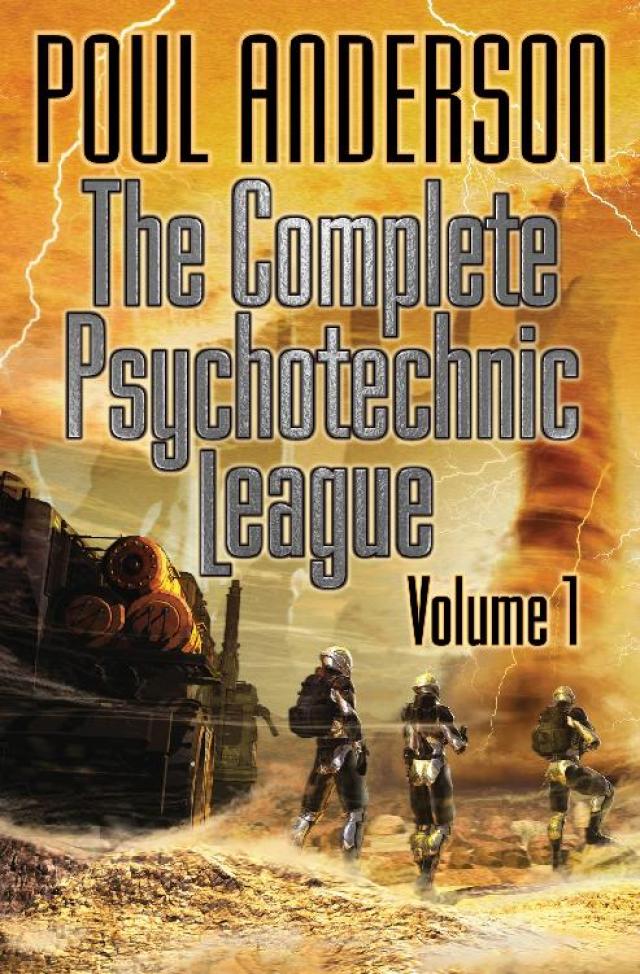


Table of Contents
Preface
The Psychotechnic League
Marius
Un-Man
The Sensitive Man
The Big Rain
Afterword
The Complete Psychotechnic League
Volume 1
POUL ANDERSON
Interstitial Material by Sandra Miesel
The Complete Psychotechnic League Volume 1
Poul Anderson
FROM THE ASHES OF WORLD WAR III
World War III has ravaged the globe. Once great nations have been brought to their knees. Now, a new science offers hope for the future: Psychodynamics, the ability to influence government and popular opinion. Led by the Psychotechnic Institute, humanity denounces its violent ways, once and for all. While peace reigns on Earth, humankind ventures out into the Solar System—and to the stars beyond. But soon the cycle of war and destruction begins anew.
The first of three volumes collecting all of multiple Hugo- and Nebula-Award winning author Poul Anderson's massive future history magnum opus. Includes short stories previously uncollected in a Psychotechnic League volume!
Baen Books
by Poul Anderson
The Technic Civilization Saga
The Van Rijn Method
David Falkayn: Star Trader
Rise of the Terran Empire
Young Flandry
Captain Flandry: Defender of the Terran Empire
Sir Dominic Flandry: The Last Knight of Terra
Flandry’s Legacy
The Psychotechnic Leage
The Complete Psychotechnic Leage, Volume 1
The Complete Psychotechnic Leage, Volume 2 (forthcoming)
The Complete Psychotechnic Leage, Volume 3 (forthcoming)
The High Crusade
To Outlive Eternity and Other Stories
Time Patrol
The Complete Psychotechnic League: Volume 1
This is a work of fiction. All the characters and events portrayed in this book are fictional, and any resemblance to real people or incidents is purely coincidental.
Copyright © 1981 by Poul Anderson
All rights reserved, including the right to reproduce this book or portions thereof in any form.
Forward copyright © 2017 by David Afsharirad
Forward copyright © 1981 by Sandra Miesel. Reprinted by permission of the author.
"Marius" originally appeared in Astounding, March 1957. Reprinted by permission of the Poul Anderson estate.
"Un-Man" originally appeared in Astounding, January, 1953. Reprinted by permission of the Poul Anderson estate.
"The Sensitive Man" originally appeared in Fantastic Universe, January, 1954. Reprinted by permission of the Poul Anderson estate.
"The Big Rain" originally appeared in Astounding, October, 1954. Reprinted by permission of the Poul Anderson estate.
Afterward copyright © 1981 by Poul Anderson. Reprinted by permission of the Poul Anderson estate.
Baen Publishing Enterprises
P.O. Box 1403
Riverdale, NY 10471
www.baen.com
ISBN: 978-1-4814-8284-4
eISBN: 978-1-62579-614-1
Cover art by Kurt Miller
First Baen printing, October 2017
Distributed by Simon & Schuster
1230 Avenue of the Americas
New York, NY 10020
Printed in the United States of America
10 9 8 7 6 5 4 3 2 1
Electronic Version by Baen Books
www.baen.com
Preface
by David Afsharirad
Poul Anderson wrote the first story in what has become known as The Psychotechnic League in 1947, the last in 1968. In those twenty-one years, he chronicled nearly ten centuries of future history, beginning just after World War III in the late 1950s and continuing through the next millennium as humanity spread throughout the galaxy. At the center of Anderson’s Psychotechnic League stories is the rise-and-fall cycle of human civilizations and the revolutionary science of psychodynamics, which enables the prediction and guidance of human cultural and sociological evolution. Working clandestinely, The Psychotechnic Institute seeks to direct humanity toward greater rationality, a one-world government, and the colonization of the Solar System and beyond. Wars erupt, societies rise and crumble, and through it all, Anderson deftly navigates the complex and ever-changing landscape of his creation.
As Heinlein did when writing his seminal future history, Anderson wrote the Psychotechnic League out of order, picking and choosing when within his future chronology to set each new tale. (In this and the following two volumes, they have been assembled according to the stories’ in-world chronology, rather than by publication date.) Similarly, Anderson did not limit himself to telling one kind of story. Reading through the short stories, novelettes, novellas, and novels that make up The Psychotechnic League, readers will discover tales of political intrigue, espionage thrillers, interplanetary adventure, and stories every bit as pulpy as the paper they were first printed on back in the 1940s and 50s, all shot-through with Anderson’s meticulous world-building and assured style.
Though Anderson wrote the final Psychotechnic League story in 1968, he had all but abandoned the series by the late 50s. This decision was partially due to his becoming uncomfortable with certain aspects of the stories, particularly the role played by the United Nations. But in addition to changing philosophical alignments, Anderson’s shift away from the Psychotechnic League has a more quotidian explanation: a worldwide atomic war did not, in fact, break out as he had predicted. No doubt a good thing for humanity, but something of a disaster for Anderson’s future history.
But just as War of the Worlds is still infinitely readable despite the fact that we have yet to be invaded by Martians, and 2001: A Space Odyssey remains a cinematic classic though the year that gives the film its title is now in the rearview, so too does Poul Anderson’s The Psychotechnic League remain as entertaining as when the stories were first published more than a half-century ago. What’s more, when Jim Baen first collected the Psychotechnic League stories in the 1980s, Sandra Miesel was enlisted to find a way to make them work for a contemporary audience. Rather than alter what Anderson had written, Miesel recontextualized Anderson’s future history as alternate history. Miesel’s forward and interstitial story introductions are reprinted here, enabling readers to suspend their disbelief if not more easily, then in a different manner.
In any case, it is not really the job of science fiction to accurately predict the future. In truth, science fiction is always about the time in which it was written; and great science fiction is about the always changing yet eternally constant human condition. Though certain elements of Anderson’s Psychotechnic League stories are now outdated, the universal truths at their center are as timeless today as when they were first written. What’s more, these are wonderful examples of a master storyteller at work. And great storytelling never goes out of style.
So turn the page and fall into the history of a future that might have been . . .
The Psychotechnic League
by Sandra Miesel
1958, the year the H-bombs fell, set human history careening in a new direction. So obvious is this nexus, an entire genre of fantastic fiction asks the question “What if World War III had not happened?” Although romantics prefer to imagine alternate twentieth centuries as lost paradises of peace and plenty, the opposite is likelier to be true.
We modern historians generally regard World War III as a mitigated catastrophe. Regrettable as its megadeaths and global devastation were, it drove humanity to establish effective world government and to colonize the solar system decades sooner than these objectives might otherwise have been achieved. More importantly, in strictly pragmatic terms, the early atomic era was the best time to resolve East-West rivalry; the crude weapons of that day could not sterilize Earth. From the standpoint of our mature integrated culture, World War III was a painful childhood illness of our race.
Conflict was inevitable once Eisenhower’s death from surgical complications elevated Nixon to the U.S. presidency in June, 1956. Cold War paranoia distorted Nixon’s reactions to unrest within the Communist bloc in the autumn of that year. Covert U.S. aid to the Hungarian rebels so enraged the Soviet Union that it backed Egypt past the limits of prudence during the Suez Crisis. The savage Mideast war that followed left Socialism dominant throughout the region and the U.S.S.R. in possession of northern Iran.
The assassination of Tito shortly afterwards enabled the Soviets to bring Yugoslavia back under their control. Political strife among Krushchev, Bulganin, and Zhukov made Soviet policy too erratic for American analysts to predict. International tensions built during 1958. When the U.S.S.R. threatened a new Berlin blockade and the People’s Republic of China seized the Nationalist-held islands of Quemoy and Matsu, Nixon took adamant stands on two fronts at once. The East responded with a pre-emptive strike at the West on Christmas Eve, 1958.
These first bombs destroyed prime U.S. targets at home and abroad. The Philippines and Australia’s major ports were immobilized. NATO countries lost their capitals and military bases but most of their territory was spared pending future conquest. However, U.S. counter-strikes carried by missiles and the Strategic Air Command inflicted proportionately more damage on enemy targets simply because there were fewer significant ones to be hit.
r /> The Soviets crossed the Rhine, but with their industrial base virtually gone and internal communications cut, they could not resupply their armies adequately, even for conventional warfare. Satellite troops mutinied rather than support a losing cause—their nationalism overpowered their Marxism. Europe liberated itself through a bitter war of attrition. Meanwhile, American and British Commonwealth forces futilely campaigned on the Asian mainland from Indochina to Manchuria.
Behind the lines, anti-Party revolutions shattered the Communist world to bloody bits. The trauma of bombardment exposed hatreds formerly hidden by the blandness of prewar American society. Racial and social clashes erupted throughout the country. Newly freed Europe faced a swarm of civil wars as each ethnic group sought to exploit the general chaos to its own advantage. Worldwide economic collapse ruined those colonies and non-aligned nations that had escaped military attack.
By the fall of 1964, the fires of international conflict had sunk to a few sullen embers. Whether these would die to ashes or burst into fresh flame depended on a single man. . . .
Marius
IT WAS RAINING AGAIN, with a bite in the air as the planet spun toward winter. They hadn’t yet restored the street lights, and an early dusk seeped up between ruined walls and hid the tattered people who dwelt in caves grubbed out of rubble. Étienne Fourre, chief of the Maquisard Brotherhood and therefore representative of France in the Supreme Council of United Free Europe, stubbed his toe on a cobblestone. Pain struck through a worn-out boot, and he swore with tired expertise. The fifty guards ringing him in, hairy men in a patchwork of clothes—looted from the uniforms of a dozen armies, their own insignia merely a hand-sewn Tricolor brassard—tensed. That was an automatic reaction, the bristling of a wolf at any unawaited noise, long ago drilled into them.
“Eh, bien,” said Fourre. “Perhaps Rouget de l’Isle stumbled on the same rock while composing the ‘Marseillaise.’”
One-eyed Astier shrugged, an almost invisible gesture in the murk. “When is the next grain shipment due?” he asked. It was hard to think of anything but food above the noise of a shrunken belly, and the Liberators had shucked military formalities during the desperate years.
“Tomorrow, I think, or the next day, if the barges aren’t waylaid by river pirates,” said Fourre. “And I don’t believe they will be, so close to Strasbourg.” He tried to smile. “Be of good cheer, my old. Next year should give an ample harvest. The Americans are shipping us a new blight-preventive.”
“Always next year,” grumbled Astier. “Why don’t they send us something to eat now?”
“The blights hit them, too. This is the best they can do for us. Had it not been for them, we would still be skulking in the woods sniping at Russians.”
“We had a little something to do with winning.”
“More than a little, thanks to Professor Valti. I do not think any of our side could have won without all the others.”
“If you call this victory.” Astier’s soured voice faded into silence. They were passing the broken cathedral, where child-packs often hid. The little wild ones had sometimes attacked armed men with their jagged bottles and rusty bayonets. But fifty soldiers were too many, of course. Fourre thought he heard a scuttering among the stones; but that might only have been the rats. Never had he dreamed there could be so many rats.
The thin, sad rain blew into his face and weighted his beard. Night rolled out of the east, like a message from Soviet lands plunged into chaos and murder. But we are rebuilding, he told himself defensively. Each week the authority of the Strasbourg Council reached a civilizing hand farther into the smashed countries of Europe. In ten years, five perhaps—automation was so fantastically productive, if only you could get hold of the machines in the first place—the men of the West would again be peaceful farmers and shopkeepers, their culture again a going concern.
If the multinational Councillors made the right decisions. And they had not been making them. Valti had finally convinced Fourre of that. Therefore he walked through the rain, hugging an old bicycle poncho to his sleazy jacket, and men in barracks were quietly estimating how many jumps it would take to reach their racked weapons. For they must overpower those who did not agree.
A wry notion, that the feudal principle of personal loyalty to a chief should have to be invoked to enforce the decrees of a new mathematics that only some thousand minds in the world understood. But you wouldn’t expect the Norman peasant Astier or the Parisian apache Renault to bend the scanty spare time of a year to learning the operations of symbolic sociology. You would merely say, “Come,” and they would come because they loved you.
The streets resounded hollow under his feet. It was a world without logic, this one. Only the accidents of survival had made the village apothecary Étienne Fourre into the de facto commander of Free France. He could have wished those accidents had taken him and spared Jeanette, but at least he had two sons living, and someday, if they hadn’t gotten too much radiation, there would be grandchildren. God was not altogether revengeful.
“There we are, up ahead,” said Astier.
Fourre did not bother to reply. He had never been under the common human necessity of forever mouthing words.
Strasbourg was the seat of the Council because of location and because it was not too badly hit. Only a conventional battle with chemical explosives had rolled through here eighteen months ago. The University was almost unscathed, and so became the headquarters of Jacques Reinach. His men prowled about on guard; one wondered what Goethe would have thought could he have returned to the scene of his student days. And yet it was men such as this, with dirty hands and clean weapons, who were civilization. It was their kind who had harried the wounded Russian colossus out of the West and who would restore law and liberty and wind-rippled fields of grain. Someday. Perhaps.
A machine-gun nest stood at the first checkpoint. The sergeant in charge recognized Fourre and gave a sloppy salute. (Still, the fact that Reinach had imposed so much discipline on his horde spoke for the man’s personality.) “Your escort must wait here, my general,” he said, half-apologizing. “A new regulation.”
“I know,” said Fourre. Not all of his guards did, and he must shush a snarling. “I have an appointment with the Commandant.”
“Yes, sir. Please stay to the lighted paths. Otherwise you might be shot by mistake for a looter.”
Fourre nodded and walked through, in among the buildings. His body wanted to get in out of the rain, but he went slowly, delaying the moment. Jacques Reinach was not just his countryman but his friend. Fourre was nowhere near as close to, say, Helgesen of the Nordic Alliance, or the Italian Totti, or Rojansky of Poland, and he positively disliked the German Auerbach.
But Valti’s matrices were not concerned with a man’s heart. They simply told you that given such and such conditions, this and that would probably happen. It was a cold knowledge to bear.
The structure housing the main offices was a loom of darkness, but a few windows glowed at Fourre. Reinach had had an electric generator installed—and rightly, to be sure, when his tired staff and his tired self must often work around the clock.
A sentry admitted Fourre to an outer room. There half a dozen men picked their teeth and diced for cartridges while a tubercular secretary coughed over files written on old laundry bills, flyleaves, any scrap of paper that came to hand. The lot of them stood up, and Fourre told them he had come to see the Commandant, chairman of the Council.