The complete psychotechn.., p.19
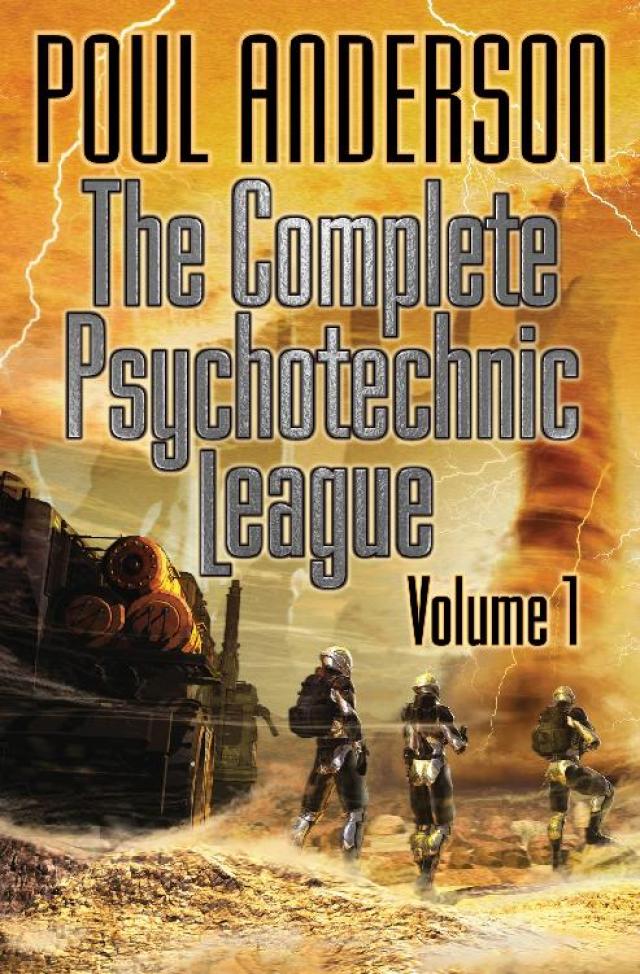
The Complete Psychotechnic League, Volume 1,
p.19


Elena stood over her victim even as he toppled and aimed at the man across the room. The armchair had knocked his rifle aside. “Drop that or I shoot,” she said.
Dalgetty snatched up a gun for himself, leveling it at the door. He more than half expected those outside to come rushing in, expected hell would explode. But the thick oak panels must have choked off sound.
Slowly, the man behind the chair let his rifle fall to the floor. His mouth was stretched wide with supernatural fear.
“My God!” Tighe’s long form was erect, shaking, his calm broken into horror. “Simon, the risk . . .”
“We didn’t have anything to lose, did we?” Dalgetty’s voice was thick, but the abnormal energy was receding from him. He felt a surge of weariness and knew that soon the payment must be made for the way he had abused his body. He looked down at the corpse before him. “I didn’t mean to do that,” he whispered.
Tighe collected himself with an effort of disciplined will and stepped over to Bancroft. “He’s alive, at least,” he said. “Oh, my God, Simon! You could have been killed so easily.”
“I may yet. We aren’t out of the woods by any means. Find something to tie those two others up with, will you, Dad?”
The Englishman nodded. Elena’s slugged guard was stirring and groaning. Tighe bound and gagged him with strips torn from his tunic. Under the submachine gun, the other submitted meekly enough. Dalgetty rolled them behind a sofa with the one he had slain.
Bancroft was wakening too. Dalgetty located a flask of bourbon and gave it to him. Clearing eyes looked up with the same terror. “Now what?” mumbled Bancroft. “You can’t get away—”
“We can damn well try. If it had come to fighting with the rest of your gang, we’d have used you as a hostage, but now there’s a neater way. On your feet! Here, straighten your tunic, comb your hair. Okay, you’ll do just as you’re told, because if anything goes wrong, we’ll have nothing at all to lose by shooting you.” Dalgetty rapped out his orders.
Bancroft looked at Elena, and there was more than physical hurt in his eyes. “Why did you do it?”
“FBI,” she said.
He shook his head, still stunned, and shuffled over to the desk visiphone and called the hangar. “I’ve got to get to the mainland in a hurry. Have the speedster ready in ten minutes. No, just the regular pilot, nobody else. I’ll have Dalgetty with me, but it’s okay. He’s on our side now.”
They went out the door. Elena cradled her tommy gun under one arm. “You can go back to the barracks, boys,” said Bancroft wearily to the men outside. “It’s all been settled.”
A quarter hour later, Bancroft’s private jet was in the air. Five minutes after that, he and the pilot were bound and locked in a rear compartment. Michael Tighe took the controls. “This boat has legs,” he said. “Nothing can catch us between here and California.”
“All right.” Dalgetty’s tones were flat with exhaustion. “I’m going back to rest, Dad.” Briefly his hand rested on the older man’s shoulder. “It’s good to have you back,” he said.
“Thank you, son,” said Michael Tighe. “I can’t tell you more. I haven’t the words.”
IX
DALGETTY found a reclining seat and eased himself into it. One by one, he began releasing the controls over himself—sensitivities, nerve blocs, glandular stimulation. Fatigue and pain mounted within him. He looked out at the stars and listened to the dark whistle of air with merely human senses.
Elena Casimir came to sit beside him, and he realized that his job wasn’t done. He studied the long lines of her face. She could be a hard foe but just as stubborn a friend.
“What do you have in mind for Bancroft?” he asked.
“Kidnapping charges for him and the whole gang,” she said. “He won’t wriggle out of it, I can guarantee you.” Her eyes rested on him, unsure, a little frightened. “Federal prison psychiatrists have Institute training,” she murmured. “You’ll see that his personality is reshaped your way, won’t you?”
“As far as possible,” Simon said. “Though it doesn’t matter much. Bancroft is finished as a factor to be reckoned with. There’s still Bertrand Meade himself, of course. Even if Bancroft made a full confession, I doubt that we could touch him. But the Institute has now learned to take precautions against extralegal methods—and within the framework of the law, we can give him cards and spades and still defeat him.”
“With some help from my department,” Elena said. There was a touch of steel in her voice. “But the whole story of this rescue will have to be played down. It wouldn’t do to have too many ideas floating around in the public mind, would it?”
“That’s right,” he admitted. His head felt heavy, he wanted to rest it on her shoulder and sleep for a century. “It’s up to you, really. If you submit the right kind of report to your superiors, it can all be worked out. Everything else will just be detail. But otherwise, you’ll ruin everything.”
“I don’t know.” She looked at him for a long while. “I don’t know if I should or not. You may be correct about the Institute and the justice of its aims and methods. But how can I be sure, when I don’t know what’s behind it? How do I know there wasn’t more truth than fiction in that Tau Ceti story, that you aren’t really the agent of some nonhuman power quietly taking over all our race?” At another time Dalgetty might have argued, tried to veil it from her, tried to trick her once again. But now he was too weary. There was a great surrender in him. “I’ll tell you if you wish,” he said, “and after that it’s in your hands. You can make us or break us.”
“Go on, then.” Her tone withdrew into wariness.
“I’m human,” he said. “I’m as human as you are. Only I’ve had rather special training, that’s all. It’s another discovery of the Institute for which we don’t feel the world is ready. It’d be too big a temptation for too many people, to create followers like me.” He looked away, into the windy dark. “The scientist is also a member of the society and has a responsibility toward it. This—restraint—of ours is one way in which we meet that obligation.”
She didn’t speak, but suddenly one hand reached over and rested on his. The impulsive gesture brought warmth flooding through him.
“Dad’s work was mostly in mass-action psych,” he said, making his tone try to cover what he felt, “but he has plenty of associates trying to understand the individual human being as a functioning mechanism. A lot’s been learned since Freud, both from the psychiatric and the neurological angle. Ultimately, those two are interchangeable.
“Some thirty years ago, one of the teams which founded the Institute learned enough about the relationship between the conscious, subconscious, and involuntary minds to begin practical tests. Along with a few others, I was a guinea pig. And their theories worked.
“I needn’t go into the details of my training. It involved physical exercises, mental practice, some hypnotism, diet, and so on. It went considerably beyond the important Synthesis education, which is the most advanced thing known to the general public. But its aim—only partially realized as yet—its aim was simply to produce the completely integrated human being.”
Dalgetty paused. The wind flowed and muttered beyond the wall.
“There is no sharp division between conscious and subconscious or even between those and the centers controlling involuntary functions,” he said. “The brain is a continuous structure. Suppose, for instance, that you become aware of a runaway car bearing down on you.
“Your heartbeat speeds up, your adrenaline output increases, your sight sharpens, your sensitivity to pain drops—it’s all preparation for fight or flight. Even without obvious physical necessity, the same thing can happen on a lesser scale—for example, when you read an exciting story. And psychotics, especially hysterics, can produce some of the damnedest physiological symptoms you ever saw.”
“I begin to understand,” she whispered.
“Rage or fear brings abnormal strength and fast reaction. But the psychotic can do more than that. He can show physical symptoms like burns, stigmata or—if female—false pregnancy. Sometimes he becomes wholly insensitive in some part of his body via a nerve bloc. Bleeding can start or stop without apparent cause. He can go into a coma, or he can stay awake for days without getting sleepy. He can—”
“Read minds?” It was a defiance.
“Not that I know of.” Simon chuckled. “But human sense organs are amazingly good. It only takes three or four quanta to stimulate the visual purple—a little more actually, because of absorption by the eyeball itself. There have been hysterics who could hear a watch ticking twenty feet away that the normal person could not hear at one foot. And so on.
“There are excellent reasons why the threshold of perception is relatively high in ordinary people—the stimuli of usual conditions would be blinding and deafening, unendurable, if there weren’t a defense.” He grimaced. “I know!”
“But the telepathy?” Elena persisted.
“It’s been done before,” he said. “Some apparent cases of mind reading in the last century were shown to be due to extremely acute hearing. Most people subvocalize their surface thoughts. With a little practice, a person who can hear those vibrations can learn to interpret them. That’s all.” He smiled with one side of his mouth. “If you want to hide your thoughts from me, just break that habit, Elena.”
She looked at him with an emotion he could not quite recognize. “I see,” she breathed. “And your memory must be perfect too, if you can pull any datum out of the subconscious. And you can—do everything, can’t you?”
“No,” he said. “I’m only a test case. They’ve learned a great deal by observing me, but the only thing that makes me unusual is that I have conscious control of certain normally subconscious and involuntary functions. Not all of them, by a long shot. And I don’t use that control any more than necessary.
“There are sound biological reasons why man’s mind is so divided and plenty of penalties attached to a case like mine. It’ll take me a couple of months to get back in shape after this bout. I’m due for a good old-fashioned nervous breakdown, and while it won’t last long, it won’t be much fun while it does last.”
The appeal rose in his eyes as he watched Elena. “All right,” he said. “Now you have the story. What are you going to do about it?”
For the first time, she gave him a real smile. “Don’t worry,” she said. “Don’t worry, Simon.”
“Will you come hold my hand while I’m recuperating?” he asked.
“I’m holding it now, you fool,” Elena answered.
Dalgetty chuckled happily. Then he went to sleep.
Although the Institute continued to claim disinterested good intentions, abuse was inherent in psychodynamics. The debate between Dalgetty and Casimir was carried on by others with increasing vehemence and violence. The new planetary settlements offered broader battlefields for contending movements. In midcentury Venus withdrew from the United Nations following the Second Conference of Rio. Later events demonstrated that it was simpler to remodel a world than to remake mankind.
The Big Rain
I
THE ROOM WAS SMALL and bare, nothing but a ventilator grill to relieve the drabness of its plastic walls, no furniture except a table and a couple of benches. It was hot, and the cold light of fluoros glistened off the sweat which covered the face of the man who sat there alone.
He was a big man, with hard bony features under close-cropped reddish-brown hair; his eyes were gray, with something chilly in them, and moved restlessly about the chamber to assess its crude homemade look. The coverall which draped his lean body was a bit too colorful. He had fumbled a cigarette out of his belt pouch and it smoldered between his fingers, now and then he took a heavy drag on it. But he sat quietly enough, waiting.
The door opened and another man came in. This one was smaller, with bleak features. He wore only shorts to whose waistband was pinned a star-shaped badge, and a needle gun holstered at his side, but somehow he had a military look.
“Simon Hollister?” he asked unnecessarily.
“That’s me,” said the other, rising. He loomed over the newcomer, but he was unarmed; they had searched him thoroughly the minute he disembarked.
“I am Captain Karsov, Guardian Corps.” The English was fluent, with only a trace of accent. “Sit down.” He lowered himself to a bench. “I am only here to talk to you.”
Hollister grimaced. “How about some lunch?” he complained. “I haven’t eaten for”—he paused a second—“thirteen hours, twenty-eight minutes.”
His precision didn’t get by Karsov, but the officer ignored it for the time being. “Presently,” he said. “There isn’t much time to lose, you know. The last ferry leaves in forty hours, and we have to find out before then if you are acceptable or must go back on it.”
“Hell of a way to treat a guest,” grumbled Hollister.
“We did not ask you to come,” said Karsov coldly. “If you wish to stay on Venus, you had better conform to the regulations. Now, what do you think qualifies you?”
“To live here? I’m an engineer. Construction experience in the Amazon basin and on Luna. I’ve got papers to prove it, and letters of recommendation, if you’d let me get at my baggage.”
“Eventually. What is your reason for emigrating?”
Hollister looked sullen. “I didn’t like Earth.”
“Be more specific. You are going to be narcoquizzed later, and the whole truth will come out. These questions are just to guide the interrogators, and the better you answer me now the quicker and easier the quiz will be for all of us.”
Hollister bristled. “That’s an invasion of privacy.”
“Venus isn’t Earth,” said Karsov with an attempt at patience. “Before you were even allowed to land, you signed a waiver which puts you completely under our jurisdiction as long as you are on this planet. I could kill you, and the U.N. would not have a word to say. But we do need skilled men, and I would rather O.K. you for citizenship. Do not make it too hard for me.”
“All right.” Hollister shrugged heavy shoulders. “I got in a fight with a man. He died. I covered up the traces pretty well, but I could never be sure—sooner or later the police might get on to the truth, and I don’t like the idea of corrective treatment. So I figured I’d better blow out while I was still unsuspected.”
“Venus is no place for the rugged individualist, Hollister. Men have to work together, and be very tolerant of each other, if they are to survive at all.”
“Yes, I know. This was a special case. The man had it coming.” Hollister’s face twisted. “I have a daughter—Never mind. I’d rather tell it under narco than consciously. But I just couldn’t see letting a snake like that get ‘corrected’ and then walk around free again.” Defensively: “I’ve always been a rough sort, I suppose, but you’ve got to admit this was extreme provocation.”
“That is all right,” said Karsov, “if you are telling the truth. But if you have family ties back on Earth, it might lessen your usefulness here.”
“None,” said Hollister bitterly. “Not any more.”
The interview went on. Karsov extracted the facts skillfully: Hollister, Simon James; born Frisco Unit, U.S.A., of good stock; chronological age, thirty-eight Earth-years; physiological age, thanks to taking intelligent advantage of biomedics, about twenty-five; Second-class education, major in civil engineering with emphasis on nuclear-powered construction machines; work record; psych rating at last checkup; et cetera, et cetera, et cetera. Somewhere a recorder took sound and visual impressions of every nuance for later analysis and filing.
At the end, the Guardian rose and stretched. “I think you will do,” he said. “Come along now for the narcoquiz. It will take about three hours, and you will need another hour to recover, and then I will see that you get something to eat.”
The city crouched on a mountainside in a blast of eternal wind. Overhead roiled the poisonous gray clouds; sometimes a sleet of paraformaldehyde hid the grim red slopes around, and always the scudding dust veiled men’s eyes so they could not see the alkali desert below. Fantastically storm-gnawed crags loomed over the city, and often there was the nearby rumble of an avalanche, but the ledge on which it stood had been carefully checked for stability.
The city was one armored unit of metal and concrete, low and rounded as if it hunched its back against the shrieking steady gale. From its shell protruded the stacks of hundreds of outsize Hilsch tubes, swivel-mounted so that they always faced into the wind. It blew past filters which caught the flying dust and sand and tossed them down a series of chutes to the cement factory. The tubes grabbed the rushing air and separated fast and slow molecules; the cooler part went into a refrigeration system which kept the city at a temperature men could stand—outside, it hovered around the boiling point of water; the smaller volume of super-heated air was conducted to the maintenance plant where it helped run the city’s pumps and generators. There were also nearly a thousand windmills, turning furiously and drinking the force of the storm.
None of this air was for breathing. It was thick with carbon dioxide; the rest was nitrogen, inert gases, formaldehyde vapor, a little methane and ammonia. The city devoted many hectares of space to hydroponic plants which renewed its oxygen and supplied some of the food, as well as to chemical purifiers, pumps, and blowers. “Free as air” was a joke on Venus.
Near the shell was the spaceport where ferries from the satellite station and the big interplanetary ships landed. Pilots had to be good to bring down a vessel, or even take one up, under such conditions as prevailed here. Except for the landing cradles, the radio mast, and the GCA shack in the main shell, everything was underground, as most of the city was.