The complete psychotechn.., p.27
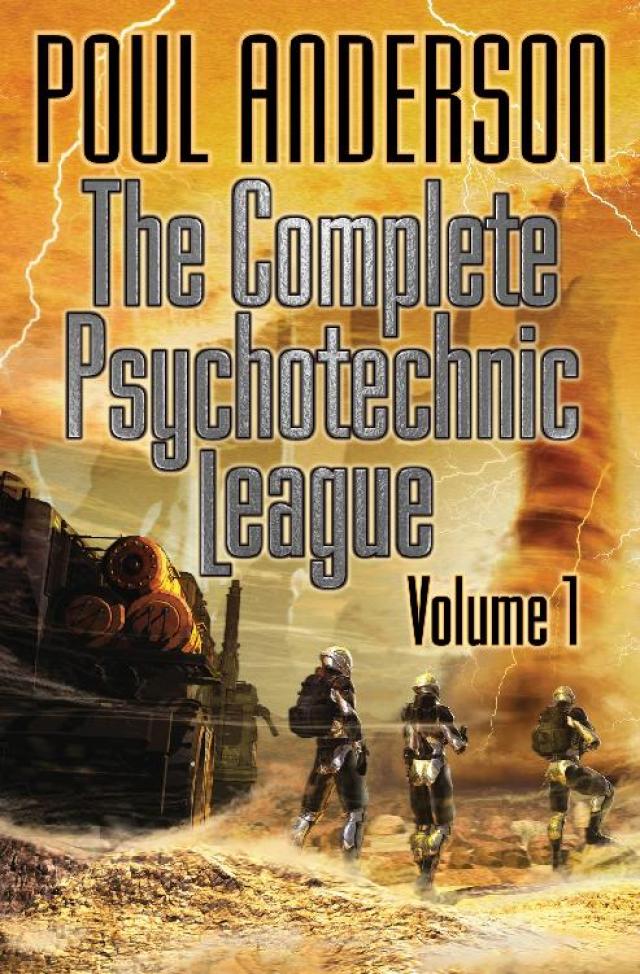
The Complete Psychotechnic League, Volume 1,
p.27


“You have called that ship up there, I suppose?”
“Yes. They’re sending down a ferry.”
“The ferry could have an accident. We would apologize profusely, explain that a shell went wild while we were fighting you gangsters, and even pay for the boat. I tell you this so that you can see there is no hope. You had better give up.”
“No hope if we do that either,” said Hollister. “I’d rather take my chances back on Earth; they can’t do worse than treat my mind.”
“Are you still keeping up that farce?” inquired Karsov. But he wasn’t sure of himself, that was plain. He couldn’t understand how an Un-man could have gotten past his quiz. Hollister had no intention of enlightening him.
“What have you got to lose by letting us go?” asked the Earthman. “So we tell a horror story back home. People there already know you rule with a rough hand.”
“I am not going to release you,” said Karsov. “You are finished. That second party of yours will not last long, even if they make it outside as I suppose they intend—they will suffocate. I am going to call the spaceship captain on the emergency circuit and explain there is a fight going on and he had better recall his boat. That should settle the matter; if not, the boat will be shot down. As for your group, there will be sleep gas before long.”
“I’ll blow my brains out before I let you take me,” said Hollister sullenly.
“That might save a lot of trouble,” said Karsov. He turned and walked away. Hollister was tempted to kill him, but decided to save that pleasure for a while. No use goading the police into a possible use of high explosives.
He went back to the shack and called the Evening Star again. “Hello, Captain Brackney? UNI speaking. The bosses down here are going to radio you with a pack of lies. Pretend to believe them and say you’ll recall your ferry. Remember, they think just one is coming down. Then—” He continued his orders.
“That’s murder!” said the captain. “Pilot One won’t have a chance—”
“Yes, he will. Call him now, use spacer code; I don’t think any of these birds know it, if they should overhear you. Tell him to have his spacesuit on and be ready for a crash landing, followed by a dash to the second boat.”
“It’s still a long chance.”
“What do you think I’m taking? These are UNI orders, captain. I’m boss till we get back to Earth, if I live so long. All right, got everything? Then I’ll continue recording.”
After a while he caught the first whiff and said into the mike. “The gas is coming now. I’ll have to close my helmet. Hollister signing off.”
His men and the technies slapped down their cover. It would be so peaceful here for a little time, with this sector sealed off while gas poured through its ventilators. Hollister tried to grin reassuringly, but it didn’t come off.
“Last round,” he said. “Half of us, the smallest ones, are going to go to sleep now. The rest will use their oxygen, and carry them outside when we go.”
Someone protested. Hollister roared him down. “Not another word! This is the only chance for all of us. No man has oxygen for much more than an hour; we have at least an hour and a half to wait. How else can we do it?”
They submitted unwillingly, and struggled against the anaesthetic as long as they could. Hollister took one of the dead men’s bottles to replace the first of his that gave out. His band was now composed of three sleeping men and three conscious but exhausted.
He was hoping the cops wouldn’t assault them quickly. Probably not; they would be rallying outside, preparing to meet the ferry with a mobile canon if it should decide to land after all. The rebels trapped in here would keep.
The minutes dragged by. A man at the point of death was supposed to review his whole life, but Hollister didn’t feel up to it. He was too tired. He sat watching the telescreen which showed the space field. Dust and wind and the skeleton cradles, emptiness, and a roiling gloom beyond.
One of the wakeful men, a convict, spoke into the helmet circuit: “So you are UNI. Has all this been just to get you back to Earth?”
“To get my report back,” said Hollister.
“There are many dead,” said one of the Latins, in English. “You have sacrificed us, played us like pawns, no? What of those two we left back at Last Chance?”
“I’m afraid they’re doomed,” said Hollister tonelessly, and the guilt which is always inherent in leadership was heavy on him.
“It was worth it,” said the convict. “If you can smash this rotten system, it was well worth it.” His eyes were haunted. They would always be haunted.
“Better not talk,” said Hollister. “Save your oxygen.”
One hour. The pips on the radar-scopes were high and strong now. The spaceboats weren’t bothering with atmospheric braking, they were spending fuel to come almost straight down.
One hour and ten minutes. Was Barbara still alive?
One hour and twenty minutes.
One hour and thirty minutes. Any instant—
“There, señor! There!”
Hollister jumped to his feet. Up in a corner of the screen, a white wash of fire—here she came!
The ferry jetted slowly groundward, throwing up a cloud of dust as her fierce blasts tore at the field. Now and then she wobbled, caught by the high wind, but she had been built for just these conditions. Close, close—were they going to let her land after all? Yes, now she was entering the cradle, now the rockets were still.
A shellburst struck her hull amidships and burst it open. The police were cautious, they hadn’t risked spilling her nuclear engine and its radioactivity on the field. She rocked in the cradle. Hollister hoped the crash-braced pilot had survived. And he hoped the second man was skillful and had been told exactly what to do.
That ferry lanced out of the clouds, descending fast. She wasn’t very maneuverable, but the pilot rode her like a horseman, urging, pleading, whipping and spurring when he had to. She slewed around and fell into a shaky curve, out of screen range.
If the gods were good, her blast had incinerated the murderers of the first boat.
She came back into sight, fighting for control. Hollister howled. “Guide her into a cradle!” He waved his gun at the seated technies. “Guide her safely in if you want to live!”
She was down.
Tiny figures were running toward her, heedless of earth still smoking underfoot. Three of them veered and approached the radio shack. “O.K.!” rapped Hollister. “Back into the corridor!” He dragged one of the unconscious men himself; stooping, he sealed the fellow’s suit against the poison gases outside. There would be enough air within it to last a sleeper a few minutes.
Concussion smashed at him. He saw shards of glass and wire flying out the door and ricocheting nastily about his head. Then the yell of Venus’ wind came to him. He bent and picked up his man. “Let’s go!”
They scrambled through the broken wall and out onto the field. The wind was at their backs, helping them for once. One of the dynamiters moved up alongside Hollister. He saw Barbara’s face, dim behind the helmet.
When he reached the ferry, the others were loading the last boxes of food. A figure in space armor was clumping unsteadily toward them from the wrecked boat. Maybe their luck had turned. Sweeping the field with his eyes, Hollister saw only ruin. There were still surviving police, but they were inside the city and it would take minutes for them to get out again.
He counted the men with him and estimated the number of food boxes. Fifteen all told, including his two erstwhile captives—Barbara’s party must have met opposition—but she still lived, God be praised! There were supplies enough, it would be a hungry trip home but they’d make it.
Fernandez peered out of the air lock. “Ready,” he announced. “Come aboard. We have no seats, so we must rise at low acceleration, but the pilot says there is fuel to spare.”
Hollister helped Barbara up the ladder and into the boat. “I hope you’ll like Earth,” he said awkwardly.
“I know I will—with you there,” she told him.
Hollister looked through the closing air lock at the desolation which was Venus. Some day it would bloom, but—
“We’ll come back,” he said.
When the terraforming was done, would mercy and justice, as well as bounty, rain down on parched Venus? Could planets and people develop in separate ways and still remain at peace with one another? After a century’s effort, the Institute’s dream of a sane citizenry in a stable civilization was little closer to fulfillment. Long-term political issues within and among societies had not yet been solved. Could the Psychotechnic Institute and the Un-men it created withstand the insidious temptations of power? Watching over human destiny was their self-appointed role, but who shall watch the watchmen?
Afterword
SCIENCE FICTION is indebted to Robert A. Heinlein for many good things. Not least among them is the concept of a “future history.” Other writers before him had told stories in series, but had set them in static societies or else in such short time spans that no real development occurred. Olaf Stapledon had chronicled the entire future of our species, and then of the universe, but those books of his had no characters to speak of and were on a geological rather than historical scale. Heinlein wrote vivid tales of events happening to individuals, but civilization itself became a protagonist too, ever changing as the hopefulness of the first interplanetary era was lost in corruption followed by dictatorship, regained after a revolution, shunted aside in later turmoil, eventually restored as mankind approached racial maturity.
Like most readers, I was fascinated. Rather early in my own writing career, I embarked on something similar. It would not be what I did exclusively, nor would it have a byline reserved to itself, but it would tie together a number of stories. Each of these must, of course, be comprehensible alone. Yet for those who remembered from one to the next, the interrelationships would add depth to all—or so I hoped.
Accordingly, I drew up a chart in the manner of Heinlein and, from time to time, completed a piece whose title was on it. Like him, I did not follow chronological order, but wrote whatever I felt like whenever the mood struck me. Still, the undertaking was ambitious: to tell the story of humanity from the near future on through its expansion into the galaxy.
The set of tales has been dubbed the “Psychotechnic League series.” A group of them comprise this book. A few more exist, notably the novels Virgin Planet and The Peregrine.
Eventually I gave it up. That did not happen overnight; the last part, “The Pirate,” appeared in 1968, though before then there had been a long hiatus. I just found myself more and more turning elsewhere, especially to a new future history quite unlike the first.
A good reason for this abandonment was that the real world had, predictably, not been behaving as I described. For example, World War Three remains ahead of us, rather than behind. No doubt I could have fudged my dates a bit. However, I could not explain away important scientific discoveries and technological advances which I had failed to foresee.
People and institutions had also changed profoundly, as had my view of them. Once I was a flaming liberal, a fact which is probably most obvious in “Un-Man.” Nowadays I consider the United Nations a dangerous farce on which we ought to bring down the curtain. (In justice to it and myself, though, please remember that when I wrote this novella the U.N. had quite a different character from that it has since acquired, and looked improvable.)
Otherwise my current political opinions are irrelevant here, because I no longer preach in my fiction, I simply tell stories. I like to think they are better stories, and better told, than formerly.
Then why resurrect these old ones?
Well, first and foremost is the hope that they will entertain you. True, they are on a time line which never came into being, but that matters little. We continue to relish the works of H. Rider Haggard and Edgar Rice Burroughs, despite everything we have learned about Africa and Mars. If you, reader, are my age, you may have encountered these yarns when they originally appeared, and they may now evoke pleasant memories of youth. If you are my daughter’s age, or younger, they may be new to you—and may you enjoy them as your father or mother perhaps did!
I could even imitate Heinlein again and bail out the whole series by declaring that it shows an alternate cosmos. However, Mrs. Miesel has now done that on my behalf.
As a second justification for the book, it may prove of some small use to scholars of science fiction. These tales were not seminal like Heinlein’s, but they were a noticeable part of the field a generation ago. We’ve all come a long way since then, but sometimes we do well to look back and see where we have been.
—Poul Anderson
Poul Anderson, The Complete Psychotechnic League, Volume 1